


EN 14594:2005
(Main)Respiratory protective devices - Continuous flow compressed air line breathing apparatus - Requirements, testing, marking
General Information
- Abstract
This document specifies minimum requirements for continuous flow compressed air line breathing apparatus for use with a full face mask, half mask, or incorporating a hood, helmet or suit, and apparatus used in abrasive blasting operations, as a respiratory protective device. Escape and diving apparatus are not covered by this document.
Laboratory and practical performance tests are included for the assessment of conformance to the requirements.
- Status
- Withdrawn
- Publication Date
- 19-Apr-2005
- Withdrawal Date
- 22-Sep-2026
- Technical Committee
- CEN/TC 79 - Respiratory protective devices
- Current Stage
- 9960 - Withdrawal effective - Withdrawal
- Start Date
- 16-May-2018
- Completion Date
- 23-Sep-2026
- Directive
- Harmonized Standard2016/425 - Regulation (EU) 2016/425 of the European Parliament and of the Council of 9 March 2016 on personal protective equipment and repealing Council Directive 89/686/EECOJ Ref: C, C 113 OJ Date: 27-Mar-2018
Not Harmonized89/686/EEC - Personal protective equipment (PPE)OJ Ref: C 247, C 3, C 306, C 91 OJ Date: 06-Oct-2005

Relations
- Effective Date
- 22-Dec-2008
- Effective Date
- 22-Dec-2008
- Effective Date
- 22-Dec-2008
- Effective Date
- 22-Dec-2008
- Effective Date
- 22-Dec-2008
- Effective Date
- 22-Dec-2008
- Effective Date
- 22-Dec-2008
- Effective Date
- 22-Dec-2008
- Effective Date
- 22-Dec-2008
- Effective Date
- 22-Dec-2008
- Effective Date
- 09-Dec-2015
- Effective Date
- 28-Jan-2026
- Effective Date
- 28-Jan-2026
- Effective Date
- 28-Jan-2026
- Effective Date
- 28-Jan-2026
Get Certified
Connect with accredited certification bodies for this standard

CIS Institut d.o.o.
Personal Protective Equipment (PPE) certification body. Notified Body NB-2890 for EU Regulation 2016/425 PPE.

Kiwa BDA Testing
Building and construction product certification.
Kmetijski inštitut Slovenije
Agricultural Institute of Slovenia. Soil testing, plant health, agricultural product analysis.
Sponsored listings
Frequently Asked Questions
EN 14594:2005 is a standard published by the European Committee for Standardization (CEN). Its full title is "Respiratory protective devices - Continuous flow compressed air line breathing apparatus - Requirements, testing, marking". This standard covers: This document specifies minimum requirements for continuous flow compressed air line breathing apparatus for use with a full face mask, half mask, or incorporating a hood, helmet or suit, and apparatus used in abrasive blasting operations, as a respiratory protective device. Escape and diving apparatus are not covered by this document. Laboratory and practical performance tests are included for the assessment of conformance to the requirements.
This document specifies minimum requirements for continuous flow compressed air line breathing apparatus for use with a full face mask, half mask, or incorporating a hood, helmet or suit, and apparatus used in abrasive blasting operations, as a respiratory protective device. Escape and diving apparatus are not covered by this document. Laboratory and practical performance tests are included for the assessment of conformance to the requirements.
EN 14594:2005 is classified under the following ICS (International Classification for Standards) categories: 13.340.30 - Respiratory protective devices. The ICS classification helps identify the subject area and facilitates finding related standards.
EN 14594:2005 has the following relationships with other standards: It is inter standard links to EN 271:1995/AC:1997, EN 271:1995, EN 270:1994/A1:2000, EN 139:1994/AC:1995, EN 270:1994, EN 12419:1999, EN 139:1994/A1:1999, EN 271:1995/A1:2000, EN 139:1994, EN 1835:1999, EN 14594:2018, EN 13274-3:2001, EN ISO 13934-2:2014, EN 132:1998, EN 13274-2:2001. Understanding these relationships helps ensure you are using the most current and applicable version of the standard.
EN 14594:2005 is associated with the following European legislation: EU Directives/Regulations: 2016/425, 89/686/EEC, 93/68/EEC, 93/95/EEC, 96/58/EC; Standardization Mandates: M/031. When a standard is cited in the Official Journal of the European Union, products manufactured in conformity with it benefit from a presumption of conformity with the essential requirements of the corresponding EU directive or regulation.
EN 14594:2005 is available in PDF format for immediate download after purchase. The document can be added to your cart and obtained through the secure checkout process. Digital delivery ensures instant access to the complete standard document.
Standards Content (Sample)
STANDARDOprema za varovanje dihal - Dihalni aparat na stisnjeni zrak s trajnim pretokom - Zahteve, preskušanje, označevanjeRespiratory protective devices - Continuous flow compressed air line breathing apparatus - Requirements, testing, marking©
Standard je založil in izdal Slovenski inštitut za standardizacijo. Razmnoževanje ali kopiranje celote ali delov tega dokumenta ni dovoljenoReferenčna številkaSIST EN 14594:2005(en)ICS13.340.30
EUROPEAN STANDARDNORME EUROPÉENNEEUROPÄISCHE NORMEN 14594April 2005ICS 13.340.30Supersedes EN 12419:1999, EN 139:1994, EN1835:1999, EN 270:1994, EN 271:1995English versionRespiratory protective devices - Continuous flow compressed airline breathing apparatus - Requirements, testing, markingAppareils de protection respiratoire - Appareils deprotection respiratoire isolants à adduction d'air compriméà débit continu - Exigences, essais, marquageAtemschutzgeräte - Druckluft-Schlauchgeräte mitkontinuierlichem Luftstrom - Anforderungen, Prüfung,KennzeichnungThis European Standard was approved by CEN on 15 March 2005.CEN members are bound to comply with the CEN/CENELEC Internal Regulations which stipulate the conditions for giving this EuropeanStandard the status of a national standard without any alteration. Up-to-date lists and bibliographical references concerning such nationalstandards may be obtained on application to the Central Secretariat or to any CEN member.This European Standard exists in three official versions (English, French, German). A version in any other language made by translationunder the responsibility of a CEN member into its own language and notified to the Central Secretariat has the same status as the officialversions.CEN members are the national standards bodies of Austria, Belgium, Cyprus, Czech Republic, Denmark, Estonia, Finland, France,Germany, Greece, Hungary, Iceland, Ireland, Italy, Latvia, Lithuania, Luxembourg, Malta, Netherlands, Norway, Poland, Portugal, Slovakia,Slovenia, Spain, Sweden, Switzerland and United Kingdom.EUROPEAN COMMITTEE FOR STANDARDIZATIONCOMITÉ EUROPÉEN DE NORMALISATIONEUROPÄISCHES KOMITEE FÜR NORMUNGManagement Centre: rue de Stassart, 36
B-1050 Brussels© 2005 CENAll rights of exploitation in any form and by any means reservedworldwide for CEN national Members.Ref. No. EN 14594:2005: E
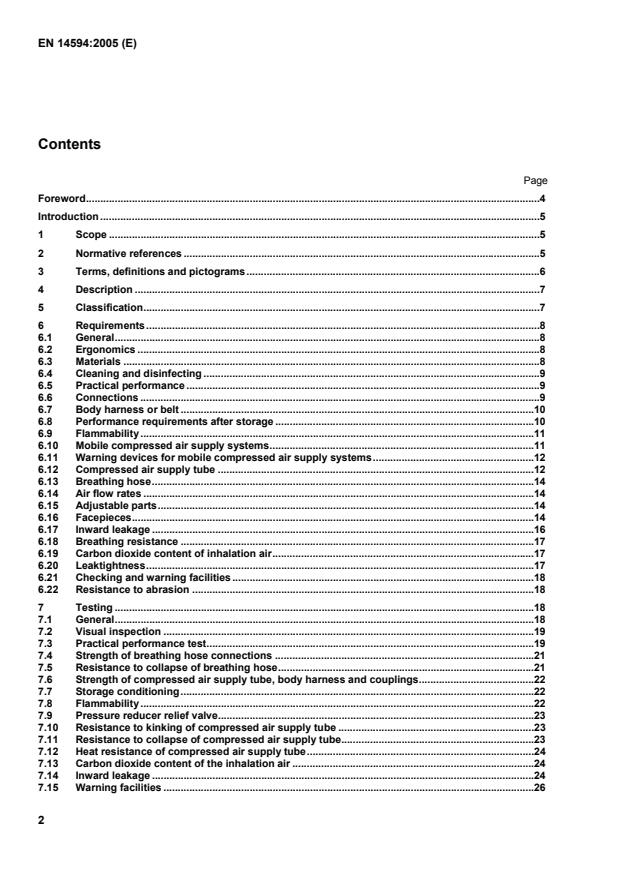
Marking.42 Annex ZA (informative)
Relationship between this European Standard and the Essential Requirements of EU Directive 89/686/EEC (PPE).43 Bibliography.46
% 1A and 1B 10,00 2A and 2B 2,00 3A and 3B 0,50 4A and 4B 0,05
Class 4A devices shall incorporate either a full face mask in accordance with EN 136 or a hood/helmet/suit. Class 4B devices shall incorporate a full face mask in accordance with EN 136 or apparatus suitable for use in abrasive blasting operations. Apparatus for use in abrasive blasting operations shall only conform to Class 4B. 6 Requirements 6.1 General Unless otherwise specified, the values stated in this European Standard are expressed as nominal values. Except for temperature limits, values which are not stated as maxima or minima shall be subject to a tolerance of ± 5 %. Unless otherwise specified, the ambient temperature for testing shall be between 16 °C and 32 °C and the temperature limits shall be subject to an accuracy of ± 1 °C. Wherever a test clause is referenced, all subclauses of the test clause shall apply, unless otherwise stated. 6.2 Ergonomics The requirements of this European Standard are intended to take account of the interaction between the wearer, the respiratory protective device, and where possible the working environment in which the respiratory protective device is likely to be used. The device shall satisfy 6.3, 6.9 and 6.10. Testing shall be done accordance with 7.3. 6.3 Materials 6.3.1 All materials used in the construction shall have adequate resistance to deterioration by heat and adequate mechanical strength. Testing shall be done in accordance with 7.3, after any pre-conditioning according to 7.7, and any safety data sheet, if applicable, and declaration of the manufacturer related to materials used in the construction of the device. Testing shall be done accordance with 7.2. 6.3.2 With the exception of devices for abrasive blasting operations, exposed parts, i.e. those which may be subjected to impact during use of the apparatus shall not be made of aluminium, magnesium, titanium or their alloys.
...