


EN 15198:2007
(Main)Methodology for the risk assessment of non-electrical equipment and components for intended use in potentially explosive atmospheres
General Information
- Abstract
This European Standard specifies basic methodology used in achieving safety of equipment for intended use in potentially explosive atmospheres.
The provisions specified in this European Standard are intended for the designer. It also specifies a strategy for standard makers.
This European Standard specifies the procedure and information required to allow ignition risk assessment to be carried out for the design of equipment or component.
This European Standard provides advice for a decision to be made for the categorisation of equipment but does not provide means to prove the conformity of equipment categories.
In this procedure the following information is to be taken into account:
a) Possible occurrence of an explosive atmosphere inside the equipment or component or penetrating the equipment or component from the outside (in normal operation or during malfunctions) and the amount of explosive atmosphere involved leading to possible explosion impact inside of the equipment or component;
b) equipment or components surrounded by an explosive atmosphere (in normal operation or during malfunctions);
c) equipment or components wholly or partly surrounded by an explosive atmosphere considering also any explosive atmosphere in connection (in normal operation or during malfunctions);
d) presence and likelihood (effectiveness) of ignition sources.
The final objective is designing and manufacturing equipment or components intended for use in potentially explosive atmospheres. For this purpose equipment or components if necessary shall be designed with adequate preventive and/or protective measures.
This European Standard specifies neither specific methods of analysis associated with ignition risk assessment, nor specific requirements for a category of equipment. It describes the methodology of ignition risk assessment.
(continued)
- Status
- Published
- Publication Date
- 21-Aug-2007
- Withdrawal Date
- 28-Feb-2008
- Technical Committee
- CEN/TC 305 - Potentially explosive atmospheres - Explosion prevention and protection
- Drafting Committee
- CEN/TC 305/WG 4 - Terminology and Methodology
- Current Stage
- 9093 - Decision to confirm - Review Enquiry
- Start Date
- 29-Nov-2017
- Completion Date
- 23-Sep-2026
- Directive
- Harmonized Standard2014/34/EU - Directive 2014/34/EU Of The European Parliament And Of The Council of 26 February 2014 on the harmonisation of the laws of the Member States relating to equipment and protective systems intended for use in potentially explosive atmospheres (recast)OJ Ref: C, C 126, HARMONIZIRAN OJ Date: 08-Apr-2016
Not Harmonized94/9/EC - Equipment and protective systems intended for use in potentially explosive atmospheres (ATEX)OJ Ref: C, C 20 OJ Date: 27-Jan-2009


Overview
EN 15198:2007 - “Methodology for the risk assessment of non-electrical equipment and components for intended use in potentially explosive atmospheres” (CEN) defines a structured methodology for performing ignition risk assessment during design of non‑electrical equipment and components. It sets out the logical steps designers should follow to identify ignition hazards, estimate ignition risk, evaluate whether the intended safety level is met, and document the outcome. EN 15198:2007 supports integrated explosion protection strategies but does not prescribe specific analysis methods or provide conformity proof for equipment categories.
Key Topics
- Scope and purpose: Methodology for designers and guidance for standards makers on achieving safety in potentially explosive atmospheres (Group I/II equipment).
- Four-step assessment procedure:
- Product description: performance, lifetime, configuration, materials and intended use.
- Identification of ignition hazards: internal and external explosive atmospheres, possible ignition sources and their effectiveness.
- Ignition risk estimation: probability that an ignition source capable of igniting an explosive atmosphere will occur.
- Ignition risk evaluation: determine if the intended level of protection (linked to equipment categorisation) is achieved.
- Information requirements: design drawings, materials data, maintenance/cleaning requirements, test reports, accident history and uncertainty records.
- Limits and exclusions: does not apply to equipment that contains an explosive atmosphere internally with no interfaces to external atmospheres; does not specify methods to prove category conformity.
- Documentation: requires technical documentation of the assessment; Annex A gives an example reporting scheme and Annex ZA maps the standard to EU Directive 94/9/EC (ATEX).
Applications
- Who uses EN 15198:2007:
- Design engineers and manufacturers of non‑electrical equipment for hazardous areas
- Standards writers developing product or protection standards
- Safety engineers conducting ignition hazard analyses
- Practical uses:
- Structuring ignition risk assessments to inform design choices and preventive/protective measures
- Supporting decisions about product design, maintenance and installation requirements relevant to explosion safety
- Providing a consistent, auditable record for regulatory and internal safety reviews (technical documentation)
Related Standards
- EN 1127-1 / EN 1127-2 - basic concepts and methodology for explosive atmospheres
- EN 13237 - terms and definitions for equipment in potentially explosive atmospheres
- EN 13463-1 - applicability to equipment categories
- EN 15233 - functional safety assessment of protective systems
- EU Directive 94/9/EC (ATEX) - regulatory context (referenced in Annex ZA)
Keywords: EN 15198:2007, ignition risk assessment, non‑electrical equipment, potentially explosive atmospheres, explosion protection, CEN, equipment categorisation, ignition hazards, risk assessment methodology.
Relations
- Effective Date
- 28-Jan-2026
- Effective Date
- 28-Jan-2026
- Effective Date
- 28-Jan-2026
- Referred By
EN 1012-3:2013 - Compressors and vacuum pumps - Safety requirements - Part 3: Process compressors - Effective Date
- 28-Jan-2026
- Effective Date
- 28-Jan-2026
Get Certified
Connect with accredited certification bodies for this standard

CIS Institut d.o.o.
Personal Protective Equipment (PPE) certification body. Notified Body NB-2890 for EU Regulation 2016/425 PPE.

Kiwa BDA Testing
Building and construction product certification.
Kmetijski inštitut Slovenije
Agricultural Institute of Slovenia. Soil testing, plant health, agricultural product analysis.
Sponsored listings
Frequently Asked Questions
EN 15198:2007 is a standard published by the European Committee for Standardization (CEN). Its full title is "Methodology for the risk assessment of non-electrical equipment and components for intended use in potentially explosive atmospheres". This standard covers: This European Standard specifies basic methodology used in achieving safety of equipment for intended use in potentially explosive atmospheres. The provisions specified in this European Standard are intended for the designer. It also specifies a strategy for standard makers. This European Standard specifies the procedure and information required to allow ignition risk assessment to be carried out for the design of equipment or component. This European Standard provides advice for a decision to be made for the categorisation of equipment but does not provide means to prove the conformity of equipment categories. In this procedure the following information is to be taken into account: a) Possible occurrence of an explosive atmosphere inside the equipment or component or penetrating the equipment or component from the outside (in normal operation or during malfunctions) and the amount of explosive atmosphere involved leading to possible explosion impact inside of the equipment or component; b) equipment or components surrounded by an explosive atmosphere (in normal operation or during malfunctions); c) equipment or components wholly or partly surrounded by an explosive atmosphere considering also any explosive atmosphere in connection (in normal operation or during malfunctions); d) presence and likelihood (effectiveness) of ignition sources. The final objective is designing and manufacturing equipment or components intended for use in potentially explosive atmospheres. For this purpose equipment or components if necessary shall be designed with adequate preventive and/or protective measures. This European Standard specifies neither specific methods of analysis associated with ignition risk assessment, nor specific requirements for a category of equipment. It describes the methodology of ignition risk assessment. (continued)
This European Standard specifies basic methodology used in achieving safety of equipment for intended use in potentially explosive atmospheres. The provisions specified in this European Standard are intended for the designer. It also specifies a strategy for standard makers. This European Standard specifies the procedure and information required to allow ignition risk assessment to be carried out for the design of equipment or component. This European Standard provides advice for a decision to be made for the categorisation of equipment but does not provide means to prove the conformity of equipment categories. In this procedure the following information is to be taken into account: a) Possible occurrence of an explosive atmosphere inside the equipment or component or penetrating the equipment or component from the outside (in normal operation or during malfunctions) and the amount of explosive atmosphere involved leading to possible explosion impact inside of the equipment or component; b) equipment or components surrounded by an explosive atmosphere (in normal operation or during malfunctions); c) equipment or components wholly or partly surrounded by an explosive atmosphere considering also any explosive atmosphere in connection (in normal operation or during malfunctions); d) presence and likelihood (effectiveness) of ignition sources. The final objective is designing and manufacturing equipment or components intended for use in potentially explosive atmospheres. For this purpose equipment or components if necessary shall be designed with adequate preventive and/or protective measures. This European Standard specifies neither specific methods of analysis associated with ignition risk assessment, nor specific requirements for a category of equipment. It describes the methodology of ignition risk assessment. (continued)
EN 15198:2007 is classified under the following ICS (International Classification for Standards) categories: 13.230 - Explosion protection. The ICS classification helps identify the subject area and facilitates finding related standards.
EN 15198:2007 has the following relationships with other standards: It is inter standard links to EN 1127-2:2014, EN 1127-1:2019, EN 13237:2003, EN 1012-3:2013, EN 1127-1:2011. Understanding these relationships helps ensure you are using the most current and applicable version of the standard.
EN 15198:2007 is associated with the following European legislation: EU Directives/Regulations: 2014/34/EU, 94/9/EC; Standardization Mandates: M/BC/CEN/92/46. When a standard is cited in the Official Journal of the European Union, products manufactured in conformity with it benefit from a presumption of conformity with the essential requirements of the corresponding EU directive or regulation.
EN 15198:2007 is available in PDF format for immediate download after purchase. The document can be added to your cart and obtained through the secure checkout process. Digital delivery ensures instant access to the complete standard document.
Standards Content (Sample)
2003-01.Slovenski inštitut za standardizacijo. Razmnoževanje celote ali delov tega standarda ni dovoljeno.Methodology for the risk assessment of non-electrical equipment and components for intended use in potentially explosive atmospheresMéthodes pour l'évaluation du risque d'inflammation des appareils et des composants non électriques destinés a etre utilisés en atmospheres explosiblesMethodik zur Risikobewertung für nicht-elektrische Geräte und Komponenten zur Verwendung in explosionsgefährdeten BereichenTa slovenski standard je istoveten z:EN 15198:2007SIST EN 15198:2007en,fr,de13.230Varstvo pred eksplozijoExplosion protectionICS:SLOVENSKI
STANDARDSIST EN 15198:200701-oktober-2007
EUROPEAN STANDARDNORME EUROPÉENNEEUROPÄISCHE NORMEN 15198August 2007ICS 13.230 English VersionMethodology for the risk assessment of non-electrical equipmentand components for intended use in potentially explosiveatmospheresMéthodes pour l'évaluation du risque d'inflammation desappareils et des composants non électriques destinés àêtre utilisés en atmosphères explosiblesMethodik zur Risikobewertung für nicht-elektrische Geräteund Komponenten zur Verwendung inexplosionsgefährdeten BereichenThis European Standard was approved by CEN on 13 July 2007.CEN members are bound to comply with the CEN/CENELEC Internal Regulations which stipulate the conditions for giving this EuropeanStandard the status of a national standard without any alteration. Up-to-date lists and bibliographical references concerning such nationalstandards may be obtained on application to the CEN Management Centre or to any CEN member.This European Standard exists in three official versions (English, French, German). A version in any other language made by translationunder the responsibility of a CEN member into its own language and notified to the CEN Management Centre has the same status as theofficial versions.CEN members are the national standards bodies of Austria, Belgium, Bulgaria, Cyprus, Czech Republic, Denmark, Estonia, Finland,France, Germany, Greece, Hungary, Iceland, Ireland, Italy, Latvia, Lithuania, Luxembourg, Malta, Netherlands, Norway, Poland, Portugal,Romania, Slovakia, Slovenia, Spain, Sweden, Switzerland and United Kingdom.EUROPEAN COMMITTEE FOR STANDARDIZATIONCOMITÉ EUROPÉEN DE NORMALISATIONEUROPÄISCHES KOMITEE FÜR NORMUNGManagement Centre: rue de Stassart, 36
B-1050 Brussels© 2007 CENAll rights of exploitation in any form and by any means reservedworldwide for CEN national Members.Ref. No. EN 15198:2007: E
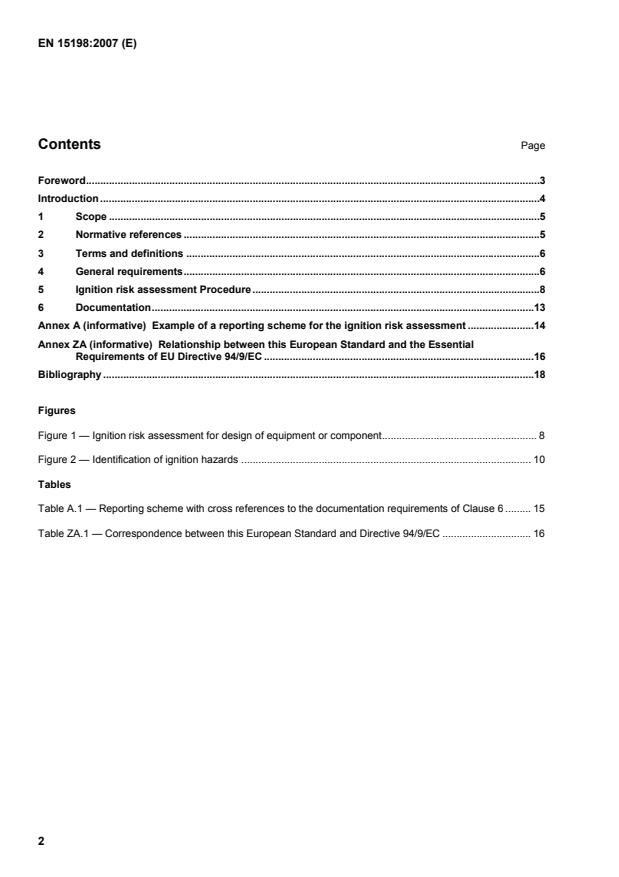
Example of a reporting scheme for the ignition risk assessment.14 Annex ZA (informative)
Relationship between this European Standard and the Essential Requirements of EU Directive 94/9/EC.16 Bibliography.18
Figures Figure 1 — Ignition risk assessment for design of equipment or component.8 Figure 2 — Identification of ignition hazards.10 Tables Table A.1 — Reporting scheme with cross references to the documentation requirements of Clause 6.15 Table ZA.1 — Correspondence between this European Standard and Directive 94/9/EC.16
For relationship with EU Directive 94/9/EC, see informative Annex ZA, which is an integral part of this document. According to the CEN/CENELEC Internal Regulations, the national standards organizations of the following countries are bound to implement this European Standard: Austria, Belgium, Bulgaria, Cyprus, Czech Republic, Denmark, Estonia, Finland, France, Germany, Greece, Hungary, Iceland, Ireland, Italy, Latvia, Lithuania, Luxembourg, Malta, Netherlands, Norway, Poland, Portugal, Romania, Slovakia, Slovenia, Spain, Sweden, Switzerland and the United Kingdom.
This European Standard does not provide means to prove the conformity of equipment categories. The procedure of ignition risk assessment for the design of equipment and components lead to a defined safety level which allows categorisation according to the appropriate criteria.
It is in both the manufacturer's and user's interest to establish a common methodology for achieving safety, reliability and efficacy in functioning and operating equipment and components with respect to the ignition hazards. Thus, ignition risk assessment is a tool which provides the essential link between manufacturers and users, but only aspects that directly address manufacturers are incorporated. Integrated explosion safety is conceived to prevent the formation of explosive atmospheres as well as sources of ignition and, should an explosion nevertheless occur, to halt it immediately and / or to limit its effects. In this connection, the manufacturer must take measures with respect to the potential ignition sources. In addition, equipment and component must be designed and constructed after due analysis of possible operating faults in order as far as possible to preclude dangerous situations taking the misuse which can reasonably be anticipated into account. Therefore it is absolutely necessary to conduct an ignition risk assessment process. For the equipment and components the identification of the potential ignition sources is the most relevant part of the ignition risk assessment.
The provisions specified in this European Standard are intended for the designer. It also specifies a strategy for standard makers. This European Standard specifies the procedure and information required to allow ignition risk assessment to be carried out for the design of equipment or component.
This European Standard provides advice for a decision to be made for the categorisation of equipment but does not provide means to prove the conformity of equipment categories. In this procedure the following information is to be taken into account: a) Possible occurrence of an explosive atmosphere inside the equipment or component or penetrating the equipment or component from the outside (in normal operation or during malfunctions) and the amount of explosive atmosphere involved leading to possible explosion impact inside of the equipment or component; b) equipment or components surrounded by an explosive atmosphere (in normal operation or during malfunctions); c) equipment or components wholly or partly surrounded by an explosive atmosphere considering also any explosive atmosphere in connection (in normal operation or during malfunctions); d) presence and likelihood (effectiveness) of ignition sources. The final objective is designing and manufacturing equipment or components intended for use in potentially explosive atmospheres. For this purpose equipment or components if necessary should be designed with adequate preventive and/or protective measures. This European Standard specifies neither specific methods of analysis associated with ignition risk assessment, nor specific requirements for a category of equipment. It describes the methodology of ignition risk assessment. This European Standard does not apply to equipment with a potentially explosive atmosphere inside under operating conditions, and without interfaces to an external potentially explosive atmospheres. This European Standard is applicable to all categories of equipment referred to in EN 13463-1. This ignition risk assessment procedure does not preclude the conditions prevailing in an installation where the equipment or component is put into operation by a user. NOTE Functional safety assessment of protective systems is covered by EN 15233. 2 Normative references The following referenced documents are indispensable for the application of this document. For dated references, only the edition cited applies. For undated references, the latest edition of the referenced document (including any amendments) applies. EN 1127-1, Explosive atmospheres — Explosion prevention and protection — Part 1: Basic concepts and methodology
probability of occurrence of an ignition source that is capable of igniting an explosive atmosphere 3.2 ignition hazard
occurrence of a potential ignition source that is capable of igniting an explosive atmosphere 3.3
potential ignition source equipment related ignition source that has the capability to ignite an explosive atmosphere (i.e. to become an effective ignition source) 3.4 protective measure means used to reduce the probability of an ignition source to become effective 3.5 ignition risk estimation determination of the probability of the occurrence of an ignition source 3.6 ignition risk evaluation procedure to determine whether the intended level of protection (related to the equipment category) has been achieved 4 General requirements 4.1 Basic concept Ignition risk assessment is a series of logical steps (see Figure 1) that enable designers and safety engineers to examine in a systematic way, the function of an equipment or component arising from its use in a potentially explosive atmosphere and to decide whether protective measures and/or type of protection are needed. The objective shall be to achieve an adequate level of safety.
Ignition risk assessment includes the following four steps:
a) product description: performance, lifetime, configuration (see 5.2), b) identification of ignition hazards (see 5.3), c) ignition risk estimation (see 5.4), d) ignition risk evaluation (see 5.5). These four steps are the basis for the decision whether the intended safety level is achieved (see 5.6). The result of the assessment shall be detailed in the technical documentation (see Clause 6).
NOTE The determination of correct categories and the selection of the suitable protective measures is not part of this standard. 4.2 Extent of ignition risk assessment Initially the boundary or limit of the equipment and/or components must be specified under which the ignition risk assessment has to be carried out. The limit is determined by the extent of explosive atmosphere or the ignition sources which are originated by the considered equipment and/or components.
The ignition risk assessment shall be limited to equipment and/or components and not extended to aspects for which the user is responsible. The extent of the ignition risk assessment, which includes all operations, shall take into account: a) intended use; and b) misuse which can be reasonably anticipated. An ignition risk assessment shall also include the possibility of an explosion inside the equipment and/or components causing an impact on the outside. NOTE Misuse that can be reasonably anticipated indicates incorrect use and/or operation of the equipment and/or components by the operator due to carelessness or misunderstanding. Misuse is not part of the normal operation. Intent is not included in misuse that can reasonably be anticipated. 4.3 Information needed for ignition risk assessment The information needed to perform the ignition risk assessment shall include the following where appropriate: a) intended use referring to group I or group II and categories 1, 2, 3; b) initial appraisal of the equipment or component;
c) materials to be processed (or necessary safety data); d) requirements for maintenance including cleaning; e) design drawings; f) results of design calculations made, examinations carried out. If available: g) test reports, if they allow the evaluation of the probability of occurrence and/or the efficiency of ignition sources; h) accident history; i) information on relevant safety aspects. If an accident history is not available for the equipment and/or components, available information for similar equipment and/or components shall be used as it is unlikely that equipment and/or components are so unique that similar equipment and/or components cannot be found. The absence of an accident history, a small
NOTE Data is used to define foreseeable operations requirements related to reliability, serviceability, durability, disposability, benign failure and failsafe characteristics and labelling, warnings, identification, traceability requirements and instructions. Data based on the consensus of expert opinion derived indirectly from experience as opposed to measured data, may be used to supplement qualitative assessment. 5 Ignition risk assessment Procedure 5.1 Principle Procedure The principal steps for the ignition risk assessment procedure are shown in Figure 1. It is comprised of four steps taking into consideration the assessment criteria in the oval blocks. To guarantee the intended level of protection maintenance and installation requirements shall also be considered.
Key a Protective measures / types of protection and equipment conformity are not part of ignition risk assessment Figure 1 — Ignition risk assessment for design of equipment or component
b) limits in terms of use, time and space; c) accurate definition of the function d) selection of materials for construction; e) performance, lifetime and configuration; f) description of the type of substances that shall be processed and process conditions. Constructive attributes of the material (e.g. non-conductive or non-sparking) may be presupposed provided that their application shall be implemented. It is not permissible to change the material due to constructional demands. Types of protection (e.g. liquid immersion "k" or control of ignition source "b") shall be regarded as non-existent in this step. 5.3 Identification of ignition hazards 5.3.1 General Generally, an equipment and/or component shall be assessed by considering the probability and amount of explosive atmosphere.
The block diagram in Figure 2 provides the aspects for determination whether ignition hazards are present.
Block 1: It shall be decided if the intended use is the use in an explosive atmosphere (i.e. surrounding the equipment or component). If equipment or a component containing a potentially explosive atmosphere can, due to its construction, operation etc. create a potentially explosive atmosphere, which wholly or partially surrounds it, then such equipment or a component is in effect in a potentially explosive atmosphere. Block 2: It shall be analysed, whether an explosive atmosphere will occur inside the equipment or component either from the process itself or from a connection to the surrounding area. This is necessary because an internal explosion, which can ignite the explosive atmosphere in the surrounding of the equipment, shall be considered as an ignition source of its own. Therefore the likelihood and duration of occurrence of an internal explosive atmosphere shall be determined. Block 3: It shall be decided if the present ignition source is able to ignite the atmosphere, i.e. the ignition source is a potential ignition source. It is to consider if this ignition source becomes effective under normal conditions, foreseeable malfunctions or rare malfunctions.
NOTE The energy required to ignite an explosive atmospheres depends on its nature. Thus, non electrical equipment or a component that moves very slowly or has low power may not ignite the particular explosive atmosphere present during intended use. Block 4: Ignition hazard of equipment or co
...