


EN 15987:2015
(Main)Leather - Terminology - Key definitions for the leather trade
General Information
- Abstract
This European Standard specifies the key terms and definitions used for the leather trade and provides guidance on the correct use of the term “leather”.
Defined parameters in this standard need to be assessed using standard test methods specific for leather.
NOTE See Bibliography for leather test method standards.
- Status
- Withdrawn
- Publication Date
- 28-Apr-2015
- Withdrawal Date
- 22-Sep-2026
- Technical Committee
- CEN/TC 289 - Leather
- Current Stage
- 9960 - Withdrawal effective - Withdrawal
- Start Date
- 26-Oct-2022
- Completion Date
- 23-Sep-2026

Relations
- Effective Date
- 06-May-2015
- Effective Date
- 24-Feb-2021
- Referred By
EN 16887:2017 - Leather - Environmental footprint - Product Category Rules (PCR) - Carbon footprints - Effective Date
- 28-Jan-2026
- Referred By
EN 16484:2015 - Leather - Requirements for the determination of the origin of leather production - Effective Date
- 28-Jan-2026
- Effective Date
- 28-Jan-2026
Get Certified
Connect with accredited certification bodies for this standard

Control Union Certifications
Global certification for agriculture and sustainability.

Hohenstein Institut
Textile testing and certification.

Bureau Veritas Bangladesh
Bureau Veritas certification services in Bangladesh.
Sponsored listings
Frequently Asked Questions
EN 15987:2015 is a standard published by the European Committee for Standardization (CEN). Its full title is "Leather - Terminology - Key definitions for the leather trade". This standard covers: This European Standard specifies the key terms and definitions used for the leather trade and provides guidance on the correct use of the term “leather”. Defined parameters in this standard need to be assessed using standard test methods specific for leather. NOTE See Bibliography for leather test method standards.
This European Standard specifies the key terms and definitions used for the leather trade and provides guidance on the correct use of the term “leather”. Defined parameters in this standard need to be assessed using standard test methods specific for leather. NOTE See Bibliography for leather test method standards.
EN 15987:2015 is classified under the following ICS (International Classification for Standards) categories: 01.040.59 - Textile and leather technology (Vocabularies); 59.140.99 - Other standards related to leather technology. The ICS classification helps identify the subject area and facilitates finding related standards.
EN 15987:2015 has the following relationships with other standards: It is inter standard links to EN 15987:2011, EN 15987:2022, EN 16887:2017, EN 16484:2015, CEN/TS 15430-2:2012. Understanding these relationships helps ensure you are using the most current and applicable version of the standard.
EN 15987:2015 is available in PDF format for immediate download after purchase. The document can be added to your cart and obtained through the secure checkout process. Digital delivery ensures instant access to the complete standard document.
Standards Content (Sample)
2003-01.Slovenski inštitut za standardizacijo. Razmnoževanje celote ali delov tega standarda ni dovoljeno.Usnje - Terminologija - Definicije za trgovanje z usnjemLeder - Terminologie - Hauptdefinitionen für den LederhandelCuir - Terminologie - Définitions pour le commerce du cuirLeather - Terminology - Key definitions for the leather trade59.140.01Usnjarska tehnologija na splošnoLeather technology in general01.040.59Tekstilna in usnjarska tehnologija (Slovarji)Textile and leather technology (Vocabularies)ICS:Ta slovenski standard je istoveten z:EN 15987:2015SIST EN 15987:2015en,fr,de01-julij-2015SIST EN 15987:2015SLOVENSKI
STANDARDSIST EN 15987:20111DGRPHãþD
EUROPEAN STANDARD NORME EUROPÉENNE EUROPÄISCHE NORM
EN 15987
April 2015 ICS 01.040.59; 59.140.99 Supersedes EN 15987:2011English Version
Leather - Terminology - Key definitions for the leather trade
Cuir - Terminologie - Définitions pour le commerce du cuir Leder - Terminologie - Hauptdefinitionen für den Lederhandel This European Standard was approved by CEN on 28 February 2015.
CEN members are bound to comply with the CEN/CENELEC Internal Regulations which stipulate the conditions for giving this European Standard the status of a national standard without any alteration. Up-to-date lists and bibliographical references concerning such national standards may be obtained on application to the CEN-CENELEC Management Centre or to any CEN member.
This European Standard exists in three official versions (English, French, German). A version in any other language made by translation under the responsibility of a CEN member into its own language and notified to the CEN-CENELEC Management Centre has the same status as the official versions.
CEN members are the national standards bodies of Austria, Belgium, Bulgaria, Croatia, Cyprus, Czech Republic, Denmark, Estonia, Finland, Former Yugoslav Republic of Macedonia, France, Germany, Greece, Hungary, Iceland, Ireland, Italy, Latvia, Lithuania, Luxembourg, Malta, Netherlands, Norway, Poland, Portugal, Romania, Slovakia, Slovenia, Spain, Sweden, Switzerland, Turkey and United Kingdom.
EUROPEAN COMMITTEE FOR STANDARDIZATION
COMITÉ EUROPÉEN DE NORMALISATION EUROPÄISCHES KOMITEE FÜR NORMUNG
CEN-CENELEC Management Centre:
Avenue Marnix 17,
B-1000 Brussels © 2015 CEN All rights of exploitation in any form and by any means reserved worldwide for CEN national Members. Ref. No. EN 15987:2015 ESIST EN 15987:2015
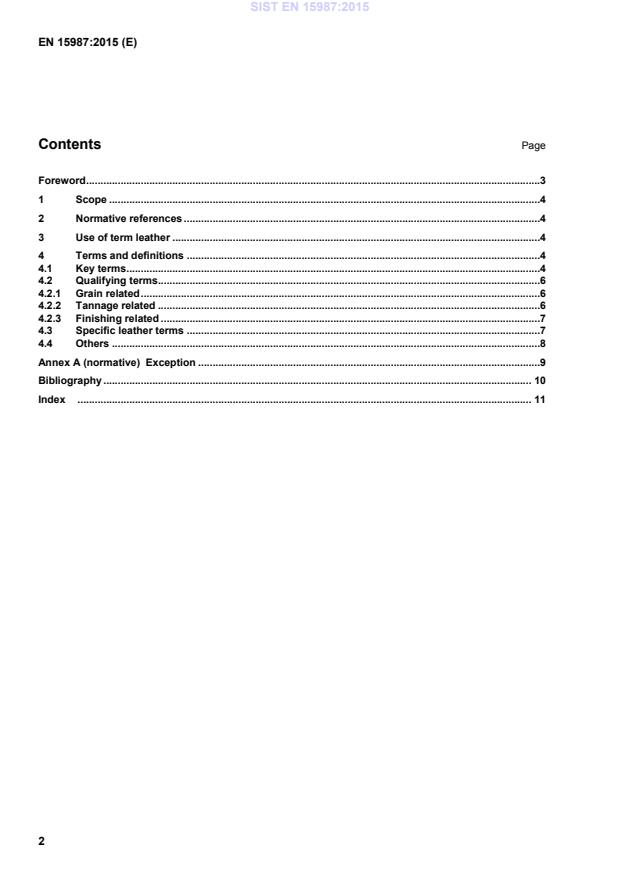
Exception .9 Bibliography . 10 Index
.............................................................................................................................................................. 11
leather hide or skin with its original fibrous structure more or less intact, tanned to be imputrescible, where the hair or wool may or may not have been removed, whether or not the hide or skin has been split into layers or segmented either before or after tanning and where any surface coating or surface layer, however applied, is not thicker than 0,15 mm Note 1 to entry: If the tanned hide or skin is disintegrated mechanically and/or chemically into fibrous particles, small pieces or powders and then, with or without the combination of a binding agent, is made into sheets or other forms, such sheets or forms are not leather. Note 2 to entry: If the grain layer has been completely removed, the term leather is not to be used without further qualification, e.g. split leather, suede leather. SIST EN 15987:2015
split leather layer from a hide or skin made from a flesh split or a middle split, without any grain structure, tanned to be imputrescible Note 1 to entry: A split is a layer of hide or skin obtained by dividing it horizontally (splitting) to obtain at least two separate layers; the top layer is called grain split, and the bottom layer is called flesh split; for heavy hides also a middle split can be obtained. Note 2 to entry: If the name of the animal whence it originates, or the part of the animal whence it comes, is included in the description, the term “split leather” will be used as a noun, e.g. pig split leather. 4.1.3
crust leather which is tanned, fatliquored and dried, before finishing 4.1.3.1
dyed crust leather tanned, dyed, fatliquored and dried, before finishing 4.1.4
pelt hide or skin prepared for tanning by removal of the hair or the wool, epidermis and flesh Note 1 to entry: The term pelt can also be used for the skin of an animal with fur or hair still on it. 4.1.5
pickled pelt pelt treated with acid and brine, to be preserved or to be prepared for tanning Note 1 to entry: The term pelt can also be used for the skin of an animal with fur or hair still on it. 4.1.6
wet-blue leather in a wet condition after chrome tanning Not
...