


FprEN 16716
(Main)Mountaineering equipment - Avalanche airbag systems - Safety requirements and test methods
General Information
- Abstract
This document specifies safety requirements and test methods for avalanche airbag systems to reduce the risk of being buried by a snow avalanche.
This document does not consider personal protection against impact or cold temperature.
- Status
- Not Published
- Publication Date
- 25-Nov-2026
- Technical Committee
- CEN/TC 136 - Sports, playground and other recreational equipment
- Drafting Committee
- CEN/TC 136/WG 5 - Mountaineering and climbing equipment
- Current Stage
- 4599 - Dispatch of FV draft to CMC - Finalization for Vote
- Start Date
- 28-May-2026
- Completion Date
- 28-May-2026

Overview
The FprEN 16716:2025 standard, developed by CEN (European Committee for Standardization), outlines the safety requirements and test methods for avalanche airbag systems designed specifically for mountaineering equipment. These systems aim to reduce the risk of burial during snow avalanches by deploying airbags that increase a user’s volume and buoyancy in snow, enhancing survival chances. This standard updates and supersedes the previous EN 16716:2017 to reflect advancements in safety and technology in avalanche airbag systems.
This standard does not address protection against impact injuries or cold temperatures but focuses strictly on the functionality, reliability, and durability of the airbag systems themselves.
Key Topics
Function and Activation
Avalanche airbag systems must include reliable activation mechanisms (e.g., deployment handles, pull cords) with clearly defined activation forces and distances. Enhancements have been made for airbag stability and connection integrity to carrying systems.Design Requirements
The standard specifies rigorous performance criteria covering material strength, ergonomic design for user comfort and safety, and the robustness of detachable and electric avalanche airbag systems. For example, carrying systems must withstand pull forces up to 4 kN with strict limits on buckle slippage.Testing Protocols
A wide array of test methods ensures product reliability, including:- Activation force and distance tests
- Airbag inflation volume and pressure measurements
- Deployment readiness indicators to confirm system status
- Performance under varying temperatures and condensation effects
- Corrosion resistance and electrical interference tests for electronic components
Marking and User Information
Clear, permanent marking requirements and comprehensive manufacturer instructions are mandatory, especially for electrical versions including battery information, start-up tests, and integrated indication systems.New Additions in 2025 Edition
- Deployment readiness indicator tests
- Increased strength requirements for carrying systems
- Interference and electromagnetic compatibility (EMC) testing for electrical airbags with avalanche beacons
- Updated ergonomic and material standards for leg loops
Applications
Mountaineering & Winter Sports
Avalanche airbag systems adhering to FprEN 16716:2025 are essential safety devices for climbers, skiers, snowboarders, and other winter sports enthusiasts operating in avalanche-prone areas.Safety Equipment Manufacturers
Companies designing and producing avalanche airbags benefit from this standard to ensure compliance with European regulations, improve product safety, and enhance user confidence.Outdoor Safety Organizations & Rescuers
Standards-based airbags can improve survival outcomes during avalanche rescues and training scenarios, providing ergonomic and functional reliability in extreme conditions.Regulatory Compliance
This standard supports alignment with EU Regulation (EU) 2016/425 concerning personal protective equipment, ensuring that products meet essential health and safety requirements for the European market.
Related Standards
- EN 12277:2015+A1:2018 – Mountaineering harnesses – safety requirements and test methods
- EN IEC 55014 series – Electromagnetic compatibility for household and similar electrical equipment
- EN ISO 9227:2022 – Salt spray tests for corrosion resistance
- EN ISO 13849-1:2023 – Safety-related control system design principles
- EN 62133-1:2017 & EN 62133-2:2017 – Safety requirements for portable sealed secondary cells and batteries
- ISO 7000 – Graphical symbols for equipment marking
- Regulation (EU) 2016/425 – Essential health and safety requirements for personal protective equipment
Why This Standard Matters
By implementing FprEN 16716:2025, manufacturers ensure avalanche airbag systems are designed and tested against rigorous safety benchmarks, minimizing failure rates and enhancing the protection offered to users in avalanche incidents. This European Standard fosters innovation while maintaining the highest safety levels for professional mountaineering and recreational winter sports, ensuring users face reduced burial risks and increased chances of survival.
Keywords: avalanche airbag systems, mountaineering equipment, safety requirements, test methods, avalanche safety, EPP standards, CEN, winter sports safety, activation system, ergonomic design, electromagnetic compatibility, avalanche survival equipment.
Relations
- Effective Date
- 19-Jan-2023
Get Certified
Connect with accredited certification bodies for this standard

CIS Institut d.o.o.
Personal Protective Equipment (PPE) certification body. Notified Body NB-2890 for EU Regulation 2016/425 PPE.

Kiwa BDA Testing
Building and construction product certification.
Kmetijski inštitut Slovenije
Agricultural Institute of Slovenia. Soil testing, plant health, agricultural product analysis.
Sponsored listings
Frequently Asked Questions
FprEN 16716 is a draft published by the European Committee for Standardization (CEN). Its full title is "Mountaineering equipment - Avalanche airbag systems - Safety requirements and test methods". This standard covers: This document specifies safety requirements and test methods for avalanche airbag systems to reduce the risk of being buried by a snow avalanche. This document does not consider personal protection against impact or cold temperature.
This document specifies safety requirements and test methods for avalanche airbag systems to reduce the risk of being buried by a snow avalanche. This document does not consider personal protection against impact or cold temperature.
FprEN 16716 is classified under the following ICS (International Classification for Standards) categories: 13.340.99 - Other protective equipment; 97.220.20 - Winter sports equipment; 97.220.40 - Outdoor and water sports equipment. The ICS classification helps identify the subject area and facilitates finding related standards.
FprEN 16716 has the following relationships with other standards: It is inter standard links to EN 16716:2017. Understanding these relationships helps ensure you are using the most current and applicable version of the standard.
FprEN 16716 is associated with the following European legislation: EU Directives/Regulations: 2016/425; Standardization Mandates: M/031, M/571, M/571 Amd 1. When a standard is cited in the Official Journal of the European Union, products manufactured in conformity with it benefit from a presumption of conformity with the essential requirements of the corresponding EU directive or regulation.
FprEN 16716 is available in PDF format for immediate download after purchase. The document can be added to your cart and obtained through the secure checkout process. Digital delivery ensures instant access to the complete standard document.
Standards Content (Sample)
SLOVENSKI STANDARD
01-marec-2025
Gorniška oprema - Sistem zračnih blazin za zaščito v snežnih plazovih - Varnostne
zahteve in preskusne metode
Mountaineering equipment - Avalanche airbag systems - Safety requirements and test
methods
Bergsteigerausrüstung - Lawinen-Airbag-Systeme - Sicherheitstechnische
Anforderungen und Prüfverfahren
Équipement d'alpinisme et d'escalade - Systèmes de sac gonflable anti-ensevelissement
lors d'une avalanche - Exigences de sécurité et méthodes d'essai
Ta slovenski standard je istoveten z: prEN 16716
ICS:
13.340.99 Druga varovalna oprema Other protective equipment
97.220.20 Oprema za zimske športe Winter sports equipment
2003-01.Slovenski inštitut za standardizacijo. Razmnoževanje celote ali delov tega standarda ni dovoljeno.
DRAFT
EUROPEAN STANDARD
prEN 16716
NORME EUROPÉENNE
EUROPÄISCHE NORM
January 2025
ICS 13.340.99; 97.220.20; 97.220.40 Will supersede EN 16716:2017
English Version
Mountaineering equipment - Avalanche airbag systems -
Safety requirements and test methods
Équipement d'alpinisme et d'escalade - Systèmes de Bergsteigerausrüstung - Lawinen-Airbag-Systeme -
sac gonflable anti-ensevelissement lors d'une Sicherheitstechnische Anforderungen und
avalanche - Exigences de sécurité et méthodes d'essai Prüfverfahren
This draft European Standard is submitted to CEN members for enquiry. It has been drawn up by the Technical Committee
CEN/TC 136.
If this draft becomes a European Standard, CEN members are bound to comply with the CEN/CENELEC Internal Regulations
which stipulate the conditions for giving this European Standard the status of a national standard without any alteration.
This draft European Standard was established by CEN in three official versions (English, French, German). A version in any other
language made by translation under the responsibility of a CEN member into its own language and notified to the CEN-CENELEC
Management Centre has the same status as the official versions.
CEN members are the national standards bodies of Austria, Belgium, Bulgaria, Croatia, Cyprus, Czech Republic, Denmark, Estonia,
Finland, France, Germany, Greece, Hungary, Iceland, Ireland, Italy, Latvia, Lithuania, Luxembourg, Malta, Netherlands, Norway,
Poland, Portugal, Republic of North Macedonia, Romania, Serbia, Slovakia, Slovenia, Spain, Sweden, Switzerland, Türkiye and
United Kingdom.
Recipients of this draft are invited to submit, with their comments, notification of any relevant patent rights of which they are
aware and to provide supporting documentation.
Warning : This document is not a European Standard. It is distributed for review and comments. It is subject to change without
notice and shall not be referred to as a European Standard.
EUROPEAN COMMITTEE FOR STANDARDIZATION
COMITÉ EUROPÉEN DE NORMALISATION
EUROPÄISCHES KOMITEE FÜR NORMUNG
CEN-CENELEC Management Centre: Rue de la Science 23, B-1040 Brussels
© 2025 CEN All rights of exploitation in any form and by any means reserved Ref. No. prEN 16716:2025 E
worldwide for CEN national Members.
prEN 16716:2025 (E)
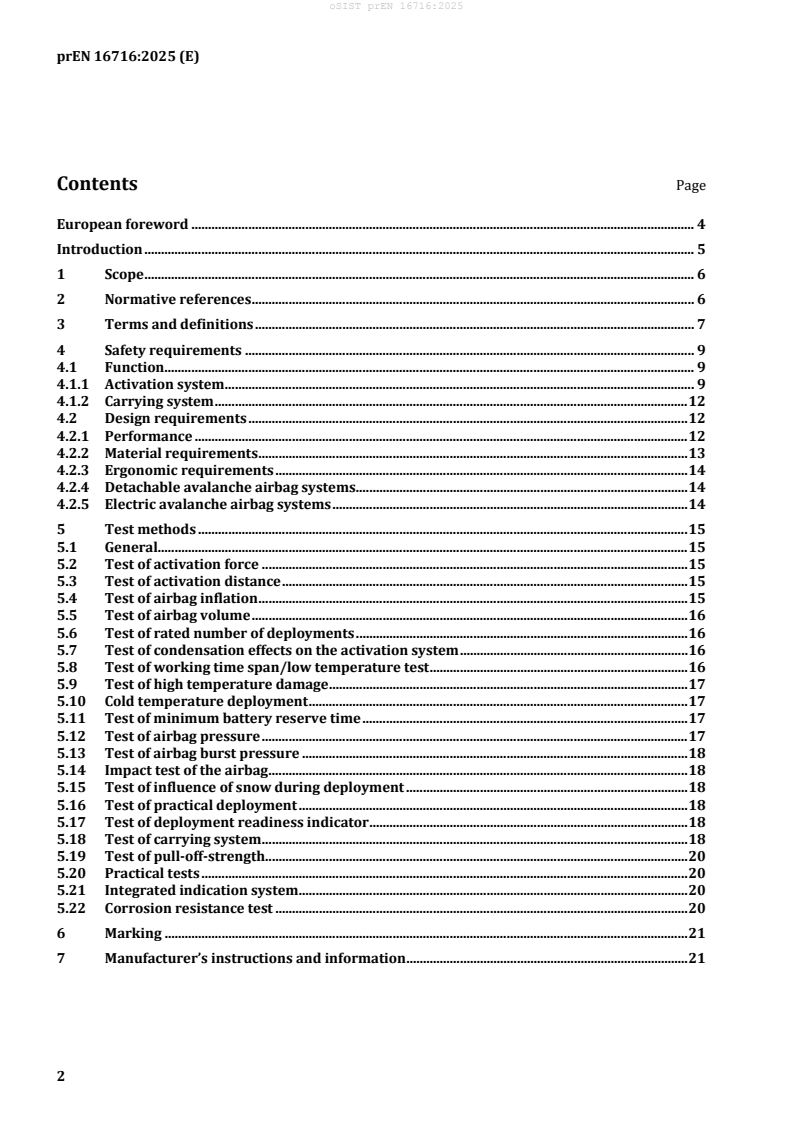
Contents Page
European foreword . 4
Introduction . 5
1 Scope . 6
2 Normative references . 6
3 Terms and definitions . 7
4 Safety requirements . 9
4.1 Function . 9
4.1.1 Activation system . 9
4.1.2 Carrying system . 12
4.2 Design requirements . 12
4.2.1 Performance . 12
4.2.2 Material requirements . 13
4.2.3 Ergonomic requirements . 14
4.2.4 Detachable avalanche airbag systems . 14
4.2.5 Electric avalanche airbag systems . 14
5 Test methods . 15
5.1 General. 15
5.2 Test of activation force . 15
5.3 Test of activation distance . 15
5.4 Test of airbag inflation . 15
5.5 Test of airbag volume . 16
5.6 Test of rated number of deployments . 16
5.7 Test of condensation effects on the activation system . 16
5.8 Test of working time span/low temperature test . 16
5.9 Test of high temperature damage . 17
5.10 Cold temperature deployment . 17
5.11 Test of minimum battery reserve time . 17
5.12 Test of airbag pressure . 17
5.13 Test of airbag burst pressure . 18
5.14 Impact test of the airbag . 18
5.15 Test of influence of snow during deployment . 18
5.16 Test of practical deployment . 18
5.17 Test of deployment readiness indicator . 18
5.18 Test of carrying system . 18
5.19 Test of pull-off-strength . 20
5.20 Practical tests . 20
5.21 Integrated indication system . 20
5.22 Corrosion resistance test . 20
6 Marking . 21
7 Manufacturer’s instructions and information . 21
prEN 16716:2025 (E)
Annex A (informative) Interference test electrical avalanche airbag systems with avalanche
beacons . 23
A.1 Introduction . 23
A.2 Preparation . 23
A.3 Tests . 23
Annex B (informative) Test method to measure EMI of electrical avalanche airbag systems
with avalanche beacons in laboratory . 26
B.1 Introduction . 26
B.2 Procedure . 26
Annex C (informative) Standards on mountaineering equipment . 29
Annex ZA (informative) Relationship between this European Standard and the essential
requirements of Regulation (EU) 2016/425 aimed to be covered . 31
Bibliography . 32
prEN 16716:2025 (E)
European foreword
This document (prEN 16716:2025) has been prepared by Technical Committee CEN/TC 136 “Sports,
playground and other recreational facilities and equipment”, the secretariat of which is held by DIN.
This document is currently submitted to the CEN Enquiry.
This document will supersede EN 16716:2017.
prEN 16716:2025 includes the following significant technical changes with respect to EN 16716:2017:
a) new subclause 4.1.1.16, Airbag stability, where requirements for the connection of airbag(s) to the
carrying system are defined;
b) new subclause 4.1.1.17/5.17 Deployment readiness indicator, where requirements and tests are
formulated for indication for user of airbag system, that it is ready for deployment or not ready for
deployment;
c) in 4.1.2.2, Connecting strength, the load for pulling airbag against carrying system has been raised
from 3 kN to 4 kN. Buckle slippage requirement < 30 mm has been implemented;
d) in 4.2.2, Material requirements, more requirements for leg loop have been implemented;
e) in 4.2.5.2/5.21, Integrated indication system, has been improved with a required start-up self-test
and a test method for it;
f) in 5.16, Test of practical deployment test, parameters have been specified;
g) Figures 3 a – 3 d have been improved to be conform to test;
h) in Clause 6, Marking, small improvements have been made;
i) in Clause 7, Manufacturer’s instructions and information, small improvements have been made and
additional information for electrical airbag systems is required;
j) new Annex A: Interference test electrical airbag System with avalanche beacons (informative);
k) new Annex B: Test method to measure EMI of electrical airbag systems with avalanche beacons in
laboratory (informative).
This document has been prepared under a standardization request addressed to CEN by the European
Commission. The Standing Committee of the EFTA States subsequently approves these requests for its
Member States.
For the relationship with EU Legislation, see informative Annex ZA, which is an integral part of this
document.
prEN 16716:2025 (E)
Introduction
This document is one of a package of standards for mountaineering equipment; see Annex C, Table C.1.
prEN 16716:2025 (E)
1 Scope
This document specifies safety requirements and test methods for avalanche airbag systems to reduce
the risk of being buried by a snow avalanche.
This document does not consider personal protection against impact or cold temperature.
2 Normative references
The following documents are referred to in the text in such a way that some or all of their content
constitutes requirements of this document. For dated references, only the edition cited applies. For
undated references, the latest edition of the referenced document (including any amendments) applies.
EN 12277:2015+A1:2018, Mountaineering equipment — Harnesses — Safety requirements and test
methods
EN IEC 55014-1:2021, Electromagnetic compatibility — Requirements for household appliances, electric
tools and similar apparatus — Part 1: Emission (CISPR 14-1:2020)
EN IEC 55014-2:2021, Electromagnetic compatibility — Requirements for household appliances, electric
tools and similar apparatus — Part 2: Immunity — Product family standard (CISPR 14-2:2020)
EN 60335-1:2012, Household and similar electrical appliances — Part 1: General requirements
(IEC 60335-1:2010, modified)
EN 60335-2-29:2021, Household and similar electrical appliances — Safety — Part 2-29: Particular
requirements for battery chargers (IEC 60335-2-29:2016, modified)
EN 60335-2-30:2009, Household and similar electrical appliances — Safety — Part 2-30: Particular
requirements for room heaters (IEC 60335-2-30:2009, modified)
EN 60335-2-80:2003, Household and similar electrical appliances — Safety — Part 2-80: Particular
requirements for fans (IEC 60335-2-80:2002, modified)
EN 60529:1991, Degrees of protection provided by enclosures (IP Code) (IEC 60529:1989, modified)
EN IEC 61000-6-2:2019, Electromagnetic compatibility (EMC) — Part 6-2: Generic standards — Immunity
for industrial environments (IEC 61000-6-2:2016)
EN IEC 61000-6-3:2021, Electromagnetic compatibility (EMC) — Part 6-3: Generic standards — Emission
standard for equipment in residential environments (IEC 61000-6-3:2020)
EN 61000-4-2:2009, Electromagnetic compatibility (EMC) — Part 4-2: Testing and measurement
techniques — Electrostatic discharge immunity test (IEC 61000-4-2:2008)
As impacted by EN 60335-1:2012/AC:2014, EN 60335-1:2012/A11:2014, EN 60335-1:2012/A13:2017,
EN 60335-1:2012/A1:2019, EN 60335-1:2012/A2:2019, EN 60335-1:2012/A14:2019,
EN 60335-1:2012/A15:2021 and EN 60335-1:2012/A16:2023.
As impacted by EN 60335-2-29:2021/A1:2021 and EN 60335-2-29:2021/A11:2024.
As impacted by EN 60335-2-30:2009/A11:2012, EN 60335-2-30:2009/AC:2014,
EN 60335-2-30:2009/A1:2020, EN 60335-2-30:2009/A12:2020, EN 60335-2-30:2009/A2:2022, and
EN 60335-2-30:2009/A13:2022.
As impacted by EN 60335-2-80:2003/A1:2004 and EN 60335-2-80:2003/A2:2009.
As impacted by EN 60529:1991/A1:2000, EN 60529:1991/A2:2013, EN 60529:1991/AC:2016-12 and
EN 60529:1991/A2:2013/AC:2019-02.
prEN 16716:2025 (E)
EN 61558-2-16:2009, Safety of transformers, reactors, power supply units and similar products for supply
voltages up to 1 100 V — Part 2-16: Particular requirements and tests for switch mode power supply units
and transformers for switch mode power supply units (IEC 61558-2-16:2009, modified)
EN 62133-1:2017, Secondary cells and batteries containing alkaline or other non-acid electrolytes — Safety
requirements for portable sealed secondary cells, and for batteries made from them, for use in portable
applications — Part 1: Nickel systems (IEC 62133-1:2017)
EN 62133-2:2017, Secondary cells and batteries containing alkaline or other non-acid electrolytes — Safety
requirements for portable sealed secondary cells, and for batteries made from them, for use in portable
applications — Part 2: Lithium systems (IEC 62133-2:2017)
EN IEC 62368-1:2024, Audio/video, information and communication technology equipment — Part 1:
Safety requirements (IEC 62368-1:2023)
EN ISO 9227:2022, Corrosion tests in artificial atmospheres — Salt spray tests (ISO 9227)
EN ISO 13849-1:2023, Safety of machinery — Safety-related parts of control systems — Part 1: General
principles for design (ISO 13849-1:2023)
EN ISO 13934-1:2013, Textiles — Tensile properties of fabrics — Part 1: Determination of maximum force
and elongation at maximum force using the strip method (ISO 13934-1:20113)
EN ISO 13937-2:2000, Textiles — Tear properties of fabrics — Part 2: Determination of tear force of
trouser-shaped test specimens (Single tear method) (ISO 13937-2:2000)
ISO 7000, Graphical symbols for use on equipment — Registered symbols
3 Terms and definitions
For the purposes of this document, the following terms and definitions apply.
ISO and IEC maintain terminology databases for use in standardization at the following addresses:
— ISO Online browsing platform: available at https://www.iso.org/obp/
— IEC Electropedia: available at https://www.electropedia.org/
3.1
activation system
device to initiate the deployment of the avalanche airbag system (e.g. deployment handle)
3.2
airbag
part of the avalanche airbag system which changes the shape for increasing the volume of the avalanche
airbag system
3.3
airbag volume
volume of the fully inflated airbag which changes shape during deployment
As impacted by EN 61558-2-16:2009/A1:2013.
As impacted by EN IEC 62368-1:2024/A11.
As impacted by EN ISO 9227:2022/A1:2024.
prEN 16716:2025 (E)
3.4
avalanche airbag system
personal protective equipment worn by the user, which reduces the probability of being buried in a snow
avalanche by rapidly increasing the volume of the user in combination with the device
3.5
carrying system
part of the avalanche airbag system attaching the activation system, inflating system and airbag to the
user
EXAMPLE back pack, vest
3.6
detachable airbag system
avalanche airbag system where the inflation system, activation system and airbag can be removed as a
unit from the carrying system by the user by design
3.7
fully inflated airbag
airbag inflated to a point that it achieves its intended shape and maintains that shape under its own
weight
3.8
inflation system
part of the avalanche airbag system which deploys the airbag after the activation system has been
activated
EXAMPLE gas cylinder with venturi valve
3.9
inflation time
time between initiation of deployment and fully inflated airbag
3.10
non-refillable cartridge
pressurized gas cartridge for single use or refillable only by the manufacturer or someone authorized and
trained by the manufacturer to do these refills
3.11
operating pressure
maximum pressure above atmospheric pressure in the airbag achieved during deployment of the airbag
at (23 ± 5) °C
3.12
refillable cartridge
pressurized gas cartridge with a technical application for making a refill by qualified personnel
prEN 16716:2025 (E)
4 Safety requirements
4.1 Function
4.1.1 Activation system
4.1.1.1 General
Appropriate documentation shall be provided.
NOTE It is important to show that components of the avalanche airbag system comply with applicable EU
Directives/Regulations (e.g. Transportable pressure equipment (TPED) – Directive 2010/35/EU).
4.1.1.2 Activation force
4.1.1.2.1 Mechanical activation
When tested in accordance with 5.2, the activation force for a mechanical activation system shall be
between 50 N and 150 N.
4.1.1.2.2 Activation other than by handle
Electronic means for deployment shall have a safeguard to prevent accidental deployment.
Electronic activation shall have specific electronical safety testing and shall have a functional safety level
according to EN ISO 13849-1:2023: Performance Level PLc, in accordance with 4.2.5.1.
4.1.1.3 Activation distance
When the mechanical activation system is tested in accordance with 5.3, the maximum activation distance
of 100 mm shall be met.
4.1.1.4 Airbag inflation
When tested in accordance with 5.4, full inflation of the airbag (see 3.7) shall be achieved within 5 s after
activation and the airbag shall remain fully inflated for at least 3 min.
4.1.1.5 Airbag volume
When tested in accordance with 5.5, the fully inflated airbag shall achieve a minimum volume of 150 l.
4.1.1.6 Rated number of deployments
When tested in accordance with 5.6, the device shall be able to withstand twice the rated number of
deployments stated by the manufacturer. The rated number of deployments shall at least be 20. All
deployments of the avalanche airbag system shall meet the requirements in 4.1.1.2 and 4.1.1.4.
4.1.1.7 Condensation effects
When tested in accordance with 5.7, the avalanche airbag system shall meet the requirements of 4.1.1.2
and 4.1.1.4 and condensation effects shall not lead to malfunction or damage.
4.1.1.8 Working time span
When tested in accordance with 5.8, the avalanche airbag system shall work during at least 24 h at −30 °C
without any external support (e.g. power supply, pressure support). The requirements of 4.1.1.2 and
4.1.1.4 shall be met.
prEN 16716:2025 (E)
4.1.1.9 Temperature range
Airbag systems shall achieve full inflation within the temperature range given in manufacturer’s
instructions and information or between −30 °C and 50 °C, whichever is greater, without damage. Testing
shall be carried out in accordance with the relevant clauses of 5.8, 5.9 and 5.10. The requirements of
4.1.1.2 and 4.1.1.4 shall be met and there shall be no damage to the airbag system.
4.1.1.10 Battery reserve time of electronic components
Electrically powered avalanche airbag systems shall have an integrated indication system which shows
when the battery for the activation and inflation is low. When this occurs, the activation and inflation
systems shall still be able to be deployed within the next 6 h. When tested in accordance with 5.11, the
requirements of 4.1.1.2 and 4.1.1.4 shall be met.
4.1.1.11 Pressure performance
When tested in accordance with 5.12, all components of the airbag system that will be pressurized during
full inflation shall withstand at least a pressure of the operating pressure plus 0,1 bar for 30 min without
damage. Leakage shall be compensated. After that, the airbag system shall be able to perform a further
activation. The test requirement of 4.1.1.4 shall be met.
When tested in accordance with 5.13, all components of the airbag system that will be pressurized during
full inflation shall withstand at least a pressure of the operating pressure plus 0,25 bar without bursting.
4.1.1.12 Airbag impact
When tested in accordance with 5.14, the airbag impact test shall not damage the airbag.
The airbag shall still meet the minimum inflation requirement as described in 4.1.1.4.
4.1.1.13 Airbag fabric strength
The airbag fabric shall meet the following minimum requirements:
— tensile strength according to EN ISO 13934-1:2013: warp: (1 500 N/5 cm)/weft: (1 500 N/5 cm);
— tearing strength according to EN ISO 13937-2:2000: warp: (70 N (−2))/weft: (70 N (−2)).
Verification shall be carried out by airbag fabric manufacturer’s certificate (not older than 1 year) or test
according to EN ISO 13934-1:2013 and EN ISO 13937-2:2000.
4.1.1.14 Snow influence
When tested in accordance with 5.15, the air intake components of the airbag shall not be negatively
affected by snow during deployment and full inflation shall be achieved. The requirements of 4.1.1.4 shall
be met.
4.1.1.15 Practical deployment
When tested in accordance with 5.16, the avalanche airbag system shall meet the requirements of 4.1.1.4
after deployment.
4.1.1.16 Airbag stability
The airbag(s) connection to the carrying system shall have at least a 3-point-connection over a min.
distance of 20 cm, with a min. offset of 5 cm.
Verification shall be carried out by a visual check and measurement.
prEN 16716:2025 (E)
a) Example of 3-point connection single airbag
b) Example of more than 3-point connection single airbag
c) Example of 3-point connection double airbag
Key
1 Airbag
2 Offset
3 Distance
Connection point
Figure 1 — Examples of airbag-connection to carrying-system
4.1.1.17 Deployment readiness indicator
When tested in accordance with 5.17 the airbag system needs a clear indication for the user that it is
ready for deployment and can then be deployed by only pulling deployment handle (i.e. LEDs on at
electrical systems/green marking in loading system at cartridge systems).
If the airbag system is not ready for deployment, there shall be a clear indication for that (i.e. LEDs off at
electrical systems/red or no marking in loading system at cartridge systems).
prEN 16716:2025 (E)
For cartridge systems: If deployment system is directly made ready for deployment by screwing in
cartridge(s), no further indication is required.
The cartridge(s) of a pressure airbag system is/are not under control by that indication.
4.1.2 Carrying system
4.1.2.1 General
The carrying system need to keep the avalanche airbag system firmly connected to the user during the
avalanche, including the potential where the person could slip out of the carrying system. This is verified
by 4.1.2.2 and 4.1.2.3.
4.1.2.2 Connecting strength
When tested in accordance with 5.18 the avalanche airbag system shall withstand a load of 4 kN for at
least 1 min. The avalanche airbag system shall not become detached from the dummy, and the airbag
shall not become detached from the avalanche airbag system. Load bearing fixation buckles (at backpack:
shoulder strap buckles, waist belt buckle(s)) shall not break and webbing of them shall not slip ≥ 30 mm.
Non-strength relevant fixation webbing, zippers and fixation fabric shall not become totally detached
from the carrying system, and airbag shall not burst. The avalanche airbag system and airbag shall remain
in their original intended position.
4.1.2.3 Pull-off-strength
When tested in accordance with 5.19, slippage of the carrying system above the head of the user shall be
prevented. If a leg loop or vest is used, it shall withstand a load of 800 N applied in the direction of use
for at least 1 min. The leg loop shall not break, and its fixation buckles shall not slip ≥ 30 mm. The vest
shall not break, and its fixation buckles shall not slip ≥ 30 mm.
When other systems are used to prevent slippage of the carrying system over the head of the user, they
shall be tested in the same manner.
4.2 Design requirements
4.2.1 Performance
The following requirements shall be verified by visual/practical evaluation. Where required, tests shall
be performed in accordance with 5.20.
The avalanche airbag system shall be easy for the user to put on in the proper position and keep in their
position during wearing under the consideration of external impacts such as necessary movements and
postures. It shall have a simple adjustment to provide a correct fit for the user. It shall be easy to put on
and take off according to manufacturer’s instructions and information.
The inflation system with air intake, activation system and airbag shall be adequately protected by design
against obstruction with items that the avalanche airbag system is intended to carry (e.g. residues of food,
snow shovel, probe, crampons (in cover), clothing (hardshell-jacket, t-shirts)).
Avalanche airbag systems shall be designed so that the user, under the intended conditions, can
effectively perform the risk-related activity (skiing, ski touring, snowshoeing, snowmobiling, etc.) while
having appropriate protection of the highest possible level.
If the bag is intended to carry outside devices like ice axes or skis, as recommended in manufacturer’s
instructions and information, the inflated airbag shall not be damaged, and the deployment of the airbag
shall not be blocked.
When the airbag is deployed the user shall be able to continue his relevant activity (e.g. skiing,
snowboarding, snowshoeing, snowmobiling) without losing sense of orientation, affecting field of vision,
or having movement restricted due to the inflated airbag in order to escape an avalanche.
prEN 16716:2025 (E)
Adequate measures in the construction of the device shall be taken to protect components of the
avalanche airbag system from damage, when used according to manufacturer’s instructions and
information.
To prevent accidental deployment, the activation system shall be able to be deactivated by the user (e.g.
for storage or transport reasons) as stated in manufacturer’s instructions and information
The activation system shall be able to be temporarily disabled and enabled by the user without removing
the carrying system with a method stated in manufacturer’s instructions and information.
The manual activation system shall be able to be placed in a way to be easily reached by a right- or left-
handed user during an avalanche scenario. The form of the manual activation system shall make it easy
to be grasped by the user in an avalanche scenario: solid form, usable with mittens.
When deploying the airbag, the activation system shall require only one action.
Leg loops shall be handle-able with mittens.
Waist belt buckle, chest belt buckle, leg loop buckle shall not be affected in their closure function by snow.
Cleaning by slightly shaking is acceptable.
4.2.2 Material requirements
4.2.2.1 Chemical innocuousness
The chemical innocuousness shall be proved for the used materials in contact with the user. This shall be
carried out by the manufacturer through chemical test reports, which are not older than one year, or by
accredited laboratories.
4.2.2.2 Surface conditions of part in contact with the user
Any part of the avalanche airbag system in contact or in potential contact with the user when it is worn
shall be free of roughness, sharp edges, projections and the like which could cause excessive irritation or
injuries. Verification shall be carried out by a visual and tactile inspection.
4.2.2.3 Colour requirements
The main colour of the outer shell of the airbag shall be red, yellow, orange or a mix of these colours.
4.2.2.4 Verification shall be carried out by a visual check.4.2.2.4 Leg loops requirements
Leg loops shall have at least an openable backpack attachment (i.e. loop or connector). At least one part
of the backpack attachment shall be in contrasting signal colour to the rest of the backpack/vest, not black
or white, but red, yellow, orange, or similar.
Leg loop shall be connected to carrying system inseparably and shall be adjustable.
Loop chains are allowed instead of leg loop webbing with adjustment buckle. Max. single loop size of loop
chains is 60 mm, measured in lying flat.
Verification shall be carried out by a visual check and measurement.
4.2.2.5 Corrosion resistance
Avalanche airbag systems shall be provided with adequate corrosion protection. The corrosion resistance
test is specified in 5.22.
prEN 16716:2025 (E)
4.2.3 Ergonomic requirements
The centre of volume of the airbag (see Figure 2, shaded area) shall always be more than 10 cm above the
centre of gravity of the user’s body but not more than 10 cm above the height of the user’s body. The
airbag shall be symmetric in lateral direction to the user’s body. The front-back axis of the centre of
gravity of the user’s body shall have a maximum distance of 50 cm to the relevant centre of volume line
of the airbag (see Figure 2). Verification shall be carried out by a visual check and measurement on a
person of (1,80 ± 0,05) m.
Dimensions in centimetres
Key
1 centre of gravity of user
allowed area for centre of volume of airbag
Figure 2 — Allowed area for centre of volume of airbag
4.2.4 Detachable avalanche airbag systems
For detachable avalanche airbag systems, system installation errors shall be prevented by means of
design (e.g. colour or shape coded applications). Verification shall be carried out by a visual check.
4.2.5 Electric avalanche airbag systems
4.2.5.1 General
For electronic airbag activation and inflation system the following standards shall be met:
a) Electronic: EN ISO 13849-1:2023: Performance Level PLc;
b) Software: EN ISO 13849-1:2023, 4.6.2 (Requirements for safety-related embedded software);
c) Charger: EN 61558-2-16:2009; EN 60335-2-29:2021; or EN IEC 62368-1:2024;
d) Battery: EN 62133-1:2017; EN 62133-2:2017 (EC 2006/66);
e) Motor: EN 60335-1:2012; EN 60335-2-30:2009; EN 60335-2-80:2003;
prEN 16716:2025 (E)
f) Controller: EN 60335-1:2012; EN 60529:1991 (IP 55);
g) EMC: EN IEC 55014-1:2021, EN IEC 55014-2:2021; EN IEC 61000-6-2:2019;
EN IEC 61000-6-3:2021 E. – EMC test for ≥ 8 kV (8 kV contact discharge/15 kV air discharge (home
health care medical devices) EN 61000-4-2:2009, Test level 4);
This shall be verified by certificates, which are not older than one year, provided by accredited
laboratories, according to the relevant standards.
For prevention of interference of electrical avalanche airbag systems with avalanche transceivers, see
Annexes A and B (informative).
4.2.5.2 Integrated indication system
When tested in accordance with 5.21, the device shall be equipped with an integrated indication system
which indicates to the user if the system is on and if the energy supply of the device is outside of its normal
operating capabilities. The indicator(s) shall be visible to the user in accordance with manufacturer’s
instructions and information.
When electrical airbag is switched on a start-up self-test shall be performed to ensure, that system/motor
is working. Before the system is ready for deployment, the start-up self-test shall give indication about
its status. The indicator(s) shall be recognizable to the user in accordance with manufacturer’s
instructions and information.
5 Test methods
5.1 General
Pressure measurements shall be conducted at an altitude between 0 m and 1 000 m and at an air pressure
(reduced to sea level) between 980 hPa and 1 020 hPa. All tests shall be made within (23 ± 5) °C and
relative humidity RH of (55 ± 5) %, if not stated otherwise.
Non-refillable cartridges for cold tests shall be supplied at the lowest end of the fill range. Non-refillable
cartridges for hot tests shall be supplied at the highest end of the fill range.
5.2 Test of activation force
The avalanche airbag system is installed on a person as described in manufacturer’s instructions and
information and deployed with the following method:
Use a load cell with an accuracy of better than 1 N, fixed with a cord on the deployment handle, in a length
that the test person can push it in deployment handle activation direction till activation. Push slowly till
activation of the avalanche airbag system and measure the required force.
5.3 Test of activation distance
The avalanche airbag system shall be installed on an EN 12277:2015+A1:2018 dummy as described in
manufacturer’s instructions and information.
Activate the device as described in manufacturer’s instructions and information and measure the
activation distance (distance, which the hand makes, between unloaded manual activation system and
deployed manual activation system) measured in the direction of pull with an accuracy of ±10 mm.
5.4 Test of airbag inflation
The avalanche airbag system shall be deployed as described in manufacturer’s instructions and
information and the time shall be measured from activating the activation system until the airbag is fully
inflated with an accuracy of ±0,1 s. It shall be checked if the airbag is still fully inflated after 3 min.
prEN 16716:2025 (E)
5.5 Test of airbag volume
The volume shall be determined by filling the airbag with hollow plastic balls having a single diameter
between 15 mm and 20 mm. The volume shall be measured accordingly, e.g. in accordance with
ASTM F2153-07 (2018).
Alternatively, the following test shall be carried out:
Construct a cylindrical container with vertical walls large enough to hold an upright fully inflated airbag
leaving at least 10 cm of clearance between system and edges of container. Reference measurement tool
and calibration method shall be suitable for its intended use, e.g. in accordance with ASTM F2153-07
(2018). Place a fully deployed airbag into the container and then fill with hollow plastic balls having a
single diameter between 15 mm and 20 mm in diameter, making sure the spheres are occupying all the
voids. Tamp and fill the container until the container is full and the airbag is totally covered with hollow
plastic balls. Remove the airbag, being careful not to remove any of the hollow plastic balls with it.
Calculate the volume of the airbag.
5.6 Test of rated number of deployments
Following the description in manufacturer’s instructions and information, the avalanche airbag system is
endorsed on a person, then deployed and reloaded again.
Then again, the avalanche airbag system is deployed. This process shall be repeated until double the
number of deployments, given as rated number of deployments by the manufacturer, is reached.
5.7 Test of condensation effects on the activation system
Sprinkle evenly over all exterior surfaces of the pack of the avalanche airbag system (all pockets and
compartments closed, hanging in upright position) for (120 ± 5) s with normal tapped water of
(10 ± 5) °C at 5 l/min. Let the water drop off for (60 ± 5) s. Freeze this avalanche airbag for 4 h to 6 h at
(−30 ± 5) °C in the upright position. Remove the device from the freezer to (23 ± 5) °C for (600 ± 10) s,
then put it back into the freezer at (−30 ± 5) °C for 1 h to 1,5 h. Then remove the device from the freezer
and deploy the system at (23 ± 5) °C within 1 min.
5.8 Test of working time span/low temperature test
a) For refillable cartridge systems:
The cartridge shall be filled to the minimum of the manufacturer recommended filling pressure (filled
under (23 ± 5) °C) under consideration of the tolerance of the filling gauge.
b) For non-refillable cartridge systems:
Perform this test for non-refillable cartridges with those filled to the lower end of the filling range
(see 5.1).
c) For electrical systems:
Electrical systems shall be fully charged before being placed into the climate chamber and switched on
for the whole storage time.
Put the avalanche airbag system into a freezer for (24 ± 0,5) h at (−30 ± 5) °C. Then put the device out of
the climate chamber and deploy the system at (23 ± 5) °C within 1 min.
prEN 16716:2025 (E)
5.9 Test of high temperature damage
a) For refillable cartridge systems:
The cartridge shall be filled with maximum of the manufacturer recommended filling pressure (filled
under room temperature) under consideration of the tolerance of the filling gauge.
b) For non-refillable cartridge systems:
Perform this test for non-refillable cartridges with a cartridge filled to the upper end of the filling range
(see 5.1).
c) For electrical systems:
Electrical systems shall be fully charged before being placed into the climate chamber and switched on
for the whole storage time.
The avalanche airbag system shall be conditioned at (50 ± 2) °C for at least 10 h. Install the avalanche
airbag system on a person and deploy it as described in manufacturer’s instructions and information
at(23 ± 5) °C within 1 min.
5.10 Cold temperature deployment
The avalanche airbag system shall be conditioned at (−15 ± 2) °C for at least 10 h. At temperature of
(−15 ± 2) °C, install the avalanche airbag system on a person and deploy it as described in manufacturer’s
instructions and information.
5.11 Test of minimum battery reserve time
Use the electrical avalanche airbag system at normal climate until the electronic indicator system
switches to “recharge” or “replace” as mentioned in manufacturer’s instructions and information. Then
put the device in a freezer at (−15 ± 2) °C and leave it there for (6 ± 0,2) h. At temperature of (−15 ± 2) °C,
install the avalanche airbag system on a person and deploy it as described in manufacturer’s instructions
and information.
5.12 Test of airbag pressure
Determine the operation pressure of the avalanche airbag system (for cartridge systems by using a
cartridge filled to the highest end of the fill range).
Cartridge systems: If different pressure gases are used in cartridges all used pressure gas options shall
be tested. If same pressure gas is used in different cartridges (i.e. steel and carbon fibre) then no
additional testing is required when same filling pressure is used.
The airbag shall be prepared with a pressure measurement device to measure the operating pressure of
the airbag. The maximum operating pressure of the airbag when deployed at ambient climate shall then
be measured. After that the airbag is prepared with an external source of compressed air. The airbag shall
be pressurized to the operational pressure plus (0,1 ± 0,01) bar as test pressure for ( 30 ) min. Leakage
+5
shall be compensated. For this purpose, the test airbag shall be modified with a pressure measurement
and filling adapter.
After that the pressure measurement devices shall be removed and the avalanche airbag system shall be
re-packed and deployed again.
prEN 16716:2025 (E)
5.13 Test of airbag burst pressure
The airbag shall be prepared with a pressure measurement device and filled with the operating pressure
plus (0,25 ± 0,01) bar to measure the total pressure of the airbag. For this purpose, the test airbag shall
be modified with a pressure measurement and filling adapter. The test shall be carried out at (23 ± 5) °C.
5.14 Impact test of the airbag
Position
...