


EN 15399:2018
(Main)Gas infrastructure - Safety Management System for Gas Networks with maximum operting pressure up to and including 16 bar
General Information
- Abstract
This document specifies requirements on the development and implementation of a safety management system for operators of a gas network with a maximum operating pressure up to and including 16 bar according to EN 12007 (all parts).
This document refers to all activities and processes related to safety aspects and performed by gas operators of a gas network with a maximum operating pressure up to and including 16 bar, including those activities entrusted to contractors. It includes safety-related provisions on operation of the gas network.
The described safety management system is applicable to infrastructure for the distribution of processed, non-toxic and non-corrosive gas of the 2nd gas family as classified in EN 437, including injected gases from non-conventional sources.
NOTE 1 Gases from non-conventional resources can be bio methane, hydrogen, shale gas, synthetic gases and others.
This document can also apply for gas infrastructure conveying only gases from non-conventional sources, such as bio methane grids or gases of the 3rd family as classified in EN 437.
For safety management and pipeline integrity management systems of gas networks with a maximum operating pressure above 16 bar generally EN 16348 applies.
NOTE 2 If minor sections of the gas network are operated with a maximum operating pressure above 16 bar, these can also be managed by an SMS according to this document. For the pipeline integrity management EN 16348 applies.
NOTE 3 If minor sections of a gas transmission network are operated with a maximum operating pressure up to and including 16 bar, this document or EN 16348 can be applied. In any case, for the pipeline integrity management system EN 16348 applies.
Specific requirements for occupational health and safety are excluded from this document. National legislation and other European and/or international standards, e.g. OHSAS 18001, apply.
This document specifies common basic principles for gas infrastructure. It is important that users of this standard are aware that more detailed national standards and/or code of practice may exist in the CEN member countries. This document is intended to be applied in association with these national standards and/or codes of practice setting out the above-mentioned basic principles.
In the event of conflicts in terms of more restrictive requirements in national legislation/regulation with the requirements of this standard, the national legislation/regulation takes precedence as illustrated in CEN/TR 13737 (all parts).
NOTE 4 CEN/TR 13737 (all parts) contains:
- clarification of relevant legislation/regulations applicable in a country;
- if appropriate, more restrictive national requirements;
- national contact point for the latest information.
- Status
- Withdrawn
- Publication Date
- 11-Dec-2018
- Withdrawal Date
- 22-Sep-2026
- Technical Committee
- CEN/TC 234 - Gas infrastructure
- Current Stage
- 9960 - Withdrawal effective - Withdrawal
- Start Date
- 03-Aug-2022
- Completion Date
- 23-Sep-2026



Relations
- Effective Date
- 19-Dec-2018
- Effective Date
- 20-Jan-2021
Get Certified
Connect with accredited certification bodies for this standard

BSI Group
BSI (British Standards Institution) is the business standards company that helps organizations make excellence a habit.

Bureau Veritas
Bureau Veritas is a world leader in laboratory testing, inspection and certification services.

DNV
DNV is an independent assurance and risk management provider.
Sponsored listings
Frequently Asked Questions
EN 15399:2018 is a standard published by the European Committee for Standardization (CEN). Its full title is "Gas infrastructure - Safety Management System for Gas Networks with maximum operting pressure up to and including 16 bar". This standard covers: This document specifies requirements on the development and implementation of a safety management system for operators of a gas network with a maximum operating pressure up to and including 16 bar according to EN 12007 (all parts). This document refers to all activities and processes related to safety aspects and performed by gas operators of a gas network with a maximum operating pressure up to and including 16 bar, including those activities entrusted to contractors. It includes safety-related provisions on operation of the gas network. The described safety management system is applicable to infrastructure for the distribution of processed, non-toxic and non-corrosive gas of the 2nd gas family as classified in EN 437, including injected gases from non-conventional sources. NOTE 1 Gases from non-conventional resources can be bio methane, hydrogen, shale gas, synthetic gases and others. This document can also apply for gas infrastructure conveying only gases from non-conventional sources, such as bio methane grids or gases of the 3rd family as classified in EN 437. For safety management and pipeline integrity management systems of gas networks with a maximum operating pressure above 16 bar generally EN 16348 applies. NOTE 2 If minor sections of the gas network are operated with a maximum operating pressure above 16 bar, these can also be managed by an SMS according to this document. For the pipeline integrity management EN 16348 applies. NOTE 3 If minor sections of a gas transmission network are operated with a maximum operating pressure up to and including 16 bar, this document or EN 16348 can be applied. In any case, for the pipeline integrity management system EN 16348 applies. Specific requirements for occupational health and safety are excluded from this document. National legislation and other European and/or international standards, e.g. OHSAS 18001, apply. This document specifies common basic principles for gas infrastructure. It is important that users of this standard are aware that more detailed national standards and/or code of practice may exist in the CEN member countries. This document is intended to be applied in association with these national standards and/or codes of practice setting out the above-mentioned basic principles. In the event of conflicts in terms of more restrictive requirements in national legislation/regulation with the requirements of this standard, the national legislation/regulation takes precedence as illustrated in CEN/TR 13737 (all parts). NOTE 4 CEN/TR 13737 (all parts) contains: - clarification of relevant legislation/regulations applicable in a country; - if appropriate, more restrictive national requirements; - national contact point for the latest information.
This document specifies requirements on the development and implementation of a safety management system for operators of a gas network with a maximum operating pressure up to and including 16 bar according to EN 12007 (all parts). This document refers to all activities and processes related to safety aspects and performed by gas operators of a gas network with a maximum operating pressure up to and including 16 bar, including those activities entrusted to contractors. It includes safety-related provisions on operation of the gas network. The described safety management system is applicable to infrastructure for the distribution of processed, non-toxic and non-corrosive gas of the 2nd gas family as classified in EN 437, including injected gases from non-conventional sources. NOTE 1 Gases from non-conventional resources can be bio methane, hydrogen, shale gas, synthetic gases and others. This document can also apply for gas infrastructure conveying only gases from non-conventional sources, such as bio methane grids or gases of the 3rd family as classified in EN 437. For safety management and pipeline integrity management systems of gas networks with a maximum operating pressure above 16 bar generally EN 16348 applies. NOTE 2 If minor sections of the gas network are operated with a maximum operating pressure above 16 bar, these can also be managed by an SMS according to this document. For the pipeline integrity management EN 16348 applies. NOTE 3 If minor sections of a gas transmission network are operated with a maximum operating pressure up to and including 16 bar, this document or EN 16348 can be applied. In any case, for the pipeline integrity management system EN 16348 applies. Specific requirements for occupational health and safety are excluded from this document. National legislation and other European and/or international standards, e.g. OHSAS 18001, apply. This document specifies common basic principles for gas infrastructure. It is important that users of this standard are aware that more detailed national standards and/or code of practice may exist in the CEN member countries. This document is intended to be applied in association with these national standards and/or codes of practice setting out the above-mentioned basic principles. In the event of conflicts in terms of more restrictive requirements in national legislation/regulation with the requirements of this standard, the national legislation/regulation takes precedence as illustrated in CEN/TR 13737 (all parts). NOTE 4 CEN/TR 13737 (all parts) contains: - clarification of relevant legislation/regulations applicable in a country; - if appropriate, more restrictive national requirements; - national contact point for the latest information.
EN 15399:2018 is classified under the following ICS (International Classification for Standards) categories: 03.100.70 - Management systems; 91.140.40 - Gas supply systems. The ICS classification helps identify the subject area and facilitates finding related standards.
EN 15399:2018 has the following relationships with other standards: It is inter standard links to CEN/TS 15399:2007, EN 17649:2022. Understanding these relationships helps ensure you are using the most current and applicable version of the standard.
EN 15399:2018 is available in PDF format for immediate download after purchase. The document can be added to your cart and obtained through the secure checkout process. Digital delivery ensures instant access to the complete standard document.
Standards Content (Sample)
2003-01.Slovenski inštitut za standardizacijo. Razmnoževanje celote ali delov tega standarda ni dovoljeno.Gasinfrastruktur - Sicherheits-Management-Systeme für Gasnetze mit maximalem Betriebsdruck bis einschließlich 16 barInfrastructures gazières - Systémes de management de sécurité pour des reseaux de gaz pour pression maximale de service inférieure ou égale à 16 barGas infrastructure - Safety Management Systems for gas networks with maximum operating pressure up to and including 16 bar91.140.40Sistemi za oskrbo s plinomGas supply systemsICS:Ta slovenski standard je istoveten z:EN 15399:2018SIST EN 15399:2019en,fr,de01-februar-2019SIST EN 15399:2019SLOVENSKI
STANDARDSIST-TS CEN/TS 15399:20081DGRPHãþD
EUROPEAN STANDARD NORME EUROPÉENNE EUROPÄISCHE NORM
EN 15399
December
t r s z English Version
Gas infrastructure æ Safety Management System for Gas Networks with maximum operting pressure up to and including
s x bar Infrastructures gazières æ Systémes de management de sécurité pour des reseaux de gaz pour pression maximale de service inférieure ou égale à
s x bar
Gasinfrastruktur æ SicherheitsæManagement System für Gasnetze mit maximalem Betriebsdruck bis einschließlich
s x bar This European Standard was approved by CEN on
t x October
t r s zä
egulations which stipulate the conditions for giving this European Standard the status of a national standard without any alterationä Upætoædate lists and bibliographical references concerning such national standards may be obtained on application to the CENæCENELEC Management Centre or to any CEN memberä
translation under the responsibility of a CEN member into its own language and notified to the CENæCENELEC Management Centre has the same status as the official versionsä
CEN members are the national standards bodies of Austriaá Belgiumá Bulgariaá Croatiaá Cyprusá Czech Republicá Denmarká Estoniaá Finlandá Former Yugoslav Republic of Macedoniaá Franceá Germanyá Greeceá Hungaryá Icelandá Irelandá Italyá Latviaá Lithuaniaá Luxembourgá Maltaá Netherlandsá Norwayá Polandá Portugalá Romaniaá Serbiaá Slovakiaá Sloveniaá Spainá Swedená Switzerlandá Turkey and United Kingdomä
EUROPEAN COMMITTEE FOR STANDARDIZATION COMITÉ EUROPÉEN DE NORMALISATION EUROPÄISCHES KOMITEE FÜR NORMUNG
CEN-CENELEC Management Centre:
Rue de la Science 23,
B-1040 Brussels
t r s z CEN All rights of exploitation in any form and by any means reserved worldwide for CEN national Membersä Refä Noä EN
s w u { {ã t r s z ESIST EN 15399:2019
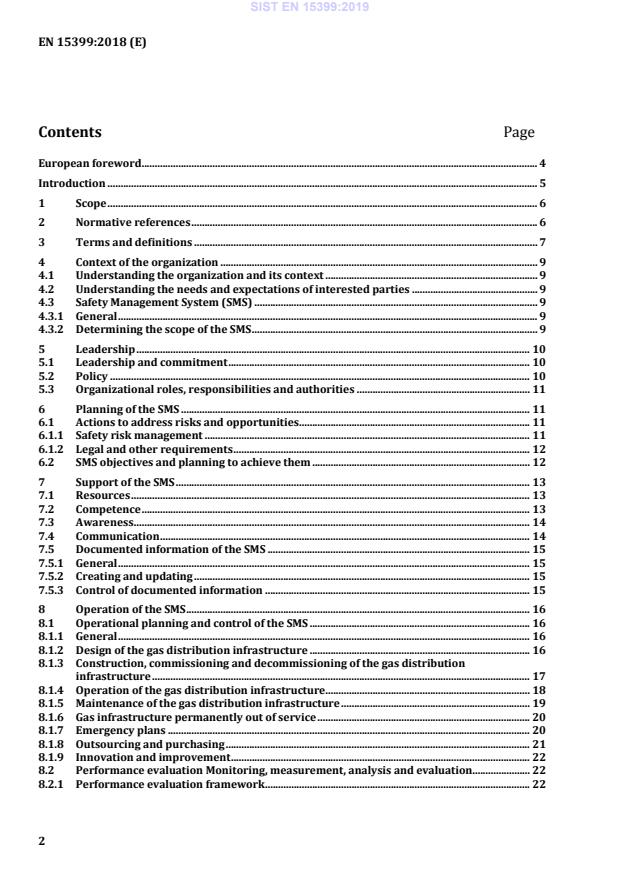
Page European foreword . 4 Introduction . 5 1 Scope . 6 2 Normative references . 6 3 Terms and definitions . 7 4 Context of the organization . 9 4.1 Understanding the organization and its context . 9 4.2 Understanding the needs and expectations of interested parties . 9 4.3 Safety Management System (SMS) . 9 4.3.1 General . 9 4.3.2 Determining the scope of the SMS . 9 5 Leadership . 10 5.1 Leadership and commitment . 10 5.2 Policy . 10 5.3 Organizational roles, responsibilities and authorities . 11 6 Planning of the SMS . 11 6.1 Actions to address risks and opportunities . 11 6.1.1 Safety risk management . 11 6.1.2 Legal and other requirements . 12 6.2 SMS objectives and planning to achieve them . 12 7 Support of the SMS . 13 7.1 Resources . 13 7.2 Competence . 13 7.3 Awareness . 14 7.4 Communication . 14 7.5 Documented information of the SMS . 15 7.5.1 General . 15 7.5.2 Creating and updating . 15 7.5.3 Control of documented information . 15 8 Operation of the SMS . 16 8.1 Operational planning and control of the SMS . 16 8.1.1 General . 16 8.1.2 Design of the gas distribution infrastructure . 16 8.1.3 Construction, commissioning and decommissioning of the gas distribution infrastructure . 17 8.1.4 Operation of the gas distribution infrastructure . 18 8.1.5 Maintenance of the gas distribution infrastructure . 19 8.1.6 Gas infrastructure permanently out of service . 20 8.1.7 Emergency plans . 20 8.1.8 Outsourcing and purchasing . 21 8.1.9 Innovation and improvement . 22 8.2 Performance evaluation Monitoring, measurement, analysis and evaluation . 22 8.2.1 Performance evaluation framework . 22 SIST EN 15399:2019
Plan-Do-Check-Act (PDCA) methodology . 26 Bibliography . 27 SIST EN 15399:2019
...