


EN 13311-3:2001
(Main)Biotechnology - Performance criteria for vessels - Part 3: Glass pressure vessels
General Information
- Abstract
This European Standard specifies performance criteria for glass pressure vessels used in biotechnological processes with respect to the potential risks to the worker and the environment from microorganisms in use. This European Standard applies where the intended use of glass pressure vessels includes hazardous or potentially hazardous microorganisms used in biotechnological processes or where exposure of the worker or the environment to such microorganisms is restricted for reasons of safety.
- Status
- Published
- Publication Date
- 20-Mar-2001
- Withdrawal Date
- 29-Sep-2001
- Technical Committee
- CEN/TC 233 - Biotechnology
- Drafting Committee
- CEN/TC 233/WG 4 - Equipment
- Current Stage
- 9093 - Decision to confirm - Review Enquiry
- Start Date
- 01-Oct-2025
- Completion Date
- 23-Sep-2026
- Directive
- Not Harmonized90/219/EEC - Contained use of genetically modified micro-organisms


Overview
EN 13311-3:2001 is a European Standard developed by CEN that specifies performance criteria for glass pressure vessels used in biotechnological processes. This standard primarily addresses safety concerns related to the handling of hazardous or potentially hazardous microorganisms within these vessels. It is pivotal for minimizing the risks posed to workers and the environment by microorganisms that may be contained or processed within glass pressure vessels.
This standard applies to vessels fabricated from glass and other brittle materials, such as acrylate polymers or porcelain, used in biotechnology where safety from microbial exposure is critical. EN 13311-3:2001 augments general safety standards for pressure vessels with specific performance requirements relevant to biotechnology.
Key Topics
Scope and Safety Focus
EN 13311-3:2001 targets glass pressure vessels used with dangerous microorganisms, defining requirements to prevent accidental release via breakage, leakage, explosion, or rupture.Hazard Identification
The standard highlights key hazards including accidental breakage, leaks at vessel connections, explosion risks, flying glass injuries, and structural weakening due to temperature cycling or mechanical stress.Performance Criteria
The vessels are classified based on:- Leaktightness: Ensuring no microbial escape through seals or ports.
- Cleanability: Facilitating effective sterilization and sanitation during use.
- Sterilizability: Capability to undergo sterilization procedures without damage, including autoclaving and sterilization-in-place (SIP).
Testing and Verification
It prescribes mandatory testing protocols for leaktightness and cleanability, with detailed guidance on test methods outlined in Annex A (including pressure loss tests, helium probing, and bioaerosol monitoring).Design and Usage Recommendations
The annex provides practical guidance on:- Protective sheathing to reduce explosion hazards.
- Use of pressure relief devices.
- Design considerations relating to vessel diameter and pressure.
- Safe autoclaving and connection practices.
- Managing pressure buildup from clogged filters.
- Importance of secondary containment where microbial release must be strictly controlled.
Marking, Packaging, and Documentation
The standard mandates consistent marking, secure packaging, and comprehensive documentation aligned with general performance standards EN 13311-1.
Applications
EN 13311-3:2001 applies extensively across biotechnology sectors where glass pressure vessels are employed, including:
- Fermentation Processes - Glass fermenters used in producing pharmaceuticals, biofuels, and enzymes.
- Bioprocessing Equipment - Reaction vessels, chromatography columns, and sampling bottles requiring microbial containment.
- Laboratory and Pilot Plant Settings - Vessels subject to sterilization and pressure cycling in research and small-scale production.
- Cryogenic and Cell Disruption Applications - Specialized glass vessels involved in biotechnological sample processing.
By conforming to EN 13311-3, manufacturers and users ensure enhanced microbial safety, reduced contamination risk, and compliance with European regulatory requirements. The standard supports operational safety for workers and enhances environmental protection during biotechnological manufacturing.
Related Standards
EN 13311-3 is part of a series of CEN standards addressing vessel performance in biotechnology:
- EN 13311-1:2001 – General Performance Criteria for Vessels
- EN 13311-2:2001 – Pressure Protection Devices for Vessels
- EN 13311-4:2001 – Performance Criteria for Bioreactors
- EN 13311-5:2001 – Kill Tanks Performance Criteria
- EN 13311-6:2001 – Performance Criteria for Chromatography Columns
Additional relevant standards include:
- EN 1595 – General rules for design, manufacture, and testing of borosilicate glass pressure equipment
- EN 12298:1998 – Testing procedures for leaktightness of biotechnology equipment
These complementary standards provide comprehensive guidelines for the safe and reliable use of pressure vessels containing microorganisms in the biotechnology industry.
Keywords: EN 13311-3, biotechnology standards, glass pressure vessels, microbial safety, vessel performance criteria, bioprocess equipment, leaktightness testing, sterilizability, protective sheathing, pressure relief devices, European Standard, CEN.
Relations
- Effective Date
- 28-Jan-2026
Frequently Asked Questions
EN 13311-3:2001 is a standard published by the European Committee for Standardization (CEN). Its full title is "Biotechnology - Performance criteria for vessels - Part 3: Glass pressure vessels". This standard covers: This European Standard specifies performance criteria for glass pressure vessels used in biotechnological processes with respect to the potential risks to the worker and the environment from microorganisms in use. This European Standard applies where the intended use of glass pressure vessels includes hazardous or potentially hazardous microorganisms used in biotechnological processes or where exposure of the worker or the environment to such microorganisms is restricted for reasons of safety.
This European Standard specifies performance criteria for glass pressure vessels used in biotechnological processes with respect to the potential risks to the worker and the environment from microorganisms in use. This European Standard applies where the intended use of glass pressure vessels includes hazardous or potentially hazardous microorganisms used in biotechnological processes or where exposure of the worker or the environment to such microorganisms is restricted for reasons of safety.
EN 13311-3:2001 is classified under the following ICS (International Classification for Standards) categories: 07.080 - Biology. Botany. Zoology; 07.100.01 - Microbiology in general. The ICS classification helps identify the subject area and facilitates finding related standards.
EN 13311-3:2001 has the following relationships with other standards: It is inter standard links to EN 13311-1:2001. Understanding these relationships helps ensure you are using the most current and applicable version of the standard.
EN 13311-3:2001 is associated with the following European legislation: EU Directives/Regulations: 90/219/EEC, 90/220/EEC, 90/679/EEC; Standardization Mandates: M/BC/CEN/91/19. When a standard is cited in the Official Journal of the European Union, products manufactured in conformity with it benefit from a presumption of conformity with the essential requirements of the corresponding EU directive or regulation.
EN 13311-3:2001 is available in PDF format for immediate download after purchase. The document can be added to your cart and obtained through the secure checkout process. Digital delivery ensures instant access to the complete standard document.
Standards Content (Sample)
2003-01.Slovenski inštitut za standardizacijo. Razmnoževanje celote ali delov tega standarda ni dovoljeno.Biotechnik - Leistungskriterien für Behälter - Teil 3: Druckbehälter aus GlasBiotechnologie - Criteres de performance des récipients - Partie 3: Récipients sous pression en verreBiotechnology - Performance criteria for vessels - Part 3: Glass pressure vessels07.100.01Mikrobiologija na splošnoMicrobiology in general07.080Biologija. Botanika. ZoologijaBiology. Botany. ZoologyICS:Ta slovenski standard je istoveten z:EN 13311-3:2001SIST EN 13311-3:2002en01-januar-2002SIST EN 13311-3:2002SLOVENSKI
STANDARD
EUROPEAN STANDARDNORME EUROPÉENNEEUROPÄISCHE NORMEN 13311-3March 2001ICS 07.080; 07.100.01English versionBiotechnology - Performance criteria for vessels - Part 3: Glasspressure vesselsBiotechnologie - Critères de performance des récipients -Partie 3: Récipients sous pression en verreBiotechnik - Leistungskriterien für Behälter - Teil 3:Druckbehälter aus GlasThis European Standard was approved by CEN on 4 February 2001.CEN members are bound to comply with the CEN/CENELEC Internal Regulations which stipulate the conditions for giving this EuropeanStandard the status of a national standard without any alteration. Up-to-date lists and bibliographical references concerning such nationalstandards may be obtained on application to the Management Centre or to any CEN member.This European Standard exists in three official versions (English, French, German). A version in any other language made by translationunder the responsibility of a CEN member into its own language and notified to the Management Centre has the same status as the officialversions.CEN members are the national standards bodies of Austria, Belgium, Czech Republic, Denmark, Finland, France, Germany, Greece,Iceland, Ireland, Italy, Luxembourg, Netherlands, Norway, Portugal, Spain, Sweden, Switzerland and United Kingdom.EUROPEAN COMMITTEE FOR STANDARDIZATIONCOMITÉ EUROPÉEN DE NORMALISATIONEUROPÄISCHES KOMITEE FÜR NORMUNGManagement Centre: rue de Stassart, 36
B-1050 Brussels© 2001 CENAll rights of exploitation in any form and by any means reservedworldwide for CEN national Members.Ref. No. EN 13311-3:2001 ESIST EN 13311-3:2002
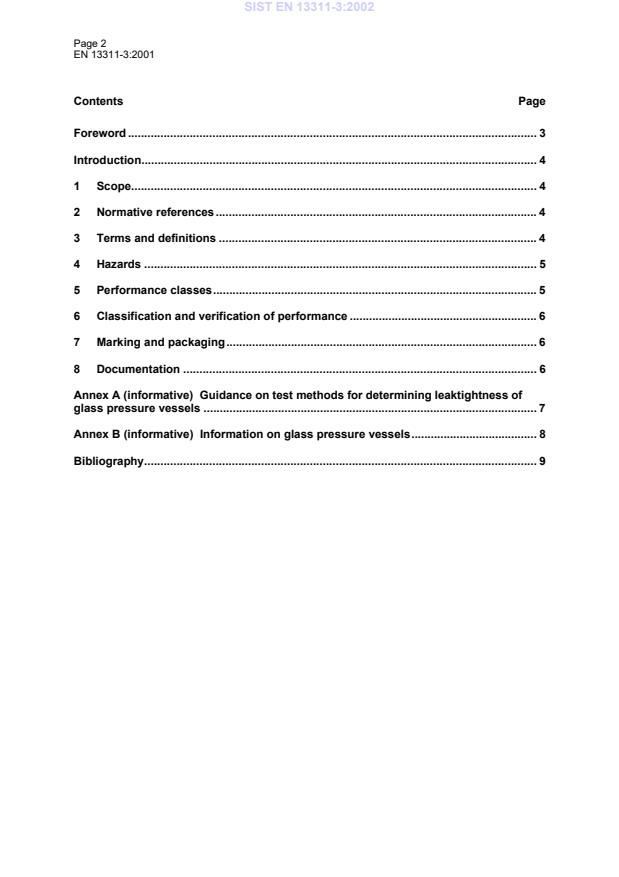
Page 2EN 13311-3:2001ContentsPageForeword.3Introduction.41Scope.42Normative references.43Terms and definitions.44Hazards.55Performance classes.56Classification and verification of performance.67Marking and packaging.68Documentation.6Annex A (informative)
Guidance on test methods for determining leaktightness ofglass pressure vessels.7Annex B (informative)
Information on glass pressure vessels.8Bibliography.9SIST EN 13311-3:2002
Page 3EN 13311-3:2001ForewordThis European Standard has been prepared by Technical Committee CEN/TC 233"Biotechnology", the secretariat of which is held by AFNOR.This European Standard shall be given the status of a national standard, either bypublication of an identical text or by endorsement, at the latest by September 2001, andconflicting national standards shall be withdrawn at the latest by September 2001.This European Standard has been prepared under a mandate given to CEN by theEuropean Commission and the European Free Trade Association.This standard is one of a series of European Standards concerned with performance criteriafor vessels. These standards are :EN 13311-1, Biotechnology - Performance criteria for vessels - Part 1: General performancecriteria.EN 13311-2, Biotechnology - Performance criteria for vessels - Part 2: Pressure protectiondevices.EN 13311-3, Biotechnology - Performance criteria for vessels - Part 3: Glass pressurevessels.EN 13311-4, Biotechnology - Performance criteria for vessels - Part 4: Bioreactors.EN 13311-5, Biotechnology - Performance criteria for vessels - Part 5: Kill tanks.EN 13311-6, Biotechnology - Performance criteria for vessels - Part 6: Chromatographycolumns.Annexes A and B are informative.This standard includes a bibliography.According to the CEN/CENELEC Internal Regulations, the national standards organizationsof the following countries are bound to implement this European Standard: Austria, Belgium,Czech Republic, Denmark, Finland, France, Germany, Greece, Iceland, Ireland, Italy,Luxembourg, Netherlands, Norway, Portugal, Spain, Sweden, Switzerland and the UnitedKingdom.SIST EN 13311-3:2002
Page 4EN 13311-3:2001IntroductionGlass pressure vessels are used in a wide variety of biotechnological processes, and varyconsiderably in scale and function. Glass pressure vessels used in biotechnology caninclude for example fermenters and feed vessels, reaction vessels, centrifuge tubes andbuckets, chromatography columns, sampling bottles, rotary evaporators, jacketedhomogenizers/cell disrupters and vessels used in cryogenic procedures.The mechanical safety of pressure vessels which can include glass vessels is described inEN 1595 (see [2]) or for example a national pressure vessel code (see [1]).Use of this European Standard will aid the equipment manufacturer in the classification ofglass pressure vessels with regard to safe performance in biotechnological processes. Theclassification is easily understandable and readily utilizable for the user and the regulatoryauthorities.1ScopeThis European Standard specifies performance criteria for glass pressure vessels used inbiotechnological processes with respect to the potential hazards to the worker and theenvironment from microorganisms in use.This European Standard applies where the intended use of glass pressure vessels includeshazardous or potentially hazardous microorganisms used in biotechnological processes orwhere exposure of the worker or the environment to such microorganisms is restricted forreasons of safety.This European Standard also applies to pressure vessels used in biotechnological processesthat are made of other brittle materials such as acrylate polymers or porcelain.This European Standard does not apply to small glass parts which form an integral part ofequipment such as sight glasses.This European Standard should be used in conjunction with other relevant standards whensubstantial parts of glass or from other brittle materials are present.2Normative referencesThis European Standard incorporates by dated or undated reference, provisions from otherpublications. These normative references are cited at the appropriate places in the text andthe publications are listed hereafter. For da
...