


prEN 1915-2
(Main)Aircraft ground support equipment - General requirements - Part 2: Stability and strength requirements, calculations and test methods
Aircraft ground support equipment - General requirements - Part 2: Stability and strength requirements, calculations and test methods
This Part of EN 1915 specifies the conditions to be taken into consideration when calculating the strength and the stability of GSE according to EN 1915-1 and the EN 12312 series under intended use conditions. It also specifies general test methods.
NOTE The methods given in this standard demonstrate one way of achieving an acceptable safety level. Methods that produce comparable results may be used.
This Part of EN 1915 does not establish additional requirements for the following:
- operation elsewhere than in an airport environment;
- operation in severe conditions, e.g. ambient temperature below -20 C or over 50 C, tropical or saturated salty atmospheric environment;
- hazards caused by wind velocity in excess of the figures given in this European Standard;
- earthquake, flood, landslide, lightning and more generally any natural catastrophe.
This Part of EN 1915 is not applicable to GSE which are manufactured before the date of publication by CEN of this Standard.
Luftfahrt-Bodengeräte - Allgemeine Anforderungen - Teil 2: Standsicherheits- und Festigkeitsanforderungen, Berechnungen und Prüfverfahren
Dieses Dokument legt die Bedingungen fest, die beim Berechnen der Stärke und Standsicherheit von Bodengeräten berücksichtigt werden müssen. Sie gibt auch die Voraussetzungen an, unter denen Prüfungen durchzuführen sind.
Es ist beabsichtigt, diesen Teil von EN 1915 in Verbindung mit EN 1915 1:2023, EN 1915 3:2004+A1:2009 (für selbstfahrende Fahrzeuge) und EN 1915 4:2004+A1:2009 und mit dem entsprechenden Teil der EN 12312 anzuwenden, um die Anforderungen an GSE innerhalb des Anwendungsbereiches von EN 12312 anzugeben.
Wenn EN 12312 keinen entsprechenden Teil für GSE enthält, gibt EN 1915 (alle Teile) allgemeine Anforderungen an, die gelten können, auch wenn zusätzliche maschinenspezifische Anforderungen erforderlich sein können, die wahrscheinlich vom Hersteller verlangt werden.
ANMERKUNG Die in diesem Dokument angegebenen Methoden bieten einen möglichen Weg zum Erreichen eines annehmbaren Schutzniveaus. Methoden, die vergleichbare Ergebnisse liefern, können ebenfalls angewendet werden.
Dieses Dokument legt keine zusätzlichen Anforderungen an Folgendes fest:
a) Betrieb außerhalb des Flughafens;
b) Betrieb unter erschwerten Bedingungen, z. B. bei Umgebungstemperaturen unter 20 °C oder über 50 °C, in tropischer oder in gesättigter Salz-Atmosphäre;
c) Gefährdungen aus Windgeschwindigkeiten oberhalb der in diesem Dokument angegebenen Werte;
d) Erdbeben, Überschwemmungen, Erdrutsche, Blitze und allgemein jede Art von Naturkatastrophen.
Dieses Dokument ist nicht auf Bodengeräte anwendbar, die vor der Veröffentlichung dieses Dokuments durch CEN hergestellt wurden.
Matériel au sol pour aéronefs - Exigences générales - Partie 2 : Exigences de stabilité et de résistance mécanique, calculs et méthodes d'essai
Podporna oprema na tleh za letalski promet - Splošne zahteve - 2. del: Zahteve za stabilnost in vzdržljivost, izračuni in preskusni postopki
General Information
- Status
- Not Published
- Publication Date
- 29-Jul-2026
- Technical Committee
- CEN/TC 274 - Aircraft ground support equipment
- Drafting Committee
- CEN/TC 274/WG 1 - Working Group Revision
- Current Stage
- 4599 - Dispatch of FV draft to CMC - Finalization for Vote
- Start Date
- 19-Jan-2026
- Due Date
- 31-Dec-2025
- Completion Date
- 19-Jan-2026
Relations
- Effective Date
- 08-Apr-2024
Overview
prEN 1915-2 is a forthcoming European standard developed by the CEN Technical Committee CEN/TC 274, focusing on Aircraft Ground Support Equipment (GSE). This standard specifies the stability and strength requirements, calculation methods, and general test procedures for GSE to be used in airport environments. It complements parts 1, 3, and 4 of EN 1915, as well as the EN 12312 series of standards that cover specific types of ground support equipment.
The primary goal of prEN 1915-2 is to ensure that aircraft ground support equipment meets a consistent level of mechanical integrity and operational safety under intended use conditions. It provides the framework for strength calculations, stability analysis, and testing to help manufacturers, maintenance personnel, and airport operators evaluate and verify the safety and reliability of GSE.
Key Topics
Strength Calculation Requirements
The standard outlines criteria for calculating the strength of metallic constructions used in GSE. It addresses loads, load combinations, stress factors, fatigue considerations, and combined stresses in structural components.Stability Calculations
It defines stability criteria considering various factors such as load forces, ground slope, elastic deflections, tyre conditions (including flat tyres), and load combinations, ensuring safe operation without tipping or structural failure.Safety-Related Machinery Components
Specific calculation requirements are provided for critical machinery parts including chain lifting elements, cylinders, hoses, wire ropes, winches, winching plants, and stabilizers.Test Methods
General procedures for verifying strength and stability through loading tests are described. This includes test loads, test execution, and interpretation of results to validate compliance with safety requirements.Hazard Considerations
The standard identifies various hazards related to GSE operation within airport environments but excludes severe conditions like extreme temperatures, natural disasters (earthquakes, floods, etc.), and wind speeds exceeding specified limits.Scope of Applicability
prEN 1915-2 applies to newly manufactured GSE from the date of publication onward and is intended to be used alongside other EN 1915 parts and EN 12312 series for comprehensive coverage.
Applications
prEN 1915-2 serves as a vital reference for multiple stakeholders involved with aircraft ground support equipment:
Manufacturers
To design and engineer GSE that comply with standardized stability and strength parameters, ensuring safe and reliable operation on airside airport locations.Safety and Compliance Engineers
To perform strength and stability calculations and conduct tests verifying GSE conformity before deployment or after modifications.Airport Operators and Maintenance Teams
To understand the essential safety requirements and test methods for maintaining equipment integrity, minimizing operational risks and downtime.Regulators and Certification Bodies
To assess compliance with European safety regulations and international best practices concerning ground support equipment mechanical safety.
This standard helps enhance the operational safety of aircraft ground support by reducing the risks of mechanical failures and accidents caused by improper stability or structural weaknesses.
Related Standards
prEN 1915-2 works alongside other European and international standards including:
- EN 1915-1:2023 – Basic safety requirements for aircraft ground support equipment.
- EN 1915-3:2004+A1:2009 – Vibration measurement methods and reduction for GSE.
- EN 1915-4:2004+A1:2009 – Noise measurement methods and reduction.
- EN 12312 series – Specific requirements for types of GSE such as passenger stairs, catering vehicles, conveyor belts, boarding bridges, fueling equipment, and more.
- EN 1993-1-9:2025 (Eurocode 3) – Design of steel structures, including fatigue considerations applied to metallic parts of GSE.
- EN ISO 12100:2010 – General principles for machine safety design, applicable in interpreting type-C standards like prEN 1915-2.
By integrating these standards, prEN 1915-2 ensures coordinated, comprehensive guidance for the design, testing, and safe use of aircraft ground support equipment within airport environments.
Keywords: aircraft ground support equipment, GSE, stability requirements, strength calculation, test methods, EN 1915, EN 12312, airport safety, metallic construction, fatigue, machinery safety, load calculations, aviation ground handling, aircraft equipment standards.

Get Certified
Connect with accredited certification bodies for this standard

DEKRA North America
DEKRA certification services in North America.

Eagle Registrations Inc.
American certification body for aerospace and defense.

Element Materials Technology
Materials testing and product certification.
Sponsored listings
Frequently Asked Questions
prEN 1915-2 is a draft published by the European Committee for Standardization (CEN). Its full title is "Aircraft ground support equipment - General requirements - Part 2: Stability and strength requirements, calculations and test methods". This standard covers: This Part of EN 1915 specifies the conditions to be taken into consideration when calculating the strength and the stability of GSE according to EN 1915-1 and the EN 12312 series under intended use conditions. It also specifies general test methods. NOTE The methods given in this standard demonstrate one way of achieving an acceptable safety level. Methods that produce comparable results may be used. This Part of EN 1915 does not establish additional requirements for the following: - operation elsewhere than in an airport environment; - operation in severe conditions, e.g. ambient temperature below -20 C or over 50 C, tropical or saturated salty atmospheric environment; - hazards caused by wind velocity in excess of the figures given in this European Standard; - earthquake, flood, landslide, lightning and more generally any natural catastrophe. This Part of EN 1915 is not applicable to GSE which are manufactured before the date of publication by CEN of this Standard.
This Part of EN 1915 specifies the conditions to be taken into consideration when calculating the strength and the stability of GSE according to EN 1915-1 and the EN 12312 series under intended use conditions. It also specifies general test methods. NOTE The methods given in this standard demonstrate one way of achieving an acceptable safety level. Methods that produce comparable results may be used. This Part of EN 1915 does not establish additional requirements for the following: - operation elsewhere than in an airport environment; - operation in severe conditions, e.g. ambient temperature below -20 C or over 50 C, tropical or saturated salty atmospheric environment; - hazards caused by wind velocity in excess of the figures given in this European Standard; - earthquake, flood, landslide, lightning and more generally any natural catastrophe. This Part of EN 1915 is not applicable to GSE which are manufactured before the date of publication by CEN of this Standard.
prEN 1915-2 is classified under the following ICS (International Classification for Standards) categories: 49.100 - Ground service and maintenance equipment. The ICS classification helps identify the subject area and facilitates finding related standards.
prEN 1915-2 has the following relationships with other standards: It is inter standard links to EN 1915-2:2001+A1:2009. Understanding these relationships helps ensure you are using the most current and applicable version of the standard.
prEN 1915-2 is associated with the following European legislation: EU Directives/Regulations: 2006/42/EC, 2023/1230; Standardization Mandates: M/396, M/605. When a standard is cited in the Official Journal of the European Union, products manufactured in conformity with it benefit from a presumption of conformity with the essential requirements of the corresponding EU directive or regulation.
prEN 1915-2 is available in PDF format for immediate download after purchase. The document can be added to your cart and obtained through the secure checkout process. Digital delivery ensures instant access to the complete standard document.
Standards Content (Sample)
SLOVENSKI STANDARD
01-september-2025
Podporna oprema na tleh za letalski promet - Splošne zahteve - 2. del: Zahteve za
stabilnost in vzdržljivost, izračuni in preskusni postopki
Aircraft ground support equipment - General requirements - Part 2: Stability and strength
requirements, calculations and test methods
Luftfahrt-Bodengeräte - Allgemeine Anforderungen - Teil 2: Standsicherheits- und
Festigkeitsanforderungen, Berechnungen und Prüfverfahren
Matériel au sol pour aéronefs - Exigences générales - Partie 2: Prescriptions de stabilité
et de résistance mécanique, calculs et méthodes d'essai
Ta slovenski standard je istoveten z: prEN 1915-2
ICS:
49.100 Oprema za servis in Ground service and
vzdrževanje na tleh maintenance equipment
2003-01.Slovenski inštitut za standardizacijo. Razmnoževanje celote ali delov tega standarda ni dovoljeno.
DRAFT
EUROPEAN STANDARD
NORME EUROPÉENNE
EUROPÄISCHE NORM
June 2025
ICS 49.100 Will supersede EN 1915-2:2001+A1:2009
English Version
Aircraft ground support equipment - General
requirements - Part 2: Stability and strength requirements,
calculations and test methods
Matériel au sol pour aéronefs - Exigences générales - Luftfahrt-Bodengeräte - Allgemeine Anforderungen -
Partie 2: Prescriptions de stabilité et de résistance Teil 2: Standsicherheits- und
mécanique, calculs et méthodes d'essai Festigkeitsanforderungen, Berechnungen und
Prüfverfahren
This draft European Standard is submitted to CEN members for enquiry. It has been drawn up by the Technical Committee
CEN/TC 274.
If this draft becomes a European Standard, CEN members are bound to comply with the CEN/CENELEC Internal Regulations
which stipulate the conditions for giving this European Standard the status of a national standard without any alteration.
This draft European Standard was established by CEN in three official versions (English, French, German). A version in any other
language made by translation under the responsibility of a CEN member into its own language and notified to the CEN-CENELEC
Management Centre has the same status as the official versions.
CEN members are the national standards bodies of Austria, Belgium, Bulgaria, Croatia, Cyprus, Czech Republic, Denmark, Estonia,
Finland, France, Germany, Greece, Hungary, Iceland, Ireland, Italy, Latvia, Lithuania, Luxembourg, Malta, Netherlands, Norway,
Poland, Portugal, Republic of North Macedonia, Romania, Serbia, Slovakia, Slovenia, Spain, Sweden, Switzerland, Türkiye and
United Kingdom.
Recipients of this draft are invited to submit, with their comments, notification of any relevant patent rights of which they are
aware and to provide supporting documentation.
Warning : This document is not a European Standard. It is distributed for review and comments. It is subject to change without
notice and shall not be referred to as a European Standard.
EUROPEAN COMMITTEE FOR STANDARDIZATION
COMITÉ EUROPÉEN DE NORMALISATION
EUROPÄISCHES KOMITEE FÜR NORMUNG
CEN-CENELEC Management Centre: Rue de la Science 23, B-1040 Brussels
© 2025 CEN All rights of exploitation in any form and by any means reserved Ref. No. prEN 1915-2:2025 E
worldwide for CEN national Members.
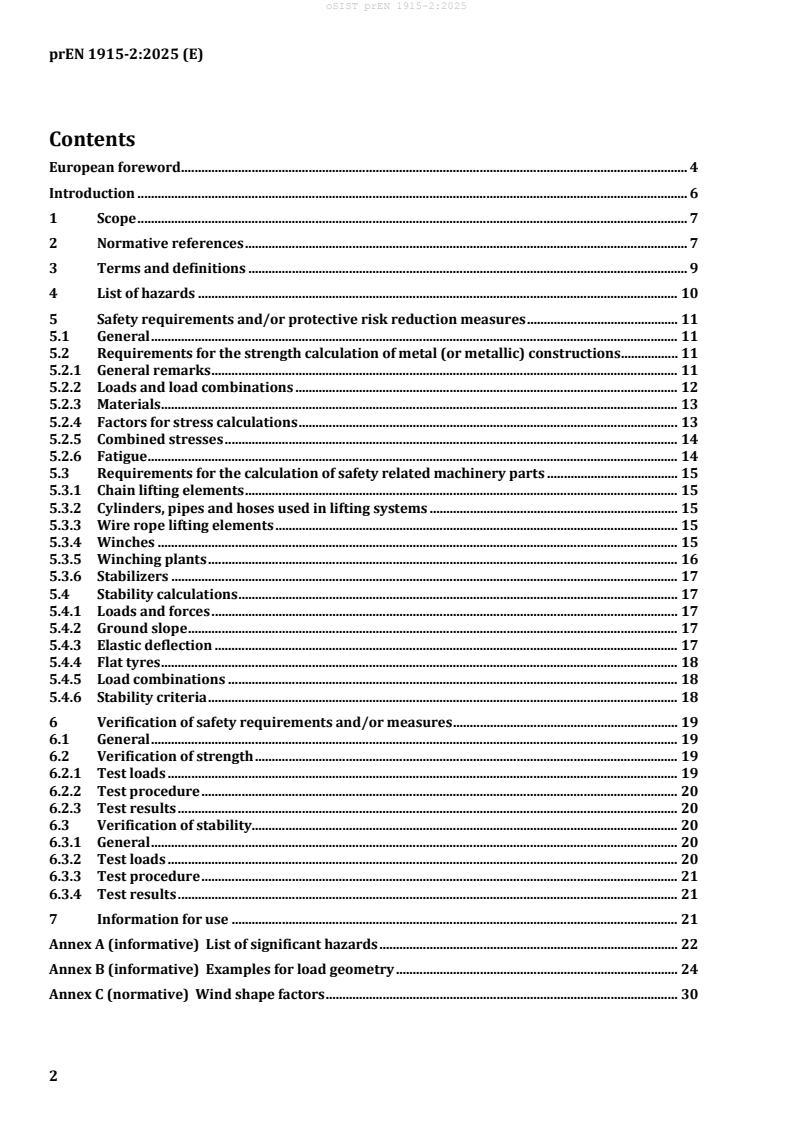
Contents
European foreword . 4
Introduction . 6
1 Scope . 7
2 Normative references . 7
3 Terms and definitions . 9
4 List of hazards . 10
5 Safety requirements and/or protective risk reduction measures . 11
5.1 General . 11
5.2 Requirements for the strength calculation of metal (or metallic) constructions . 11
5.2.1 General remarks . 11
5.2.2 Loads and load combinations . 12
5.2.3 Materials . 13
5.2.4 Factors for stress calculations . 13
5.2.5 Combined stresses . 14
5.2.6 Fatigue . 14
5.3 Requirements for the calculation of safety related machinery parts . 15
5.3.1 Chain lifting elements . 15
5.3.2 Cylinders, pipes and hoses used in lifting systems . 15
5.3.3 Wire rope lifting elements . 15
5.3.4 Winches . 15
5.3.5 Winching plants . 16
5.3.6 Stabilizers . 17
5.4 Stability calculations . 17
5.4.1 Loads and forces . 17
5.4.2 Ground slope . 17
5.4.3 Elastic deflection . 17
5.4.4 Flat tyres . 18
5.4.5 Load combinations . 18
5.4.6 Stability criteria . 18
6 Verification of safety requirements and/or measures . 19
6.1 General . 19
6.2 Verification of strength . 19
6.2.1 Test loads . 19
6.2.2 Test procedure . 20
6.2.3 Test results . 20
6.3 Verification of stability. 20
6.3.1 General . 20
6.3.2 Test loads . 20
6.3.3 Test procedure . 21
6.3.4 Test results . 21
7 Information for use . 21
Annex A (informative) List of significant hazards . 22
Annex B (informative) Examples for load geometry . 24
Annex C (normative) Wind shape factors . 30
Annex ZA (informative) Relationship between this European Standard and the essential
requirements of Regulation (EU) 2023/1230 aimed to be covered. 32
Bibliography . 39
European foreword
This document (prEN 1915-2:2025) has been prepared by Technical Committee CEN/TC 274 “Aircraft
ground support equipment”, the secretariat of which is held by DIN.
This document is currently submitted to the CEN Enquiry.
This document will supersede EN 1915-2:2001+A1:2009.
This document has been prepared under a standardization request addressed to CEN by the European
Commission. The Standing Committee of the EFTA States subsequently approves these requests for its
Member States.
For the relationship with EU Legislation, see informative Annex ZA, which is an integral part of this
document.
EN 1915, Aircraft ground support equipment ― General requirements, consists of the following parts:
— Part 1: Basic safety requirements (the present document);
— Part 2: Stability and strength requirements, calculations and test methods;
— Part 3: Vibration measurement methods and reduction;
— Part 4: Noise measurement methods and reduction.
EN 12312, Aircraft ground support equipment ― Specific requirements, consists of the following parts:
— Part 1: Passenger stairs;
— Part 2: Catering vehicles;
— Part 3: Conveyor belt vehicles;
— Part 4: Passenger boarding bridges;
— Part 5: Aircraft fuelling equipment;
— Part 6: Deicers and deicing/antiicing equipment;
— Part 7: Aircraft movement equipment;
— Part 8: Maintenance or service stairs and platforms;
— Part 9: Container/Pallet loaders;
— Part 10: Container/Pallet transfer transporters;
— Part 11: Container/Pallet dollies and loose load trailers;
— Part 12: Potable water service equipment;
— Part 13: Lavatory service equipment;
— Part 14: Disabled/incapacitated passenger boarding vehicles;
— Part 15: Baggage and equipment tractors;
— Part 16: Air start equipment;
— Part 17: Air conditioning equipment;
— Part 18: Nitrogen or Oxygen units;
— Part 19: Aircraft jacks, axle jacks and hydraulic tail stanchions;
— Part 20: Electrical ground power units.
The main changes compared to the previous edition are:
a) the Introduction was updated;
b) the Scope was updated;
c) Clause 2, Normative references, was updated;
d) requirements for steel construction changed to metal or metallic constructions;
e) The methods of calculation changed;
f) Factors for stress calculations have new bases;
g) Fatigue strength factors were updated;
h) It has been determined when inspections can be dispensed with (see 6.1);
i) Annex A, List of significant hazards, was added;
j) Annex ZA was updated;
k) the Bibliography was updated.
Introduction
The abbreviation GSE means a complete item of aircraft ground support equipment in the context of this
document.
When compiling this document, it was assumed that components without specific requirements are:
a) designed in accordance with good engineering practice and calculation codes;
b) of sound mechanical and electrical construction;
c) made of materials with adequate strength and of suitable quality;
d) made of materials free of defects;
e) components are kept in good repair and working order, so that the required characteristics remain
despite wear;
f) by design of the load bearing elements, a safe operation of the machine is ensured for loading ranges
from zero to 100 % of the rated possibilities and during tests;
g) a negotiation took place between the user and the manufacturer concerning particular conditions for
the use and places of use of the GSE;
l) the place of operation allows a safe use of GSE.
The extent to which hazards are covered is indicated in the scope of this document.
The minimum essential criteria are considered to be of primary importance in providing safe, economical
and usable GSE. Deviation from the recommended methods and conditions should occur only after careful
consideration, extensive testing and thorough in-service evaluation have shown alternative methods or
conditions to be satisfactory. Such deviations are outside the scope of this document and a manufacturer
should be able to demonstrate an equivalent level of protection.
This European Standard is a Type C standard as defined in EN ISO 12100:2010.
The machinery concerned and the extent to which hazards, hazardous situations or hazardous events are
covered are indicated in the Scope of this document.
When requirements of this type-C standard are different from those which are stated in type-A or type-B
standards, the requirements of this type-C standard take precedence over the requirements of the other
standards for machines that have been designed and built according to the requirements of this type-C
standard.
1 Scope
This document specifies the conditions to be taken into consideration when calculating the strength and
the stability of GSE. It also specifies general test methods.
This part of EN 1915 is intended to be used in conjunction with EN 1915-1:2023,
EN 1915-3:2004+A1:2009 (for self-propelled GSE) and EN 1915-4:2004+A1:2009, and with the relevant
part of EN 12312 to give the requirements for the types of GSE within the scope of EN 12312.
When EN 12312 does not contain a relevant part for a GSE, EN 1915 (all parts) gives general
requirements that may apply, although additional machine specific requirements, to be determined by
the manufacturer, are likely to be required.
NOTE The methods given in this document demonstrate one way of achieving an acceptable safety level.
Methods that produce comparable results can be used.
This document does not establish additional requirements for the following:
a) operation elsewhere than in an airport environment;
b) operation in severe conditions, e.g. ambient temperature below −20 °C or over 50 °C, tropical or
saturated salty atmospheric environment;
c) hazards caused by wind velocity in excess of the figures given in this document;
d) earthquake, flood, landslide, lightning and more generally any natural catastrophe.
This document is not applicable to GSE which are manufactured before the date of publication by CEN of
this document.
2 Normative references
The following documents are referred to in the text in such a way that some or all of their content
constitutes requirements of this document. For dated references, only the edition cited applies. For
undated references, the latest edition of the referenced document (including any amendments) applies.
EN 1915-1:2023, Aircraft ground support equipment - General requirements - Part 1: Basic safety
requirements
EN 1915-3:2004+A1:2009, Aircraft ground support equipment - General requirements - Part 3: Vibration
measurement methods and reduction
EN 1915-4:2004+A1:2009, Aircraft ground support equipment - General requirements - Part 4: Noise
measurement methods and reduction
EN 1993-1-9:2025, Eurocode 3 - Design of steel structures - Part 1-9: Fatigue
EN 12312-1:2024, Aircraft ground support equipment - Specific requirements - Part 1: Passenger stairs
EN 12312-2:2014, Aircraft ground support equipment - Specific requirements - Part 2: Catering vehicles
EN 12312-3:2017+A1:2020, Aircraft ground support equipment - Specific requirements - Part 3: Conveyor
belt vehicles
EN 12312-4:2024, Aircraft ground support equipment - Specific requirements - Part 4: Passenger boarding
bridges
EN 12312-5:2021+A1:2025, Aircraft ground support equipment - Specific requirements - Part 5: Aircraft
fuelling equipment
EN 12312-6:2017, Aircraft ground support equipment - Specific requirements - Part 6: Deicers and de-
icing/anti-icing equipment
EN 12312-7:2020, Aircraft ground support equipment - Specific requirements - Part 7: Aircraft movement
equipment
EN 12312-8:2018, Aircraft ground support equipment - Specific requirements - Part 8: Maintenance or
service stairs and platforms
EN 12312-9:2013, Aircraft ground support equipment - Specific requirements - Part 9: Container/Pallet
loaders
EN 12312-10:2005+A1:2009, Aircraft ground support equipment - Specific requirements - Part 10:
Container/Pallet transfer transporters
EN 12312-11:2005, Aircraft ground support equipment - Specific requirements - Part 11: Container/Pallet
dollies and loose load trailers
EN 12312-12:2017, Aircraft ground support equipment - Specific requirements - Part 12: Potable water
service equipment
EN 12312-13:2017, Aircraft ground support equipment - Specific requirements - Part 13: Lavatory service
equipment
EN 12312-14:2014, Aircraft ground support equipment - Specific requirements - Part 14:
Disabled/incapacitated passenger boarding vehicles
EN 12312-15:2020+A1:2022, Aircraft ground support equipment - Specific requirements - Part 15:
Baggage and equipment tractors
EN 12312-16:2005+A1:2009, Aircraft ground support equipment - Specific requirements - Part 16: Air
start equipment
EN 12312-17:2004+A1:2009, Aircraft ground support equipment - Specific requirements - Part 17: Air
conditioning equipment
EN 12312-18:2005+A1:2009, Aircraft ground support equipment - Specific requirements - Part 18:
Nitrogen or Oxygen units
EN 12312-19:2005+A1:2009, Aircraft ground support equipment - Specific requirements - Part 19: Aircraft
jacks, axle jacks and hydraulic tail stanchions
EN 12312-20:2005+A1:2009, Aircraft ground support equipment - Specific requirements - Part 20:
Electrical ground power units
EN ISO 4413:2010, Hydraulic fluid power - General rules and safety requirements for systems and their
components (ISO 4413:2010)
EN ISO 12100:2010, Safety of machinery - General principles for design - Risk assessment and risk reduction
(ISO 12100:2010)
ISO 2408:2017, Steel wire ropes — Requirements
ISO 8625-1:2018, Aerospace — Fluid systems — Vocabulary — Part 1: General terms and definitions
related to pressure
3 Terms and definitions
For the purposes of this document the terms and definitions given in EN ISO 12100:2010,
EN 1915-1:2023, ISO 8625-1:2018 and the following apply.
ISO and IEC maintain terminology databases for use in standardization at the following addresses:
— ISO Online browsing platform: available at https://www.iso.org/obp/
— IEC Electropedia: available at https://www.electropedia.org/
3.1
dead weight
mass of that part of the GSE, for which the strength is to be calculated
3.2
live load
maximum mass (including persons) a GSE or a part of it is intended to carry
3.3
local loads
loads derived from the live load for the calculation of the strength of particular parts of the GSE
3.4
snow load
maximum mass of snow or ice the GSE is intended to carry
3.5
static test load
test load or combination of test, used to simulate operational loading
3.6
dynamic forces
forces resulting from acceleration of a mass
EXAMPLE Acceleration forces, retardation forces, centrifugal forces.
3.7
secondary dynamic forces
forces caused by the movement of persons
Note 1 to entry These forces act horizontally at the centre of gravity of the body of a person. The centre of gravity
of persons is assumed to be 1,1 m above the standing area.
3.8
retardation forces
forces on particular parts of GSE caused by the maximum deceleration of the GSE
Note 1 to entry These forces act at the centre of gravity of the particular part in the direction of motion.
3.9
spring reaction force
force in the suspension under the condition of loading
3.10
wind load
force acting on a GSE or part of it due to wind pressure
Note 1 to entry This force acts horizontally at the geometric centre of the body of the GSE.
3.11
tipping edge
those part(s) of the GSE in contact with the ground, located farthest out on the most heavily loaded side
3.12
tipping moment
total of the products of those forces which tend to tip the GSE, and their distance normal to the tipping
edge
3.13
burst pressure, actual
pressure at which a component bursts or shows excessive leakage due to structural failure
SOURCE: ISO 8625-1:2018, 3.7
3.14
maximum working pressure
highest pressure at which the system is to operate
3.15
accidental load
those loads resulting from unforeseen or rare events
Note 1 to entry Those events can be e.g. failure of one lifting device and impacts.
3.16
resonance
phenomenon where a system vibrates with maximum amplitude at specific frequencies, known as natural
frequencies
Note 1 to entry Resonance can only be considered during the intended use of the GSE, e.g. passengers at
passenger boarding bridges.
4 List of hazards
This list of risks and hazards (given at Annex A, Table A.1) is based on EN ISO 12100:2010 and contains
the hazards and hazardous situations, as far as they are dealt with in this document, identified by risk
assessment as significant for this type of machinery and which require action to eliminate or reduce risks.
See also the complementary list of hazards in the other parts of EN 1915 and in the different parts of
EN 12312.
5 Safety requirements and/or protective risk reduction measures
5.1 General
GSE shall comply with the safety requirements and/or protective measures of this clause, with the
requirements of EN 1915-1:2023, EN 1915-3:2004+A1:2009 and EN 1915-4:2004+A1:2009 as relevant,
as well as with the requirements of the relevant part of EN 12312. In addition, the machine shall be
designed according to the principles of EN ISO 12100:2010 for relevant but not significant hazards, which
are not dealt with by this document.
Where a standard automotive or truck chassis is used, the manufacturer of the GSE should pay attention
to and appropriate gross mass rating for the intended use.
5.2 Requirements for the strength calculation of metal (or metallic) constructions
5.2.1 General remarks
The method of calculation shall take into account the complexity of each individual type of GSE. The
pertinence of the method of calculation shall be stated in the technical file.
Calculation models shall be performed either by
a) Finite element analysis;
b) Truss structure analysis;
c) Hand calculations
or combinations of these.
Design verification methods shall be performed either by
d) recognized engineering design methods and engineering codes;
e) actual stress measurements
or combinations of these.
NOTE Information about load geometry is given in Annex B.
The source of the design methods and engineering codes, if generally accessible, shall be stated in the
case of any unusual formulae or calculation methods. Otherwise, only formulae or calculation methods
which can be verified shall be used.
The general stress analysis shall be carried out to ensure safe levels of stress in relation to the yield stress
of the material used.
Safe levels of stress related to the loading conditions shall be demonstrated for all supporting structures.
The principal dimensions, cross sections, materials and fastening means shall be stated.
The calculation shall be performed considering 2nd theory order or large displacements analysis. Test
results, if available, shall be used to modify calculation parameters. The analysis of the load case
combinations intended shall be carried out to ensure that the severest individual load ratings can be
identified.
The global and local stability (buckling) of the GSE shall be proven according to design verification
methods given in 5.2.1. Eigenvalue buckling analysis is permitted.
Consideration shall be given to high dynamic forces which can be caused by the operation of a safety
device for the prevention of unintentional movements if there is an escape of fluid in a piping system or
a rope, chain, nut or gear fails.
The design of mechanical restraint devices shall take into account all loads and forces occurring during
blocking.
Where a system has two or more lifting elements in parallel, design shall ensure the loads resulting from
the failure of one element shall not have effects jeopardising safety. These loads shall be considered in
structural design to ensure the safety and integrity of the structure under exceptional circumstances. The
structure shall be stable but plastic deformations and / or local instabilities are allowed. The loading
condition for this accidental case shall be the combination of all vertical loads: 1,0 × dead weight +
1,1 × (live load + snow load). Resonance effects shall be avoided for live load.
Strength calculations can be performed using recognized methods such as Eurocode 3 for steel structures
(EN 1993-1-3:2024), the FKM-Guidelines, Computational strength verification of machine components ,
EN 13001-2:2021 or other recognized calculation methods.
5.2.2 Loads and load combinations
5.2.2.1 The following loads or worse combinations thereof shall be taken into account:
a) dead weight;
b) live load;
c) local loads;
d) snow load;
e) dynamic forces;
f) resonance;
g) wind load.
NOTE Load combinations are given in 5.4.5.
5.2.2.2 Loads shall be used in the calculation of the strength of the elements concerned at the most
unfavourable positions, values and directions, e.g. Table 3.
5.2.2.3 The live load shall be stated, and shall be not less than 3200 N/m . where the intended use of
the GSE is to carry persons, the live load shall be calculated on the basis of four persons per m , each
person at 80 kg.
5.2.2.4 Dynamic forces effective at the same time shall be measured under intended use conditions
or be calculated.
For GSE not designed to be driven during operation,, vertical dynamic forces shall be considered to be at
least 10 % of the component mass and live load, subject to verification by a competent authority.
NOTE See also EN 12312 series.
available from: VDMA Services GmbH, Lyoner Straße 18, D-60528 Frankfurt am Main, Germany.
5.2.2.5 For simplification of the calculation, secondary dynamic forces are introduced into the
calculation as static forces by the formula:
F = 200 N x Σ (1/i)
s
i.e. F = 200 N (1/1+1/2+1/3+.+1/i)
s
where:
i is the number of persons on the entire GSE.
5.2.2.6 The snow load shall be specified in the manufacturer instruction manual.
NOTE The snow load is depending on the geographical area of use of the GSE and can be agreed between
manufacturer and user (see introduction – negotiation).
5.2.2.7 The wind force is generally calculated by the formula:
W = c q A
where:
c is the shape factor;
A is the surface area in square metres;
q is the dynamic wind pressure in Pascals.
The dynamic wind pressure is calculated by the formula:
pv
q =
where:
v is the wind velocity, in metres per second;
ρ is the density of air in kilograms per cubic metre.
An air density at the lowest operating temperature shall always be used. As a reference, at an operating
temperature of +15 degrees, an air density of 1,225 kg per cubic metre can be used.
The maximum wind velocity shall be specified in the manufacturer instruction manual. A minimum
constant wind velocity of 20,58 m/s (40 kn) shall be considered.
NOTE The operating conditions to resist higher wind gust velocities can be agreed between manufacturer and
user (see introduction – negotiation).
For simplification, the wind velocity shall be assumed to be constant over the height of the GSE.
The shape factor c is given in Annex C.
5.2.3 Materials
Type, grade, chemical composition, weldability and mechanical characteristics (e.g. yield strength,
modulus of elasticity, shear modulus) of materials used shall be stated in the technical file.
5.2.4 Factors for stress calculations
The stress factors S as specified in Table 1 are applicable for constructional metal up to a yield of
355 N/mm .
Only for accidental load, local plastic analysis is allowed.
Table 1 — Stress factors S
a a
Structural elements Butt welds Fillet welds
Equivalent stress σ
V
1,3 1,7 (1,4) 2,1 (1,7)
Tensile stress σ
Z
Compressive stress σ 1,4 1,7 (1,4) 1,8 (1,5)
D
Shear stress τ 1,7 2,1 (1,7) 2,1 (1,7)
a The stress factors between brackets can be used for welding quality B according to EN ISO 5817:2023 and
welds in accordance with EN ISO 3834-1:2021, EN ISO 3834-2:2021, EN ISO 3834-3:2021 and
EN ISO 3834-4:2021.
The established stress resulting from the multiplication of the calculated stress by the stress factor S shall
not exceed the yield stress of the respective material.
5.2.5 Combined stresses
Where situations of combined plane stresses exist, the equivalent stress shall be verified, paying attention
to the plus or minus signs, as follows:
22 2
σ σ+σ −σσ + 3τ
v x y xy
5.2.6 Fatigue
A fatigue calculation shall be carried out. The conditions for calculation shall be given in the technical file,
taking into account the intended load spectrum.
NOTE See introduction – negotiation.
For constructional metal up to a yield of 355 N/mm , a fatigue calculation need not be made for an
intended number of cycles less than 2 × 10 .
4 2
In case of cycles of 2 × 10 or higher for constructional metal up to a yield of 355 N/mm , the stress factor
S as per Table 1 shall be multiplied by the fatigue strength factor D as given in Table 2.
Table 2 — Fatigue strength factors D
Cycles Fatigue strength factor D
< 2 × 10 1,00
4 4
≥ 2 × 10 and < 5 × 10 1,10
4 5
≥ 5 × 10 and < 10 1,20
5 5
≥ 10 and < 2 × 10 1,30
5 5
≥ 2 × 10 and < 5 × 10 1,45
5 6
≥ 5 × 10 and < 10 1,55
6 6
≥ 10 and > 2 × 10 1,60
As an alternative to Table 2 p
...
Questions, Comments and Discussion
Ask us and Technical Secretary will try to provide an answer. You can facilitate discussion about the standard in here.
Loading comments...