


EN 14877:2013
(Main)Synthetic surfaces for outdoor sports areas - Specification
General Information
- Abstract
This European Standard specifies the requirements for synthetic (polymeric) surfaces (installed in situ and prefabricated) for outdoor sports facilities. It covers synthetic surfaces for the following applications:
- athletics, track and field;
- tennis;
- multi-sports.
The European Standard has two parts. The first describes the requirements for the testing of products in the laboratory to ensure they are capable of providing the required levels of sports performance and player/surface interaction required for their intended use and that they are manufactured from materials of acceptable quality. The second section describes the requirements for installed surfaces to ensure that the sports performance and player/surface interaction properties are suitable for the intended use.
When independent third party testing of synthetic sports surfaces is required to assess compliance with this standard, it is recommended the laboratory is certified to EN ISO/IEC 17025 for the relevant test methods specified in this standard.
NOTE 1 Examples of types of surface and their fields of application are given in Annex A.
NOTE 2 'Multi-sports' will be defined by appropriate national provisions.
NOTE 3 Minimum requirements for the thickness of the synthetic sports surface are specified which means that this European Standard is not applicable to certain coatings used for sports surfaces.
This European Standard is not designed to cover the performance requirements of top-level athletics facilities; these should follow the requirements of the International Association of Athletics Federations (IAAF).
NOTE 4 This European Standard does not include requirements for synthetic turf surfaces; these are specified in EN 15330–1.
- Status
- Published
- Publication Date
- 03-Sep-2013
- Withdrawal Date
- 30-Mar-2014
- Technical Committee
- CEN/TC 217 - Surfaces for sport areas
- Drafting Committee
- CEN/TC 217/WG 6 - Synthetic turf areas
- Current Stage
- 9060 - Closure of 2 Year Review Enquiry - Review Enquiry
- Start Date
- 04-Jun-2025
- Completion Date
- 04-Jun-2025

Overview
EN 14877:2013 - Synthetic surfaces for outdoor sports areas is a European Standard from CEN that specifies technical requirements and test methods for polymeric (synthetic) surfaces used outdoors. It covers both installed in situ and prefabricated surfaces for three primary applications: athletics (track & field), tennis courts, and multi-sports areas. The standard is organised in two main parts: laboratory test requirements for products and performance requirements for installed facilities.
Key topics and technical requirements
EN 14877:2013 focuses on measurable sports-performance and material properties. Key technical topics include:
- Laboratory testing and product classification (part 1)
- Friction / slip resistance (EN 13036‑4)
- Shock absorption (EN 14808) and Force Reduction classification
- Vertical deformation (EN 14809)
- Ball rebound and angle behaviour (EN 12235, EN 13865 for tennis)
- Tensile properties and spike resistance (EN 12230, EN 14810)
- Resistance to wear and colour fastness (EN ISO 5470‑1, EN ISO 20105‑A02)
- Water permeability (EN 12616)
- Artificial weathering (EN 14836) and ageing procedures (EN 13744, EN 13817)
- Facility (in situ) tests and acceptance criteria (part 2)
- Minimum absolute thickness (athletics ≥ 10 mm; tennis & multi-sports ≥ 7 mm)
- Field measurements for shock absorption, slip resistance, vertical deformation and surface regularity (straightedge test EN 13036‑7)
- Test reporting requirements and sampling (Annex B covers wet specimen preparation)
- Quality assurance
- Recommendation that independent test laboratories be certified to EN ISO/IEC 17025 for relevant methods
Note: EN 14877 is not intended for top‑level athletics venues (those should follow IAAF requirements) and does not cover synthetic turf (see EN 15330‑1).
Applications and who uses this standard
EN 14877:2013 is used to specify, test and verify outdoor synthetic sports surfacing to ensure safe, consistent sports performance and durability. Typical users include:
- Surface manufacturers and product developers (product type approval and lab testing)
- Sports facility owners, managers, architects and contractors (specification and acceptance criteria for installation)
- Independent testing laboratories and certifiers (compliance verification; EN ISO/IEC 17025 recommended)
- Sports federations, schools and municipalities (procurement, maintenance and lifecycle planning)
Related standards
- EN 15330‑1 - synthetic turf (not covered by EN 14877)
- EN ISO/IEC 17025 - laboratory competence for third‑party testing
- Test method standards referenced inside EN 14877 (EN 14808, EN 12230, EN 13036‑4, EN 12616, EN 14836, etc.)
Keywords: EN 14877:2013, synthetic surfaces, outdoor sports areas, athletics track, tennis court, multi-sports, laboratory testing, shock absorption, slip resistance, water permeability, tensile strength, facility testing.
Relations
- Effective Date
- 11-Sep-2013
- Effective Date
- 28-Jan-2026
- Effective Date
- 28-Jan-2026
- Effective Date
- 28-Jan-2026
- Effective Date
- 28-Jan-2026
- Effective Date
- 28-Jan-2026
- Effective Date
- 28-Jan-2026
- Refers
EN 13817:2004 - Surfaces for sports areas - Procedure for accelerated ageing by exposure to hot air - Effective Date
- 28-Jan-2026
- Effective Date
- 28-Jan-2026
- Effective Date
- 28-Jan-2026
- Refers
EN 1969:2000 - Surfaces for sports areas - Determination of thickness of synthetic sports surfaces - Effective Date
- 28-Jan-2026
- Effective Date
- 28-Jan-2026
- Effective Date
- 28-Jan-2026
- Effective Date
- 28-Jan-2026
- Effective Date
- 28-Jan-2026
Frequently Asked Questions
EN 14877:2013 is a standard published by the European Committee for Standardization (CEN). Its full title is "Synthetic surfaces for outdoor sports areas - Specification". This standard covers: This European Standard specifies the requirements for synthetic (polymeric) surfaces (installed in situ and prefabricated) for outdoor sports facilities. It covers synthetic surfaces for the following applications: - athletics, track and field; - tennis; - multi-sports. The European Standard has two parts. The first describes the requirements for the testing of products in the laboratory to ensure they are capable of providing the required levels of sports performance and player/surface interaction required for their intended use and that they are manufactured from materials of acceptable quality. The second section describes the requirements for installed surfaces to ensure that the sports performance and player/surface interaction properties are suitable for the intended use. When independent third party testing of synthetic sports surfaces is required to assess compliance with this standard, it is recommended the laboratory is certified to EN ISO/IEC 17025 for the relevant test methods specified in this standard. NOTE 1 Examples of types of surface and their fields of application are given in Annex A. NOTE 2 'Multi-sports' will be defined by appropriate national provisions. NOTE 3 Minimum requirements for the thickness of the synthetic sports surface are specified which means that this European Standard is not applicable to certain coatings used for sports surfaces. This European Standard is not designed to cover the performance requirements of top-level athletics facilities; these should follow the requirements of the International Association of Athletics Federations (IAAF). NOTE 4 This European Standard does not include requirements for synthetic turf surfaces; these are specified in EN 15330–1.
This European Standard specifies the requirements for synthetic (polymeric) surfaces (installed in situ and prefabricated) for outdoor sports facilities. It covers synthetic surfaces for the following applications: - athletics, track and field; - tennis; - multi-sports. The European Standard has two parts. The first describes the requirements for the testing of products in the laboratory to ensure they are capable of providing the required levels of sports performance and player/surface interaction required for their intended use and that they are manufactured from materials of acceptable quality. The second section describes the requirements for installed surfaces to ensure that the sports performance and player/surface interaction properties are suitable for the intended use. When independent third party testing of synthetic sports surfaces is required to assess compliance with this standard, it is recommended the laboratory is certified to EN ISO/IEC 17025 for the relevant test methods specified in this standard. NOTE 1 Examples of types of surface and their fields of application are given in Annex A. NOTE 2 'Multi-sports' will be defined by appropriate national provisions. NOTE 3 Minimum requirements for the thickness of the synthetic sports surface are specified which means that this European Standard is not applicable to certain coatings used for sports surfaces. This European Standard is not designed to cover the performance requirements of top-level athletics facilities; these should follow the requirements of the International Association of Athletics Federations (IAAF). NOTE 4 This European Standard does not include requirements for synthetic turf surfaces; these are specified in EN 15330–1.
EN 14877:2013 is classified under the following ICS (International Classification for Standards) categories: 97.150 - Floor coverings; 97.220.10 - Sports facilities. The ICS classification helps identify the subject area and facilitates finding related standards.
EN 14877:2013 has the following relationships with other standards: It is inter standard links to EN 14877:2006, EN 14808:2005, EN 20105-A02:1994, EN 14809:2005, EN ISO 5470-1:2016, EN 13744:2004, EN 13036-4:2011, EN 13817:2004, EN 14836:2018, EN 13865:2017, EN 1969:2000, EN 12616:2023, EN 14810:2006, EN 12230:2023, EN 12235:2013. Understanding these relationships helps ensure you are using the most current and applicable version of the standard.
EN 14877:2013 is available in PDF format for immediate download after purchase. The document can be added to your cart and obtained through the secure checkout process. Digital delivery ensures instant access to the complete standard document.
Standards Content (Sample)
2003-01.Slovenski inštitut za standardizacijo. Razmnoževanje celote ali delov tega standarda ni dovoljeno.Podloge iz umetnih snovi za zunanje športne dejavnosti - SpecifikacijaKunststoffflächen auf Sportanlagen im Freien - AnforderungenRevêtements synthétiques pour terrains de sport en plein air - SpécificationSynthetic surfaces for outdoor sports areas - Specification97.220.10Športni objektiSports facilitiesICS:Ta slovenski standard je istoveten z:EN 14877:2013SIST EN 14877:2013en,fr,de01-november-2013SIST EN 14877:2013SLOVENSKI
STANDARDSIST EN 14877:20061DGRPHãþD
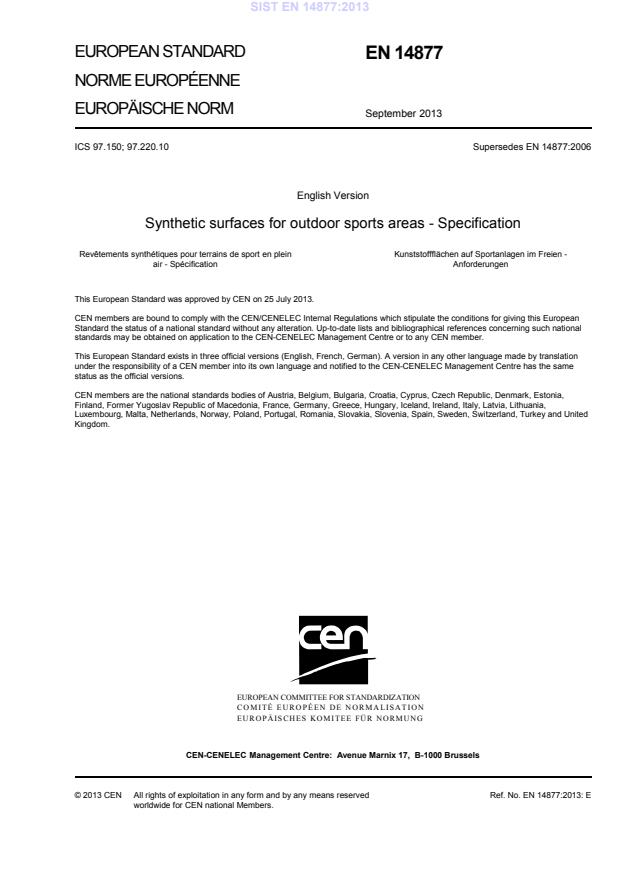
EUROPEAN STANDARD NORME EUROPÉENNE EUROPÄISCHE NORM
EN 14877
September 2013 ICS 97.150; 97.220.10 Supersedes EN 14877:2006English Version
Synthetic surfaces for outdoor sports areas - Specification
Revêtements synthétiques pour terrains de sport en plein air - Spécification
Kunststoffflächen auf Sportanlagen im Freien - Anforderungen This European Standard was approved by CEN on 25 July 2013.
CEN members are bound to comply with the CEN/CENELEC Internal Regulations which stipulate the conditions for giving this European Standard the status of a national standard without any alteration. Up-to-date lists and bibliographical references concerning such national standards may be obtained on application to the CEN-CENELEC Management Centre or to any CEN member.
This European Standard exists in three official versions (English, French, German). A version in any other language made by translation under the responsibility of a CEN member into its own language and notified to the CEN-CENELEC Management Centre has the same status as the official versions.
CEN members are the national standards bodies of Austria, Belgium, Bulgaria, Croatia, Cyprus, Czech Republic, Denmark, Estonia, Finland, Former Yugoslav Republic of Macedonia, France, Germany, Greece, Hungary, Iceland, Ireland, Italy, Latvia, Lithuania, Luxembourg, Malta, Netherlands, Norway, Poland, Portugal, Romania, Slovakia, Slovenia, Spain, Sweden, Switzerland, Turkey and United Kingdom.
EUROPEAN COMMITTEE FOR STANDARDIZATION
COMITÉ EUROPÉEN DE NORMALISATION EUROPÄISCHES KOMITEE FÜR NORMUNG
CEN-CENELEC Management Centre:
Avenue Marnix 17,
B-1000 Brussels © 2013 CEN All rights of exploitation in any form and by any means reserved worldwide for CEN national Members. Ref. No. EN 14877:2013: ESIST EN 14877:2013
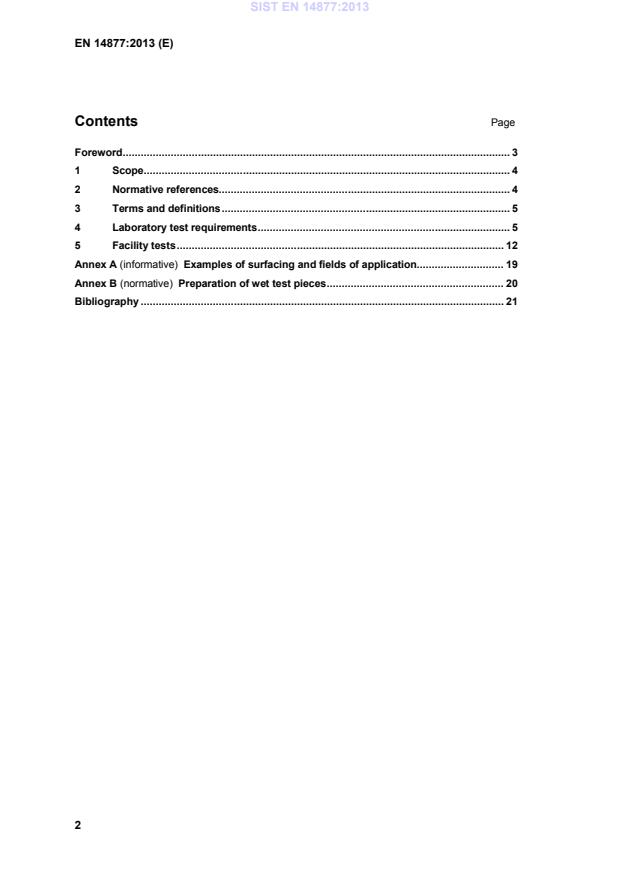
Examples of surfacing and fields of application. 19 Annex B (normative)
Preparation of wet test pieces . 20 Bibliography . 21
Table 1 — Laboratory test requirements for synthetic surfaces intended for athletics facilities
Property Test method Test Condition Requirement 1.1 Sports performance 1.1.1 Friction EN 13036–4 (CEN rubber) (23 ± 2) °C Dry 80 to 110 Wet 55 to 110 1.1.2 Shock Absorption EN 14808 (10 ± 2) °C (23 ± 2) °C (40 ± 2) °C Dry Force Reduction Classification 25 % to 34 % SA 25 to 34 After accelerated ageing by exposure to hot air in accordance with EN 13817, and immediately followed by immersion in hot water in accordance with EN 13744. The Shock Absorption to be measured between 24 h and 36 h following removal at a laboratory temperature of (23 ± 2) °C. 35 % to 50 % SA 35 to 50 The performance of the surface shall be classified by the lowest result obtained under any of the test conditions. 1.1.3 Vertical Deformation EN 14809 (10 ± 2) °C (23 ± 2)°C (40 ± 2) °C Dry ≤ 3 mm 1.2 Material characteristics 1.2.1 Water permeability EN 12616 (23 ± 2) °C — ≥ 150 mm/h 1.2.2 Resistance to wear EN ISO 5470-1 using H18 abrasive wheels and a (1 ± 0,001) kg load at 60 hz/min (23 ± 2) °C Unaged Mass loss between 500 and 1 500 cycles shall be less than 4,0 g. After artificial weathering in accordance with EN 14836.
1.2.3 Colour loss EN ISO 20105-A02 After artificial weathering in accordance with EN 14836.
Colour fastness shall be no less than grey scale 3. SIST EN 14877:2013
Table 2 — Laboratory test requirements for synthetic surfaces intended for tennis facilities
Property Test method Test Condition Requirement 2.1 Sports performance 2.1.1 Friction EN 13036–4 (CEN rubber) (23 ± 2) °C Dry 80 to 110 Wet 55 to 110 2.1.2 Shock Absorption EN 14808 (23 ± 2) °C Dry Force Reduction Classification 11 % to 19 % SA 11 to 19 After accelerated ageing by exposure to hot air in accordance with EN 13817, immediately followed by immersion in hot water in accordance with EN 13744. The Shock Absorption to be measured between 24 h and 36 h following removal at a laboratory temperature of (23 ± 2) °C. 20 % to 30 % SA 20 to 30
> 31 % SA 31+ The performance of the surface shall be classified by the lowest result obtained under any of the test conditions. 2.1.3 Vertical Deformation EN 14809 (23 ± 2) °C Dry ≤ 3 mm 2.1.4 Vertical ball rebound EN 12235 using a tennis ball (23 ± 2) °C Dry ≥ 85 % (≥ 1,19 m) 2.1.5 Angle ball behaviour (surface pace) EN 13865 (23 ± 2) °C Dry Tennis coefficien
...