


EN 15330-1:2013
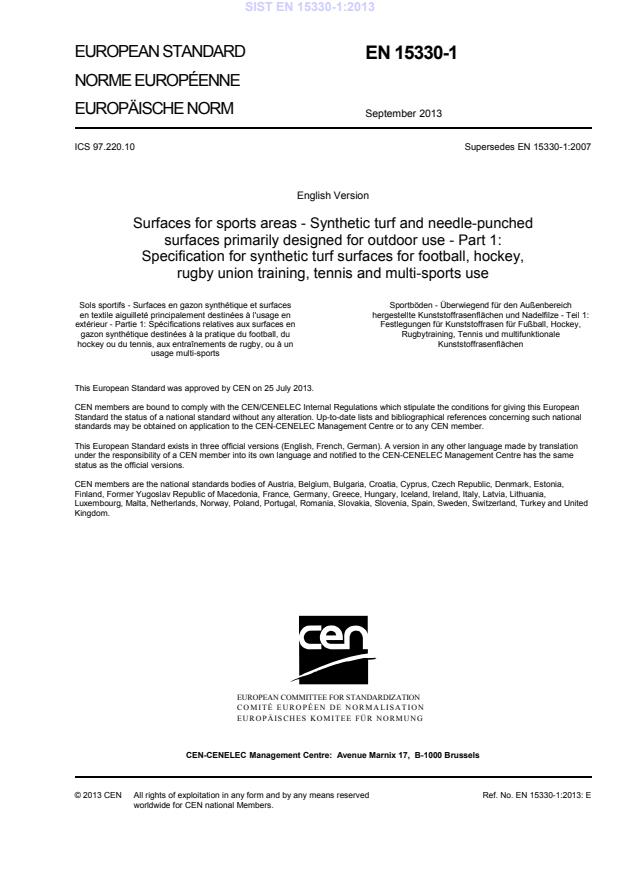
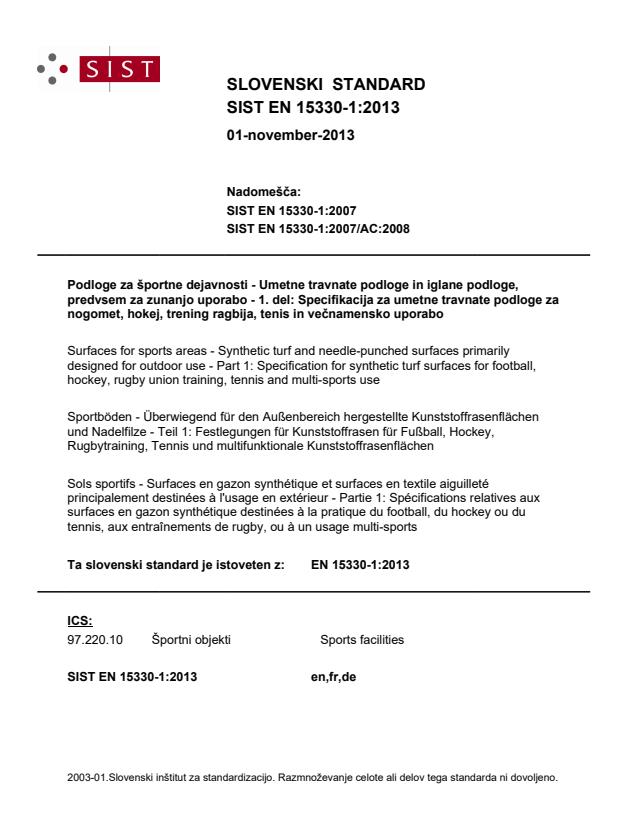
(Main)Surfaces for sports areas - Synthetic turf and needle-punched surfaces primarily designed for outdoor use - Part 1: Specification for synthetic turf surfaces for football, hockey, rugby union training, tennis and multi-sports use
General Information
- Abstract
This European Standard specifies performance, durability, product identification and facility testing requirements for synthetic turf sports surfaces used primarily outdoors. Five categories of surface are covered, each based on the principal sporting use of the surface, as follows:
- surfaces designed primarily for hockey;
- surfaces designed primarily for association football;
- surfaces designed primarily for rugby union for training purposes;
- surfaces designed primarily for tennis;
- surfaces designed for multi-sports use.
The requirements are intended to apply to surfaces used for community, educational and recreational sport. For professional and elite levels of competition, many sports governing bodies have published their own specifications; the requirements of the sports governing bodies might differ from those detailed in this European Standard and facility developers are advised to ensure that they select surfaces offering the correct level of performance for the level of competition played on the pitch or court.
NOTE Under the Laws of the Game of Rugby Union, surfaces for rugby union matches need to comply with the International Rugby Board’s IRB Regulation 22 and associated performance specification for synthetic turf surfaces.
This European Standard has two parts. The first part describes the requirements for product testing of products in the laboratory to ensure they are capable of providing the required levels of sports performance and player/surface interaction required for their intended use and that they are manufactured from materials of acceptable quality. The second section describes the requirements for installed surfaces to ensure that the sports performance and player/surface interaction of a facility is suitable for the intended use.
Some of the surfaces covered by this European Standard are designed to allow users to wear footwear fitted with studs. An example of a typical stud is given in EN 15306. For the purposes of this European Standard, multi-dimpled shoe profiles often found on footwear used on sand-filled or non-filled synthetic turfs are not considered to be studs.
When independent third party testing of synthetic turf sports surfaces is required to assess compliance with this standard, it is recommended the laboratory is certified to EN ISO/IEC 17025 for the relevant test methods specified in this standard.
- Status
- Published
- Publication Date
- 03-Sep-2013
- Withdrawal Date
- 30-Mar-2014
- Technical Committee
- CEN/TC 217 - Surfaces for sport areas
- Drafting Committee
- CEN/TC 217/WG 6 - Synthetic turf areas
- Current Stage
- 6060 - Definitive text made available (DAV) - Publishing
- Start Date
- 04-Sep-2013
- Due Date
- 12-Sep-2013
- Completion Date
- 04-Sep-2013

Overview
EN 15330-1:2013 is a CEN European Standard that specifies performance, durability, product identification and facility testing requirements for synthetic turf sports surfaces designed primarily for outdoor use. Part 1 covers synthetic turf surfaces intended for five principal uses: hockey, association football, rugby union training, tennis, and multi‑sports. The document defines laboratory type‑approval (product testing) and site acceptance testing (installed surface testing) to ensure appropriate sports performance and player/surface interaction for community, educational and recreational facilities.
Key topics and technical requirements
EN 15330-1:2013 focuses on measurable performance and material tests rather than prescribing construction methods. Key technical topics include:
- Laboratory type approval (product testing): material and component tests to verify product capability before installation, including:
- tensile properties of turf carpet and pile yarns
- tuft bind and joint strength
- resistance to artificial weathering and abrasion
- water permeability and shockpad tensile strength
- Sport‑specific performance tests: assessments tailored to each surface category, such as:
- vertical ball rebound and ball roll behaviour
- shock absorption and vertical deformation
- rotational resistance and angled ball behaviour (where relevant)
- resistance to simulated use (wear testing), including provisions for studded footwear on certain systems
- Site tests and acceptance: on‑site verification of installed surfaces to confirm that facility performance meets the intended use and manufacturer claims
- Product identification and test reporting: documentation requirements for traceability and conformity
- Laboratory competence recommendation: when third‑party testing is used, EN ISO/IEC 17025 accreditation is recommended for relevant test methods
Note: For elite/professional competition levels, sports governing bodies may have different or more stringent requirements (for example, rugby match surfaces must comply with IRB Regulation 22).
Practical applications
EN 15330-1:2013 is used to:
- Specify performance requirements in procurement documents for community and school pitches, municipal multi‑sport areas, and recreational facilities
- Guide manufacturers in product development and type approval testing for synthetic turf
- Provide acceptance testing criteria for installers and clients at handover
- Inform maintenance planning by clarifying performance parameters that should be preserved
Keywords: EN 15330-1:2013, synthetic turf standard, sports surfaces testing, performance requirements, turf type approval.
Who uses this standard
- Facility owners and operators (schools, municipalities, clubs)
- Specifiers and procurement teams
- Synthetic turf manufacturers and installers
- Test laboratories (EN ISO/IEC 17025) and quality managers
- Sports facility consultants and civil engineers
Related standards
- EN 15330-2 (needle‑punched surfaces)
- EN 15306 (example stud profile)
- EN ISO/IEC 17025 (laboratory accreditation)
- Referenced test methods: EN 12234 (ball roll), EN 12235 (vertical ball), EN 1177 (impact/critical fall height), EN 13672 (abrasion), EN 12616 (water infiltration) and others listed within EN 15330-1:2013.
Relations
- Effective Date
- 11-Sep-2013
- Effective Date
- 11-Sep-2013
- Effective Date
- 25-Aug-2026
- Effective Date
- 25-Aug-2026
- Effective Date
- 25-Aug-2026
- Effective Date
- 25-Aug-2026
- Effective Date
- 09-Feb-2026
- Effective Date
- 28-Jan-2026
- Effective Date
- 28-Jan-2026
- Effective Date
- 28-Jan-2026
- Effective Date
- 28-Jan-2026
- Refers
EN 1969:2000 - Surfaces for sports areas - Determination of thickness of synthetic sports surfaces - Effective Date
- 28-Jan-2026
- Effective Date
- 28-Jan-2026
- Effective Date
- 28-Jan-2026
- Effective Date
- 28-Jan-2026
Frequently Asked Questions
EN 15330-1:2013 is a standard published by the European Committee for Standardization (CEN). Its full title is "Surfaces for sports areas - Synthetic turf and needle-punched surfaces primarily designed for outdoor use - Part 1: Specification for synthetic turf surfaces for football, hockey, rugby union training, tennis and multi-sports use". This standard covers: This European Standard specifies performance, durability, product identification and facility testing requirements for synthetic turf sports surfaces used primarily outdoors. Five categories of surface are covered, each based on the principal sporting use of the surface, as follows: - surfaces designed primarily for hockey; - surfaces designed primarily for association football; - surfaces designed primarily for rugby union for training purposes; - surfaces designed primarily for tennis; - surfaces designed for multi-sports use. The requirements are intended to apply to surfaces used for community, educational and recreational sport. For professional and elite levels of competition, many sports governing bodies have published their own specifications; the requirements of the sports governing bodies might differ from those detailed in this European Standard and facility developers are advised to ensure that they select surfaces offering the correct level of performance for the level of competition played on the pitch or court. NOTE Under the Laws of the Game of Rugby Union, surfaces for rugby union matches need to comply with the International Rugby Board’s IRB Regulation 22 and associated performance specification for synthetic turf surfaces. This European Standard has two parts. The first part describes the requirements for product testing of products in the laboratory to ensure they are capable of providing the required levels of sports performance and player/surface interaction required for their intended use and that they are manufactured from materials of acceptable quality. The second section describes the requirements for installed surfaces to ensure that the sports performance and player/surface interaction of a facility is suitable for the intended use. Some of the surfaces covered by this European Standard are designed to allow users to wear footwear fitted with studs. An example of a typical stud is given in EN 15306. For the purposes of this European Standard, multi-dimpled shoe profiles often found on footwear used on sand-filled or non-filled synthetic turfs are not considered to be studs. When independent third party testing of synthetic turf sports surfaces is required to assess compliance with this standard, it is recommended the laboratory is certified to EN ISO/IEC 17025 for the relevant test methods specified in this standard.
This European Standard specifies performance, durability, product identification and facility testing requirements for synthetic turf sports surfaces used primarily outdoors. Five categories of surface are covered, each based on the principal sporting use of the surface, as follows: - surfaces designed primarily for hockey; - surfaces designed primarily for association football; - surfaces designed primarily for rugby union for training purposes; - surfaces designed primarily for tennis; - surfaces designed for multi-sports use. The requirements are intended to apply to surfaces used for community, educational and recreational sport. For professional and elite levels of competition, many sports governing bodies have published their own specifications; the requirements of the sports governing bodies might differ from those detailed in this European Standard and facility developers are advised to ensure that they select surfaces offering the correct level of performance for the level of competition played on the pitch or court. NOTE Under the Laws of the Game of Rugby Union, surfaces for rugby union matches need to comply with the International Rugby Board’s IRB Regulation 22 and associated performance specification for synthetic turf surfaces. This European Standard has two parts. The first part describes the requirements for product testing of products in the laboratory to ensure they are capable of providing the required levels of sports performance and player/surface interaction required for their intended use and that they are manufactured from materials of acceptable quality. The second section describes the requirements for installed surfaces to ensure that the sports performance and player/surface interaction of a facility is suitable for the intended use. Some of the surfaces covered by this European Standard are designed to allow users to wear footwear fitted with studs. An example of a typical stud is given in EN 15306. For the purposes of this European Standard, multi-dimpled shoe profiles often found on footwear used on sand-filled or non-filled synthetic turfs are not considered to be studs. When independent third party testing of synthetic turf sports surfaces is required to assess compliance with this standard, it is recommended the laboratory is certified to EN ISO/IEC 17025 for the relevant test methods specified in this standard.
EN 15330-1:2013 is classified under the following ICS (International Classification for Standards) categories: 97.220.10 - Sports facilities. The ICS classification helps identify the subject area and facilitates finding related standards.
EN 15330-1:2013 has the following relationships with other standards: It is inter standard links to EN 15330-1:2007, EN 15330-1:2007/AC:2007, ISO 1763:1986, ISO 8543:1998, ISO 11357-3:2011, ISO 2549:1972, ISO 4919:2012, EN ISO 13934-1:2013, EN 14809:2005, EN 1097-3:1998, EN 13865:2017, EN 1969:2000, EN 13180:2001, EN 15301-1:2007, EN 13672:2004. Understanding these relationships helps ensure you are using the most current and applicable version of the standard.
EN 15330-1:2013 is available in PDF format for immediate download after purchase. The document can be added to your cart and obtained through the secure checkout process. Digital delivery ensures instant access to the complete standard document.
Standards Content (Sample)
2003-01.Slovenski inštitut za standardizacijo. Razmnoževanje celote ali delov tega standarda ni dovoljeno.Sportböden - Überwiegend für den Außenbereich hergestellte Kunststoffrasenflächen und Nadelfilze - Teil 1: Festlegungen für Kunststoffrasen für Fußball, Hockey, Rugbytraining, Tennis und multifunktionale KunststoffrasenflächenSols sportifs - Surfaces en gazon synthétique et surfaces en textile aiguilleté principalement destinées à l'usage en extérieur - Partie 1: Spécifications relatives aux surfaces en gazon synthétique destinées à la pratique du football, du hockey ou du tennis, aux entraînements de rugby, ou à un usage multi-sportsSurfaces for sports areas - Synthetic turf and needle-punched surfaces primarily designed for outdoor use - Part 1: Specification for synthetic turf surfaces for football, hockey, rugby union training, tennis and multi-sports use97.220.10Športni objektiSports facilitiesICS:Ta slovenski standard je istoveten z:EN 15330-1:2013SIST EN 15330-1:2013en,fr,de01-november-2013SIST EN 15330-1:2013SLOVENSKI
STANDARDSIST EN 15330-1:2007/AC:2008SIST EN 15330-1:20071DGRPHãþD
EUROPEAN STANDARD NORME EUROPÉENNE EUROPÄISCHE NORM
EN 15330-1
September 2013 ICS 97.220.10 Supersedes EN 15330-1:2007English Version
Surfaces for sports areas - Synthetic turf and needle-punched surfaces primarily designed for outdoor use - Part 1: Specification for synthetic turf surfaces for football, hockey, rugby union training, tennis and multi-sports use
Sols sportifs - Surfaces en gazon synthétique et surfaces en textile aiguilleté principalement destinées à l'usage en extérieur - Partie 1: Spécifications relatives aux surfaces en gazon synthétique destinées à la pratique du football, du hockey ou du tennis, aux entraînements de rugby, ou à un usage multi-sports
Sportböden - Überwiegend für den Außenbereich hergestellte Kunststoffrasenflächen und Nadelfilze - Teil 1: Festlegungen für Kunststoffrasen für Fußball, Hockey, Rugbytraining, Tennis und multifunktionale Kunststoffrasenflächen This European Standard was approved by CEN on 25 July 2013.
CEN members are bound to comply with the CEN/CENELEC Internal Regulations which stipulate the conditions for giving this European Standard the status of a national standard without any alteration. Up-to-date lists and bibliographical references concerning such national standards may be obtained on application to the CEN-CENELEC Management Centre or to any CEN member.
This European Standard exists in three official versions (English, French, German). A version in any other language made by translation under the responsibility of a CEN member into its own language and notified to the CEN-CENELEC Management Centre has the same status as the official versions.
CEN members are the national standards bodies of Austria, Belgium, Bulgaria, Croatia, Cyprus, Czech Republic, Denmark, Estonia, Finland, Former Yugoslav Republic of Macedonia, France, Germany, Greece, Hungary, Iceland, Ireland, Italy, Latvia, Lithuania, Luxembourg, Malta, Netherlands, Norway, Poland, Portugal, Romania, Slovakia, Slovenia, Spain, Sweden, Switzerland, Turkey and United Kingdom.
EUROPEAN COMMITTEE FOR STANDARDIZATION
COMITÉ EUROPÉEN DE NORMALISATION EUROPÄISCHES KOMITEE FÜR NORMUNG
CEN-CENELEC Management Centre:
Avenue Marnix 17,
B-1000 Brussels © 2013 CEN All rights of exploitation in any form and by any means reserved worldwide for CEN national Members. Ref. No. EN 15330-1:2013: ESIST EN 15330-1:2013
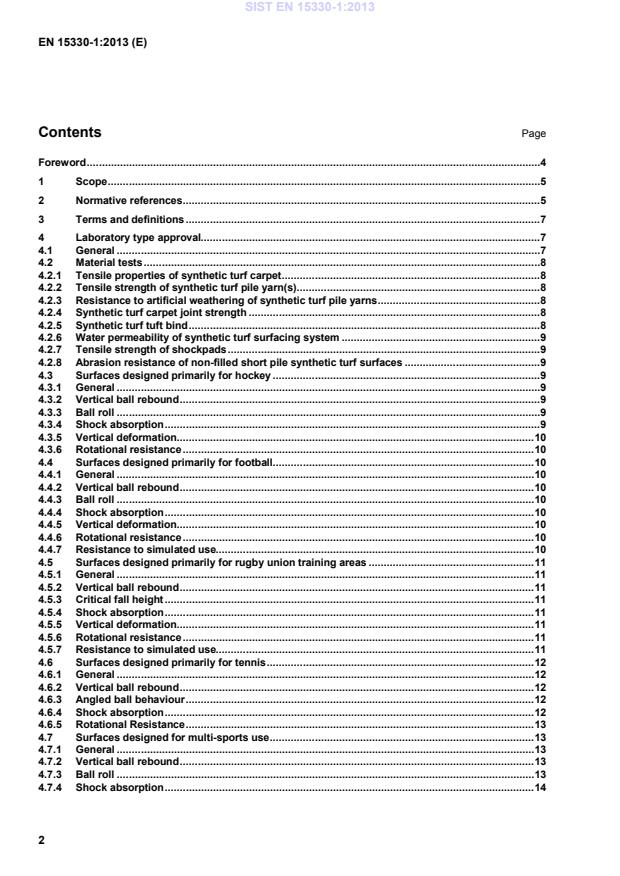
Selection of the appropriate types of synthetic grass for various sports applications . 27 Annex B (normative)
Preparation of wet test pieces . 32 Annex C (informative)
Information to be supplied by the manufacturer or supplier regarding maintenance . 33 Bibliography . 34
...