


CEN/TS 17471:2024
(Main)Cranes - Loader cranes - Interface between loader cranes and work platforms
General Information
- Abstract
This document specifies technical requirements for the interface of the basic machinery within the scope of EN 12999 equipped to allow the use of an assigned type of work platform as interchangeable equipment where the combination of the basic machinery and the work platform as interchangeable equipment is within the scope of EN 280-1.
The basic machinery covered by this document is designed to be installed on a road vehicle with load carrying capability. The combination of the basic machinery and the work platform as interchangeable equipment covered by this document belongs to Group B Type 1 class as in the scope of EN 280-1.
The basic machinery covered by this document allows two modes of operation:
- the “CRANE” mode of operation, for the use of the basic machinery as a loader crane within the scope of EN 12999;
- the “MEWP” mode of operation, for the use of the work platform with the basic machinery as within the scope of EN 280-1.
This document covers hazards related to switching between “CRANE” and “MEWP” mode as described above and covers the specific hazards related with the combination and the assembly of the work platform as interchangeable equipment with the basic machinery (see Annex A).
This document does not address hazards which may occur:
a) when using work platform not assembled with the lifting machinery but simply lifted by the machinery (e.g. suspended from the hook of the crane);
b) when using attachments not intended for the lifting of persons.
- Status
- Published
- Publication Date
- 12-Mar-2024
- Technical Committee
- CEN/TC 147 - Cranes - Safety
- Drafting Committee
- CEN/TC 147/WG 18 - Loader cranes
- Current Stage
- 6060 - Definitive text made available (DAV) - Publishing
- Start Date
- 13-Mar-2024
- Due Date
- 24-Aug-2024
- Completion Date
- 13-Mar-2024

Overview
CEN/TS 17471:2024 is a technical specification published by the European Committee for Standardization (CEN) that sets out technical requirements for the interface between loader cranes and work platforms. It specifically addresses the integration of basic machinery compliant with EN 12999 (loader cranes) equipped to use assigned types of work platforms classified under EN 280-1. This document is essential for machinery installed on road vehicles with load-carrying capabilities and enables dual operation modes:
- CRANE mode, where the machinery operates as a loader crane following EN 12999 standards.
- MEWP mode, where the machinery operates as a Mobile Elevating Work Platform as per EN 280-1 standards.
The focus of CEN/TS 17471:2024 includes the hazard assessment and safety protocols related to switching between these two operating modes, as well as the specific risks concerning the physical combination and assembly of work platforms as interchangeable equipment on the loader cranes.
Key Topics
Mode of Operation
- A secure mode selector is mandatory to switch between “CRANE” and “MEWP” modes.
- Each mode requires compliance with its respective standards (EN 12999 for CRANE and EN 280-1 for MEWP).
- Safety features must prevent unintended operation of the boom, stabilizers, and levelling systems depending on mode and connection status.
Engagement and Locking Systems
- The work platform must be securely attached, locked, and interlocked with robust mechanical and electrical controls.
- Safety control systems must comply with EN ISO 13849-1:2023 and guarantee fail-safe mechanisms to prevent unsafe states if faults occur.
- The design must avoid uncontrolled movements and prevent accidental unlocking or dismounting.
Hydraulic and Electrical Connections
- Hydraulic hoses and electrical cables connecting the platform to the loader crane must be designed to avoid incorrect or hazardous connections.
- Safe storage solutions are required for cables and hoses when the platform is not in use.
Transport Configuration
- Visual and audible warning devices must signal any non-compliance in the transport setup to ensure operator awareness.
- Systems must allow warnings to be acknowledged or silenced safely, such as when the vehicle parking brake is applied.
Instructions and Maintenance
- Detailed instructions for use must specify correct handling, connection, and disconnection procedures for the work platform.
- Maintenance guidance must include inspection intervals, especially for critical areas prone to fatigue, with emphasis on safe upkeep of the combined machinery and platform system.
Hazard Identification
- The specification provides a comprehensive list of hazards associated with mode switching and equipment combination, including ergonomic risks, potential human errors, unexpected equipment startup, assembly errors, and missing safety devices.
Practical Applications
- Loader Crane Manufacturers: Design safer and compliant machinery that supports interchangeable work platforms while mitigating safety risks.
- Work Platform Producers: Ensure platforms are compatible with loader cranes per outlined safety requirements and interface specifications.
- Vehicle Equipment Installers: Implement compliant integration of cranes and work platforms on road vehicles, maximizing operational versatility and safety.
- Safety Regulators and Inspectors: Evaluate equipment according to harmonized European standards to enforce workplace safety and machinery compliance.
- Operators and Maintenance Personnel: Follow clear instructions to safely switch modes, connect/disconnect platforms, and conduct maintenance, reducing accidents and equipment damage.
Related Standards
- EN 12999:2020 – Cranes: Loader cranes – general design and safety requirements for loader crane machinery.
- EN 280-1:2022 – Mobile Elevating Work Platforms (MEWPs): Design calculations, stability criteria, safety, and testing protocols for work platforms.
- EN ISO 12100:2010 – Safety of machinery – General design principles for risk assessment and reduction.
- EN ISO 13849-1:2023 – Safety-related parts of control systems – Design principles ensuring reliability of safety functions.
- EN ISO 4413:2010 – Hydraulic fluid power systems – Safety requirements for hydraulic components, crucial for loader cranes and platforms.
By adhering to CEN/TS 17471:2024, industry stakeholders can guarantee a safe and reliable interface between loader cranes and work platforms, facilitating safer multi-mode operations on road vehicles and helping prevent accidents caused by improper combined machinery use. This standard is a critical resource supporting the harmonization of safety practices across Europe’s loader crane and mobile elevating work platform sectors.
Relations
- Effective Date
- 28-Jan-2026
- Effective Date
- 28-Jan-2026
- Effective Date
- 28-Jan-2026
- Effective Date
- 28-Jan-2026
- Effective Date
- 28-Jan-2026
Frequently Asked Questions
CEN/TS 17471:2024 is a technical specification published by the European Committee for Standardization (CEN). Its full title is "Cranes - Loader cranes - Interface between loader cranes and work platforms". This standard covers: This document specifies technical requirements for the interface of the basic machinery within the scope of EN 12999 equipped to allow the use of an assigned type of work platform as interchangeable equipment where the combination of the basic machinery and the work platform as interchangeable equipment is within the scope of EN 280-1. The basic machinery covered by this document is designed to be installed on a road vehicle with load carrying capability. The combination of the basic machinery and the work platform as interchangeable equipment covered by this document belongs to Group B Type 1 class as in the scope of EN 280-1. The basic machinery covered by this document allows two modes of operation: - the “CRANE” mode of operation, for the use of the basic machinery as a loader crane within the scope of EN 12999; - the “MEWP” mode of operation, for the use of the work platform with the basic machinery as within the scope of EN 280-1. This document covers hazards related to switching between “CRANE” and “MEWP” mode as described above and covers the specific hazards related with the combination and the assembly of the work platform as interchangeable equipment with the basic machinery (see Annex A). This document does not address hazards which may occur: a) when using work platform not assembled with the lifting machinery but simply lifted by the machinery (e.g. suspended from the hook of the crane); b) when using attachments not intended for the lifting of persons.
This document specifies technical requirements for the interface of the basic machinery within the scope of EN 12999 equipped to allow the use of an assigned type of work platform as interchangeable equipment where the combination of the basic machinery and the work platform as interchangeable equipment is within the scope of EN 280-1. The basic machinery covered by this document is designed to be installed on a road vehicle with load carrying capability. The combination of the basic machinery and the work platform as interchangeable equipment covered by this document belongs to Group B Type 1 class as in the scope of EN 280-1. The basic machinery covered by this document allows two modes of operation: - the “CRANE” mode of operation, for the use of the basic machinery as a loader crane within the scope of EN 12999; - the “MEWP” mode of operation, for the use of the work platform with the basic machinery as within the scope of EN 280-1. This document covers hazards related to switching between “CRANE” and “MEWP” mode as described above and covers the specific hazards related with the combination and the assembly of the work platform as interchangeable equipment with the basic machinery (see Annex A). This document does not address hazards which may occur: a) when using work platform not assembled with the lifting machinery but simply lifted by the machinery (e.g. suspended from the hook of the crane); b) when using attachments not intended for the lifting of persons.
CEN/TS 17471:2024 is classified under the following ICS (International Classification for Standards) categories: 53.020.20 - Cranes. The ICS classification helps identify the subject area and facilitates finding related standards.
CEN/TS 17471:2024 has the following relationships with other standards: It is inter standard links to EN ISO 13849-1:2023, EN 280-1:2022, EN 12999:2020, EN ISO 12100:2010, EN ISO 4413:2010. Understanding these relationships helps ensure you are using the most current and applicable version of the standard.
CEN/TS 17471:2024 is available in PDF format for immediate download after purchase. The document can be added to your cart and obtained through the secure checkout process. Digital delivery ensures instant access to the complete standard document.
Standards Content (Sample)
SLOVENSKI STANDARD
01-julij-2024
Žerjavi - Nakladalni žerjavi - Vmesnik med nakladalnimi žerjavi in delovnimi
ploščadmi
Cranes - Loader cranes - Interface between loader cranes and work platforms
Krane - Ladekrane - schnittstelle zwischen Ladekranen und Arbeitsbühnen
Appareils de levage à charge suspendue- Grues de chargement - Interface entre les
grues de chargement et les plates-formes élévatrices de personnel
Ta slovenski standard je istoveten z: CEN/TS 17471:2024
ICS:
53.020.20 Dvigala Cranes
2003-01.Slovenski inštitut za standardizacijo. Razmnoževanje celote ali delov tega standarda ni dovoljeno.
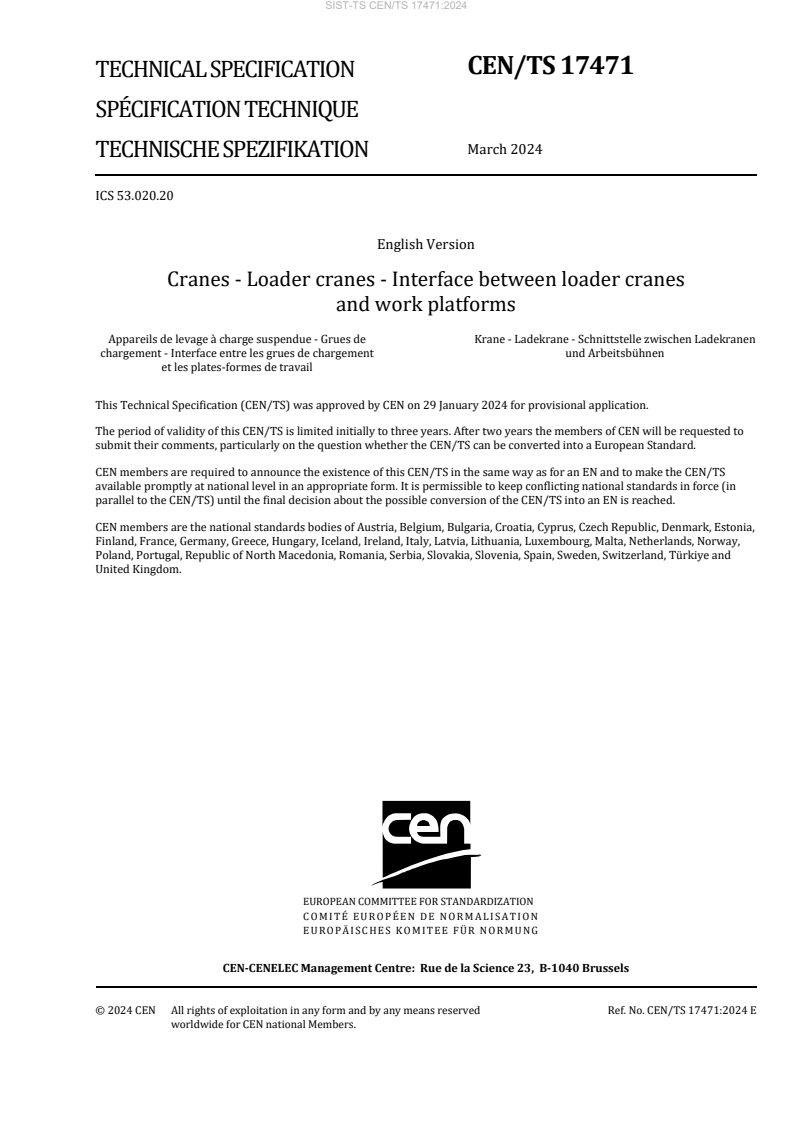
CEN/TS 17471
TECHNICAL SPECIFICATION
SPÉCIFICATION TECHNIQUE
March 2024
TECHNISCHE SPEZIFIKATION
ICS 53.020.20
English Version
Cranes - Loader cranes - Interface between loader cranes
and work platforms
Appareils de levage à charge suspendue - Grues de Krane - Ladekrane - Schnittstelle zwischen Ladekranen
chargement - Interface entre les grues de chargement und Arbeitsbühnen
et les plates-formes de travail
This Technical Specification (CEN/TS) was approved by CEN on 29 January 2024 for provisional application.
The period of validity of this CEN/TS is limited initially to three years. After two years the members of CEN will be requested to
submit their comments, particularly on the question whether the CEN/TS can be converted into a European Standard.
CEN members are required to announce the existence of this CEN/TS in the same way as for an EN and to make the CEN/TS
available promptly at national level in an appropriate form. It is permissible to keep conflicting national standards in force (in
parallel to the CEN/TS) until the final decision about the possible conversion of the CEN/TS into an EN is reached.
CEN members are the national standards bodies of Austria, Belgium, Bulgaria, Croatia, Cyprus, Czech Republic, Denmark, Estonia,
Finland, France, Germany, Greece, Hungary, Iceland, Ireland, Italy, Latvia, Lithuania, Luxembourg, Malta, Netherlands, Norway,
Poland, Portugal, Republic of North Macedonia, Romania, Serbia, Slovakia, Slovenia, Spain, Sweden, Switzerland, Türkiye and
United Kingdom.
EUROPEAN COMMITTEE FOR STANDARDIZATION
COMITÉ EUROPÉEN DE NORMALISATION
EUROPÄISCHES KOMITEE FÜR NORMUNG
CEN-CENELEC Management Centre: Rue de la Science 23, B-1040 Brussels
© 2024 CEN All rights of exploitation in any form and by any means reserved Ref. No. CEN/TS 17471:2024 E
worldwide for CEN national Members.
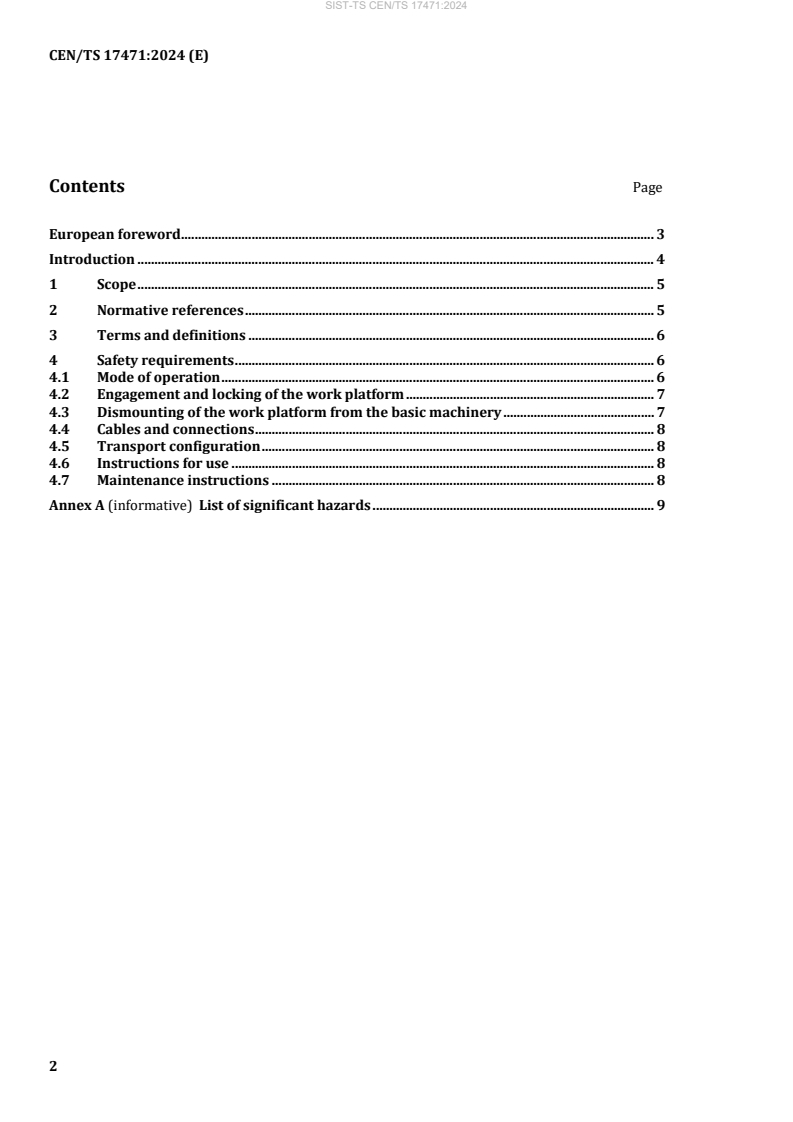
Contents Page
European foreword . 3
Introduction . 4
1 Scope . 5
2 Normative references . 5
3 Terms and definitions . 6
4 Safety requirements . 6
4.1 Mode of operation . 6
4.2 Engagement and locking of the work platform . 7
4.3 Dismounting of the work platform from the basic machinery . 7
4.4 Cables and connections . 8
4.5 Transport configuration . 8
4.6 Instructions for use . 8
4.7 Maintenance instructions . 8
Annex A (informative) List of significant hazards . 9
European foreword
This document (CEN/TS 17471:2024) has been prepared by Technical Committee CEN/TC 147, “Cranes
- Safety”, the secretariat of which is held by DIN.
Attention is drawn to the possibility that some of the elements of this document may be the subject of
patent rights. CEN shall not be held responsible for identifying any or all such patent rights.
Any feedback and questions on this document should be directed to the users’ national standards body.
A complete listing of these bodies can be found on the CEN website.
According to the CEN/CENELEC Internal Regulations, the national standards organisations of the
following countries are bound to announce this Technical Specification: Austria, Belgium, Bulgaria,
Croatia, Cyprus, Czech Republic, Denmark, Estonia, Finland, France, Germany, Greece, Hungary, Iceland,
Ireland, Italy, Latvia, Lithuania, Luxembourg, Malta, Netherlands, Norway, Poland, Portugal, Republic of
North Macedonia, Romania, Serbia, Slovakia, Slovenia, Spain, Sweden, Switzerland, Türkiye and the
United Kingdom.
Introduction
Machinery within the scope of EN 12999:2020 can be equipped with a work platform as interchangeable
equipment. Machinery designed for handling of goods which is equipped with a work platform as
interchangeable equipment is within the scope of EN 280-1:2022.
However, EN 280-1:2022 does not cover hazards arising from machineries allowing several uses, nor
does it cover the specific hazards related to the combination of a work platform as interchangeable
equipment with a basic machinery within the scope of EN 12999:2020.
The machinery concerned and the extent to which hazards are covered by this document are indicated in
the scope of this document.
This document is of particular relevance for the following stakeholder groups:
— machine manufacturers (small, medium and large enterprises);
— health and safety bodies (regulators, accident prevention organizations, market surveillance, etc.).
1 Scope
This document specifies technical requirements for the interface of the basic machinery within the scope
of EN 12999 equipped to allow the use of an assigned type of work platform as interchangeable
equipment where the combination of the basic machinery and the work platform as interchangeable
equipment is within the scope of EN 280-1.
The basic machinery covered by this document is designed to be installed on a road vehicle with load
carrying capability. The combination of the basic machinery and the work platform as interchangeable
equipment covered by this document belongs to Group B Type 1 class as in the scope of EN 280-1.
The basic machinery covered by this document allows two modes of operation:
— the “CRANE” mode of operation, for the use of the basic machinery as a loader crane within the scope
of EN 12999;
— the “MEWP” mode of operation, for the use of the work platform with the basic machinery as within
the scope of EN 280-1.
This document covers hazards related to switching between “CRANE” and “MEWP” mode as described
above and covers the specific hazards related with the combination and the assembly of the work
platform as interchangeable equipment with the basic machinery (see Annex A).
This document does not address hazards which may occur:
a) when using work platform not assembled with the lifting machinery but simply lifted by the
machinery (e.g. suspended from the hook of the crane);
b) when using attachments not intended for the lifting of persons.
2 Normative references
The following docu
...