


EN 1300:2004+A1:2011
(Main + Amendment)Secure storage units - Classification for high security locks according to their resistance to unauthorized opening
General Information
- Abstract
This European Standard specifies requirements for high security locks (HSL) for reliability, resistance to burglary and unauthorized opening with methods of testing. It also provides a scheme for classifying HSL in accordance with their assessed resistance to burglary and unauthorised opening.
It applies to mechanical and electronic HSL. The following features may be included as optional subjects but they are not mandatory:
1) recognised code for preventing code altering and/or enabling/disabling parallel codes;
2) recognised code for disabling time set up;
3) integration of alarm components or functions;
4) remote control duties;
5) resistance to attacks with acids;
6) resistance to X-rays;
7) resistance to explosives;
8) time functions.
- Status
- Withdrawn
- Publication Date
- 21-Jun-2011
- Withdrawal Date
- 12-Nov-2013
- Technical Committee
- CEN/TC 263 - Secure storage of cash, valuables and data media
- Drafting Committee
- CEN/TC 263/WG 3 - Safe locks
- Current Stage
- 9960 - Withdrawal effective - Withdrawal
- Start Date
- 13-Nov-2013
- Completion Date
- 13-Nov-2013



Relations
- Effective Date
- 18-Jan-2023
- Effective Date
- 20-Nov-2013
- Effective Date
- 09-Feb-2026
- Effective Date
- 09-Feb-2026
- Effective Date
- 09-Feb-2026
- Effective Date
- 09-Feb-2026
- Effective Date
- 09-Feb-2026
- Effective Date
- 09-Feb-2026
- Effective Date
- 09-Feb-2026
- Effective Date
- 09-Feb-2026
- Effective Date
- 09-Feb-2026
- Effective Date
- 09-Feb-2026
- Effective Date
- 09-Feb-2026
- Effective Date
- 28-Jan-2026
Get Certified
Connect with accredited certification bodies for this standard

CIS Institut d.o.o.
Personal Protective Equipment (PPE) certification body. Notified Body NB-2890 for EU Regulation 2016/425 PPE.

Kiwa BDA Testing
Building and construction product certification.
Kmetijski inštitut Slovenije
Agricultural Institute of Slovenia. Soil testing, plant health, agricultural product analysis.
Sponsored listings
Frequently Asked Questions
EN 1300:2004+A1:2011 is a standard published by the European Committee for Standardization (CEN). Its full title is "Secure storage units - Classification for high security locks according to their resistance to unauthorized opening". This standard covers: This European Standard specifies requirements for high security locks (HSL) for reliability, resistance to burglary and unauthorized opening with methods of testing. It also provides a scheme for classifying HSL in accordance with their assessed resistance to burglary and unauthorised opening. It applies to mechanical and electronic HSL. The following features may be included as optional subjects but they are not mandatory: 1) recognised code for preventing code altering and/or enabling/disabling parallel codes; 2) recognised code for disabling time set up; 3) integration of alarm components or functions; 4) remote control duties; 5) resistance to attacks with acids; 6) resistance to X-rays; 7) resistance to explosives; 8) time functions.
This European Standard specifies requirements for high security locks (HSL) for reliability, resistance to burglary and unauthorized opening with methods of testing. It also provides a scheme for classifying HSL in accordance with their assessed resistance to burglary and unauthorised opening. It applies to mechanical and electronic HSL. The following features may be included as optional subjects but they are not mandatory: 1) recognised code for preventing code altering and/or enabling/disabling parallel codes; 2) recognised code for disabling time set up; 3) integration of alarm components or functions; 4) remote control duties; 5) resistance to attacks with acids; 6) resistance to X-rays; 7) resistance to explosives; 8) time functions.
EN 1300:2004+A1:2011 is classified under the following ICS (International Classification for Standards) categories: 13.310 - Protection against crime. The ICS classification helps identify the subject area and facilitates finding related standards.
EN 1300:2004+A1:2011 has the following relationships with other standards: It is inter standard links to EN 1300:2004, EN 1300:2013, EN 60068-2-2:2007, EN IEC 61000-4-2:2025, EN 60068-2-6:2008, EN 60068-2-1:2007, EN 50130-4:1995, ISO 8986-1:1993, EN 61000-4-6:2009, EN 61000-4-5:2006, EN 61000-4-4:2004, EN IEC 60068-2-17:2023, EN 61000-4-11:2004, EN ISO 22479:2022. Understanding these relationships helps ensure you are using the most current and applicable version of the standard.
EN 1300:2004+A1:2011 is available in PDF format for immediate download after purchase. The document can be added to your cart and obtained through the secure checkout process. Digital delivery ensures instant access to the complete standard document.
Standards Content (Sample)
2003-01.Slovenski inštitut za standardizacijo. Razmnoževanje celote ali delov tega standarda ni dovoljeno.Wertbehältnisse - Klassifizierung von Hochsicherheitsschlössern nach ihrem Widerstandswert gegen unbefugtes ÖffnenUnités de stockage en lieux sûrs - Classification des serrures haute sécurité en fonction de leur résistance à l'éffractionSecure storage units - Classification for high security locks according to their resistance to unauthorized opening35.220.99Druge naprave za shranjevanje podatkovOther data storage devices13.310Varstvo pred kriminalomProtection against crimeICS:Ta slovenski standard je istoveten z:EN 1300:2004+A1:2011SIST EN 1300:2004+A1:2011en,fr,de01-oktober-2011SIST EN 1300:2004+A1:2011SLOVENSKI
STANDARD
EUROPEAN STANDARD NORME EUROPÉENNE EUROPÄISCHE NORM
EN 1300:2004+A1
June 2011 ICS 13.310 Supersedes EN 1300:2004English Version
Secure storage units - Classification for high security locks according to their resistance to unauthorized opening
Unités de stockage en lieux sûrs - Classification des serrures haute sécurité en fonction de leur résistance à l'éffraction
Wertbehältnisse - Klassifizierung von Hochsicherheitsschlössern nach ihrem Widerstandswert gegen unbefugtes Öffnen This European Standard was approved by CEN on 24 March 2004 and includes Amendment 1 approved by CEN on 14 April 2011.
CEN members are bound to comply with the CEN/CENELEC Internal Regulations which stipulate the conditions for giving this European Standard the status of a national standard without any alteration. Up-to-date lists and bibliographical references concerning such national standards may be obtained on application to the CEN-CENELEC Management Centre or to any CEN member.
This European Standard exists in three official versions (English, French, German). A version in any other language made by translation under the responsibility of a CEN member into its own language and notified to the CEN-CENELEC Management Centre has the same status as the official versions.
CEN members are the national standards bodies of Austria, Belgium, Bulgaria, Croatia, Cyprus, Czech Republic, Denmark, Estonia, Finland, France, Germany, Greece, Hungary, Iceland, Ireland, Italy, Latvia, Lithuania, Luxembourg, Malta, Netherlands, Norway, Poland, Portugal, Romania, Slovakia, Slovenia, Spain, Sweden, Switzerland and United Kingdom.
EUROPEAN COMMITTEE FOR STANDARDIZATION
COMITÉ EUROPÉEN DE NORMALISATION EUROPÄISCHES KOMITEE FÜR NORMUNG
Management Centre:
Avenue Marnix 17,
B-1000 Brussels © 2011 CEN All rights of exploitation in any form and by any means reserved worldwide for CEN national Members. Ref. No. EN 1300:2004+A1:2011: ESIST EN 1300:2004+A1:2011
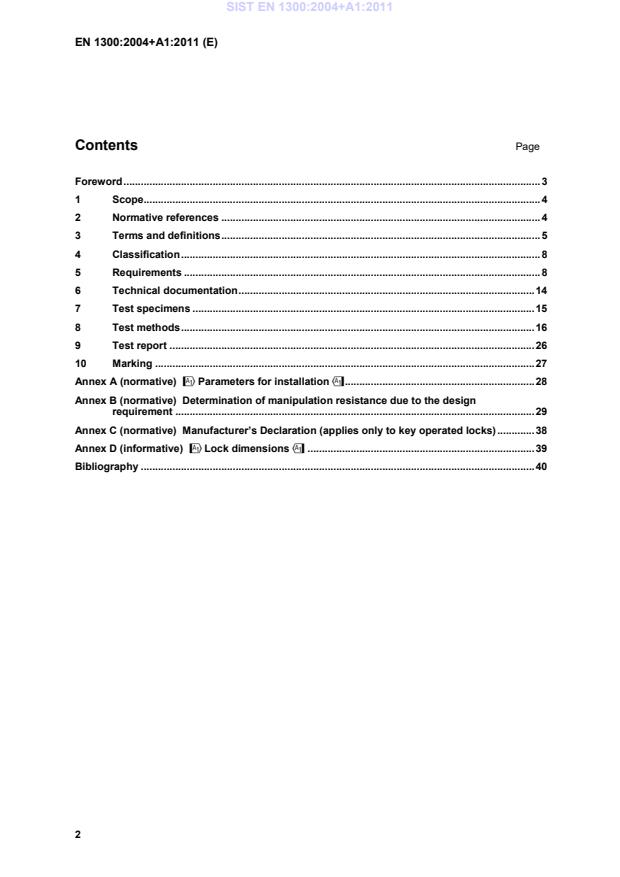
!Parameters for installation". 28 Annex B (normative)
Determination of manipulation resistance due to the design requirement . 29 Annex C (normative)
Manufacturer’s aeclaration (applies only to key operated locks) . 38 Annex D (informative)
!Lock dimensions" . 39 Bibliography . 40
Part 1: Data cabinets EN 1047-2, Secure storage units — Classification and methods of test for resistance to fire —
Part 2: Data rooms and data containers EN 1143-1, Secure storage units — Requirements, classification and methods of test for resistance to burglary — Part 1: Safes, strongroom doors and strongrooms EN 1143-2, Secure storage units — Requirements, classification and methods of test for resistance to burglary — Part 2: Deposit systems According to the CEN/CENELEC Internal Regulations, the national standards organizations of the following countries are bound to implement this European Standard: Austria, Belgium, Bulgaria, Croatia, Cyprus, Czech Republic, Denmark, Estonia, Finland, France, Germany, Greece, Hungary, Iceland, Ireland, Italy, Latvia, Lithuania, Luxembourg, Malta, Netherlands, Norway, Poland, Portugal, Romania, Slovakia, Slovenia, Spain, Sweden, Switzerland and United Kingdom.
(IEC 60068-2-1:2007)" !EN 60068-2-2:2007, Environmental testing — Part 2-2: Tests — Tests B: Dry heat
(IEC 60068-2-2:2007)" !EN 60068-2-6, Environmental testing — Part 2-6: Tests — Tests Fc: Vibration (sinusoidal)
(IEC 60068-2-6:2007)" !EN 60068-2-17, Basic environmental testing procedures — Part 2: Tests — Test Q: Sealing
(IEC 60068-2-17:1994)" !EN 61000-4-2, Electromagnetic compatibility (EMC) — Part 4: Testing and measurement techniques — Part 4-2: Electrostatic discharge immunity test (IEC 61000-4-2:2008)" !EN 61000-4-3:2006, Electromagnetic compatibility (EMC) — Part 4-3: Testing and measurement techniques — Radiated, radio-frequency, electromagnetic field immunity test
(IEC 61000-4-3:2006)" SIST EN 1300:2004+A1:2011
operating 3.25 operating condition after testing, the HSL specimen is in the secured HSL condition and can be unlocked with the opening code(s), but not all design functions are operable SIST EN 1300:2004+A1:2011
Burglary resistance which results from one minute’s use of a tool carrying the coefficient of 1 and the basic value: 0 3.28 penalty time time delay because of time exceeding the limit of trials 4 Classification HSL are classified to an HSL class (A, B, C or D) according to Tables 1, 2 and 3 by their security requirements.
General requirements (see 5.1 and 5.2, 5.3) security and reliability requirements shall be met. NOTE HSL class A has the lowest requirements and HSL class D has the highest requirements. 5 Requirements 5.1 General requirements 5.1.1 Requirements for all Classes 5.1.1.1 By evaluation according to 8.1.2, the opening code(s) shall be retained as the only valid opening code(s) until deliberately reset. !Overlaying or undocumented code(s) are not permitted." 5.1.1.2 Where mnemonic codes are used with a HSL these must be able to be changed. 5.1.1.3 By evaluation according to 8.1.2, any supplementary device (e.g. micro switch) which is fitted by the HSL manufacturer shall not be capable of being used to obtain information about the code. 5.1.1.4 An input unit is a necessary part of a HSL although one input unit may operate more than one HSL (processing unit). Each HSL shall have a processing unit to accept the correct code from the input unit. Each HSL shall also incorporate a blocking feature or be capable of causing movement of a blocking feature. If this feature has to be activated before first use a note to this effect is to be included in the instructions for the use of the lock. 5.1.1.5 If the blocking feature is not moved manually there shall be a means of indicating whether the HSL has been secured, locked and scrambled. 5.1.1.6 By evaluation according to 8.1.2 an opening code shall not be capable of being altered or being changed other than by a recognised code. 5.1.2 Class D HSL 5.1.2.1 Means shall be provided by which the locking status, locked or unlocked, is made obvious. SIST EN 1300:2004+A1:2011
the minimum number of usable codes shall be multiplied by the number of possible parallel codes. HSL with variable opening code lengths:
the smallest number of used figures which the HSL is able to accept for opening code input shall be used for the calculation of usable codes. It shall not be possible to open mechanical key operated HSL with additional keys when tested in accordance with 8.2.1.3. 5.2.2 HSL having over ride feature HSL with an over ride feature (e.g. an electronic HSL having a mechanical override) shall be classified by the least secure system used. 5.2.3 Manipulation resistance 5.2.3.1 Limit of trials The maximum number of trials per hour which can be made shall be as shown in Table 1. NOTE Mechanical token HSL are not included in Table 1 because the time taken for changing tokens sufficiently limits the rate of trials. 5.2.3.2 Manipulation The minimum resistance values, M, given in Table 1 shall be exceeded by at least two of the three test specimens in the tests for manipulation resistance made according to 8.2.2. 5.2.4 Destructive burglary resistance The minimum resistance values given in Table 1 shall be exceeded in tests in which an external force is applied according to 8.2.3. SIST EN 1300:2004+A1:2011
M Destructive burglary resistance D
records of
Minimum Minimum
opening
Resistance Resistance
events
units RU units RU
Any
Mnemonic
Material
Mnemonic
Coding Coding 2)
A
Electronic None 25 000 80 000 300 30 80
Mechanical Not 25 000 80 000 Not 30 80
applicable
applicable
B
Electronic 10 100 000 100 000 100 60 135
Mechanical Not
applicable 100 000 100 000 Not applicable 60 135 C
Electronic 50 1 000 000 1 000 000 30 100 250
Mechanical Not 1 000 000 1 000 000 Not applicable 100 250
Applicable
D
Electronic 500 3 000 000 3 000 000 10 620 500
Mechanical Not 3 000 000 3 000 000 10 1) 620 500
applicable
1)
Excluding key operated locks.
2)
The minimum number of figures required, for electronic locks only, is six (6).
HSL class Lock conditions a Test
A to B
O b FS b conditions C to D O
O b
Test level 3 4 c Resistance against conducted disturbances, induced by radio-frequency fields (Test method EN 61000-4-6)
HSL class Lock conditions a Test
A to B O
FS b conditions C to D
O b FS
Test level 3 3 Resistance to electrostatic discharge, fast transient bursts and high energy voltage surge
HSL class Lock conditions a
A to D O FS
EN 61000-4-2 4
Test level EN 61000-4-4
EN 61000-4-5
4 a N > Normal operation O > Operable FS > Fail secure b Denotes the condition under which the HSL should be tested c Frequency range 200 MHz to 2 GHz
" SIST EN 1300:2004+A1:2011
" 5.3 Reliability requirements 5.3.1 After being subjected to 10 000 cycles according to 8.3.1, the HSL shall be in its normal condition. 5.3.2 Code input by rotating a dial shall not deviate from the setting by more than 1 % of the total setting range after testing for dynamic code input to !8.3.3". 5.3.3 Code changeable HSL shall be in the normal condition after 100 code changes have been made, according to 8.3.2. 5.3.4 After testing for corrosion resistance by exposure to three cycles in accordance with EN ISO 6988 the HSL shall be in an operational condition. A completely assembled HSL is to be subjected to this test but batteries may be excluded. 6 Technical documentation 6.1 The following technical documentation shall accompany the test specimen: 6.2 Detailed construction drawings, with dimensions and tolerances. 6.3 The calculation of usable codes and all relevant parameters for that calculation. 6.4 Characteristics of detaining features including:
dimension of the bolt head or other blocking component;
blocking feature movement during locking of the bolt head or blocking element. 6.5 All dimensional values necessary for linking or connecting the HSL to external devices (e.g. code input device, means by which blocking feature is moved) including:
size of code entry hole (e.g. keyhole);
sizes of spindles, dials and dial rings;
size(s) of cable connections. SIST EN 1300:2004+A1:2011
software structure;
circuit diagram;
program code listing;
operating manual. 6.9 Description of the software method used to:
store codes;
read out codes;
protect the access to stored data and program;
avoid memory damage;
manipulation blocking. 6.10 Statement of the high security lock (HSL) class the HSL is expected to meet. 7 Test specimens 7.1 A minimum of four test specimens shall be provided. If manipulation resistance testing is to be carried out three additional specimens shall be provided. These three specimens shall be sealed, will have their opening codes selected at random and these codes shall not be known to the test teams. The applicant shall supply test specimens for manipulation testing mounted on a steel plate with cover according to 8.1.3. NOTE Specimens for manipulation resistance testing can have specific dimensional values within the limits of the technical documentation, selected by the test house. 7.2 Each test specimen shall include all security relevant parts of the HSL, specifically
the input unit;
the processing unit;
the locking device;
the blocking feature;
any override device;
any other part upon which the security of the specimen depends. SIST EN 1300:2004+A1:2011
Test specimens are tested for their security and reliability. In security tests the objective is to unlock the test specimen or cause it to fail insecure; in reliability tests the objective is to establish whether the test specimen continues to function without loss of security after exposure to the tests. Specimens of mechanical HSL for the manipulation resistance test (see 8.2.2) may be subject to up to
1 000 cycling operations (see 8.3.1.) before the manipulation test. These specimens shall not be subject to any other test prior to the manipulation test. 8.1.2 Evaluation by inspection Examine the test specimen and the technical documentation to establish conformance with the requirements in 5.1.1.1, 5.1.1.2, 5.1.1.3, 5.1.1.6, 5.1.3.1, 5.1.3.2, 5.1.3.3, 5.1.3.4, 5.1.3.5, 5.1.5.1, 5.1.5.2,
...