


EN 16125:2015
(Main)LPG Equipment and Accessories - Pipework systems and supports - LPG in liquid phase and vapour pressure phase
General Information
- Abstract
This European Standard specifies the requirements for the design, construction, testing, commissioning, operation and maintenance of LPG pipework in both the liquid phase and at full vapour pressure.
This European Standard is applicable to LPG pipework having a maximum allowable pressure of less than or equal to 25 bar.
This European Standard is applicable to new LPG pipework as well as to replacements of, or extensions to, existing LPG pipework.
This European Standard is not applicable to:
- pipelines and their accessories;
- pipework for the propulsion systems of road vehicles or boats; and
- pipework on ships.
- Status
- Withdrawn
- Publication Date
- 15-Dec-2015
- Withdrawal Date
- 22-Sep-2026
- Technical Committee
- CEN/TC 286 - Liquefied petroleum gas equipment and accessories
- Drafting Committee
- CEN/TC 286/WG 8 - LPG pipework
- Current Stage
- 9960 - Withdrawal effective - Withdrawal
- Start Date
- 25-Sep-2019
- Completion Date
- 23-Sep-2026
- Directive
- Not Harmonized97/23/EC - Pressure equipment

Relations
- Effective Date
- 17-Aug-2016
- Effective Date
- 28-Jan-2026
- Effective Date
- 28-Jan-2026
- Effective Date
- 28-Jan-2026
- Effective Date
- 28-Jan-2026
- Effective Date
- 28-Jan-2026
- Effective Date
- 28-Jan-2026
- Effective Date
- 28-Jan-2026
- Effective Date
- 28-Jan-2026
- Effective Date
- 28-Jan-2026
- Effective Date
- 28-Jan-2026
- Effective Date
- 28-Jan-2026
- Effective Date
- 28-Jan-2026
- Effective Date
- 28-Jan-2026
- Effective Date
- 28-Jan-2026
Get Certified
Connect with accredited certification bodies for this standard

Institut za varilstvo d.o.o. (Welding Institute)
Slovenia's leading welding institute since 1952. ISO 3834, EN 1090, pressure equipment certification, NDT personnel, welder qualification. Only IIW Au
Sponsored listings
Frequently Asked Questions
EN 16125:2015 is a standard published by the European Committee for Standardization (CEN). Its full title is "LPG Equipment and Accessories - Pipework systems and supports - LPG in liquid phase and vapour pressure phase". This standard covers: This European Standard specifies the requirements for the design, construction, testing, commissioning, operation and maintenance of LPG pipework in both the liquid phase and at full vapour pressure. This European Standard is applicable to LPG pipework having a maximum allowable pressure of less than or equal to 25 bar. This European Standard is applicable to new LPG pipework as well as to replacements of, or extensions to, existing LPG pipework. This European Standard is not applicable to: - pipelines and their accessories; - pipework for the propulsion systems of road vehicles or boats; and - pipework on ships.
This European Standard specifies the requirements for the design, construction, testing, commissioning, operation and maintenance of LPG pipework in both the liquid phase and at full vapour pressure. This European Standard is applicable to LPG pipework having a maximum allowable pressure of less than or equal to 25 bar. This European Standard is applicable to new LPG pipework as well as to replacements of, or extensions to, existing LPG pipework. This European Standard is not applicable to: - pipelines and their accessories; - pipework for the propulsion systems of road vehicles or boats; and - pipework on ships.
EN 16125:2015 is classified under the following ICS (International Classification for Standards) categories: 23.040.01 - Pipeline components and pipelines in general. The ICS classification helps identify the subject area and facilitates finding related standards.
EN 16125:2015 has the following relationships with other standards: It is inter standard links to EN 16125:2019, EN ISO 17637:2016, EN ISO 9606-1:2017, EN 14291:2004, EN 10226-1:2004, EN 1057:2006+A1:2010, EN 12266-1:2012, EN 10253-2:2021+A1:2025, EN 837-3:1996, EN 12266-2:2012, EN 12799:2000, EN ISO 18496:2021, EN 10217-2:2019, EN 12007-3:2015, EN 10216-2:2024. Understanding these relationships helps ensure you are using the most current and applicable version of the standard.
EN 16125:2015 is associated with the following European legislation: EU Directives/Regulations: 97/23/EC; Standardization Mandates: M/071. When a standard is cited in the Official Journal of the European Union, products manufactured in conformity with it benefit from a presumption of conformity with the essential requirements of the corresponding EU directive or regulation.
EN 16125:2015 is available in PDF format for immediate download after purchase. The document can be added to your cart and obtained through the secure checkout process. Digital delivery ensures instant access to the complete standard document.
Standards Content (Sample)
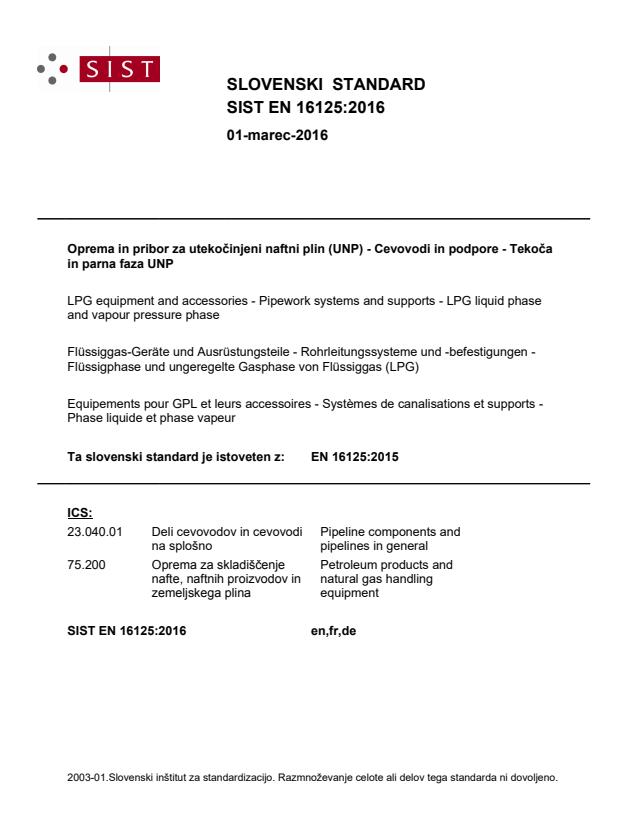
2003-01.Slovenski inštitut za standardizacijo. Razmnoževanje celote ali delov tega standarda ni dovoljeno.Flüssiggas-Geräte und Ausrüstungsteile - Rohrleitungssysteme und -befestigungen - Flüssigphase und ungeregelte Gasphase von Flüssiggas (LPG)Equipements pour GPL et leurs accessoires - Systèmes de canalisations et supports - Phase liquide et phase vapeurLPG equipment and accessories - Pipework systems and supports - LPG liquid phase and vapour pressure phase75.200Petroleum products and natural gas handling equipment23.040.01Deli cevovodov in cevovodi na splošnoPipeline components and pipelines in generalICS:Ta slovenski standard je istoveten z:EN 16125:2015SIST EN 16125:2016en,fr,de01-marec-2016SIST EN 16125:2016SLOVENSKI
STANDARD
EUROPEAN STANDARD NORME EUROPÉENNE EUROPÄISCHE NORM
EN 16125
December
t r s w ICS
t uä r v rä r s English Version
LPG Equipment and Accessories æ Pipework systems and supports æ LPG in liquid phase and vapour pressure phaseEquipements pour GPL et leurs accessoires æ Systèmes de canalisations et supports æ Phase liquide et phase vapeur
FlüssiggasæGeräte und Ausrüstungsteile æ Rohrleitungssysteme und æbefestigungen æ Flüssigphase und ungeregelte Gasphase von Flüssiggas This European Standard was approved by CEN on
u s October
t r s wä
egulations which stipulate the conditions for giving this European Standard the status of a national standard without any alterationä Upætoædate lists and bibliographical references concerning such national standards may be obtained on application to the CENæCENELEC Management Centre or to any CEN memberä
translation under the responsibility of a CEN member into its own language and notified to the CENæCENELEC Management Centre has the same status as the official versionsä
CEN members are the national standards bodies of Austriaá Belgiumá Bulgariaá Croatiaá Cyprusá Czech Republicá Denmarká Estoniaá Finlandá Former Yugoslav Republic of Macedoniaá Franceá Germanyá Greeceá Hungaryá Icelandá Irelandá Italyá Latviaá Lithuaniaá Luxembourgá Maltaá Netherlandsá Norwayá Polandá Portugalá Romaniaá Slovakiaá Sloveniaá Spainá Swedená Switzerlandá Turkey and United Kingdomä
EUROPEAN COMMITTEE FOR STANDARDIZATION COMITÉ EUROPÉEN DE NORMALISATION EUROPÄISCHES KOMITEE FÜR NORMUNG
CEN-CENELEC Management Centre:
Avenue Marnix 17,
B-1000 Brussels
t r s w CEN All rights of exploitation in any form and by any means reserved worldwide for CEN national Membersä Refä Noä EN
s x s t wã t r s w ESIST EN 16125:2016
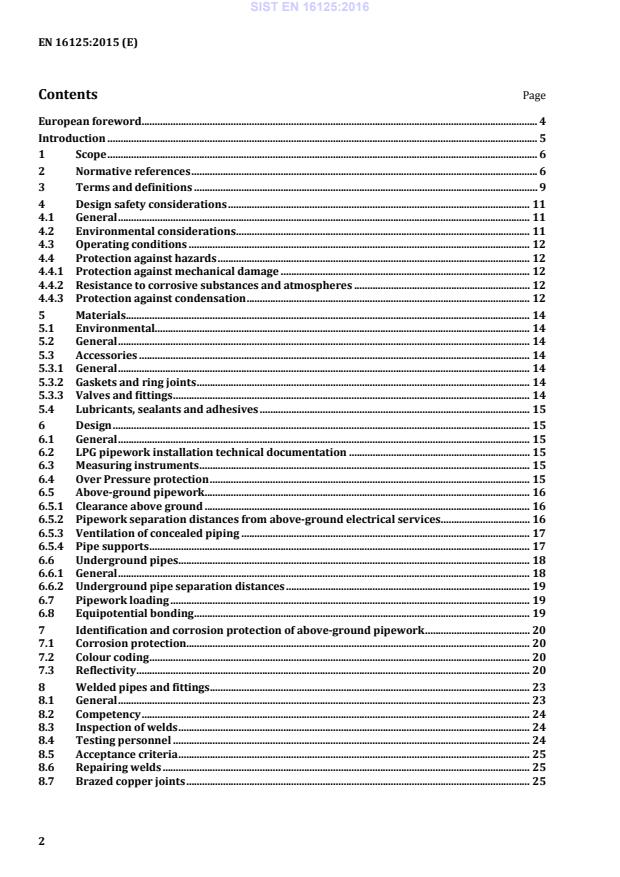
Pipe sizing – liquid phase . 30 A.1 General . 30 A.2 Viscosity of LPG . 30 A.3 Calculation of liquid velocity flow in pipework . 30 A.4 Calculation of Reynolds number . 31 A.5 Liquid flow capacity and pressure drop in pipework . 31 A.6 Liquid flow capacity and pressure drop through valves and fittings . 32 Annex B (informative)
Pipe sizing – gas phase . 37 B.1 General . 37 B.2 Calculation of full vapour flow and pressure drop in pipes . 37 B.3 Vapour flow capacity and pressure drop through valves and fittings . 37 B.4 Gas velocity . 37 Annex C (informative)
Pipework Integrity Management Systems (PIMS) . 38 C.1 Pipework Integrity Management . 38 C.2 Basic PIMS for LPG plants . 38 C.3 Assessment of condition . 38 C.4 Response (remedial action/ future monitoring or inspection) . 38 C.5 Frequency of inspection and maintenance . 39 Annex D (informative)
Environmental checklist. 40 Annex E (informative)
Manufacturing and type testing of composite pipes . 41 E.1 General . 41 E.2 Materials . 41 E.3 Physical properties . 42 E.4 Manuals . 42 E.5 Records . 43 Bibliography . 44 SIST EN 16125:2016
« t r ¹Cä In serviceá temperatures below this can be encountered during short periods, for example, when filling. In some parts of Europe and in certain applications where a lower temperature than
« t r ¹C can be encounteredá the minimum design temperature shall be
« v r ¹Câ — the maximum working temperature shall be 65°C for above ground pipework and 40 C for underground pipework; — the maximum allowable pressure for pipework shall be less than or equal to 25 bar; — pipes shall be suitable for transport and storage at
« v r ¹C and
x w ¹Cä NOTE Vacuum conditions on the pipework arising from butane at low temperature or evacuation of the pipework can expose the pipework to a vacuum of 50 mbar absolute. The minimum pressure to which pipework is normally exposed is 0 bar. 4.4 Protection against hazards 4.4.1 Protection against mechanical damage Pipework shall be protected against mechanical damage. For protection of underground pipework, see 6.6.1.4 4.4.2 Resistance to corrosive substances and atmospheres All pipework and fittings, including supports, shall be protected from corrosion according to the environment and operating conditions they will be subjected to during their service life. NOTE Stainless steel pipework and fittings can be subject to chloride induced stress cracking, e.g. coastal areas or other areas where salt laden atmospheres can occur. 4.4.3 Protection against condensation For vapour pressure pipework, precautions shall be taken to avoid problems occurring in the pipe and downstream equipment due to condensate forming. Figure 1 indicates temperatures and pressures for propane, mixes of propane/butane and butane. NOTE 1 Where the stored LPG liquid temperature is higher than the temperature of the downstream pipework, the LPG can condense to a liquid. This is known as the dew point. NOTE 2 In Figure 1, where the LPG is exposed to a pressure above the curve, the LPG vapour will condense. In order to prevent condensation of LPG, trace heating of the pipework shall be considered. Alternatively the pipework shall drain back to the vessels. If this is not possible a suitably located vapour-liquid separator (knockout pot) may be installed in the line to allow condensation to collect and subsequently boil off without causing problems. SIST EN 16125:2016
Literature Reference: Buecker,D. and Wagner, W. “Reference equations of state for thermodynamic properties of fluid phase n-Butane and Isobutane” J. Phys. Chem. Ref. Data, 35(2):929-1019,2006 Key X temperature in °C Y pressure in bar
100% Propane
80% Propane 20% Butane
50% Propane 50% Butane
20% Propane 80% Butane
100% Butane Figure 1 — Dew point graph SIST EN 16125:2016
...