


EN 16143:2013
(Main)Petroleum products - Determination of content of Benzo(a)pyrene (BaP) and selected polycyclic aromatic hydrocarbons (PAH) in extender oils - Procedure using double LC cleaning and GC/MS analysis
General Information
- Abstract
This European Standard specifies a procedure for the determination of the content of benzo[a]pyrene (BaP) in extender oils which are commonly used in the rubber industry for the production of tyres or parts of tyres. The method also yields the sum of the eight individual polycyclic aromatic hydrocarbons (PAHs) listed in Table 1.
The procedure has been tested and verified for the PAHs listed in Table 1 (those required by the European Commission [1]) and additional PAHs as listed in Table A.2.
Analysis of other PAHs is possible in principle, but sufficient quality assurance performed by the user is necessary to secure the analysis.
The application range for this method is from approximately 4 mg/kg to approximately 15 mg/kg for the eight individual PAHs and from approximately 0,5 mg/kg to approximately 2 mg/kg for BaP.
NOTE 1 The intended working range for this method is in the 0,1 mg/kg to 15 mg/kg range. For the lower levels precision has not yet been established.
NOTE 2 For the purposes of this European Standard, the term "% (m/m)" is used to represent the mass fraction (...).
(...)
- Status
- Published
- Publication Date
- 12-Feb-2013
- Withdrawal Date
- 30-Aug-2013
- Technical Committee
- CEN/TC 19 - Petroleum products, lubricants and related products
- Drafting Committee
- CEN/TC 19/WG 9 - Chromatographic test methods
- Current Stage
- 9093 - Decision to confirm - Review Enquiry
- Start Date
- 27-Dec-2018
- Completion Date
- 23-Sep-2026



Overview
EN 16143:2013 (CEN) defines a validated laboratory procedure for measuring benzo[a]pyrene (BaP) and selected polycyclic aromatic hydrocarbons (PAHs) in extender oils used in the rubber and tyre industry. The method uses a double liquid‑chromatography (LC) clean‑up (silica and Sephadex LH‑20) followed by GC/MS analysis (Selected Ion Monitoring, SIM) for identification and quantification. The standard targets the eight PAHs required by the European Commission (including BaP) and provides working ranges and quality‑assurance requirements for trace analysis.
Key topics and technical requirements
- Analytes: benzo[a]pyrene (BaP) plus seven other PAHs listed in Table 1 (e.g., BaA, BbFA, BkFA, BjFA, CHR, BeP, DBahA).
- Sample preparation: example procedure uses ≈70 mg sample dissolved in n‑pentane and spiked with internal standards; rigorous blank checks for contamination are required.
- Clean‑up: two sequential LC steps - silica column followed by Sephadex LH‑20 - to remove complex oil matrix before GC/MS.
- Instrumental analysis: GC coupled to mass spectrometer operated in SIM mode; typical GC parameters are given (e.g., 30 m × 0.25 mm × 0.25 μm column, 5 % phenyl‑methylpolysiloxane stationary phase, oven program up to 300 °C).
- Standards and QA: use of deuterated or 13C‑labelled internal standards, certified master standards, injection standards; precision assessed by inter‑laboratory studies.
- Detection/application ranges: method-tested range approximately 4–15 mg/kg for the sum of the eight PAHs and 0.5–2 mg/kg for BaP; intended working range 0.1–15 mg/kg (precision at lower end not fully established).
- Practical notes: the method requires experienced laboratories due to complex matrix effects, potential peak overlaps (benzofluoranthene isomers) and contamination risks from glassware/solvents.
Applications and users
EN 16143:2013 is intended for:
- Analytical and environmental laboratories performing PAH quantification in petroleum‑based extender oils.
- Tyre and rubber manufacturers doing incoming raw‑material QC to ensure compliance.
- Regulatory bodies and conformity assessment for enforcement of EU restrictions on PAHs in extender oils (linked to Directive 2005/69/EC).
- Product safety and R&D teams evaluating formulation changes or alternative extender oils.
Benefits include reliable BaP and PAH quantification for regulatory compliance, batch quality control, and risk assessment-provided laboratories follow the standard’s QA/precision guidance.
Related standards and references
- EN ISO 3170 / EN ISO 3171 (sampling of petroleum liquids)
- CEN inter‑laboratory precision guidance (EN ISO 4259 referenced in the standard)
- EU Directive 2005/69/EC (restrictions on PAHs in extender oils)
Keywords: EN 16143:2013, Benzo(a)pyrene, BaP, PAH analysis, extender oils, GC/MS, double LC cleaning, tyre industry, CEN standard, analytical method, regulatory compliance.
Relations
- Effective Date
- 28-Jan-2026
- Effective Date
- 28-Jan-2026
- Effective Date
- 28-Jan-2026
- Effective Date
- 28-Jan-2026
Get Certified
Connect with accredited certification bodies for this standard

Element Materials Technology
Materials testing and product certification.

ABS Group Brazil
ABS Group certification services in Brazil.

ABS Quality Evaluations Inc.
American Bureau of Shipping quality certification.
Sponsored listings
Frequently Asked Questions
EN 16143:2013 is a standard published by the European Committee for Standardization (CEN). Its full title is "Petroleum products - Determination of content of Benzo(a)pyrene (BaP) and selected polycyclic aromatic hydrocarbons (PAH) in extender oils - Procedure using double LC cleaning and GC/MS analysis". This standard covers: This European Standard specifies a procedure for the determination of the content of benzo[a]pyrene (BaP) in extender oils which are commonly used in the rubber industry for the production of tyres or parts of tyres. The method also yields the sum of the eight individual polycyclic aromatic hydrocarbons (PAHs) listed in Table 1. The procedure has been tested and verified for the PAHs listed in Table 1 (those required by the European Commission [1]) and additional PAHs as listed in Table A.2. Analysis of other PAHs is possible in principle, but sufficient quality assurance performed by the user is necessary to secure the analysis. The application range for this method is from approximately 4 mg/kg to approximately 15 mg/kg for the eight individual PAHs and from approximately 0,5 mg/kg to approximately 2 mg/kg for BaP. NOTE 1 The intended working range for this method is in the 0,1 mg/kg to 15 mg/kg range. For the lower levels precision has not yet been established. NOTE 2 For the purposes of this European Standard, the term "% (m/m)" is used to represent the mass fraction (...). (...)
This European Standard specifies a procedure for the determination of the content of benzo[a]pyrene (BaP) in extender oils which are commonly used in the rubber industry for the production of tyres or parts of tyres. The method also yields the sum of the eight individual polycyclic aromatic hydrocarbons (PAHs) listed in Table 1. The procedure has been tested and verified for the PAHs listed in Table 1 (those required by the European Commission [1]) and additional PAHs as listed in Table A.2. Analysis of other PAHs is possible in principle, but sufficient quality assurance performed by the user is necessary to secure the analysis. The application range for this method is from approximately 4 mg/kg to approximately 15 mg/kg for the eight individual PAHs and from approximately 0,5 mg/kg to approximately 2 mg/kg for BaP. NOTE 1 The intended working range for this method is in the 0,1 mg/kg to 15 mg/kg range. For the lower levels precision has not yet been established. NOTE 2 For the purposes of this European Standard, the term "% (m/m)" is used to represent the mass fraction (...). (...)
EN 16143:2013 is classified under the following ICS (International Classification for Standards) categories: 75.100 - Lubricants, industrial oils and related products. The ICS classification helps identify the subject area and facilitates finding related standards.
EN 16143:2013 has the following relationships with other standards: It is inter standard links to EN ISO 3171:1999, EN ISO 3170:2025, EN ISO 1927-2:2012, EN ISO 14719:2011. Understanding these relationships helps ensure you are using the most current and applicable version of the standard.
EN 16143:2013 is associated with the following European legislation: Standardization Mandates: M/413. When a standard is cited in the Official Journal of the European Union, products manufactured in conformity with it benefit from a presumption of conformity with the essential requirements of the corresponding EU directive or regulation.
EN 16143:2013 is available in PDF format for immediate download after purchase. The document can be added to your cart and obtained through the secure checkout process. Digital delivery ensures instant access to the complete standard document.
Standards Content (Sample)
2003-01.Slovenski inštitut za standardizacijo. Razmnoževanje celote ali delov tega standarda ni dovoljeno.ROLFLNOLþQLKMineralölerzeugnisse - Bestimmung des Gehaltes an Benzo(a)pyren (BaP) und ausgewählten polycyclischen Kohlenwasserstoffen (PAH) in Extenderölen - Verfahren mittels doppelter LC-Vorreinigung und GC/MS-AnalyseProduits petroliers - Détermination de la teneur en Benzo(a)pyrene (BaP) et polcyclic hydrocarbons aromatique selective en huiles extender - Méthodes par spectrométrie d'absorption atomique (SAA)Petroleum products - Determination of content of Benzo(a)pyrene (BaP) and selected polycyclic aromatic hydrocarbons (PAH) in extender oils - Procedure using double LC cleaning and GC/MS analysis75.100MazivaLubricants, industrial oils and related productsICS:Ta slovenski standard je istoveten z:EN 16143:2013SIST EN 16143:2013en,de01-april-2013SIST EN 16143:2013SLOVENSKI
STANDARD
EUROPEAN STANDARD NORME EUROPÉENNE EUROPÄISCHE NORM
EN 16143
February 2013 ICS 75.100 English Version
Petroleum products - Determination of content of Benzo(a)pyrene (BaP) and selected polycyclic aromatic hydrocarbons (PAH) in extender oils - Procedure using double LC cleaning and GC/MS analysis
Produits petroliers - Détermination de la teneur en Benzo(a)pyrène (BaP) et en certains hydrocarbures aromatiques polycycliques (HAP) dans les huiles de dilution - Méthode
par double purification chromatographique en phase liquide
et par GC/MS
Mineralölerzeugnisse - Bestimmung des Gehaltes an Benzo(a)pyren (BaP) und ausgewählten polycyclischen Kohlenwasserstoffen (PAKs) in Extenderölen - Verfahren mittels doppelter LC-Vorreinigung und GC/MS-Analyse This European Standard was approved by CEN on 14 December 2012.
CEN members are bound to comply with the CEN/CENELEC Internal Regulations which stipulate the conditions for giving this European Standard the status of a national standard without any alteration. Up-to-date lists and bibliographical references concerning such national standards may be obtained on application to the CEN-CENELEC Management Centre or to any CEN member.
This European Standard exists in three official versions (English, French, German). A version in any other language made by translation under the responsibility of a CEN member into its own language and notified to the CEN-CENELEC Management Centre has the same status as the official versions.
CEN members are the national standards bodies of Austria, Belgium, Bulgaria, Croatia, Cyprus, Czech Republic, Denmark, Estonia, Finland, Former Yugoslav Republic of Macedonia, France, Germany, Greece, Hungary, Iceland, Ireland, Italy, Latvia, Lithuania, Luxembourg, Malta, Netherlands, Norway, Poland, Portugal, Romania, Slovakia, Slovenia, Spain, Sweden, Switzerland, Turkey and United Kingdom.
EUROPEAN COMMITTEE FOR STANDARDIZATION
COMITÉ EUROPÉEN DE NORMALISATION EUROPÄISCHES KOMITEE FÜR NORMUNG
Management Centre:
Avenue Marnix 17,
B-1000 Brussels © 2013 CEN All rights of exploitation in any form and by any means reserved worldwide for CEN national Members. Ref. No. EN 16143:2013: ESIST EN 16143:2013
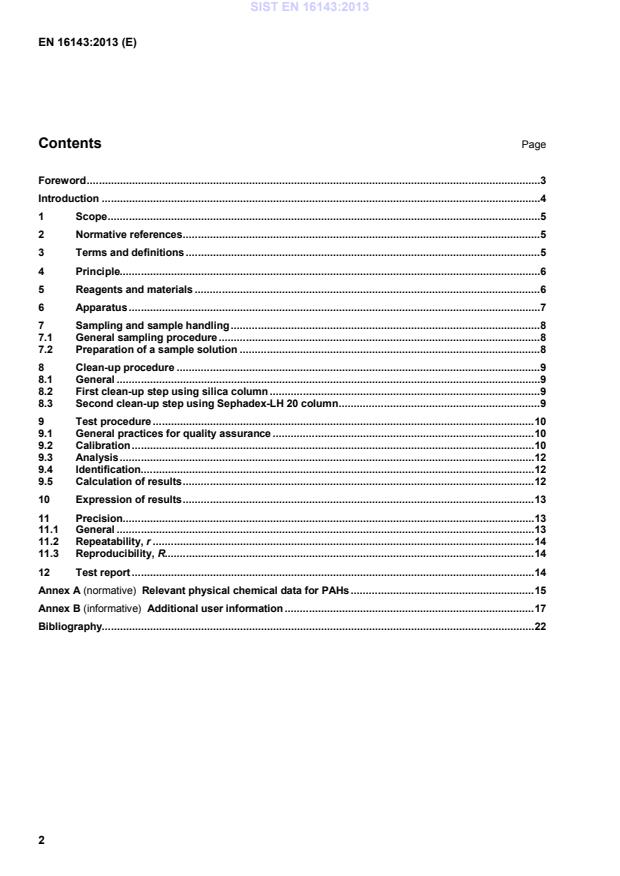
Relevant physical chemical data for PAHs . 15 Annex B (informative)
Additional user information . 17 Bibliography. 22
The complexity of the sample preparation steps and subsequent GC-MS analysis showed that laboratories need sufficient expertise to properly perform the analyses described in this document. Therefore, only a limited number of laboratories were able to participate in and contribute to the Round Robin test conducted by CEN/TC 19. In consideration of the progression of the standardization project, no additional time or resources were left e.g. to conduct additional Round Robin Tests, and the test method therefore is produced in its actual form. Further experience in the future may lead to improved precision and a more comprehensive scope. SIST EN 16143:2013
The procedure has been tested and verified for the PAHs listed in Table 1 (those required by the European Commission [1]) and additional PAHs as listed in Table A.2.
Analysis of other PAHs is possible in principle, but sufficient quality assurance performed by the user is necessary to secure the analysis.
The application range for this method is from approximately 4 mg/kg to approximately 15 mg/kg for the eight individual PAHs and from approximately 0,5 mg/kg to approximately 2 mg/kg for BaP. NOTE 1 The intended working range for this method is in the 0,1 mg/kg to 15 mg/kg range. For the lower levels precision has not yet been established. NOTE 2 For the purposes of this European Standard, the term “% (m/m)” is used to represent the mass fraction (). Table 1 — List of individual PAHs in extender oils Name of PAH Abbreviation CAS Registry number benzo(a)pyrene BaP 50-32-8 benzo(e)pyrene BeP 192-97-2 benzo(a)anthracene BaA 56-55-3 chrysene CHR 218-01-9 benzo(b)fluoranthene BbFA 205-99-2 benzo(j)fluoranthene BjFA 205-82-3 benzo(k)fluoranthene BkFA 207-08-9 dibenzo(a,h)anthracene DBahA 53-70-3 See Table A.1 for additional data on some PAH.
2 Normative references The following documents, in whole or in part, are normatively referenced in this document and are indispensable for its application. For dated references, only the edition cited applies. For undated references, the latest edition of the referenced document (including any amendments) applies. EN ISO 3170, Petroleum liquids — Manual sampling (ISO 3170) EN ISO 3171, Petroleum liquids — Automatic pipeline sampling (ISO 3171) 3 Terms and definitions For the purposes of this document, the following terms and definitions apply. SIST EN 16143:2013
1) Sephadex® is the trade name of a product supplied by GE Healthcare Bio-Sciences AB, SE-751 84 Uppsala. This information is given for the convenience of users of this European Standard and does not constitute an endorsement by CEN of the product named. Equivalent products may be used if they can be shown to lead to the same results. SIST EN 16143:2013
When a high resolution type mass spectrometer is used, the second step of the cleaning procedure (see 8.3) can be by-passed if the desired detection limits can be met. 6.2 Gas chromatographic columns. Fused silica type capillary columns with dimensions are listed in Table 2. A commonly used liquid phase is 5 % phenyl-methylpolysiloxane of 0,25 µm film thickness. Other columns of comparable or improved performance can also be used, such as a strongly recommended DB-5ms column
(5 % phenyl-methylpolysiloxane). SIST EN 16143:2013
Stationary phase 5 % phenyl-methylpolysiloxane Oven initial temperature 60 °C Initial time 2 min Temperature program 5 °C/min to 300 °C, hold for 12 min Injection according to Grob, splitless Injection temperature 275 °C to 300 °C Temperature transfer line 275 °C to 300 °C MS Detector temperature
according to the instrument manufacturer Injection volume 1 µl to 3 µl Carrier gas Helium, with a linear velocity of 40 cm/sec
Depending on chromatographic conditions (e.g. column length), it can happen that the different benzofluoranthene isomers co-elute. In these cases, determining the sum of the three isomers rather than reporting each isomer separately should be considered. Another alternative would be to use longer GC-columns (60 m instead of 30 m). See B.2 for further advice on the peak overlap of the isomers. Ferrules used shall not contain more than 40 % graphite (a suitable ferrule is made of 60 % polyimide and 40 % graphite) to decrease the risk that PAHs are absorbed. 6.3 Sample concentrator, typically a rotary evaporator or similar digital evaporator device. 7 Sampling and sample handling 7.1 General sampling procedure Samples shall be taken according to EN ISO 3170 or EN ISO 3171, as well as in accordance with the requirements of national standards or regulations for the sampling of the product under test.
If samples are not tested immediately, they shall be stored tightly sealed and in a cool and dark place. It shall be secured that glassware is thoroughly cleaned and that all new materials that may come into contact with the sample are checked by blank analysis that they give no interference. NOTE Interferences which can affect the results can occur due to contaminations from glassware, solvents and other materials that can come into contact with the sample. Such interferences will form an artefact or will increase the detector baseline. Interferences can also come from components in samples that co-elute with the specific PAHs of interest. 7.2 Preparation of a sample solution Approximately 70 mg of the sample is introduced to the nearest 0,1 mg into a 5 ml volumetric flask (5.9) and dissolved in 2 ml n-pentane (5.1.3). Before the sample clean-up, the sample solution is spiked with internal standard. The concentration of internal standard shall be adjusted such that it is in the same range as the expected PAHs in the sample. SIST EN 16143:2013
For quantification a second cleaning step shall be performed on Sephadex LH20 (5.2.2) or equivalent. These procedures are strongly recommended in order to make sure the samples are cleaned thoroughly before analysing them by GC-MS. 8.2 First clean-u
...