


EN 12312-14:2006+A1:2009
(Main + Amendment)Aircraft ground support equipment - Specific requirements - Part 14: Disabled/incapacitated passenger boarding vehicles
General Information
- Abstract
This European Standard specifies the technical requirements to minimise the hazards listed in Clause 4 which can arise during the commissioning, operation and maintenance of disabled/incapacitated passenger boarding vehicles when used as intended and under the conditions of misuse which are reasonably foreseeable by the manufacturer or his authorised representative. It also takes into account some performance requirements recognized as essential by authorities, aircraft and ground support equipment (GSE) manufacturers as well as airlines and handling agencies.
This European Standard defines specific safety requirements for transporters/boarding vehicles for transporting/boarding incapacitated or disabled passengers as defined under 3.1, hereafter referred to as boarding vehicles.
This European Standard applies to pedestrian controlled self-propelled boarding vehicles, self-propelled boarding vehicles with integrated driver’s accommodation and towable boarding vehicles, used for moving disabled or incapacitated passengers at an airport between the terminal building and the aircraft ramp and to board and disembark those passengers to and from civil aircraft.
Examples of some typical boarding vehicles are shown in Annex A.
This European Standard assumes that a disabled or incapacitated passenger may be accompanied by an attendant and may be seated in a wheelchair or reclining on a stretcher trolley.
This European Standard also assumes that the types of wheelchairs which may be employed could be:
- Standard type wheelchairs, e.g. in accordance with EN 12183;
- Wheelchairs with or without occupant self-restraint system;
- Aircraft aisle-width wheelchairs;
- Non-standard wheelchairs used at airports;
- Non occupant propelled wheelchairs;
- Battery powered wheelchairs, e.g. in accordance with EN 12184.
NOTE It is assumed that battery powered wheelchairs would not be taken into the cabin of an aircraft.
- Status
- Withdrawn
- Publication Date
- 28-Apr-2009
- Withdrawal Date
- 22-Sep-2026
- Technical Committee
- CEN/TC 274 - Aircraft ground support equipment
- Current Stage
- 9960 - Withdrawal effective - Withdrawal
- Start Date
- 18-Jun-2014
- Completion Date
- 23-Sep-2026
- Directive
- Harmonized Standard2006/42/EC - Directive 2006/42/EC of the European Parliament and of the Council of 17 May 2006 on machinery, and amending Directive 95/16/EC (recast)OJ Ref: C, C 214 OJ Date: 08-Sep-2009
Not Harmonized98/37/EC - Machinery

Relations
- Effective Date
- 19-Jan-2023
- Effective Date
- 18-Jan-2023
- Effective Date
- 08-Jun-2022
- Effective Date
- 17-Sep-2026
- Effective Date
- 17-Sep-2026
- Effective Date
- 25-Aug-2026
- Effective Date
- 25-Aug-2026
- Effective Date
- 25-Aug-2026
- Effective Date
- 25-Aug-2026
- Effective Date
- 25-Aug-2026
- Effective Date
- 25-Aug-2026
- Effective Date
- 28-Jan-2026
- Effective Date
- 28-Jan-2026
- Effective Date
- 28-Jan-2026
- Effective Date
- 28-Jan-2026
Get Certified
Connect with accredited certification bodies for this standard

BUREAU VERITAS Certification Germany
Bureau Veritas certification in Germany.

Element Materials Technology
Materials testing and product certification.

AQMS Ltd.
AQMS provides ISO certification to SMEs across the UK.
Sponsored listings
Frequently Asked Questions
EN 12312-14:2006+A1:2009 is a standard published by the European Committee for Standardization (CEN). Its full title is "Aircraft ground support equipment - Specific requirements - Part 14: Disabled/incapacitated passenger boarding vehicles". This standard covers: This European Standard specifies the technical requirements to minimise the hazards listed in Clause 4 which can arise during the commissioning, operation and maintenance of disabled/incapacitated passenger boarding vehicles when used as intended and under the conditions of misuse which are reasonably foreseeable by the manufacturer or his authorised representative. It also takes into account some performance requirements recognized as essential by authorities, aircraft and ground support equipment (GSE) manufacturers as well as airlines and handling agencies. This European Standard defines specific safety requirements for transporters/boarding vehicles for transporting/boarding incapacitated or disabled passengers as defined under 3.1, hereafter referred to as boarding vehicles. This European Standard applies to pedestrian controlled self-propelled boarding vehicles, self-propelled boarding vehicles with integrated driver’s accommodation and towable boarding vehicles, used for moving disabled or incapacitated passengers at an airport between the terminal building and the aircraft ramp and to board and disembark those passengers to and from civil aircraft. Examples of some typical boarding vehicles are shown in Annex A. This European Standard assumes that a disabled or incapacitated passenger may be accompanied by an attendant and may be seated in a wheelchair or reclining on a stretcher trolley. This European Standard also assumes that the types of wheelchairs which may be employed could be: - Standard type wheelchairs, e.g. in accordance with EN 12183; - Wheelchairs with or without occupant self-restraint system; - Aircraft aisle-width wheelchairs; - Non-standard wheelchairs used at airports; - Non occupant propelled wheelchairs; - Battery powered wheelchairs, e.g. in accordance with EN 12184. NOTE It is assumed that battery powered wheelchairs would not be taken into the cabin of an aircraft.
This European Standard specifies the technical requirements to minimise the hazards listed in Clause 4 which can arise during the commissioning, operation and maintenance of disabled/incapacitated passenger boarding vehicles when used as intended and under the conditions of misuse which are reasonably foreseeable by the manufacturer or his authorised representative. It also takes into account some performance requirements recognized as essential by authorities, aircraft and ground support equipment (GSE) manufacturers as well as airlines and handling agencies. This European Standard defines specific safety requirements for transporters/boarding vehicles for transporting/boarding incapacitated or disabled passengers as defined under 3.1, hereafter referred to as boarding vehicles. This European Standard applies to pedestrian controlled self-propelled boarding vehicles, self-propelled boarding vehicles with integrated driver’s accommodation and towable boarding vehicles, used for moving disabled or incapacitated passengers at an airport between the terminal building and the aircraft ramp and to board and disembark those passengers to and from civil aircraft. Examples of some typical boarding vehicles are shown in Annex A. This European Standard assumes that a disabled or incapacitated passenger may be accompanied by an attendant and may be seated in a wheelchair or reclining on a stretcher trolley. This European Standard also assumes that the types of wheelchairs which may be employed could be: - Standard type wheelchairs, e.g. in accordance with EN 12183; - Wheelchairs with or without occupant self-restraint system; - Aircraft aisle-width wheelchairs; - Non-standard wheelchairs used at airports; - Non occupant propelled wheelchairs; - Battery powered wheelchairs, e.g. in accordance with EN 12184. NOTE It is assumed that battery powered wheelchairs would not be taken into the cabin of an aircraft.
EN 12312-14:2006+A1:2009 is classified under the following ICS (International Classification for Standards) categories: 49.100 - Ground service and maintenance equipment. The ICS classification helps identify the subject area and facilitates finding related standards.
EN 12312-14:2006+A1:2009 has the following relationships with other standards: It is inter standard links to EN 12312-14:2006, EN 12312-14:2006/prA1, EN 12312-14:2014, EN 1915-2:2026, EN ISO 31915-3:2026, ISO 10542-2:2001, ISO 10542-1:2001, ISO 7718:2003, ISO 7193:1985, ISO 16004:2005, ISO 10542-3:2005, EN ISO 11148-9:2011, EN 1915-3:2004+A1:2009, EN 13634:2010, EN 1837:2020. Understanding these relationships helps ensure you are using the most current and applicable version of the standard.
EN 12312-14:2006+A1:2009 is associated with the following European legislation: EU Directives/Regulations: 2006/42/EC, 98/37/EC; Standardization Mandates: M/079, M/396. When a standard is cited in the Official Journal of the European Union, products manufactured in conformity with it benefit from a presumption of conformity with the essential requirements of the corresponding EU directive or regulation.
EN 12312-14:2006+A1:2009 is available in PDF format for immediate download after purchase. The document can be added to your cart and obtained through the secure checkout process. Digital delivery ensures instant access to the complete standard document.
Standards Content (Sample)
2003-01.Slovenski inštitut za standardizacijo. Razmnoževanje celote ali delov tega standarda ni dovoljeno.RWQLNRYLuftfahrt-Bodengeräte - Besondere Anforderungen - Teil 14: Behinderten-TransportgeräteMatériels au sol pour aéronefs - Exigences particulières - Partie 14: Matériel d'accès à bord des passagers handicapésAircraft ground support equipment - Specific requirements - Part 14: Disabled/incapacitated passenger boarding vehicles49.100Oprema za servis in vzdrževanje na tlehGround service and maintenance equipmentICS:Ta slovenski standard je istoveten z:EN 12312-14:2006+A1:2009SIST EN 12312-14:2007+A1:2009en01-julij-2009SIST EN 12312-14:2007+A1:2009SLOVENSKI
STANDARD
EUROPEAN STANDARD NORME EUROPÉENNE EUROPÄISCHE NORM
EN 12312-14:2006+A1
April 2009 ICS 49.100 Supersedes EN 12312-14:2006English Version
Aircraft ground support equipment - Specific requirements - Part 14: Disabled/incapacitated passenger boarding vehicles
Matériels au sol pour aéronefs - Exigences particulières - Partie 14: Matériel d'accès à bord des passagers handicapés
Luftfahrt-Bodengeräte - Besondere Anforderungen - Teil 14: Behinderten-Transportgeräte This European Standard was approved by CEN on 28 August 2006 and includes Amendment 1 approved by CEN on 1 March 2009.
CEN members are bound to comply with the CEN/CENELEC Internal Regulations which stipulate the conditions for giving this European Standard the status of a national standard without any alteration. Up-to-date lists and bibliographical references concerning such national standards may be obtained on application to the CEN Management Centre or to any CEN member.
This European Standard exists in three official versions (English, French, German). A version in any other language made by translation under the responsibility of a CEN member into its own language and notified to the CEN Management Centre has the same status as the official versions.
CEN members are the national standards bodies of Austria, Belgium, Bulgaria, Cyprus, Czech Republic, Denmark, Estonia, Finland, France, Germany, Greece, Hungary, Iceland, Ireland, Italy, Latvia, Lithuania, Luxembourg, Malta, Netherlands, Norway, Poland, Portugal, Romania, Slovakia, Slovenia, Spain, Sweden, Switzerland and United Kingdom.
EUROPEAN COMMITTEE FOR STANDARDIZATION
COMITÉ EUROPÉEN DE NORMALISATION EUROPÄISCHES KOMITEE FÜR NORMUNG
Management Centre:
Avenue Marnix 17,
B-1000 Brussels © 2009 CEN All rights of exploitation in any form and by any means reserved worldwide for CEN national Members. Ref. No. EN 12312-14:2006+A1:2009: ESIST EN 12312-14:2007+A1:2009
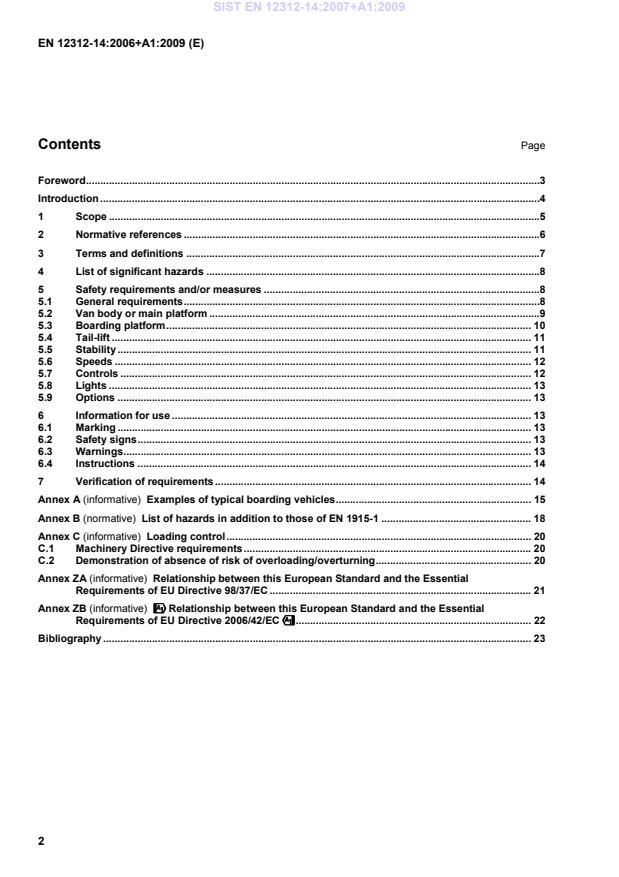
Examples of typical boarding vehicles . 15Annex B (normative)
List of hazards in addition to those of EN 1915-1 . 18Annex C (informative)
Loading control . 20C.1 Machinery Directive requirements . 20C.2 Demonstration of absence of risk of overloading/overturning . 20Annex ZA (informative)
Relationship between this European Standard and the Essential Requirements of EU Directive 98/37/EC . 21Annex ZB (informative)
!!!!Relationship between this European Standard and the Essential Requirements of EU Directive 2006/42/EC"""" . 22Bibliography . 23 SIST EN 12312-14:2007+A1:2009
1 Scope This European Standard specifies the technical requirements to minimise the hazards listed in Clause 4 which can arise during the commissioning, operation and maintenance of disabled/incapacitated passenger boarding vehicles when used as intended and under the conditions of misuse which are reasonably foreseeable by the manufacturer or his authorised representative. It also takes into account some performance requirements recognized as essential by authorities, aircraft and ground support equipment (GSE) manufacturers as well as airlines and handling agencies. This European Standard defines specific safety requirements for transporters/boarding vehicles for transporting/boarding incapacitated or disabled passengers as defined under 3.1, hereafter referred to as boarding vehicles. This European Standard applies to pedestrian controlled self-propelled boarding vehicles, self-propelled boarding vehicles with integrated driver’s accommodation and towable boarding vehicles, used for moving disabled or incapacitated passengers at an airport between the terminal building and the aircraft ramp and to board and disembark those passengers to and from civil aircraft. Examples of some typical boarding vehicles are shown in Annex A. This European Standard assumes that a disabled or incapacitated passenger may be accompanied by an attendant and may be seated in a wheelchair or reclining on a stretcher trolley. This European Standard also assumes that the types of wheelchairs which may be employed could be: Standard type wheelchairs, e.g. in accordance with EN 12183; Wheelchairs with or without occupant self-restraint system; Aircraft aisle-width wheelchairs; Non-standard wheelchairs used at airports; Non occupant propelled wheelchairs; Battery powered wheelchairs, e.g. in accordance with EN 12184. NOTE It is assumed that battery powered wheelchairs would not be taken into the cabin of an aircraft. This European Standard does not apply to other forms of aircraft loaders not specifically designed for boarding of incapacitated or disabled passengers, e.g. mobile lounges, boarding bridges or externally mounted pods such as used on helicopters. Noise and vibration are dealt with respectively in EN 1915-4 and EN 1915-3. This European Standard does not deal with hazards in respect to a standard automotive chassis and from other vehicles on the apron. This Part of EN 12312 is not applicable to disabled/incapacitated passenger boarding vehicles which are manufactured before the date of publication by CEN of this standard.
!This part of EN 12312 is intended to be used in conjunction with EN 1915-1, EN 1915-2, EN 1915-3 (for vehicles) and EN 1915-4." SIST EN 12312-14:2007+A1:2009
EN ISO 14122-3:2001, Safety of machinery — Permanent means of access to machinery — Part 3: Stairs, stepladders and guard-rails (ISO 14122-3:2001) ISO 7193, Wheelchairs — Maximum overall dimensions ISO 7718, Aircraft — Main-deck passenger doors — Interface requirements for connection with passenger-boarding bridge or transfer vehicle ISO 10542-1, Technical systems and aids for disabled or handicapped persons — Wheelchair tiedown and occupant-restraint systems — Part 1: Requirements and test methods for all systems ISO 10542-2, Technical systems and aids for disabled or handicapped persons — Wheelchair tiedown and occupant-restraint systems — Part 2: Four-point strap-type tiedown systems ISO 10542-3, Technical systems and aids for disabled or handicapped persons — Wheelchair tiedown and occupant-restraint systems — Part 3: Docking-type tiedown systems ISO 16004, Aircraft ground equipment — Passenger boarding bridge or transfer vehicle — Requirements for interface with aircraft doors SIST EN 12312-14:2007+A1:2009
...