


EN 2831:1993
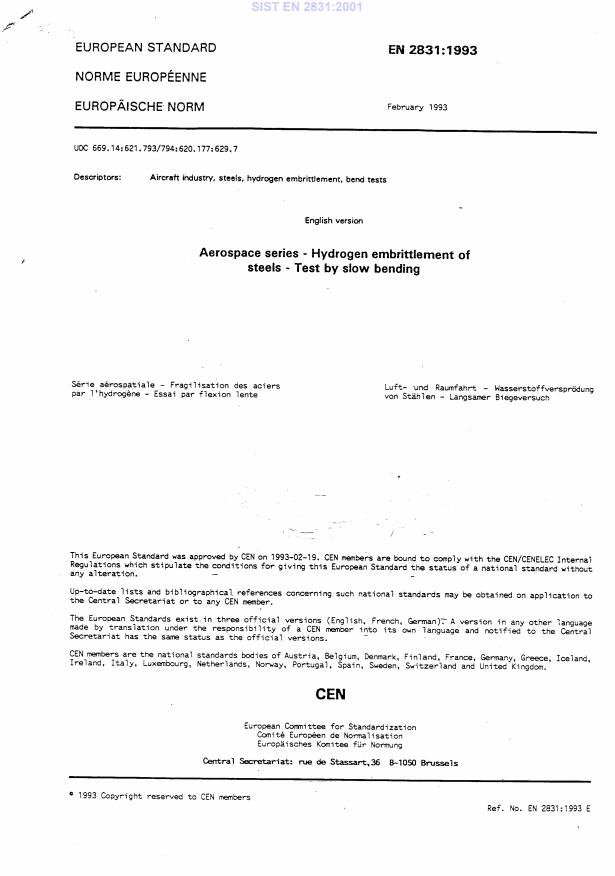
(Main)Aerospace series - Hydrogen embrittlement of steels - Test by slow bending
General Information
- Abstract
This standard specifies the test method by slow bending, which is used to assess the hydrogen embrittlement of steels during chemical or electrolytic surface treatments. This test is also used to verify the recovery of the initial ductility during de-embrittlement treatments. It is applicable whenever referenced.
- Status
- Published
- Publication Date
- 25-Feb-1993
- Withdrawal Date
- 30-Aug-1993
- Technical Committee
- ASD-STAN - Aerospace
- Drafting Committee
- ASD-STAN/D 4 - Metallic
- Current Stage
- 9093 - Decision to confirm - Review Enquiry
- Start Date
- 21-Jan-2024
- Completion Date
- 23-Sep-2026

Overview
EN 2831:1993 is a European standard developed by CEN that focuses on the assessment of hydrogen embrittlement in steels through a slow bending test method. This aerospace series standard is essential for evaluating the susceptibility of steel components subjected to chemical or electrolytic surface treatments that may introduce hydrogen. Additionally, it helps verify the recovery of initial ductility following de-embrittlement treatments. The standard is widely applicable in aerospace and metallurgical industries where steel integrity under hydrogen exposure is critical.
Key Topics
Hydrogen Embrittlement in Steels
Hydrogen embrittlement is a phenomenon where steel loses its ductility and toughness due to the presence of hydrogen. This standard addresses the methods to detect and measure this condition effectively.Test by Slow Bending Method
The prescribed test involves the slow bending of steel samples to induce stress, allowing the identification of embrittlement caused by hydrogen infiltration. The procedure measures the loss of ductility and structural weaknesses.Surface Treatment Implications
Chemical and electrolytic surface treatments can introduce hydrogen into steel. EN 2831:1993 provides a reliable test framework to evaluate steel performance after such treatments.De-Embrittlement Verification
Some steels undergo de-embrittlement treatments aimed at restoring ductility by removing hydrogen. This standard includes methods to confirm the success of these treatments.
Applications
Aerospace Industry
Ensures that steel components used in aircraft and spacecraft maintain their mechanical properties despite exposure to hydrogen during manufacturing or operational processes.Steel Manufacturing and Quality Control
Used by steel producers and treatment facilities to assess the risk of hydrogen embrittlement and verify the effectiveness of treatment processes.Surface Engineering Processes
Important for industries utilizing plating, coating, or chemical surface modifications prone to hydrogen absorption.Research and Development
Supports development of new steel alloys and treatment methods resistant to hydrogen embrittlement.
Related Standards
EN 10130: Cold Rolled Low Carbon Steel Flat Products
Provides material specifications commonly tested for hydrogen embrittlement.ISO 7539 Series: Corrosion of Metals and Alloys - Stress Corrosion Testing
Complements EN 2831 by addressing stress corrosion cracking, a related failure mode.ASTM F1624: Slow Strain Rate Testing
An alternative method to evaluate hydrogen embrittlement and ductility loss.EN 10204: Metallic Products - Types of Inspection Documents
Relevant to documentation and certification associated with steel testing and quality assurance.
By adhering to EN 2831:1993, engineers and quality assurance specialists can reliably identify hydrogen-induced vulnerabilities in steel components, ensuring safety and performance in critical aerospace applications and beyond. This standard is pivotal for maintaining material integrity where hydrogen exposure is a risk factor.
Relations
- Effective Date
- 28-Jan-2026
- Effective Date
- 28-Jan-2026
- Effective Date
- 28-Jan-2026
Get Certified
Connect with accredited certification bodies for this standard

BUREAU VERITAS Certification Germany
Bureau Veritas certification in Germany.

Element Materials Technology
Materials testing and product certification.

AQMS Ltd.
AQMS provides ISO certification to SMEs across the UK.
Sponsored listings
Frequently Asked Questions
EN 2831:1993 is a standard published by the European Committee for Standardization (CEN). Its full title is "Aerospace series - Hydrogen embrittlement of steels - Test by slow bending". This standard covers: This standard specifies the test method by slow bending, which is used to assess the hydrogen embrittlement of steels during chemical or electrolytic surface treatments. This test is also used to verify the recovery of the initial ductility during de-embrittlement treatments. It is applicable whenever referenced.
This standard specifies the test method by slow bending, which is used to assess the hydrogen embrittlement of steels during chemical or electrolytic surface treatments. This test is also used to verify the recovery of the initial ductility during de-embrittlement treatments. It is applicable whenever referenced.
EN 2831:1993 is classified under the following ICS (International Classification for Standards) categories: 49.025.10 - Steels. The ICS classification helps identify the subject area and facilitates finding related standards.
EN 2831:1993 has the following relationships with other standards: It is inter standard links to EN 2786:2008, EN 2133:2020, EN 2133:2010. Understanding these relationships helps ensure you are using the most current and applicable version of the standard.
EN 2831:1993 is available in PDF format for immediate download after purchase. The document can be added to your cart and obtained through the secure checkout process. Digital delivery ensures instant access to the complete standard document.
Standards Content (Sample)
2003-01.Slovenski inštitut za standardizacijo. Razmnoževanje celote ali delov tega standarda ni dovoljeno.Aerospace series - Hydrogen embrittlement of steels - Test by slow bendingLuft- und Raumfahrt - Wasserstoffversprödung von Stählen - Langsamer BiegeversuchSérie aérospatiale - Fragilisation des aciers par l'hydrogene - Essai par flexion
...