


FprEN 12693
(Main)Refrigerating systems and heat pumps - Safety and environmental requirements - Positive displacement refrigerant compressors
Refrigerating systems and heat pumps - Safety and environmental requirements - Positive displacement refrigerant compressors
This document is applicable to positive displacement refrigerant compressors for stationary and mobile refrigerating systems and heat pumps defined in 3.1, hereafter called compressors.
It is applicable for compressors used in commercial and industrial appliances and with electrical energy supply including integral motors, up to 1 000 VAC and 1 500 VDC.
It is applicable to open drive, semi hermetic and hermetic motor compressors, which contain a positive compression function.
This document is not applicable to:
- compressors used in household appliance for which EN 60335-2 -4 applies;
- compressors using water or air as refrigerant;
- compressors in vehicle air conditioning systems covered by a specific product standard, e.g. ISO 13043.
This document does not deal with requirements for emission of noise.
NOTE 1 Compressors for automotive comfort air conditioning systems can be developed according e.g. SAE J 639.
NOTE 2 Noise emission depends on the complete installation of the built-in compressors and the corresponding operating conditions.
For semi-hermetic and open drive compressors which include moving parts and for which the external envelope is primarily designed for mechanical loads, thermal loads (to limit the possible deformation due to temperature), stiffness of the structure (external mechanical loads and weight of the equipment), taking into account established safe industrial practice, it is considered that pressure is not a significant design factor.
Attached parts covering other functions e.g. oil separators, oil coolers, suction accumulators comply to EN 14276-1 or EN 13445-6 (cast iron) or EN 13445-8 (aluminium) or show compliance to the relevant European requirements. This is applicable also to shells for hermetic compressors either welded or with any kind of permanent joint.
Requirements for compressors used in explosive atmospheres are not covered by this document.
NOTE 3 For further guidance see EN 1127-1.
This document deals with significant hazards, hazardous situations and events relevant to compressors, when they are used as intended and under conditions for misuse which are reasonably foreseeable by the manufacturer (see Clause 4).
This document specifies safety requirements for the design, construction, manufacture and testing, documentation and marking of compressors, including integral accessories, e.g. shut-off valve, if necessary.
This document relates to the compressor itself which is to be incorporated in a refrigerating system.
This document is not applicable to compressors as specified in the scope which are manufactured before the date of publication.
Kälteanlagen und Wärmepumpen - Sicherheitstechnische und umweltrelevante Anforderungen - Verdrängerverdichter für Kältemittel
Dieses Dokument ist anwendbar für Verdrängerverdichter für Kältemittel nach der Definition in 3.1, die für ortsfeste und ortsveränderliche Kälteanlagen und Wärmepumpen verwendet und im Folgenden als Verdichter bezeichnet werden.
Es ist anwendbar für Verdichter, die in gewerblichen und industriellen Anlagen eingesetzt werden und zu deren Energieversorgung Integralmotoren mit bis zu 1 000 V Wechselstrom oder 1 500 V Gleichstrom verwendet werden.
Es ist anwendbar für Verdichter mit offenem Antrieb sowie für halbhermetische und hermetische Motorverdichter mit positiver Verdrängungsfunktion.
Dieses Dokument ist nicht anwendbar auf:
Verdichter, die für Geräte für den Hausgebrauch vorgesehen sind, für die EN 60335 2 34 gilt;
Verdichter, bei denen Wasser oder Luft als Kältemittel dient;
Verdichter für die Fahrzeugklimatisierung, die unter eine bestimmte Produktnorm fallen, z. B. ISO 13043.
Dieses Dokument enthält keine Anforderungen im Hinblick auf Geräuschemission.
ANMERKUNG 1 Verdichter für die Fahrzeugklimatisierung können z. B. nach SAE J 639 entwickelt werden.
ANMERKUNG 2 Die Geräuschemission ist von der Gesamtanlage des eingebauten Verdichters und den entsprechenden Betriebsbedingungen abhängig.
Bei Verdichtern mit halbhermetischem oder offenem Antrieb, die bewegliche Teile enthalten und bei denen die äußere Hülle unter Berücksichtigung bewährter und sicherer industrieller Verfahrensweisen vor allem im Hinblick auf die Aufnahme mechanischer Lasten, den Widerstand gegen thermische Beanspruchungen (zur Begrenzung der möglichen Verformung durch Temperatureinwirkung) und auf Steifigkeit der Konstruktion (äußere mechanische Lasten und Gewicht der Ausrüstung) ausgelegt ist, wird davon ausgegangen, dass der Druck keinen wesentlichen Faktor für die Auslegung darstellt.
Anbauteile mit anderen Funktionen, wie z. B. Ölabscheider, Ölkühler und Ausgleichsbehälter, entsprechen EN 14276 1 oder EN 13445 6 (Gusseisen) bzw. EN 13445 8 (Aluminium), oder es ist nachgewiesen, dass sie die einschlägigen europäischen Anforderungen erfüllen. Dies ist auch anwendbar für die Gehäuse von hermetischen Verdichtern, deren Verbindungen entweder geschweißt oder auf andere Art dauerhaft ausgeführt sind.
Dieses Dokument enthält keine Anforderungen an Verdichter für den Einsatz in explosionsgefährdeten Atmosphären.
ANMERKUNG 3 Weitere Hinweise hierzu sind EN 1127 1 zu entnehmen.
Dieses Dokument behandelt signifikante Gefährdungen sowie Gefährdungssituationen und -ereignisse, die beim bestimmungsgemäßen Einsatz von Verdichtern sowie beim falschen Einsatz auftreten können, soweit dieser für den Hersteller mit vertretbarem Aufwand vorhersehbar ist (siehe Abschnitt 4).
Dieses Dokument legt sicherheitstechnische Anforderungen für die Auslegung, Konstruktion und Herstellung sowie für die Prüfung, Dokumentation und Kennzeichnung von Verdichtern fest, die gegebenenfalls auch für ihre fest eingebauten Zubehörteile, z. B. das Absperrventil, gelten.
Dieses Dokument betrifft den in eine Kälteanlage einzubauenden Verdichter selbst.
Dieses Dokument ist nicht auf Verdichter anwendbar, die den Festlegungen in diesem Anwendungsbereich entsprechen, aber vor der Veröffentlichung dieses Dokuments hergestellt wurden.
Systèmes de réfrigération et pompes à chaleur - Exigences de sécurité et d'environnement - Compresseurs volumétriques pour fluides frigorigènes
Le présent document s’applique aux compresseurs volumétriques pour fluides frigorigènes pour les systèmes de réfrigération mobiles et fixes et les pompes à chaleur définis en 3.1, ci-après désignés par compresseurs.
Il s’applique aux compresseurs utilisés dans les appareils commerciaux et industriels ainsi qu’aux compresseurs ayant une alimentation électrique y compris les moteurs intégrés, jusqu’à 1 000 VAC et 1 500 VDC.
Il s’applique aux motocompresseurs ouverts, semi-hermétiques et hermétiques ayant une fonction de compression volumétrique.
Le présent document ne s’applique pas :
- aux compresseurs utilisés dans les appareils domestiques pour lesquels l’EN 60335-2-34 s’applique ;
- aux compresseurs utilisant l’eau ou l’air comme fluide frigorigène ;
- aux compresseurs pour systèmes de conditionnement d’air de véhicules couverts par une norme de produit spécifique, par exemple, l’ISO 13043.
Le présent document ne traite pas les exigences relatives à l’émission acoustique.
NOTE 1 Les compresseurs pour systèmes de conditionnement d’air de confort automobile peuvent être développés selon par exemple la SAE J 639.
NOTE 2 L’émission acoustique dépend de l’installation complète des compresseurs intégrés et des conditions d’utilisation correspondantes.
Pour les compresseurs semi-hermétiques et ouverts incluant des parties mobiles et pour lesquels l’enveloppe externe est principalement conçue pour les charges mécaniques, les charges thermiques (pour limiter la possible déformation due à la température), la rigidité de la structure (charges mécaniques externes et poids de l’équipement), prenant en compte la pratique industrielle de sécurité établie, il est considéré que la pression n’est pas un critère de conception significatif.
Les pièces jointes couvrant d’autres fonctions, par exemple séparateurs d’huile, refroidisseurs d’huile, bouteilles anti-coup de liquide, sont conformes à l’EN 14276-1, à l’EN 13445-6 (fonte) ou à l’EN 13445-8 (aluminium) ou démontrent leur conformité aux exigences européennes appropriées. Cela s’applique également aux enveloppes des compresseurs hermétiques, qu’elles soient soudées ou qu’elles comportent tout genre de joint permanent.
Les exigences relatives aux compresseurs utilisés dans des atmosphères explosives ne sont pas couvertes par le présent document.
NOTE 3 Pour plus de recommandations, voir l’EN 1127-1.
Le présent document traite des phénomènes dangereux significatifs, des situations et des événements dangereux relatifs aux compresseurs, lorsqu’ils sont utilisés comme cela est prévu et dans les conditions de mauvais usage raisonnablement prévisible par le fabricant (voir l'Article 4).
Le présent document spécifie des exigences de sécurité pour la conception, la construction, la fabrication et l’essai, la documentation et le marquage des compresseurs, y compris les accessoires intégrés, par exemple robinet d’arrêt, si nécessaire.
Le présent document porte sur le compresseur lui-même, destiné à être intégré dans un système de réfrigération.
Le présent document ne s’applique pas aux compresseurs, comme cela est spécifié dans le domaine d’application, qui sont fabriqués avant la date de publication.
Hladilni sistemi in toplotne črpalke - Varnostnotehnične in okoljevarstvene zahteve - Kompresorji za hladilne tekočine z iztiskavanjem
General Information
- Status
- Not Published
- Publication Date
- 15-Mar-2026
- Technical Committee
- CEN/TC 182 - Refrigerating systems, safety and environmental requirements
- Drafting Committee
- CEN/TC 182/WG 2 - Design and testing
- Current Stage
- 5060 - Closure of Vote - Formal Approval
- Start Date
- 15-Jan-2026
- Completion Date
- 15-Jan-2026
Relations
- Effective Date
- 28-Jan-2023
Overview
The FprEN 12693 standard, developed by the European Committee for Standardization (CEN), specifies safety and environmental requirements for positive displacement refrigerant compressors used in refrigerating systems and heat pumps. It applies to both stationary and mobile compressors used in commercial and industrial applications, including hermetic, semi-hermetic, and open drive motor compressors operating with electrical supplies up to 1,000 VAC and 1,500 VDC. This standard focuses on compressors incorporating a positive compression function and excludes compressors used in household appliances, water or air refrigerants, and vehicle air conditioning systems covered by other specific standards.
This updated draft supersedes EN 12693:2008 and outlines the essential design, manufacturing, testing, marking, and documentation requirements relevant to ensuring the safe operation and environmental sustainability of refrigerant compressors integrated into refrigeration and heat pump systems.
Key Topics
- Scope and Application: Covers positive displacement refrigerant compressors for commercial and industrial use, excluding household and automotive compressor types.
- Safety Hazards and Risk Assessment: Addresses significant hazards linked to compressor use, including mechanical, pressure, and electrical risks.
- Design and Construction Requirements: Emphasizes strength, stability, material selection, and protection against rupture or bursting for compressor components.
- Electrical Safety: Specifies requirements for electrical insulation, current ratings, protection against live parts, internal wiring, and motor protection devices.
- Environmental and Emission Controls: Includes measures aimed at reducing refrigerant emissions from compressors and attached accessories.
- Testing and Verification: Describes type and individual testing protocols such as strength tests, pressure relief device functionality, electrical safety verification, and leak tightness tests.
- Marking and Documentation: Defines mandatory markings, graphical symbols, warning labels, and the provision of user manuals to promote safe handling and operation.
- Manufacturing Practices: Recommends quality assured production procedures in line with established industrial safety practices.
- Design Calculation Methods: Provides annexes with normative guidance on design calculations, experimental design approaches, and pressure limits at varying operating temperatures.
- Material and Structural Integrity: Contains informative annexes detailing material characteristics and design criteria specific to refrigerant compressor construction.
Applications
The FprEN 12693 standard is critical for manufacturers, designers, and installers of:
- Industrial Refrigeration Systems: Ensuring compressors meet safety and durability standards in large-scale cooling plants.
- Commercial Refrigerating Equipment: Compliance with safety requirements in supermarket, restaurant, and cold storage refrigeration units.
- Heat Pumps: Guaranteeing environmental and operational safety in heat pump systems used for heating and cooling applications.
- Positive Displacement Compressor Design and Testing: Guiding engineering processes for compressor component validation and certification.
- Compliance and Quality Assurance Programs: Enabling stakeholders to meet regulatory and market demands for safety and environmental performance.
By adopting this standard, industries can enhance system reliability, reduce risk of failure or refrigerant leaks, and promote efficient, eco-friendly refrigerant compressor solutions.
Related Standards
- EN 60335-2-4: Household refrigerating appliance compressor requirements, excluded from this standard’s scope.
- EN 14276-1 / EN 13445-6 / EN 13445-8: Standards covering accessories like oil separators and shells attached to compressors.
- ISO 13043: Relevant for automotive air conditioning compressors, not covered under FprEN 12693.
- EN 1127-1: Offers guidance on equipment safety in explosive atmospheres, referenced but outside this document’s scope.
- SAE J639: Automotive comfort air conditioning compressors development standard.
This comprehensive framework ensures that positive displacement refrigerant compressors used in modern refrigeration and heat pump systems meet stringent safety, environmental, and performance standards, supporting sustainable industrial and commercial applications globally.

Get Certified
Connect with accredited certification bodies for this standard

DNV
DNV is an independent assurance and risk management provider.

Lloyd's Register
Lloyd's Register is a global professional services organisation specialising in engineering and technology.
DNV Energy Systems
Energy and renewable energy certification.
Sponsored listings
Frequently Asked Questions
FprEN 12693 is a draft published by the European Committee for Standardization (CEN). Its full title is "Refrigerating systems and heat pumps - Safety and environmental requirements - Positive displacement refrigerant compressors". This standard covers: This document is applicable to positive displacement refrigerant compressors for stationary and mobile refrigerating systems and heat pumps defined in 3.1, hereafter called compressors. It is applicable for compressors used in commercial and industrial appliances and with electrical energy supply including integral motors, up to 1 000 VAC and 1 500 VDC. It is applicable to open drive, semi hermetic and hermetic motor compressors, which contain a positive compression function. This document is not applicable to: - compressors used in household appliance for which EN 60335-2 -4 applies; - compressors using water or air as refrigerant; - compressors in vehicle air conditioning systems covered by a specific product standard, e.g. ISO 13043. This document does not deal with requirements for emission of noise. NOTE 1 Compressors for automotive comfort air conditioning systems can be developed according e.g. SAE J 639. NOTE 2 Noise emission depends on the complete installation of the built-in compressors and the corresponding operating conditions. For semi-hermetic and open drive compressors which include moving parts and for which the external envelope is primarily designed for mechanical loads, thermal loads (to limit the possible deformation due to temperature), stiffness of the structure (external mechanical loads and weight of the equipment), taking into account established safe industrial practice, it is considered that pressure is not a significant design factor. Attached parts covering other functions e.g. oil separators, oil coolers, suction accumulators comply to EN 14276-1 or EN 13445-6 (cast iron) or EN 13445-8 (aluminium) or show compliance to the relevant European requirements. This is applicable also to shells for hermetic compressors either welded or with any kind of permanent joint. Requirements for compressors used in explosive atmospheres are not covered by this document. NOTE 3 For further guidance see EN 1127-1. This document deals with significant hazards, hazardous situations and events relevant to compressors, when they are used as intended and under conditions for misuse which are reasonably foreseeable by the manufacturer (see Clause 4). This document specifies safety requirements for the design, construction, manufacture and testing, documentation and marking of compressors, including integral accessories, e.g. shut-off valve, if necessary. This document relates to the compressor itself which is to be incorporated in a refrigerating system. This document is not applicable to compressors as specified in the scope which are manufactured before the date of publication.
This document is applicable to positive displacement refrigerant compressors for stationary and mobile refrigerating systems and heat pumps defined in 3.1, hereafter called compressors. It is applicable for compressors used in commercial and industrial appliances and with electrical energy supply including integral motors, up to 1 000 VAC and 1 500 VDC. It is applicable to open drive, semi hermetic and hermetic motor compressors, which contain a positive compression function. This document is not applicable to: - compressors used in household appliance for which EN 60335-2 -4 applies; - compressors using water or air as refrigerant; - compressors in vehicle air conditioning systems covered by a specific product standard, e.g. ISO 13043. This document does not deal with requirements for emission of noise. NOTE 1 Compressors for automotive comfort air conditioning systems can be developed according e.g. SAE J 639. NOTE 2 Noise emission depends on the complete installation of the built-in compressors and the corresponding operating conditions. For semi-hermetic and open drive compressors which include moving parts and for which the external envelope is primarily designed for mechanical loads, thermal loads (to limit the possible deformation due to temperature), stiffness of the structure (external mechanical loads and weight of the equipment), taking into account established safe industrial practice, it is considered that pressure is not a significant design factor. Attached parts covering other functions e.g. oil separators, oil coolers, suction accumulators comply to EN 14276-1 or EN 13445-6 (cast iron) or EN 13445-8 (aluminium) or show compliance to the relevant European requirements. This is applicable also to shells for hermetic compressors either welded or with any kind of permanent joint. Requirements for compressors used in explosive atmospheres are not covered by this document. NOTE 3 For further guidance see EN 1127-1. This document deals with significant hazards, hazardous situations and events relevant to compressors, when they are used as intended and under conditions for misuse which are reasonably foreseeable by the manufacturer (see Clause 4). This document specifies safety requirements for the design, construction, manufacture and testing, documentation and marking of compressors, including integral accessories, e.g. shut-off valve, if necessary. This document relates to the compressor itself which is to be incorporated in a refrigerating system. This document is not applicable to compressors as specified in the scope which are manufactured before the date of publication.
FprEN 12693 is classified under the following ICS (International Classification for Standards) categories: 23.140 - Compressors and pneumatic machines; 27.080 - Heat pumps. The ICS classification helps identify the subject area and facilitates finding related standards.
FprEN 12693 has the following relationships with other standards: It is inter standard links to EN 12693:2008. Understanding these relationships helps ensure you are using the most current and applicable version of the standard.
FprEN 12693 is associated with the following European legislation: EU Directives/Regulations: 2006/42/EC; Standardization Mandates: M/396. When a standard is cited in the Official Journal of the European Union, products manufactured in conformity with it benefit from a presumption of conformity with the essential requirements of the corresponding EU directive or regulation.
FprEN 12693 is available in PDF format for immediate download after purchase. The document can be added to your cart and obtained through the secure checkout process. Digital delivery ensures instant access to the complete standard document.
Standards Content (Sample)
SLOVENSKI STANDARD
oSIST prEN 12693:2023
01-maj-2023
Hladilni sistemi in toplotne črpalke - Varnostnotehnične in okoljevarstvene
zahteve - Kompresorji za hladilne tekočine z iztiskavanjem
Refrigerating systems and heat pumps - Safety and environmental requirements -
Positive displacement refrigerant compressors
Kälteanlagen und Wärmepumpen - Sicherheitstechnische und umweltrelevante
Anforderungen - Verdrängerverdichter für Kältemittel
Systèmes de réfrigération et pompes à chaleur - Exigences de sécurité et
d'environnement - Compresseurs volumétriques pour fluides frigorigènes
Ta slovenski standard je istoveten z: prEN 12693
ICS:
23.140 Kompresorji in pnevmatični Compressors and pneumatic
stroji machines
27.080 Toplotne črpalke Heat pumps
27.200 Hladilna tehnologija Refrigerating technology
oSIST prEN 12693:2023 en,fr,de
2003-01.Slovenski inštitut za standardizacijo. Razmnoževanje celote ali delov tega standarda ni dovoljeno.
oSIST prEN 12693:2023
oSIST prEN 12693:2023
DRAFT
EUROPEAN STANDARD
prEN 12693
NORME EUROPÉENNE
EUROPÄISCHE NORM
March 2023
ICS Will supersede EN 12693:2008
English Version
Refrigerating systems and heat pumps - Safety and
environmental requirements - Positive displacement
refrigerant compressors
Systèmes de réfrigération et pompes à chaleur - Kälteanlagen und Wärmepumpen -
Exigences de sécurité et d'environnement - Sicherheitstechnische und umweltrelevante
Compresseurs volumétriques pour fluides frigorigènes Anforderungen - Verdrängerverdichter für Kältemittel
This draft European Standard is submitted to CEN members for enquiry. It has been drawn up by the Technical Committee
CEN/TC 182.
If this draft becomes a European Standard, CEN members are bound to comply with the CEN/CENELEC Internal Regulations
which stipulate the conditions for giving this European Standard the status of a national standard without any alteration.
This draft European Standard was established by CEN in three official versions (English, French, German). A version in any other
language made by translation under the responsibility of a CEN member into its own language and notified to the CEN-CENELEC
Management Centre has the same status as the official versions.
CEN members are the national standards bodies of Austria, Belgium, Bulgaria, Croatia, Cyprus, Czech Republic, Denmark, Estonia,
Finland, France, Germany, Greece, Hungary, Iceland, Ireland, Italy, Latvia, Lithuania, Luxembourg, Malta, Netherlands, Norway,
Poland, Portugal, Republic of North Macedonia, Romania, Serbia, Slovakia, Slovenia, Spain, Sweden, Switzerland, Türkiye and
United Kingdom.
Recipients of this draft are invited to submit, with their comments, notification of any relevant patent rights of which they are
aware and to provide supporting documentation.
Warning : This document is not a European Standard. It is distributed for review and comments. It is subject to change without
notice and shall not be referred to as a European Standard.
EUROPEAN COMMITTEE FOR STANDARDIZATION
COMITÉ EUROPÉEN DE NORMALISATION
EUROPÄISCHES KOMITEE FÜR NORMUNG
CEN-CENELEC Management Centre: Rue de la Science 23, B-1040 Brussels
© 2023 CEN All rights of exploitation in any form and by any means reserved Ref. No. prEN 12693:2023 E
worldwide for CEN national Members.
oSIST prEN 12693:2023
prEN 12693:2023 (E)
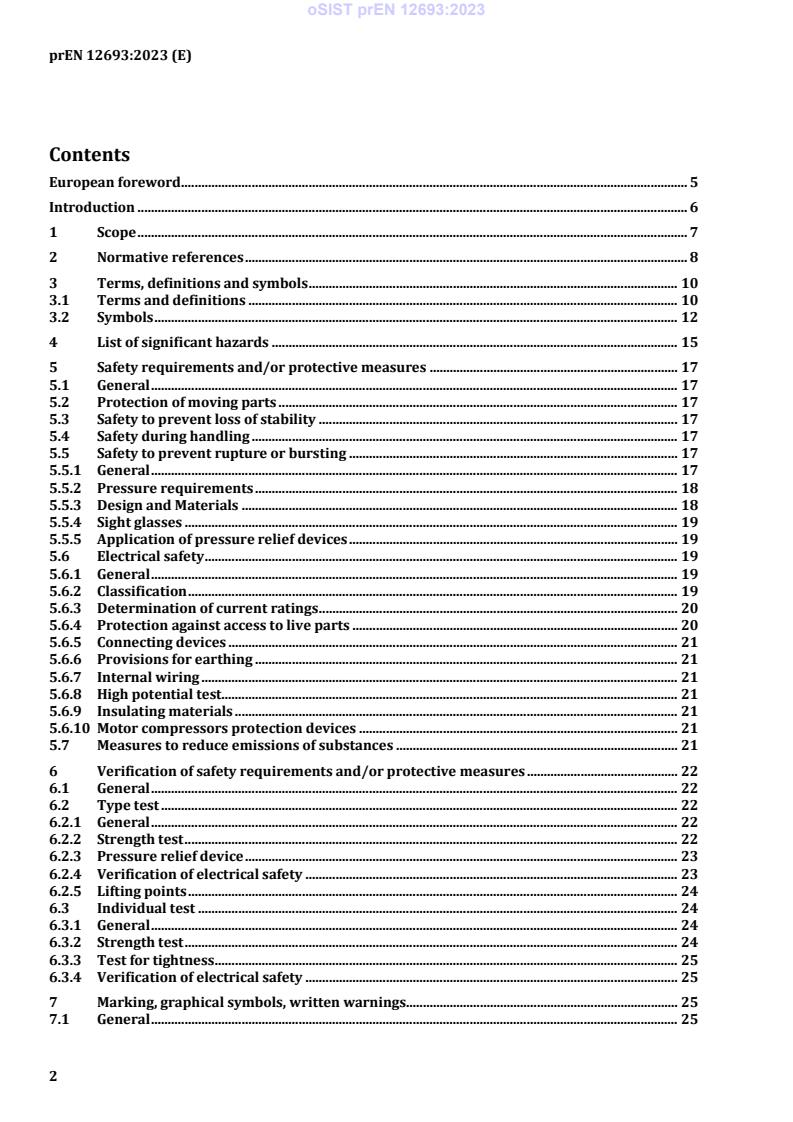
Contents
European foreword . 5
Introduction . 6
1 Scope . 7
2 Normative references . 8
3 Terms, definitions and symbols . 10
3.1 Terms and definitions . 10
3.2 Symbols . 12
4 List of significant hazards . 15
5 Safety requirements and/or protective measures . 17
5.1 General . 17
5.2 Protection of moving parts . 17
5.3 Safety to prevent loss of stability . 17
5.4 Safety during handling . 17
5.5 Safety to prevent rupture or bursting . 17
5.5.1 General . 17
5.5.2 Pressure requirements . 18
5.5.3 Design and Materials . 18
5.5.4 Sight glasses . 19
5.5.5 Application of pressure relief devices . 19
5.6 Electrical safety . 19
5.6.1 General . 19
5.6.2 Classification . 19
5.6.3 Determination of current ratings . 20
5.6.4 Protection against access to live parts . 20
5.6.5 Connecting devices . 21
5.6.6 Provisions for earthing . 21
5.6.7 Internal wiring . 21
5.6.8 High potential test. 21
5.6.9 Insulating materials . 21
5.6.10 Motor compressors protection devices . 21
5.7 Measures to reduce emissions of substances . 21
6 Verification of safety requirements and/or protective measures . 22
6.1 General . 22
6.2 Type test . 22
6.2.1 General . 22
6.2.2 Strength test . 22
6.2.3 Pressure relief device . 23
6.2.4 Verification of electrical safety . 23
6.2.5 Lifting points . 24
6.3 Individual test . 24
6.3.1 General . 24
6.3.2 Strength test . 24
6.3.3 Test for tightness . 25
6.3.4 Verification of electrical safety . 25
7 Marking, graphical symbols, written warnings. 25
7.1 General . 25
oSIST prEN 12693:2023
prEN 12693:2023 (E)
7.2 Marking . 26
7.3 Graphical symbols, written warnings and information . 27
7.3.1 Lifting points . 27
7.3.2 Pressurizing the housing . 27
7.3.3 Lubricant charge . 27
8 Appropriate manufacturing procedures . 27
9 Documentation and information for the user . 28
9.1 General . 28
9.2 Instruction handbook . 28
Annex A (normative) Procedure for the design of a refrigerant compressor by calculation . 29
A.1 Calculation method . 29
A.1.1 General . 29
A.1.2 Strength values for the design calculation . 29
A.1.3 Documentation . 29
A.2 Design stress to be used for the calculation . 30
A.2.1 Design stress for main pressure bearing parts . 30
A.2.2 Design calculation of screws, fasteners, nuts and bolts . 32
Annex B (normative) Experimental design method for refrigerant compressors . 33
B.1 Experimental design method . 33
B.1.1 General . 33
B.1.2 Choice and verification of material properties . 33
B.1.3 Procedure for the experimental design method . 33
B.1.4 Testing at maximum allowable design test pressure P . 33
F
B.1.5 Testing at minimum burst test pressure P . 34
Test
B.1.6 Documentation . 34
B.2 Determination of maximum allowable design test pressure PF . 34
B.3 Determination of the minimum burst test pressure P . 35
Test
B.4 Correction for the actual wall thickness . 35
Annex C (normative) Determination of the allowable pressure at the maximum operating
temperature . 37
C.1 Relation of the allowable pressure and higher temperatures . 37
C.1.1 General . 37
C.1.2 Documentation . 37
C.2 Determination of the maximum allowable pressure at higher temperatures . 37
Annex D (normative) Determination of the allowable pressure at minimum operating
temperature — Requirements to avoid brittle fracture . 38
D.1 Relation of the allowable pressure and lower temperatures . 38
D.1.1 General . 38
D.1.2 Requirements of materials and proof of material properties . 38
oSIST prEN 12693:2023
prEN 12693:2023 (E)
D.1.3 Documentation . 38
D.2 Determination of the maximum allowable pressure at the minimum operating
temperature . 39
D.3 Determination of the maximum allowable pressure at the minimum operating
temperature on the basis of an empirical method (t -Method) . 39
min
D.3.1 General . 39
, t and t . 39
D.3.2 Determining tmin 100 min 75 min 25
D.3.3 Welded constructions . 40
D.3.4 Determination of the safety factor . 40
D.3.5 Material test and documentation . 40
D.4 Determination of the minimum operating temperature TS based on reference
min
thickness e . 40
B
D.4.1 General . 40
D.4.2 Temperature adjustment . 41
D.4.3 Determining design reference temperature T . 41
R
D.5 Determination of screws, fasteners, nuts and bolts below – 10 °C . 48
Annex E (informative) Compilation of material characteristics of often used materials . 49
Annex F (informative) Basic design criteria for refrigerant compressors . 74
F.1 General . 74
F.2 Compressor capability against technical performance . 74
F.2.1 Design, dimensioning and manufacturing rules . 74
F.2.2 Choice of material . 74
F.3 Compressor capability against user requirements . 74
F.3.1 Design, dimensioning and manufacturing rules . 74
F.3.2 Choice of material . 75
Annex ZA (informative) Relationship between this European Standard and the essential
requirements of EU-Directive 2006/42/EC aimed to be covered . 76
Bibliography . 78
oSIST prEN 12693:2023
prEN 12693:2023 (E)
European foreword
This document (prEN 12693:2023) has been prepared by Technical Committee CEN/TC 182
“Refrigerating systems, safety and environmental requirements”, the secretariat of which is held by DIN.
This document is currently submitted to the CEN Enquiry.
This document will supersede EN 12693:2008.
The main changes with respect to the previous edition are listed below:
a) normative referenced updated
b) thermal hazards added to Clause 4 Table 2
c) requirements on vibration added to 5.1
d) requirements for spacings in 5.6.4 Table 3 adjusted
e) NOTE in 6.2.3 transferred to normative text
f) requirements for testing in 6.3.4 modified
g) editorially revised
This document has been prepared under a Standardization Request given to CEN by the European
Commission and the European Free Trade Association, and supports essential requirements of EU
Directive(s) / Regulation(s).
For relationship with EU Directive(s) / Regulation(s), see informative Annex ZA, which is an integral part
of this document.
oSIST prEN 12693:2023
prEN 12693:2023 (E)
Introduction
This standard is a type C standard as stated in EN ISO 12100.
The machinery concerned and the extent to which hazards, hazardous situations and hazardous events
are covered are indicated in the scope of this standard.
When provisions of this type C standard are different from those which are stated in type A or B
standards, the provisions of this type C standard take precedence over the provisions of the other
standards, for machines that have been designed and built according to the provisions of this type C
standard.
oSIST prEN 12693:2023
prEN 12693:2023 (E)
1 Scope
This document applies to positive displacement refrigerant compressors for stationary and mobile
refrigerating systems and heat pumps defined in 3.1, hereafter called compressors.
It applies for compressors used in commercial and industrial appliances and with electrical energy supply
including integral motors, up to 1 000 VAC and 1 500 VDC.
It applies to open drive, semi hermetic and hermetic motor compressors, which contain a positive
compression function.
This document is not applicable to:
— compressors used in household appliance for which EN 60335-2-34 applies;
— compressors using water or air as refrigerant;
— compressors in vehicle air conditioning systems covered by a specific product standard, e.g.
ISO 13043
This document does not deal with requirements for emission of noise and vibration .
NOTE 1 Compressors for automotive comfort air conditioning systems can be developed according e.g. SAE J
639.
NOTE 2 Noise emission depends on the complete installation of the built-in compressors and the corresponding
operating conditions.
For semi-hermetic and open drive compressors which include moving parts and for which the external
envelope is primarily designed for mechanical loads, thermal loads (to limit the possible deformation due
to temperature), stiffness of the structure (external mechanical loads and weight of the equipment),
taking into account established safe industrial practice, it is considered that pressure is not a significant
design factor.
Attached parts covering other functions e.g. oil separators, oil coolers, suction accumulators comply to
EN 14276-1 or EN 13445-6 (cast iron) or EN 13445-8 (aluminium) or show compliance to the relevant
European requirements. This applies also to shells for hermetic compressors either welded or with any
kind of permanent joint.
Requirements for compressors used in explosive atmospheres are not covered by this document.
NOTE 3 For further guidance see EN 13463-1.
This document deals with significant hazards, hazardous situations and events relevant to compressors,
when they are used as intended and under conditions for misuse which are reasonably foreseeable by
the manufacturer (see Clause 4).
This document specifies safety requirements for the design, construction, manufacture and testing,
documentation and marking of compressors, including integral accessories, e.g. shut-off valve, if
necessary.
The requirements in this document take account of the intended use, as defined in EN ISO 12100:2010,
3.12.
This document relates to the compressor itself which is to be incorporated in a refrigerating system.
This document is not applicable to compressors as defined in the scope which are manufactured before
the date of publication.
oSIST prEN 12693:2023
prEN 12693:2023 (E)
2 Normative references
The following documents are referred to in the text in such a way that some or all of their content
constitutes requirements of this document. For dated references, only the edition cited applies. For
undated references, the latest edition of the referenced document (including any amendments) applies.
EN 378-1:2016+A1:2020, Refrigerating systems and heat pumps - Safety and environmental requirements
- Part 1: Basic requirements, definitions, classification and selection criteria
EN 378-2:2016, Refrigerating systems and heat pumps - Safety and environmental requirements - Part 2:
Design, construction, testing, marking and documentation
EN 1515-1:1999, Flanges and their joints - Bolting - Part 1: Selection of bolting
EN 1515-2:2001, Flanges and their joints - Bolting - Part 2: Classification of bolt materials for steel flanges,
PN designated
EN 1515-3:2005, Flanges and their joints - Bolting - Part 3: Classification of bolt materials for steel flanges,
class designated
EN 1515-4:2021, Flanges and their joints - Bolting - Part 4: Selection of bolting for equipment subject to the
Pressure Equipment Directive 2014/68/EU
EN 1779:1999 , Non-destructive testing - Leak testing - Criteria for method and technique selection
EN 10204:2004, Metallic products - Types of inspection documents
EN 13136:2013+A1:2018, Refrigerating systems and heat pumps - Pressure relief devices and their
associated piping - Methods for calculation
EN 20898 (series), Mechanical properties of fasteners
EN 60034-1:2010, Rotating electrical machines - Part 1: Rating and performance (IEC 60034-1:2010,
modified)
EN 60204-1:2018, Safety of machinery - Electrical equipment of machines - Part 1: General requirements
(IEC 60204-1:2016, modified)
EN 60529:1991, Degrees of protection provided by enclosures (IP Code) (IEC 60529 1989 + A1:1999 +
A2:2013 + Cor.1:2019)
EN 60999-1:2000, Connecting devices - Electrical copper conductors - Safety requirements for screw-type
and screwless-type clamping units - Part 1: General requirements and particular requirements for clamping
2 2
units for conductors from 0,2 mm up to 35 mm (included) (IEC 60999-1:1999)
Document impacted by A1:2003.
Document impacted by Corrigendum October 2010.
Document impacted by A1:2000, A2:2013 and AC:2019-02.
oSIST prEN 12693:2023
prEN 12693:2023 (E)
EN 60999-2:2003, Connecting devices - Electrical copper conductors - Safety requirements for screw-type
and screwless-type clamping units - Part 2: Particular requirements for clamping units for conductors above
2 2
35 mm up to 300 mm (included) (IEC 60999-2:2003)
EN 61010-1:2010, Safety requirements for electrical equipment for measurement, control and laboratory
use — Part 1: General requirements (IEC 61010-1:2010 + COR:2011 + A1:2016, modified +
A1:2016/COR1:2019)
EN ISO 898-1:2013, Mechanical properties of fasteners made of carbon steel and alloy steel - Part 1: Bolts,
screws and studs with specified property classes - Coarse thread and fine pitch thread (ISO 898-1:2013)
EN ISO 898-2:2022, Mechanical properties of fasteners made of carbon steel and alloy steel — Part 2: Nuts
with specified property classes – Coarse thread and fine pitch thread (ISO 898-2:2022)
EN ISO 898-3:2018, Mechanical properties of fasteners made of carbon steel and alloy steel — Part 3: Flat
washers with specified property classes (ISO 898-3:2018 + Amd 1:2020)
EN ISO 898-5:2012, Mechanical properties of fasteners made of carbon steel and alloy steel - Part 5: Set
screws and similar threaded fasteners with specified hardness classes - Coarse thread and fine pitch thread
(ISO 898-5:2012)
EN ISO 4126 (series), Safety devices for protection against excessive pressure (ISO 4126 series)
EN ISO 9606-1:2017, Qualification testing of welders - Fusion welding - Part 1: Steels (ISO 9606-1:2012
including Cor 1:2012 and Cor 2:2013)
EN ISO 12100:2010, Safety of machinery - General principles for design - Risk assessment and risk reduction
(ISO 12100:2010)
EN ISO 13732-1:2008, Ergonomics of the thermal environment - Methods for the assessment of human
responses to contact with surfaces - Part 1: Hot surfaces (ISO 13732-1:2006)
EN ISO 13857:2019, Safety of machinery - Safety distances to prevent hazard zones being reached by upper
and lower limbs (ISO 13857:2019)
EN ISO 14120:2015, Safety of machinery - Guards - General requirements for the design and construction
of fixed and movable guards (ISO 14120:2015)
EN ISO 15607:2019, Specification and qualification of welding procedures for metallic materials - General
rules (ISO 15607:2019)
EN ISO 15614-1:2017, Specification and qualification of welding procedures for metallic materials -
Welding procedure test - Part 1: Arc and gas welding of steels and arc welding of nickel and nickel alloys
(ISO 15614-1:2017 + Amd 1:2019)
Document impacted by A1:2019 and A1:2019/AC:2019.
Document impacted by A1:2021.
Document impacted by A1:2019.
oSIST prEN 12693:2023
prEN 12693:2023 (E)
EN ISO 15614-2:2005, Specification and qualification of welding procedures for metallic materials -
Welding procedure test - Part 2: Arc welding of aluminium and its alloys (ISO 15614-2:2005)
EN ISO 21922:2021, Refrigerating systems and heat pumps - Valves - Requirements, testing and marking
(ISO 21922:2021)
CEN ISO/TR 15608:2017, Welding — Guidelines for a metallic material grouping system
(ISO/TR 15608:2017)
ISO 9606-2:2004, Qualification test of welders - Fusion welding - Part 2: Aluminium and aluminium alloys
ISO 10816-3:2009, Mechanical vibration – Evaluation of machine vibration by measurements on
nonrotating parts – Part 3: Industrial machines with nominal power above 15 kW and nominal speeds
between 120 r/min and 15 000 r/min when measured in situ
ISO 20816-1:2016, Mechanical vibration — Measurement and evaluation of machine vibration — Part 1:
General guidelines
ISO 20816-8:2018, Mechanical vibration — Measurement and evaluation of machine vibration — Part 8:
Reciprocating compressor systems
3 Terms, definitions and symbols
3.1 Terms and definitions
For the purposes of this document, the terms and definitions given in EN 378-1:2016+A1:2020,
EN ISO 12100:2010 and the following apply.
ISO and IEC maintain terminology databases for use in standardization at the following addresses:
— ISO Online browsing platform: available at https://www.iso.org/obp
— IEC Electropedia: available at https://www.electropedia.org
NOTE All pressures are gauge pressures unless otherwise specified.
3.1.1
positive displacement compressor
compressor in which compression is obtained by changing the internal volume of the compression
chamber
Document impacted by Amd.1:2017.
oSIST prEN 12693:2023
prEN 12693:2023 (E)
3.1.2
maximum allowable pressure
PS
maximum allowable pressure as stated by the compressor manufacturer, chosen by the manufacturer for
each pressure stage of the compressor
Note 1 to entry: The common situation is that different values for PS are chosen for each pressure stage of the
compressor.
Note 2 to entry: There are in minimum two pressure stages on each compressor: the low pressure side (LP) and
the high pressure side (HP), but additional intermediate pressure stage(s) can be present.
Note 3 to entry: The individual pressure stage of a compressor is connected to the corresponding “part of the
refrigerating system”, as defined in EN 378-1:2016+A1:2020, 3.1.8.
3.1.3
compressor overflow device
device specifically intended to protect only the compressor against bursting caused by abnormal
conditions, e.g. the discharge valve shut
Note 1 to entry: The device relieves from the high pressure/intermediate side of the compressor to a lower
pressure side.
Note 2 to entry: The device may be a bursting disc or may be a spring loaded overflow valve. Spring loaded
overflow valves can be either back pressure compensating or back pressure dependent type.
3.1.4
corrosion
all forms of material waste (e. g. oxidation, erosion, wear and abrasion)
3.1.5
maximum operating temperature
highest temperature that can occur during operation or standstill of the refrigerating system or during
testing under test conditions
3.1.6
minimum operating temperature
lowest temperature that can occur during operation or standstill of the refrigerating system or during
testing under test conditions
3.1.7
pressure bearing part
part, which is subject to stress due to internal pressure greater than 50 kPa (0,5 bar) gauge
3.1.8
main pressure bearing part
part, which constitute the envelope under pressure, essential for the integrity of the equipment
Note 1 to entry: Examples are housings, ends and flanges.
[SOURCE: EN 13445-1:2021]
oSIST prEN 12693:2023
prEN 12693:2023 (E)
3.1.9
maximum allowable pressure at ambient temperature (–10 °C to + 50 °C)
PS
maximum pressure for which the refrigerant compressor is designed, as specified by the manufacturer,
at ambient temperature (–10 °C to + 50 °C)
3.2 Symbols
For the purposes of this document, the symbols of Table 1 apply.
Table 1 — Symbols
A Elongation after fracture where the measured length is equal or greater than mm
L
0,4 times of diameter of the rod
A Elongation after fracture where the measured length is equal to 5 times of %
diameter of the rod
a Lifetime in years for calculating effect of corrosion; typically 20 years —
C Factor to compensate for the quality of a casting —
Q
δ Negative wall thickness tolerance mm
e
e Actual wall thickness at given measuring points of the refrigerant compressor mm
act
to be tested
e Reference thickness is the minimum material thickness needed to give mm
B
adequate strength to pressure bearing parts
e Reduction in wall thickness caused by occurrence of corrosion mm
c
e Wall thickness as specified in the design drawing mm
con
KV Impact rupture energy J
KV Threshold value of impact rupture energy, where the impact rupture energy J
is defined as independent of the temperature
t
KV Standard value of impact rupture energy at standard temperature of the J
material
KV Impact rupture energy at minimum operating temperature TS J
TS min min
P Maximum allowable design test pressure bar
F
PS Maximum allowable pressure bar
PS Maximum allowable pressure at ambient temperature (−10 °C to + 50 °C) bar
PS Maximum allowable pressure at maximum operating temperature bar
TS max
PS Maximum allowable pressure at minimum operating temperature bar
TS min
P Minimum burst test pressure (greater than P ) bar
Test F
R Proof strength, 0,2 % offset at ambient temperature MPa,
p 0,2
N/mm
R Proof strength, 0,2 % offset at minimum operating temperature MPa,
p 0,2 TS min
N/mm
R Proof strength, 0,2 % offset at temperature t MPa,
p 0,2/t
N/mm
oSIST prEN 12693:2023
prEN 12693:2023 (E)
Rp 0,2 TS max Proof strength, 0,2 % offset at maximum operating temperature MPa,
N/mm
R Proof strength, 1,0 % offset at ambient temperature MPa,
p 1,0
N/mm
R Upper yield strength MPa,
eH
N/mm
R Upper yield strength at maximum operating temperature MPa,
eH TS max
N/mm
R Tensile strength MPa,
m
N/mm
R Tensile strength at maximum operating temperature MPa,
m TS max
N/mm
R Actual tensile strength of the material of the refrigerant compressor to be MPa,
m act
tested N/mm
R Tensile strength used for the design MPa,
m con
N/mm
S Factor to compensate effects of corrosion —
C
S relation between maximum allowable strength at operating temperature and —
fast
the maximum allowable strength at ambient temperature
S Factor taking into consideration the impact rupture energy reduction due to —
TS min
minimum operating temperature
S Factor to allow for the reduction in strength due to the maximum operating —
TS max
temperature
S Factor to allow for the test pressure —
σ
σ Initial design stress MPa,
con
N/mm
σ Allowable stress values derived from σ MPa,
corr con
N/mm
t Lowest temperature at which pressure bearing parts can be used, if their load °C
min 25
amounts to 25 % of the allowable design stress at 20 °C, taking the safety
factors according to Table A.1 into account
t Lowest temperature at which pressure bearing parts can be used, if their load °C
min 75
amounts to 75 % of the allowable design stress at 20 °C, taking the safety
factors according to Table A.1 into account
tmin 100 Lowest temperature at which pressure bearing parts can be used, if their load °C
amounts to 100 % of the allowable design stress at 20 °C, taking the safety
factors according to Table A.1 into account
T Design reference temperature is the minimum operating temperature TS
R min
adjusted. Used when determining TS based on reference thickness e
min B
T Temperature adjustment of the design reference temperature T
S R
T Impact test temperature
KV
TS Operating temperature °C
oSIST prEN 12693:2023
prEN 12693:2023 (E)
TSmin Lowest operating temperature °C
TS Maximum operating temperature °C
max
X Correction of the actual wall thickness relative to the wall thickness of the —
design
Y Correction on the basis of current strength values of the test sample relative —
to the strength parameters for the design of refrigerant compressor
Z Factor to allow for the quality of a joint (e.g. welded joint) —
∂ Wall thickness reduction per year mm
NOTE 1 bar = 0,1 MPa.
oSIST prEN 12693:2023
prEN 12693:2023 (E)
4 List of significant hazards
See Table 2.
This clause contains all significant hazards, hazardous situations and events, as far as they are dealt with in this standard, identified by risk
assessment as significant for type of compressors and which requires action to eliminate or reduce the risk. The risk assessment shall be made
according to EN ISO 12100. The compressors shall be manufactured in accordance with the principle listed in EN ISO 12100 to eliminate or reduce
the foreseeable risk.
Table 2 — List of significant hazards, hazardous situations, safety requirements and/or measures
Significant hazard
Safety requirements and/or
Hazardous situation Reference Verification
measures
according to EN ISO 12100
Mechanical
Moving parts Possible injuries to human body Guards 5.2 V
Loss of stability Possible injuries at transport and Fixing points 5.3 V
operation
Lifting points 5.4, 7.3.1 D / V
Lifting points 6.2.5 T
Rupture or bursting Possible injuries from ejected parts or Design criteria 5.5 D
fluid
Strength test 6.2.2, 6.2.3, 6.3.2 T
Tightness test 6.3.3 T
V
Electrical
Contact live parts Possible injuries from electrocution Design criteria 5.6.1, 5.6.2, 5.6.3, 5.6.4, D
5.6.5, 5.6.9
Earthing D
5.6.6
Internal wiring D
5.6.7
High potential test T
5.6.8,6.2.4, 6.3.4
Protection devices V
5.6.10
Electrostatic phenomena Possible injuries from electric shock Earthing 5.6.6 D
oSIST prEN 12693:2023
prEN 12693:2023 (E)
Significant hazard
Safety requirements and/or
Hazardous situation Reference Verification
measures
according to EN ISO 12100
Thermal
Contact with hot or cold Possible injuries to the skin Design criteria, Warning signs 5.1, 8.2
objects
Vibration
vibrating equipment Possible injuries from ejected parts or Design criteria 5.1
fluid
Materials and substances
Contact or inhaling gasses Possible injuries from aggressive Means and instructions 5.7 V
media at draining
Warning 7.3.2 V
NOTE Verification methods:
V Visual inspection, verifies the required features of the components
T A test or check verifies that the features provided perform their function in such a way that the requirement is met
M Measurement verifies that requirements are met to the specified limits
D Drawing and / or calculations verify that the design characteristics meet the requirements
oSIST prEN 12693:2023
prEN 12693:2023 (E)
5 Safety requirements and/or protective measures
5.1 General
Compressors shall comply with the safety requirements and/or measures of this clause.
In addition, the compressors shall be designed according to the principles of EN ISO 12100 for relevant
but not significant hazard, which are not dealt with by this standard.
Furthermore, the refrigerating system which the compressor is part of, shall be in accordance with the
requirements of the EN 378-2.
To avoid fatigue problems with parts of the refrigerating system connected to the compressor, vibration
values shall be classified and verified according to relevant part of ISO 10816 or ISO 20816. The following
parts of the standard are used:
— for reciprocating compressors ISO 20816-8:2018,
— for other compressors ISO 20816-1:2016 or ISO 10816-3:2009, depending on the power
consumption.
As surface temperatures on a refrigerant compressor and the attached parts and piping depend on
operating conditions and properties of specific refrigerants, protection shall be provided considering the
requirements in EN ISO 13732-1.
5.2 Protection of moving parts
Protection shall be provided for moving parts such as automatic drives, fans or indicators of capacity
controls by fixed guards according to EN ISO 14120. Openings such as slots, holes, etc. shall comply with
EN ISO 13857:2019, Table 4
5.3 Safety to prevent loss of stability
Compressors shall be equipped with fixing points to ensure that they shall not tip or fall over during
transport and operation.
5.4 Safety during handling
Compressors above 25 kg weight shall be equipped with lifting points or arrangement to enable safe
lifting, installation and maintenance. Lifting points or arrangements shall be designed for to carry
1,25 times the weight of the compressor allocated to the individual lifting point.
NOTE For design it is sufficient to use a factor 2 against deformation and a factor 3 against fracture correlated
to vertical lifting.
5.5 Safety to prevent rupture or bursting
5.5.1 General
Compressors and associated components shall be designed and manufactured to withstand the pressure
and temperatures which can occur during operation, standstill and transportation taking into account
the thermal, chemical and mechanical stresses to be expected.
The materials shall be selected based upon suitability for the application. The choice of materials and
selection of dimensions shall be based on the need for sufficient strength, rigidity and stability to cope
with dynamic effects. The ability of the compressor to withstand internal pressure shall be demonstrated
by type test (see 6.2) or by individual test (see 6.3).
oSIST prEN 12693:2023
prEN 12693:2023 (E)
5.5.2 Pressure requirements
The compressor shall be designed to withstand the pressures occurring during its intended use in a
refriger
...
Questions, Comments and Discussion
Ask us and Technical Secretary will try to provide an answer. You can facilitate discussion about the standard in here.
Loading comments...