


EN 15652:2009
(Main)Foodstuffs - Determination of niacin by HPLC
General Information
- Abstract
by high performance liquid chromatography (HPLC) by three different ways of hydrolysis, acid hydrolysis (A),
enzymatic hydrolysis (B) or acid/alkaline hydrolysis (C).
The method has been validated in interlaboratory tests on fortified and non-fortified samples such as breakfast
cereal powder, chocolate cereals, cooked ham, green peas, lyophilized green peas with ham, lyophilized soup,
nutritive orange juice, milk powder and wheat flour, at levels from 0,5 mg/100 g to 24 mg/100 g. For further
information on the validation data, see Annex B.
A and B give similar results for niacin. In options A and B niacin is calculated as the sum of nicotinamide and
nicotinic acid, and expressed as nicotinic acid [1]. Option C gives higher results than A and B for niacin with
non-supplemented cereals, but similar results for other products. In option C, niacin is calculated and
expressed as nicotinic acid after transformation of nicotinamide into nicotinic acid [2].
Option A is faster and cheaper than B and C.
Option B is used if an exact quantification of nicotinamide and nicotinic acid is needed. This cannot be done
with option A, because there is a slight transformation of nicotinamide into nicotinic acid during the acid
hydrolysis.
Option C quantifies total niacin. The alkaline hydrolysis is able to liberate other forms giving higher results for
niacin, which in some foods such as maize and cereals are not normally biologically available, see [3], [4] and
[5].
Information on a comparison between the three different ways of hydrolysis is given in Annex C.
- Status
- Published
- Publication Date
- 26-May-2009
- Technical Committee
- CEN/TC 275 - Food analysis - Horizontal methods
- Drafting Committee
- CEN/TC 275/WG 9 - Vitamins and Carotenoids
- Current Stage
- 9060 - Closure of 2 Year Review Enquiry - Review Enquiry
- Start Date
- 04-Jun-2026
- Completion Date
- 04-Jun-2026



Overview - EN 15652:2009 (Foodstuffs - Determination of niacin by HPLC)
EN 15652:2009 (CEN) specifies a validated HPLC method for determination of niacin (vitamin B3) in foodstuffs. The standard covers three extraction/hydrolysis options - acid hydrolysis (A), enzymatic hydrolysis (B) and acid/alkaline hydrolysis (C) - followed by HPLC separation with post‑column UV derivatization and fluorimetric detection. The method was validated by interlaboratory trials on a range of matrices (breakfast cereals, chocolate cereals, cooked ham, green peas, soups, orange juice, milk powder, wheat flour) at levels from 0.5 to 24 mg/100 g (see Annex B).
Key topics and technical requirements
- Three extraction routes
- Option A - acid hydrolysis (HCl, boiling 1 h): faster and cheaper; slight conversion of nicotinamide to nicotinic acid.
- Option B - enzymatic hydrolysis (NADase, 37 °C, ~18 h): used when separate quantification of nicotinamide and nicotinic acid is required.
- Option C - acid + alkaline hydrolysis (including autoclave step): measures total niacin (all forms converted to nicotinic acid), often higher for cereals due to liberation of bound, non‑bioavailable forms.
- Quantification
- Niacin is reported as nicotinic acid after molecular weight correction.
- Options A and B sum nicotinamide + nicotinic acid; Option C converts nicotinamide to nicotinic acid for total niacin.
- Chromatography & detection
- Reverse‑phase HPLC (recommended RP‑18 column, 250 × 4 mm, 5 µm) with mobile phase containing phosphate buffer + H2O2 + Cu2+.
- Post‑column UV irradiation (BLB lamp) with fluorescence detection (excitation 322 nm, emission 380 nm).
- Sample prep & validation
- Homogenization, filtration (0.45 µm) and matrix‑specific extraction steps are defined.
- Precision and comparison data are provided in Annexes B and C.
Applications - who uses EN 15652
- Food testing laboratories and quality control units verifying niacin content for:
- Nutritional labeling and compliance
- Fortification checks in cereals and processed foods
- Regulatory testing and official control
- Food manufacturers, cereal processors and nutrition researchers assessing:
- Total vs. bioavailable niacin
- Effectiveness of fortification processes
Related standards and references
- EN ISO 3696:1995 - water for analytical laboratory use (referenced for reagent grade water).
- Annex B - interlaboratory validation data; Annex C - comparison of hydrolysis options.
Keywords: EN 15652, niacin determination, HPLC, nicotinic acid, nicotinamide, acid hydrolysis, enzymatic hydrolysis, alkaline hydrolysis, post‑column derivatization, fluorimetric detection.
Relations
- Effective Date
- 28-Jan-2026
Get Certified
Connect with accredited certification bodies for this standard

BSI Group
BSI (British Standards Institution) is the business standards company that helps organizations make excellence a habit.

Bureau Veritas
Bureau Veritas is a world leader in laboratory testing, inspection and certification services.

DNV
DNV is an independent assurance and risk management provider.
Sponsored listings
Frequently Asked Questions
EN 15652:2009 is a standard published by the European Committee for Standardization (CEN). Its full title is "Foodstuffs - Determination of niacin by HPLC". This standard covers: by high performance liquid chromatography (HPLC) by three different ways of hydrolysis, acid hydrolysis (A), enzymatic hydrolysis (B) or acid/alkaline hydrolysis (C). The method has been validated in interlaboratory tests on fortified and non-fortified samples such as breakfast cereal powder, chocolate cereals, cooked ham, green peas, lyophilized green peas with ham, lyophilized soup, nutritive orange juice, milk powder and wheat flour, at levels from 0,5 mg/100 g to 24 mg/100 g. For further information on the validation data, see Annex B. A and B give similar results for niacin. In options A and B niacin is calculated as the sum of nicotinamide and nicotinic acid, and expressed as nicotinic acid [1]. Option C gives higher results than A and B for niacin with non-supplemented cereals, but similar results for other products. In option C, niacin is calculated and expressed as nicotinic acid after transformation of nicotinamide into nicotinic acid [2]. Option A is faster and cheaper than B and C. Option B is used if an exact quantification of nicotinamide and nicotinic acid is needed. This cannot be done with option A, because there is a slight transformation of nicotinamide into nicotinic acid during the acid hydrolysis. Option C quantifies total niacin. The alkaline hydrolysis is able to liberate other forms giving higher results for niacin, which in some foods such as maize and cereals are not normally biologically available, see [3], [4] and [5]. Information on a comparison between the three different ways of hydrolysis is given in Annex C.
by high performance liquid chromatography (HPLC) by three different ways of hydrolysis, acid hydrolysis (A), enzymatic hydrolysis (B) or acid/alkaline hydrolysis (C). The method has been validated in interlaboratory tests on fortified and non-fortified samples such as breakfast cereal powder, chocolate cereals, cooked ham, green peas, lyophilized green peas with ham, lyophilized soup, nutritive orange juice, milk powder and wheat flour, at levels from 0,5 mg/100 g to 24 mg/100 g. For further information on the validation data, see Annex B. A and B give similar results for niacin. In options A and B niacin is calculated as the sum of nicotinamide and nicotinic acid, and expressed as nicotinic acid [1]. Option C gives higher results than A and B for niacin with non-supplemented cereals, but similar results for other products. In option C, niacin is calculated and expressed as nicotinic acid after transformation of nicotinamide into nicotinic acid [2]. Option A is faster and cheaper than B and C. Option B is used if an exact quantification of nicotinamide and nicotinic acid is needed. This cannot be done with option A, because there is a slight transformation of nicotinamide into nicotinic acid during the acid hydrolysis. Option C quantifies total niacin. The alkaline hydrolysis is able to liberate other forms giving higher results for niacin, which in some foods such as maize and cereals are not normally biologically available, see [3], [4] and [5]. Information on a comparison between the three different ways of hydrolysis is given in Annex C.
EN 15652:2009 is classified under the following ICS (International Classification for Standards) categories: 67.050 - General methods of tests and analysis for food products. The ICS classification helps identify the subject area and facilitates finding related standards.
EN 15652:2009 has the following relationships with other standards: It is inter standard links to EN ISO 3696:1995. Understanding these relationships helps ensure you are using the most current and applicable version of the standard.
EN 15652:2009 is available in PDF format for immediate download after purchase. The document can be added to your cart and obtained through the secure checkout process. Digital delivery ensures instant access to the complete standard document.
Standards Content (Sample)
2003-01.Slovenski inštitut za standardizacijo. Razmnoževanje celote ali delov tega standarda ni dovoljeno.Lebensmittel - Bestimmung von Niacin mit HPLCProduits alimentaires - Dosage de la niacine par CLHPFoodstuffs - Determination of niacin by HPLC67.050Splošne preskusne in analizne metode za živilske proizvodeGeneral methods of tests and analysis for food productsICS:Ta slovenski standard je istoveten z:EN 15652:2009SIST EN 15652:2009en,fr,de01-september-2009SIST EN 15652:2009SLOVENSKI
STANDARD
EUROPEAN STANDARDNORME EUROPÉENNEEUROPÄISCHE NORMEN 15652May 2009ICS 67.050 English VersionFoodstuffs - Determination of niacin by HPLCProduits alimentaires - Dosage de la niacine par CLHPLebensmittel - Bestimmung von Niacin mit HPLCThis European Standard was approved by CEN on 23 April 2009.CEN members are bound to comply with the CEN/CENELEC Internal Regulations which stipulate the conditions for giving this EuropeanStandard the status of a national standard without any alteration. Up-to-date lists and bibliographical references concerning such nationalstandards may be obtained on application to the CEN Management Centre or to any CEN member.This European Standard exists in three official versions (English, French, German). A version in any other language made by translationunder the responsibility of a CEN member into its own language and notified to the CEN Management Centre has the same status as theofficial versions.CEN members are the national standards bodies of Austria, Belgium, Bulgaria, Cyprus, Czech Republic, Denmark, Estonia, Finland,France, Germany, Greece, Hungary, Iceland, Ireland, Italy, Latvia, Lithuania, Luxembourg, Malta, Netherlands, Norway, Poland, Portugal,Romania, Slovakia, Slovenia, Spain, Sweden, Switzerland and United Kingdom.EUROPEAN COMMITTEE FOR STANDARDIZATIONCOMITÉ EUROPÉEN DE NORMALISATIONEUROPÄISCHES KOMITEE FÜR NORMUNGManagement Centre:
Avenue Marnix 17,
B-1000 Brussels© 2009 CENAll rights of exploitation in any form and by any means reservedworldwide for CEN national Members.Ref. No. EN 15652:2009: ESIST EN 15652:2009
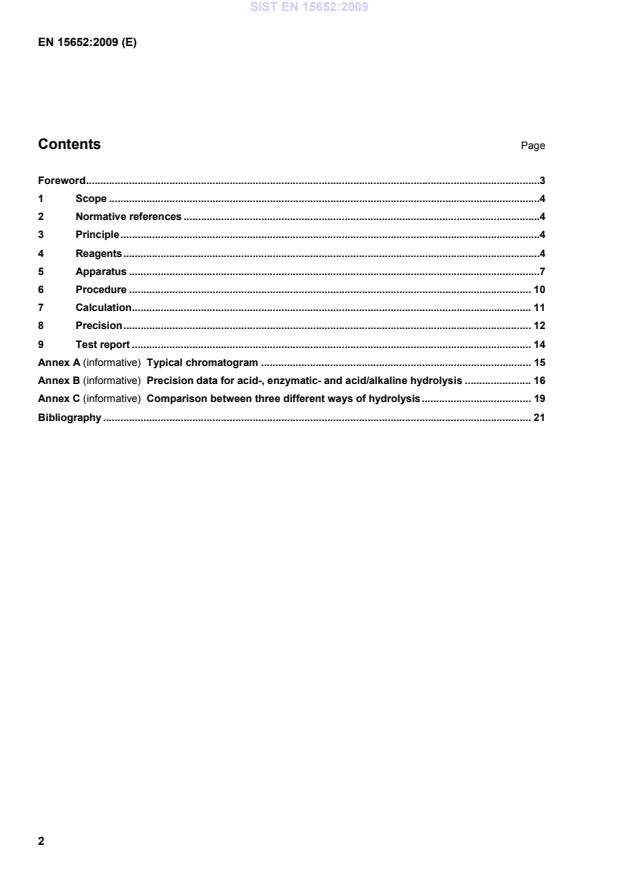
Typical chromatogram . 15Annex B (informative)
Precision data for acid-, enzymatic- and acid/alkaline hydrolysis . 16Annex C (informative)
Comparison between three different ways of hydrolysis . 19Bibliography . 21 SIST EN 15652:2009
-18 °C. 4.2.15 Hydrochloric acid solution (options A and C), c(HCl) = 0,1 mol/l
1 This information is given for the convenience of users of this European Standard and does not constitute an endorsement by CEN of the product named. Equivalent products may be used if they can be shown to lead to the same results. SIST EN 15652:2009
WARNING 1
— Harmful UV light could come out of the metal box containing the lamp. WARNING 2 — If bubble formation occurs in the tube due to overheating, the tube should be efficiently cooled by air circulation, for example by lifting the box.
2 LiChrospher® 60 RP-18 Select B endcapped and VL-120 BLB are examples of suitable products available commercially. This information is given for the convenience of users of ths European Standard and does not constitute an endorsement by CEN of the product named. Equivalent products may be used if they can be shown to lead to the same results. SIST EN 15652:2009
Key 1 lamp tube 2 from column 3 to detector Figure 1 — Schematic representation and dimensions (mm) of the lamp, lamp housing (in upside down position) and placement of the lamp housing on bench (in operating position)
Dimensions in millimetres
Key 1 reflector 2 lamp tube Figure 2 — Cross section of the lamp housing (in upside down position) with tube lamp and dimensions SIST EN 15652:2009
...