


EN 12814-4:2018
(Main)Testing of welded joints of thermoplastics semi-finished products - Part 4: Peel test
General Information
- Abstract
This document specifies the dimensions, the method of sampling and the preparation of the test specimens, and also the conditions for performing the peel test perpendicular to the weld in order to determine the peel resistance and the failure behaviour.
A peel test can be used in conjunction with other tests (e.g. tensile creep, macroscopic examination...) to assess the performance of welded assemblies, made from thermoplastics materials.
Peel tests are applicable to overlap welded assemblies made from thermoplastics materials.
The T-peel test as defined in Clause 5 will be used only for assessing welded sheet assemblies. This test is not applicable to welded test pieces containing sheets of different nominal thickness.
The decohesion test as defined in Clause 6 will be used only for assessing electrofusion joints with nominal thickness of pipe/fitting greater than 10 mm.
For socket fusion and for electrofusion socket joints with nominal outside diameter less than or equal to 90 mm, a crush test will be used, as defined in Clause 7.
The crush test can also be used for electrofusion joints with outside diameters greater than 90 mm.
The crush test for electrofusion saddle joints will be performed in accordance with ISO 13955 [1].
NOTE A decohesion test is also defined in ISO 13954 [2].
The tests defined in this standard are not intended to be used for assessment and/or qualification of thermoplastic fittings that already have their own requirements, e.g. polyethylene fittings according to EN 1555-3 [3] and EN 12201-3 [4].
- Status
- Published
- Publication Date
- 03-Apr-2018
- Withdrawal Date
- 30-Oct-2018
- Technical Committee
- CEN/TC 249 - Plastics
- Drafting Committee
- CEN/TC 249/WG 16 - Welding of thermoplastics
- Current Stage
- 9093 - Decision to confirm - Review Enquiry
- Start Date
- 29-Aug-2024
- Completion Date
- 17-Sep-2026

Overview
EN 12814-4:2018 - Testing of welded joints of thermoplastics semi‑finished products - Part 4: Peel test (CEN) specifies sampling, specimen dimensions, preparation and test conditions for performing peel tests perpendicular to a weld to determine peel resistance and failure behaviour of welded thermoplastic assemblies. The standard defines three main test methods (T‑peel, decohesion and crush tests), their intended scope and basic test procedures, and is intended to be used alongside other assessments such as tensile creep or macroscopic examination.
Key topics and requirements
- Scope and applicability
- Applicable to overlap welded assemblies made from thermoplastics.
- Not intended to replace specific fitting qualification requirements (e.g., EN 1555‑3, EN 12201‑3).
- T‑peel test (Clause 5)
- Used for welded sheet assemblies (T‑peel geometry).
- Defines specimen dimensions, conditioning, test speed (material‑dependent), apparatus requirements and calculation of peel resistance (P1 = mean maximum force / specimen width).
- Decohesion test (Clause 6)
- Intended for electrofusion joints with nominal wall thickness > 10 mm.
- Sections are cut at equidistant positions around the joint and subjected to longitudinal peel to record ductile vs brittle failure and percentage brittle fracture.
- Crush test (Clause 7)
- Used for socket fusion and electrofusion socket joints with nominal outside diameter ≤ 90 mm (and optionally > 90 mm).
- Describes axial sectioning and squeezing procedure to evaluate fusion-plane fracture and weld integrity.
- Electrofusion saddle joints: test performed per ISO 13955.
- Specimen preparation and conditioning
- Minimum ageing/conditioning times (e.g., at least 8 h between welding and machining); avoidance of heating and notching during cutting; marking original position.
- Test equipment and recording
- Conformance to ISO 5893 for tensile/compression test machines; requirements for displacement rate stability and force measurement accuracy.
- Reporting
- Test report content and failure mode documentation (force–displacement curves, location/length of brittle or ductile failure).
Applications and who uses this standard
- Quality control and R&D for manufacturers of thermoplastic pipes, fittings and semi‑finished sheets.
- Independent test laboratories performing weld qualification or failure analysis.
- Design and quality engineers assessing joint integrity after process changes (welding parameters, materials).
- Specifiers and regulators seeking standardized test methods for welded thermoplastic assemblies.
Related standards
- EN 12814 series (Parts 1–8) - complementary tests (bend, tensile, creep, macroscopic examination, etc.)
- ISO 5893 - test machine specification
- ISO 13954 / ISO 13955 - related decohesion/crush methods
- EN 14728 - weld imperfections
- EN 1555‑3, EN 12201‑3 - product‑specific polyethylene fittings requirements
Keywords: EN 12814‑4:2018, peel test, welded joints, thermoplastics, decohesion test, T‑peel, crush test, electrofusion, socket fusion, welding test standard.
Relations
- Effective Date
- 11-Apr-2018
- Effective Date
- 25-Aug-2026
- Effective Date
- 28-Jan-2026
- Effective Date
- 28-Jan-2026
- Effective Date
- 28-Jan-2026
- Effective Date
- 28-Jan-2026
- Effective Date
- 28-Jan-2026
- Effective Date
- 28-Jan-2026
- Effective Date
- 28-Jan-2026
- Effective Date
- 23-May-2018
- Effective Date
- 18-Nov-2015
Get Certified
Connect with accredited certification bodies for this standard

DVS-ZERT GmbH
German welding certification society.
CARES (UK Certification Authority for Reinforcing Steels)
UK certification for reinforcing steels and construction.
EWF/IIW (European/International Welding Federation)
International welding personnel certification.
Sponsored listings
Frequently Asked Questions
EN 12814-4:2018 is a standard published by the European Committee for Standardization (CEN). Its full title is "Testing of welded joints of thermoplastics semi-finished products - Part 4: Peel test". This standard covers: This document specifies the dimensions, the method of sampling and the preparation of the test specimens, and also the conditions for performing the peel test perpendicular to the weld in order to determine the peel resistance and the failure behaviour. A peel test can be used in conjunction with other tests (e.g. tensile creep, macroscopic examination...) to assess the performance of welded assemblies, made from thermoplastics materials. Peel tests are applicable to overlap welded assemblies made from thermoplastics materials. The T-peel test as defined in Clause 5 will be used only for assessing welded sheet assemblies. This test is not applicable to welded test pieces containing sheets of different nominal thickness. The decohesion test as defined in Clause 6 will be used only for assessing electrofusion joints with nominal thickness of pipe/fitting greater than 10 mm. For socket fusion and for electrofusion socket joints with nominal outside diameter less than or equal to 90 mm, a crush test will be used, as defined in Clause 7. The crush test can also be used for electrofusion joints with outside diameters greater than 90 mm. The crush test for electrofusion saddle joints will be performed in accordance with ISO 13955 [1]. NOTE A decohesion test is also defined in ISO 13954 [2]. The tests defined in this standard are not intended to be used for assessment and/or qualification of thermoplastic fittings that already have their own requirements, e.g. polyethylene fittings according to EN 1555-3 [3] and EN 12201-3 [4].
This document specifies the dimensions, the method of sampling and the preparation of the test specimens, and also the conditions for performing the peel test perpendicular to the weld in order to determine the peel resistance and the failure behaviour. A peel test can be used in conjunction with other tests (e.g. tensile creep, macroscopic examination...) to assess the performance of welded assemblies, made from thermoplastics materials. Peel tests are applicable to overlap welded assemblies made from thermoplastics materials. The T-peel test as defined in Clause 5 will be used only for assessing welded sheet assemblies. This test is not applicable to welded test pieces containing sheets of different nominal thickness. The decohesion test as defined in Clause 6 will be used only for assessing electrofusion joints with nominal thickness of pipe/fitting greater than 10 mm. For socket fusion and for electrofusion socket joints with nominal outside diameter less than or equal to 90 mm, a crush test will be used, as defined in Clause 7. The crush test can also be used for electrofusion joints with outside diameters greater than 90 mm. The crush test for electrofusion saddle joints will be performed in accordance with ISO 13955 [1]. NOTE A decohesion test is also defined in ISO 13954 [2]. The tests defined in this standard are not intended to be used for assessment and/or qualification of thermoplastic fittings that already have their own requirements, e.g. polyethylene fittings according to EN 1555-3 [3] and EN 12201-3 [4].
EN 12814-4:2018 is classified under the following ICS (International Classification for Standards) categories: 25.160.40 - Welded joints and welds. The ICS classification helps identify the subject area and facilitates finding related standards.
EN 12814-4:2018 has the following relationships with other standards: It is inter standard links to EN 12814-4:2001, ISO 5893:2002, EN 1307:2014, EN 13067:2020, EN 14879-4:2007, EN 12814-8:2021, EN 12814-8:2024, EN 12814-8:2001, EN 13067:2012, EN 12814-4:2018/AC:2018, EN 12654-1:1998. Understanding these relationships helps ensure you are using the most current and applicable version of the standard.
EN 12814-4:2018 is available in PDF format for immediate download after purchase. The document can be added to your cart and obtained through the secure checkout process. Digital delivery ensures instant access to the complete standard document.
Standards Content (Sample)
2003-01.Slovenski inštitut za standardizacijo. Razmnoževanje celote ali delov tega standarda ni dovoljeno.Prüfen von Schweißverbindungen aus thermoplastischen Kunststoffen - Teil 4: SchälversuchEssai des assemblages soudés sur produits semi-finis en thermoplastiques - Partie 4 : Essai de pelageTesting of welded joints of thermoplastics semi-finished products - Part 4: Peel test25.160.40Varjeni spoji in variWelded joints and weldsICS:Ta slovenski standard je istoveten z:EN 12814-4:2018SIST EN 12814-4:2018en,fr,de01-junij-2018SIST EN 12814-4:2018SLOVENSKI
STANDARDSIST EN 12814-4:20021DGRPHãþD
EUROPEAN STANDARD NORME EUROPÉENNE EUROPÄISCHE NORM
EN 12814-4
April
t r s z ICS
t wä s x rä v r Supersedes EN
s t z s væ vã t r r sEnglish Version
Testing of welded joints of thermoplastics semiæfinished products æ Part
vã Peel test Essai des assemblages soudßs sur produits semiæfinis en thermoplastiques æ Partie
v ã Essai de pelage
Prüfen von Schweißverbindungen aus thermoplastischen Kunststoffen æ Teil
vã SchälversuchThis European Standard was approved by CEN on
s r December
t r s yä
egulations which stipulate the conditions for giving this European Standard the status of a national standard without any alterationä Upætoædate lists and bibliographical references concerning such national standards may be obtained on application to the CENæCENELEC Management Centre or to any CEN memberä
translation under the responsibility of a CEN member into its own language and notified to the CENæCENELEC Management Centre has the same status as the official versionsä
CEN members are the national standards bodies of Austriaá Belgiumá Bulgariaá Croatiaá Cyprusá Czech Republicá Denmarká Estoniaá Finlandá Former Yugoslav Republic of Macedoniaá Franceá Germanyá Greeceá Hungaryá Icelandá Irelandá Italyá Latviaá Lithuaniaá Luxembourgá Maltaá Netherlandsá Norwayá Polandá Portugalá Romaniaá Serbiaá Slovakiaá Sloveniaá Spainá Swedená Switzerlandá Turkey and United Kingdomä
EUROPEAN COMMITTEE FOR STANDARDIZATION COMITÉ EUROPÉEN DE NORMALISATION EUROPÄISCHES KOMITEE FÜR NORMUNG
CEN-CENELEC Management Centre:
Rue de la Science 23,
B-1040 Brussels
t r s z CEN All rights of exploitation in any form and by any means reserved worldwide for CEN national Membersä Refä Noä EN
s t z s væ vã t r s z ESIST EN 12814-4:2018
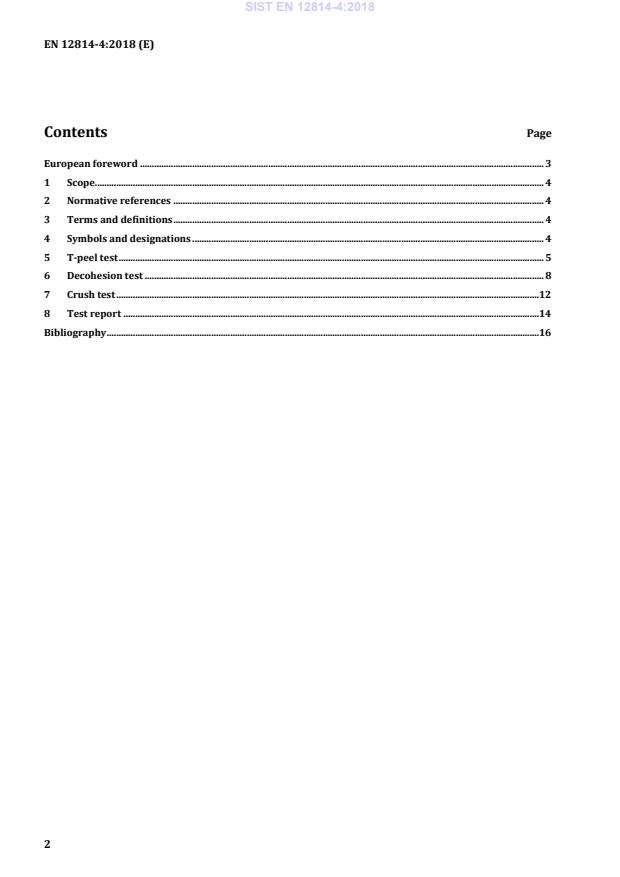
Contents Page European foreword . 3 1 Scope. 4 2 Normative references . 4 3 Terms and definitions . 4 4 Symbols and designations . 4 5 T-peel test . 5 6 Decohesion test . 8 7 Crush test . 12 8 Test report . 14 Bibliography . 16 SIST EN 12814-4:2018
Figure 1 — T-peel test specimen The value of Lc shall be greater than, or equal to, b. Table 2 — Dimensions of test specimen Dimensions in millimetres an b a Li an
1,5 15
15 1,5 < an
3 15
10 x an 3 < an
5 25
10 x an an > 5 5 x an
10 x an a
For reinforced materials, b shall be 50 mm. The tolerance for b shall be ± 0,5 mm. 5.2.2 Preparation of test specimens The time between the end of the welding operations and the start of machining operations, shall be at least 8 h. The welded test specimens shall be cut perpendicular to the welded joint. The test specimens shall be cut with parallel sides as shown in Figure 1. During cutting, heating of the test specimen should be avoided. Cutting of the test specimen shall not produce notches. After cutting, a visual examination of the weld should be carried out and any imperfections, as defined in EN 14728 [5], recorded. Each test specimen shall be marked so that its original position in the test piece can be identified. 5.2.3 Number of test specimens At least 5 specimens shall be tested for each welded test piece unless otherwise specified in the relevant application standard. SIST EN 12814-4:2018
...