


prEN 16423
(Main)Liquefied petroleum gases - Determination of dissolved residue - Gas chromatographic method using liquid, on-column injection
General Information
- Abstract
This European Standard specifies a method for the determination of the dissolved residual matter, also known as evaporation residue, in liquefied petroleum gases (LPG), by gas chromatography in the range of (10 to 600) mg/kg (ppm mass).
This test method quantifies soluble organic compounds (hydrocarbon materials), sometimes called ‘evaporation residue’, which can be present in liquefied petroleum gases and which are substantially less volatile than the LPG product, i.e. with a boiling point between 174 °C and 522 °C (C10 to C40). Higher boiling materials, or materials that adhere permanently to the chromatographic column, will not be detected.
WARNING - This standard does not purport to address all of the safety concerns, if any, associated with its use. It is the responsibility of the user of this standard to establish appropriate safety and health practices and determine the applicability of regulatory limitations prior to use.
- Status
- Not Published
- Publication Date
- 30-Jan-2028
- Technical Committee
- CEN/TC 19 - Petroleum products, lubricants and related products
- Current Stage
- 4020 - Submission to enquiry - Enquiry
- Start Date
- 10-Sep-2026
- Due Date
- 10-Sep-2026
- Completion Date
- 10-Sep-2026

Overview
prEN 16423 is a European draft standard developed by CEN for the determination of dissolved residue-also referred to as evaporation residue-in liquefied petroleum gases (LPG). This method employs gas chromatography with liquid, on-column injection to measure soluble organic compounds present in LPG within a range of 10 to 600 mg/kg. The standard aims to provide a highly sensitive, precise, and reproducible approach to quantify organic residues, particularly those with higher boiling points (C10 to C40, 174 °C to 522 °C), which are less volatile than LPG itself. Accurate detection of these residues is critical to maintaining fuel quality, protecting equipment, and ensuring regulatory compliance.
Key Topics
Dissolved Residue in LPG
Refers to the total amount of non-volatile organic compounds dissolved in LPG, often resulting from production, transport, or storage. This residue can impact LPG’s performance in practical applications.Gas Chromatographic Methodology
The standard specifies the use of high-pressure, liquid phase, on-column injection into a gas chromatograph equipped with a flame ionization detector (FID). This configuration allows for sensitive and selective detection and quantification of heavy hydrocarbon residues.Scope and Limitations
The method quantifies residues with boiling points between 174 °C and 522 °C (C10 to C40). Compounds with higher boiling points or those adhering permanently to chromatographic components go undetected.Calibration and Quality Control
Calibration is achieved with certified mineral oil standards, and daily validation is recommended. Annexes provide detailed guidance on quality assurance procedures, density corrections, and precision assessment.Safety Considerations
Due to the flammable and potentially hazardous nature of LPG, the standard emphasizes the need for rigorous safety, health, and regulatory compliance during the handling and analysis process.
Applications
LPG Production and Distribution
Ensuring that LPG used as fuel for automotive, domestic, or industrial purposes adheres to purity specifications by monitoring dissolved residues.Quality Control Laboratories
QC labs use this method for routine testing of LPG to meet internal standards and external regulatory requirements, supporting compliance with EN 589 and other fuel standards.Root Cause Analysis
The technique’s ability to provide both quantitative data and compositional 'fingerprinting' aids in tracing contaminants back to their source, facilitating improvements in process control or supply chain integrity.Research and Development
The method is valuable for R&D related to fuel formulation, process optimization, and understanding residue-related issues in downstream applications.
Related Standards
EN 589
Automotive fuels - LPG - Requirements and test methods: Defines the broader requirements and testing framework for automotive LPG.EN ISO 4257
Liquefied petroleum gases - Method of sampling: Provides standardized procedures for LPG sampling, essential for reliable analytical results.EN ISO 4259
Petroleum products - Determination and application of precision data in relation to methods of test: Offers guidance on evaluating repeatability and reproducibility.EN 15470 / EN 15471
Alternative manual methods for evaporation residue determination, with lower sensitivity compared to prEN 16423.EN ISO 8973
LPG - Calculation of density and mass/mass conversions: Used for density corrections in analytical calculations.
By implementing prEN 16423, stakeholders ensure that LPG quality is precisely monitored and controlled, supporting safe use, operational efficiency, and compliance with EU standards. This standard is essential for professionals involved in LPG analysis, quality control, and regulatory testing.
Relations
- Effective Date
- 22-Oct-2025
Get Certified
Connect with accredited certification bodies for this standard

Element Materials Technology
Materials testing and product certification.

ABS Group Brazil
ABS Group certification services in Brazil.

ABS Quality Evaluations Inc.
American Bureau of Shipping quality certification.
Sponsored listings
Frequently Asked Questions
prEN 16423 is a draft published by the European Committee for Standardization (CEN). Its full title is "Liquefied petroleum gases - Determination of dissolved residue - Gas chromatographic method using liquid, on-column injection". This standard covers: This European Standard specifies a method for the determination of the dissolved residual matter, also known as evaporation residue, in liquefied petroleum gases (LPG), by gas chromatography in the range of (10 to 600) mg/kg (ppm mass). This test method quantifies soluble organic compounds (hydrocarbon materials), sometimes called ‘evaporation residue’, which can be present in liquefied petroleum gases and which are substantially less volatile than the LPG product, i.e. with a boiling point between 174 °C and 522 °C (C10 to C40). Higher boiling materials, or materials that adhere permanently to the chromatographic column, will not be detected. WARNING - This standard does not purport to address all of the safety concerns, if any, associated with its use. It is the responsibility of the user of this standard to establish appropriate safety and health practices and determine the applicability of regulatory limitations prior to use.
This European Standard specifies a method for the determination of the dissolved residual matter, also known as evaporation residue, in liquefied petroleum gases (LPG), by gas chromatography in the range of (10 to 600) mg/kg (ppm mass). This test method quantifies soluble organic compounds (hydrocarbon materials), sometimes called ‘evaporation residue’, which can be present in liquefied petroleum gases and which are substantially less volatile than the LPG product, i.e. with a boiling point between 174 °C and 522 °C (C10 to C40). Higher boiling materials, or materials that adhere permanently to the chromatographic column, will not be detected. WARNING - This standard does not purport to address all of the safety concerns, if any, associated with its use. It is the responsibility of the user of this standard to establish appropriate safety and health practices and determine the applicability of regulatory limitations prior to use.
prEN 16423 is classified under the following ICS (International Classification for Standards) categories: 75.160.20 - Liquid fuels. The ICS classification helps identify the subject area and facilitates finding related standards.
prEN 16423 has the following relationships with other standards: It is inter standard links to EN 16423:2013. Understanding these relationships helps ensure you are using the most current and applicable version of the standard.
prEN 16423 is available in PDF format for immediate download after purchase. The document can be added to your cart and obtained through the secure checkout process. Digital delivery ensures instant access to the complete standard document.
Standards Content (Sample)
SLOVENSKI STANDARD
01-september-2026
Utekočinjeni naftni plini - Določanje raztopljenega ostanka - Metoda plinske
kromatografije z injiciranjem tekočine v kolono
Liquefied petroleum gases - Determination of dissolved residue - Gas chromatographic
method using liquid, on-column injection
Flüssiggas - Bestimmung gelöster Rückstände - Gaschromatographisches Prüfverfahren
durch Direkteinspritzung von Flüssigkeit auf die Säule
Gaz de pétrole liquéfié - Détermination des résidus dissous - Méthode par
chromatographie en phase gazeuse avec injection liquide on-column
Ta slovenski standard je istoveten z: prEN 16423
ICS:
75.160.20 Tekoča goriva Liquid fuels
2003-01.Slovenski inštitut za standardizacijo. Razmnoževanje celote ali delov tega standarda ni dovoljeno.
DRAFT
EUROPEAN STANDARD
NORME EUROPÉENNE
EUROPÄISCHE NORM
September 2026
ICS Will supersede EN 16423:2013
English Version
Liquefied petroleum gases - Determination of dissolved
residue - Gas chromatographic method using liquid, on-
column injection
Gaz de pétrole liquéfié - Détermination des résidus Flüssiggas - Bestimmung gelöster Rückstände -
dissous - Méthode par chromatographie en phase Gaschromatographisches Prüfverfahren durch
gazeuse avec injection liquide on-column Direkteinspritzung von Flüssigkeit auf die Säule
This draft European Standard is submitted to CEN members for enquiry. It has been drawn up by the Technical Committee
CEN/TC 19.
If this draft becomes a European Standard, CEN members are bound to comply with the CEN/CENELEC Internal Regulations
which stipulate the conditions for giving this European Standard the status of a national standard without any alteration.
This draft European Standard was established by CEN in three official versions (English, French, German). A version in any other
language made by translation under the responsibility of a CEN member into its own language and notified to the CEN-CENELEC
Management Centre has the same status as the official versions.
CEN members are the national standards bodies of Austria, Belgium, Bulgaria, Croatia, Cyprus, Czech Republic, Denmark, Estonia,
Finland, France, Germany, Greece, Hungary, Iceland, Ireland, Italy, Latvia, Lithuania, Luxembourg, Malta, Netherlands, Norway,
Poland, Portugal, Republic of North Macedonia, Romania, Serbia, Slovakia, Slovenia, Spain, Sweden, Switzerland, Türkiye and
United Kingdom.
Recipients of this draft are invited to submit, with their comments, notification of any relevant patent rights of which they are
aware and to provide supporting documentation.
Warning : This document is not a European Standard. It is distributed for review and comments. It is subject to change without
notice and shall not be referred to as a European Standard.
EUROPEAN COMMITTEE FOR STANDARDIZATION
COMITÉ EUROPÉEN DE NORMALISATION
EUROPÄISCHES KOMITEE FÜR NORMUNG
CEN-CENELEC Management Centre: Rue de la Science 23, B-1040 Brussels
© 2026 CEN All rights of exploitation in any form and by any means reserved Ref. No. prEN 16423:2026 E
worldwide for CEN national Members.
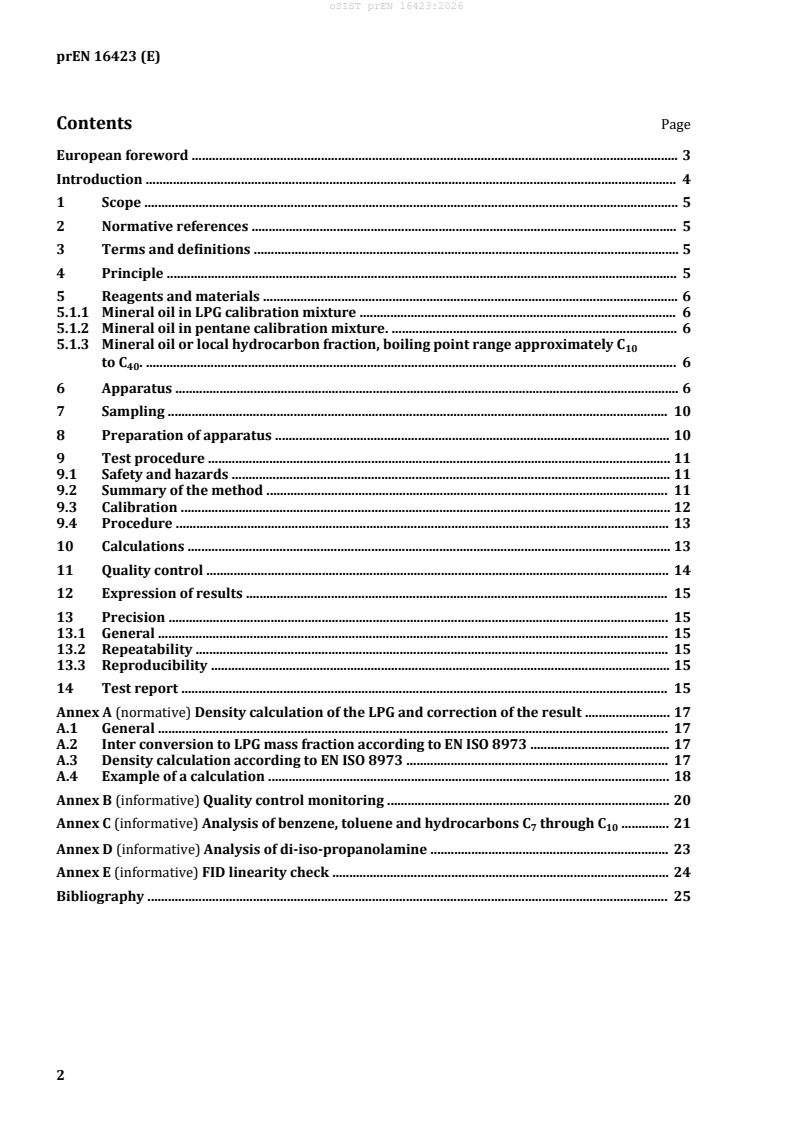
Contents Page
European foreword . 3
Introduction . 4
1 Scope . 5
2 Normative references . 5
3 Terms and definitions . 5
4 Principle . 5
5 Reagents and materials . 6
5.1.1 Mineral oil in LPG calibration mixture . 6
5.1.2 Mineral oil in pentane calibration mixture. . 6
5.1.3 Mineral oil or local hydrocarbon fraction, boiling point range approximately C
to C . . 6
6 Apparatus . 6
7 Sampling . 10
8 Preparation of apparatus . 10
9 Test procedure . 11
9.1 Safety and hazards . 11
9.2 Summary of the method . 11
9.3 Calibration . 12
9.4 Procedure . 13
10 Calculations . 13
11 Quality control . 14
12 Expression of results . 15
13 Precision . 15
13.1 General . 15
13.2 Repeatability . 15
13.3 Reproducibility . 15
14 Test report . 15
Annex A (normative) Density calculation of the LPG and correction of the result . 17
A.1 General . 17
A.2 Inter conversion to LPG mass fraction according to EN ISO 8973 . 17
A.3 Density calculation according to EN ISO 8973 . 17
A.4 Example of a calculation . 18
Annex B (informative) Quality control monitoring . 20
Annex C (informative) Analysis of benzene, toluene and hydrocarbons C through C . 21
7 10
Annex D (informative) Analysis of di-iso-propanolamine . 23
Annex E (informative) FID linearity check . 24
Bibliography . 25
European foreword
This document (prEN 16423:2026) has been prepared by Technical Committee CEN/TC 19 “Gaseous
and liquid fuels, lubricants and related products of petroleum, synthetic and biological origin”, the
secretariat of which is held by NEN.
This document is currently submitted to the CEN Enquiry.
This document will supersede EN 16423:2013.
- Refreshed chromatograms
- Clarification of the use of blank subtraction
- Addition of the calculation factors for DME
- Addition of an informative Annex F that presents a faster and extended methodology
Any feedback and questions on this document should be directed to the users’ national standards body.
A complete listing of these bodies can be found on the CEN website.
Introduction
Control over the residue content as spécifiéd in is of EN 589 [1] considerable importance in end-use
applications of Liquéfiéd Petroleum Gas (LPG). Dissolved residual matter, also known as evaporation
residue, in LPG is contamination which can occur during production, transportation or storage.
This standard has been developed as a potential replacement of the commonly used methods, as this
method of determination:
— is quicker and much more sensitive than manual methods, such as ASTM D 2158 [2] or EN 15471
[3], which are based on evaporation of (large) sample volumes followed by visual or gravimetric
estimation of residue content;
— provides enhanced sensitivity in measurements of heavier (evaporation) residues compared to
EN 15470 [4], with a quantification limit of 10 mg/kg total residue;
— gives both quantitative results and information about contaminant composition such as boiling
point range and fingérprint, which can be very useful in tracing the source of a particular
contaminant.
1 Scope
This document spécifiés a method for the determination of the dissolved residual matter, also known
as evaporation residue, in liquéfiéd petroleum gases (LPG), by gas chromatography in the range of (10
to 600) mg/kg (ppm mass).
This test method quantifiés soluble organic compounds (hydrocarbon materials), sometimes called
‘evaporation residue’, which can be present in liquéfiéd petroleum gases and which are substantially
less volatile than the LPG product, i.e. with a boiling point between 174 °C and 522 °C (C to C ). Higher
10 40
boiling materials, or materials that adhere permanently to the chromatographic column, will not be
detected.
WARNING This document does not purport to address all of the safety concerns, if any, associated with
its use. It is the responsibility of the user of this document to establish appropriate safety and health
practices and determine the applicability of regulatory limitations prior to use.
2 Normative references
The following documents are referred to in the text in such a way that some or all of their content
constitutes requirements of this document. For dated references, only the edition cited applies. For
undated references, the latest edition of the referenced document (including any amendments) applies.
ISO 1998-1, Petroleum industry — Terminology — Part 1: Raw materials and products
EN 589, Automotive fuels - LPG - Requirements and test methods
EN ISO 4257:2001/AC, Liquefied petroleum gases - Method of sampling (ISO 4257:2001/Cor.1:2007)
3 Terms and definitions
For the purposes of this document, the following terms and définitions apply/ the terms and définitions
given in EN 589, ISO 1998-1 and the following apply.
— ISO Online browsing platform: available athttp://www.iso.org/obp
— IEC Electropedia: available athttp://www.electropedia.org/
3.1
high pressure liquefied gas injector
sample introduction device which injects liquéfiéd gas samples under pressure and at room temperature
directly onto the chromatographic column thereby maintaining the sample in liquid phase during the
injection process
3.2
pressure station
device that supplies high pressure inert gas to a suitable sample cylinder and therefore maintains sample
in the liquid phase during the injection procedure
4 Principle
A small quantity of LPG is directly transferred in liquid phase from the sample cylinder on to a GC column
using a high pressure liquéfiéd gas injector. The mixture is then analysed by capillary gas
chromatography and the dissolved residue content is quantifiéd by the external standard method.
5 Reagents and materials
IMPORTANT - Standards that are prepared in pentane, normally liquid at room temperature, shall be
stored under refrigeration and transferred to sample cylinders prior to use. Alternatively, they can be
stored in air tight cylinders
5.1 Mineral oil in LPG calibration mixture.
One of the following mixtures shall be selected for calibration:
5.1.1 Mineral oil in LPG calibration mixture
cértifiéd calibration mixture with about 50 mg/kg mineral oil in LPG.
5.1.2 Mineral oil in pentane calibration mixture.
Prepare a calibration standard of mineral oil in pentane. Record the exact weighed value to the nearest
mg of mineral oil and calculate the concentration in mg/kg. The concentration of the mineral oil shall
be close to the expected concentration of the contamination in the LPG sample.
5.1.3 Mineral oil or local hydrocarbon fraction, boiling point range approximately C to C .
10 40
Alternatively, a well characterised local hydrocarbon fraction, within the range C to C , can be used
10 40
to provide quantitative and qualitative comparison to the contaminant in the sample. Care should be
taken to ensure no more than 10% m/m% of the sample falls outside the C to C range.
10 40
5.2 Validation standard, mineral oil in pentane.
Prepare a validation standard of mineral oil in pentane. Record the exact weighed value to the nearest
mg of mineral oil and calculate the concentration in mg/kg. The concentration of the mineral oil shall
be close to the expected concentration of the contamination in the LPG sample.
5.3 n-Alkane retention time standard, mixture containing at least C and C in a concentration
10 40
of (nominally) 5 mg/l each, dissolved in pentane or heptane.
5.4 Solvent, GC grade pentane.
6 Apparatus
NOTE Successfully used columns and conditions are given in Table 1.
6.1 Gas chromatograph, equipped with a Large Volume Cold on Column Injector (LVOCI), linear
temperature programmable column oven, and a flamé ionisation detector (FID), with data acquisition
and processing system.
For checking the linearity of the FID one may use Annex E.
6.2 Solvent vent, controlled to allow venting the major part of the matrix.
6.3 Retention gap, uncoated stainless steel capillary.
6.4 Retaining pre-column, a column with a polydimethylsiloxane stationary phase.
6.5 Analytical column, a column with a polydimethylsiloxane stationary phase.
6.6 Column coupler, coupling device suitable for leak free coupling of the retention gap to the
retaining pre-column.
See Figure 1 for a schematic overview of the couplings inside the GC oven and the couplings to the
solvent vent valve.
Table 1 — Typical column configuration
Equipment part Typical operation conditions
35 °C for 3 min, 35 °C to 340 °C at 25 °C/min, 340 °C for
Oven program
10 min
Type: cool on-column
Inlet program
Temp: 55 °C for 3 min, 55 °C to 340 °C at 25 °C/min, 340
°C for 9 min
Air flow: 400 ml/min
Hydrogen flow: 40 ml/min
Detector settings Make up gas flow: 20 ml/min
Temperature: 350 °C
Data rate: 20 Hz
a
Retention gap: Sulfinért® ) stainless steel capillary
with inner diameter 0,53 mm and length of 5 m
Column
Retaining pre-column: 3 m HP-1, 0,53 mm, 2,65 µm
Analytical column: HP-1, 30 m, 0,32 mm, 0,25 µm
Sample flow: 2 ml/min
Pressure station Nitrogen pressure: 2 500 kPa
Nitrogen purge pressure: 500 kPa
Liquéfiéd gas injector Injection: 25 ms
a
Sulfinért ® is a stainless steel treatment system from Restek Co., 110 Benner Circle, Bellefonte, PA 16823,
USA. This information is given for the convenience of users of this European Standard and does not constitute
an endorsement by CEN of the product named. Equivalent products may be used if they can be shown to lead to
the same results.
6.7 Column splitter, suitable for leak-free coupling of the retaining pre-column to one side of the
analytical column and the deactivated capillary on the other side.
See Figure 1 for a schematic overview of the couplings inside the GC oven and the couplings to the
solvent vent valve.
Key
A solvent vent valve
B cool on-column inlet
C detector
D column splitter
E retention gap
F retaining pre-column
G analytical column
Figure 1 — Column overview
6.8 High pressure liquefied gas injector, a high pressure valve as in Figure 2, directly connected
to a needle which is inserted in the injection port of the GC, after which the valve is triggered in order
to introduce a representative aliquot into the GC system without sample discrimination.
Key
A eletrical attachment
B solenoid on
C valve spring
D spray tip
E pressurised fuel injection
F injector casing
G plunger
Figure 2
High pressure valve
6.9 Pressure station, ensuring a sample in liquid phase at a constant pressure, with a typical
configuration as in Figure 3 .
Key
A sample cylinder
B sample line in
C injection device
D cool on column inlet
E gas chromatograph
F sample line out
G rotometer
H vaporiser
I waste system
Figure 3 — Typical configuration of the pressure station
7 Sampling
Unless otherwise spécifiéd in the commodity spécification, samples shall be taken as described in
EN ISO 4257:2001/AC and/or in accordance with the requirements of national regulations for the
sampling of the product under test.
8 Preparation of apparatus
WARNING Take all the necessary safety measures and, in particular, earth the equipment in order to
eliminate the risks associated with static electricity.
8.1 Gas chromatograph: install and verify performance in accordance with the manufacturer’s
instructions. Typical operating conditions are shown in Table 1.
8.2 Pressure station: install in accordance with the manufacturer’s instructions. Purge sample and
check carefully for leaks. Connect the outlet to a waste system.
8.3 High pressure liquefied gas injector: install in accordance with the manufacturer’s
instructions.
8.4 Column configuration: install the columns as shown in Figure 1, using low dead volume
connections, and check for leaks.
9 Test procedure
9.1 Safety and hazards
9.1.1 There is a significant firé hazard from LPG, and since the boiling point of LPG can be as low as
-41 °C, there is a risk of freezing “burns”. Take appropriate safety precautions to prevent ignition or
firé, and wear suitable protective equipment to protect against skin contact with LPG.
9.1.2 An appropriate laboratory ventilation system shall be used.
9.1.3 An appropriate waste line shall be installed. The pressure station and injector shall be
connected to this line. The waste line shall exit outside the building. An appropriate waste facility shall
be available for liquid (pentane).
9.1.4 The pressure station, cylinder, injector and controller shall be grounded appropriately.
9.2 Summary of the method
a) A sample cylinder of LPG is pressurised on the pressure station to 2 500 kPa using nitrogen or
helium.
b) The injection system is flushéd with LPG in liquid phase at room temperature. The end of the
injection purge line is connected to a heated vaporiser which vaporises the LPG before transporting
it to a waste disposal system.
c) After flushing, the injection device is routed to the GC injector port and LPG (25 ms activation time
equivalent to 30 µl) is introduced via a high pressure valve and needle which is inserted into the
Cool On Column inlet.
d) The gas chromatograph is equipped with a solvent vent which routes most of the LPG light
components out of the analytical system and leaves behind the components of interest.
e) The dissolved residue to be determined is retained on the pre-column.
f) After venting, the light ends, the flow from the pre-column is switched to the analytical column and
a temperature program is started.
g) Dissolved residue contaminants are separated and
...