


EN 13463-3:2005
(Main)Non-electrical equipment for use in potentially explosive atmospheres - Part 3: Protection by flameproof enclosure 'd'
General Information
- Abstract
This EN contains requirements for the construction and testing of equipment with type of protection flameproof enclosure, intended for use in potentially explosive atmospheres.
- Status
- Withdrawn
- Publication Date
- 19-Apr-2005
- Withdrawal Date
- 22-Sep-2026
- Current Stage
- 9960 - Withdrawal effective - Withdrawal
- Start Date
- 14-Mar-2018
- Completion Date
- 23-Sep-2026
- Directive
- Harmonized Standard2014/34/EU - Directive 2014/34/EU Of The European Parliament And Of The Council of 26 February 2014 on the harmonisation of the laws of the Member States relating to equipment and protective systems intended for use in potentially explosive atmospheres (recast)OJ Ref: C, C 126, HARMONIZIRAN OJ Date: 08-Apr-2016
Not Harmonized94/9/EC - Equipment and protective systems intended for use in potentially explosive atmospheres (ATEX)OJ Ref: C 300, C 57 OJ Date: 30-Nov-2005

Relations
- Effective Date
- 09-Feb-2026
- Refers
EN 60079-0:2004 - Electrical apparatus for explosive gas atmospheres - Part 0: General requirements - Effective Date
- 09-Feb-2026
- Effective Date
- 28-Jan-2026
- Effective Date
- 28-Jan-2026
- Effective Date
- 28-Jan-2026
- Effective Date
- 28-Jan-2026
Get Certified
Connect with accredited certification bodies for this standard

CIS Institut d.o.o.
Personal Protective Equipment (PPE) certification body. Notified Body NB-2890 for EU Regulation 2016/425 PPE.

Kiwa BDA Testing
Building and construction product certification.
Kmetijski inštitut Slovenije
Agricultural Institute of Slovenia. Soil testing, plant health, agricultural product analysis.
Sponsored listings
Frequently Asked Questions
EN 13463-3:2005 is a standard published by the European Committee for Standardization (CEN). Its full title is "Non-electrical equipment for use in potentially explosive atmospheres - Part 3: Protection by flameproof enclosure 'd'". This standard covers: This EN contains requirements for the construction and testing of equipment with type of protection flameproof enclosure, intended for use in potentially explosive atmospheres.
This EN contains requirements for the construction and testing of equipment with type of protection flameproof enclosure, intended for use in potentially explosive atmospheres.
EN 13463-3:2005 is classified under the following ICS (International Classification for Standards) categories: 13.230 - Explosion protection. The ICS classification helps identify the subject area and facilitates finding related standards.
EN 13463-3:2005 has the following relationships with other standards: It is inter standard links to EN 60079-1:2004, EN 60079-0:2004, EN 1127-1:1997, EN 13463-1:2001, EN 1127-2:2002, EN 1755:2015. Understanding these relationships helps ensure you are using the most current and applicable version of the standard.
EN 13463-3:2005 is associated with the following European legislation: EU Directives/Regulations: 2014/34/EU, 94/9/EC; Standardization Mandates: M/BC/CEN/92/46. When a standard is cited in the Official Journal of the European Union, products manufactured in conformity with it benefit from a presumption of conformity with the essential requirements of the corresponding EU directive or regulation.
EN 13463-3:2005 is available in PDF format for immediate download after purchase. The document can be added to your cart and obtained through the secure checkout process. Digital delivery ensures instant access to the complete standard document.
Standards Content (Sample)
2003-01.Slovenski inštitut za standardizacijo. Razmnoževanje celote ali delov tega standarda ni dovoljeno.Non-electrical equipment for use in potentially explosive atmospheres - Part 3: Protection by flameproof enclosure 'd'Appareils non électriques destinés a etre utilisés en atmospheres explosibles - Partie 3 : protection par enveloppe antidéflagrante 'd'Nicht-elektrische Geräte für den Einsatz in explosionsgefährdeten Bereichen - Teil 3: Schutz durch druckfeste Kapselung 'd'13.230Varstvo pred eksplozijoExplosion protectionICS:SIST EN 13463-3:2005enTa slovenski standard je istoveten z:EN 13463-3:200501-julij-2005SIST EN 13463-3:2005SLOVENSKI
STANDARD
EUROPEAN STANDARDNORME EUROPÉENNEEUROPÄISCHE NORMEN 13463-3April 2005ICS 13.230English versionNon-electrical equipment for use in potentially explosiveatmospheres - Part 3: Protection by flameproof enclosure 'd'Appareils non électriques destinés à être utilisés enatmosphères explosibles - Partie 3 : protection parenveloppe antidéflagrante 'd'Nicht-elektrische Geräte für den Einsatz inexplosionsgefährdeten Bereichen - Teil 3: Schutz durchdruckfeste Kapselung 'd'This European Standard was approved by CEN on 15 March 2005.CEN members are bound to comply with the CEN/CENELEC Internal Regulations which stipulate the conditions for giving this EuropeanStandard the status of a national standard without any alteration. Up-to-date lists and bibliographical references concerning such nationalstandards may be obtained on application to the Central Secretariat or to any CEN member.This European Standard exists in three official versions (English, French, German). A version in any other language made by translationunder the responsibility of a CEN member into its own language and notified to the Central Secretariat has the same status as the officialversions.CEN members are the national standards bodies of Austria, Belgium, Cyprus, Czech Republic, Denmark, Estonia, Finland, France,Germany, Greece, Hungary, Iceland, Ireland, Italy, Latvia, Lithuania, Luxembourg, Malta, Netherlands, Norway, Poland, Portugal, Slovakia,Slovenia, Spain, Sweden, Switzerland and United Kingdom.EUROPEAN COMMITTEE FOR STANDARDIZATIONCOMITÉ EUROPÉEN DE NORMALISATIONEUROPÄISCHES KOMITEE FÜR NORMUNGManagement Centre: rue de Stassart, 36
B-1050 Brussels© 2005 CENAll rights of exploitation in any form and by any means reservedworldwide for CEN national Members.Ref. No. EN 13463-3:2005: E
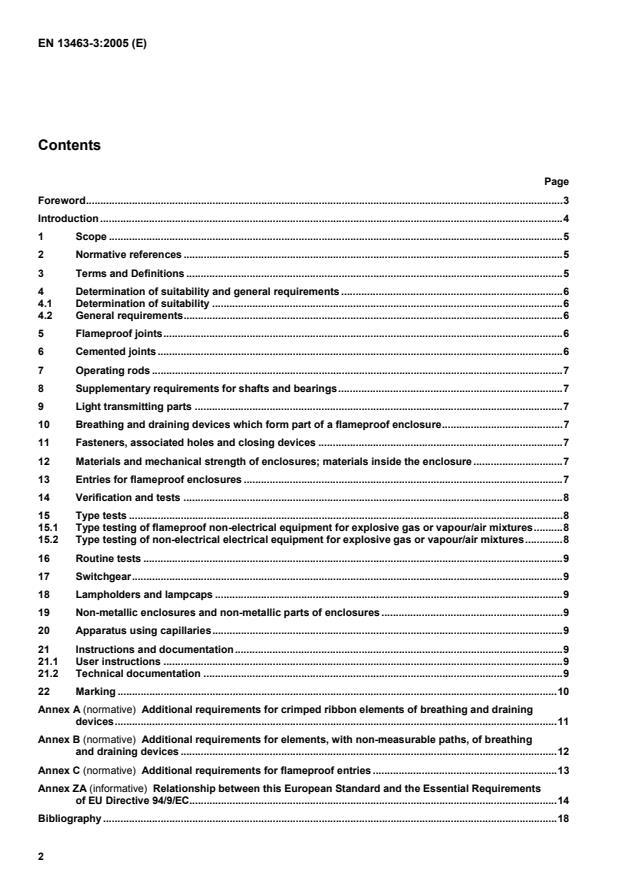
Additional requirements for crimped ribbon elements of breathing and draining devices.11 Annex B (normative)
Additional requirements for elements, with non-measurable paths, of breathing and draining devices.12 Annex C (normative)
Additional requirements for flameproof entries.13 Annex ZA (informative)
Relationship between this European Standard and the Essential Requirements of EU Directive 94/9/EC.14 Bibliography.18
According to the CEN/CENELEC Internal Regulations, the national standards organizations of the following countries are bound to implement this European Standard: Austria, Belgium, Cyprus, Czech Republic, Denmark, Estonia, Finland, France, Germany, Greece, Hungary, Iceland, Ireland, Italy, Latvia, Lithuania, Luxembourg, Malta, Netherlands, Norway, Poland, Portugal, Slovakia, Slovenia, Spain, Sweden, Switzerland and United Kingdom.
a) Equipment with potentially hot rubbing surfaces exceeding the ignition temperature of the atmosphere surrounding them, e.g. friction clutches and brake linings b) equipment that has to operate at high temperature to function correctly, such as catalytic converters in the exhaust systems of flameproof internal combustion engines, or hot catalytic pellistors used in the sensors of flammable gas measuring instruments, c) equipment producing incendive frictional sparks in normal operation. Little equipment is currently made to flameproof designs for dust applications, because alternative designs using dust tight enclosures are usually cheaper. There are however non-mining applications where both dust and gas are present, where this document may be applicable.
Where dust alone is present, there is usually no mechanism to create inside an enclosure an explosive dust cloud, although deposits of dust may form. The risk from a fire involving dust deposits inside the enclosure is not considered by this document, as it falls outside the concept of protection by flameproof enclosure.
The equipment grouping and temperature classification defined in EN 13463-1 apply. The subdivisions of the gas Group IIA, IIB and IIC described in EN 60079-0 (which refer to equipment atmospheres of different gases or vapours) also apply to the requirements for Group II equipment in this document. 4.2 General requirements All references to EN 60079-0 in EN 60079-1 shall additionally be taken as a reference to EN 13463-1 and where conflict occurs, EN 13463-1 shall take precedence. 5 Flameproof joints Flameproof joints shall conform to EN 60079-1:2004, Clause 5 which includes tables of the required maximum gap for different gas groups. The following modifications shall apply hereby: a) In EN 60079-1:2004, Clause 5 reference to the word “electrical” shall be replaced by “non-electrical” and the word “apparatus” shall be replaced by “equipment”. b) EN 60079-1:2004, 5.1 shall be replaced by the following: “When tested in accordance with 15.1 (Ability of the enclosure to withstand the pressure of an internal explosion), the enclosure shall not suffer permanent deformation or damage, which reduces the level of ignition protection provided by the enclosure to an unsatisfactory level. That is, by either weakening the mechanical strength / robustness of the enclosure, or by enlarging the width of any flameproof joint." "When tested in accordance with 15.2 (Ability of the enclosure joints to prevent flame transmission), the enclosure shall not transmit an incendive flame through its flameproof joints.” All flameproof joints, whether permanently closed or designed to be opened from time to time, shall comply, in the absence of pressure, with the requirements of Clause 5.
NOTE The values given in Clause 5 constitute the necessary conditions. Additional measures can be necessary in order to pass the non-transmission test of 15.2. The surface of joints may be protected against corrosion Coating with paint is not permitted. Other coating material may be used if the material and application procedure have been shown not to adve
...