


EN 16096:2012
(Main)Conservation of cultural property - Condition survey and report of built cultural heritage
General Information
- Abstract
This European Standard provides guidelines for a condition survey of built cultural heritage. It states how the condition of the built cultural heritage should be assessed, documented, recorded and reported on.
It encompasses evaluation of the condition of a building or other structure mainly by visual observation, together – when necessary – with simple measurements. The relevant data and documentation on the built cultural heritage should be collected and included in the report.
This European Standard can be applied to all built cultural heritage such as buildings, ruins, bridges and other standing structures. Built cultural heritage comprises both protected and non-protected significant buildings and structures. Archaeological sites and cultural landscapes are not dealt with in this standard.
This European Standard does not specify how to carry out a diagnosis (3.7) of the built cultural heritage. For listed/protected immovable heritage, specific national rules for expert documentation and works may apply.
This European Standard may be applied in order to:
a) identify maintenance measures and the need for further investigation and diagnostics of damage;
b) define procurement needs and the requirement for detailed specification;
c) provide a unified method to obtain comparative data, when carrying out a condition survey for a group of buildings or a region.
- Status
- Published
- Publication Date
- 31-Jul-2012
- Withdrawal Date
- 27-Feb-2013
- Technical Committee
- CEN/TC 346 - Conservation of cultural property
- Drafting Committee
- WG 17 - Management and monitoring of built heritage
- Current Stage
- 9093 - Decision to confirm - Review Enquiry
- Start Date
- 22-May-2024
- Completion Date
- 17-Sep-2026



Overview
EN 16096:2012 - Conservation of cultural property: Condition survey and report of built cultural heritage (CEN) provides a European guideline for assessing, documenting and reporting the physical condition of built cultural heritage. The standard covers condition surveys of buildings, ruins, bridges and other standing structures using mainly visual observation and simple measurements. It sets out what information should be collected, how to record condition, and how to produce a clear condition report to support conservation, maintenance and management decisions.
Key Topics and Requirements
- Scope and applicability
- Applies to all built cultural heritage (protected and non-protected); excludes archaeological sites and cultural landscapes.
- Does not specify diagnostic investigations; further diagnostics may be required beyond the standard.
- Survey objectives
- Establish the current condition, identify maintenance needs, and inform further investigation or procurement.
- Planning
- Define scope, resources, recording format, safety measures and required access/permits before inspection.
- Qualifications
- Surveys should be carried out by professionals familiar with traditional materials, construction techniques and decay mechanisms; interdisciplinary teams for complex sites.
- Information to record
- Object identification, geographic data, ownership and protection status; architectural and component descriptions; environmental/contextual factors.
- Recording condition
- Use agreed component lists, visual descriptions, condition classification and simple measurements where needed.
- Risk assessment & recommendations
- Assess risks to significance and stability, recommend maintenance, preventive conservation and any further investigations.
- Reporting
- Produce a dated, authored condition report summarizing findings, grading overall condition and listing prioritized recommendations.
- Supporting material
- Annex A provides an example reporting form; digital data management is recommended.
Practical Applications
- Heritage managers and owners use EN 16096:2012 to create standardized condition reports that support:
- Preventive conservation and routine maintenance planning
- Procurement specifications and tender documents
- Prioritization of repair works and budgeting
- Comparative surveys across multiple buildings or regions for asset management
- Typical users: conservation architects, surveyors, structural engineers, conservation officers, public heritage authorities, facility managers and consultants.
Related Standards
- EN 16095 - Condition reporting for decorative elements (e.g., mural paintings, stained glass)
- EN 15898 - Terminology and conservation principles referenced for definitions
EN 16096:2012 is a practical, management-focused standard ideal for organizations that need consistent, comparable condition surveys and robust documentation to support conservation, maintenance and decision-making for built cultural heritage.
Relations
- Effective Date
- 25-Mar-2026
- Effective Date
- 28-Jan-2026
- Referred By
EN 17429:2020 - Conservation of cultural heritage - Procurement of conservation services and works - Effective Date
- 28-Jan-2026
- Effective Date
- 28-Jan-2026
- Effective Date
- 28-Jan-2026
- Effective Date
- 28-Jan-2026
- Effective Date
- 28-Jan-2026
- Effective Date
- 28-Jan-2026
- Effective Date
- 28-Jan-2026
- Effective Date
- 28-Jan-2026
Frequently Asked Questions
EN 16096:2012 is a standard published by the European Committee for Standardization (CEN). Its full title is "Conservation of cultural property - Condition survey and report of built cultural heritage". This standard covers: This European Standard provides guidelines for a condition survey of built cultural heritage. It states how the condition of the built cultural heritage should be assessed, documented, recorded and reported on. It encompasses evaluation of the condition of a building or other structure mainly by visual observation, together – when necessary – with simple measurements. The relevant data and documentation on the built cultural heritage should be collected and included in the report. This European Standard can be applied to all built cultural heritage such as buildings, ruins, bridges and other standing structures. Built cultural heritage comprises both protected and non-protected significant buildings and structures. Archaeological sites and cultural landscapes are not dealt with in this standard. This European Standard does not specify how to carry out a diagnosis (3.7) of the built cultural heritage. For listed/protected immovable heritage, specific national rules for expert documentation and works may apply. This European Standard may be applied in order to: a) identify maintenance measures and the need for further investigation and diagnostics of damage; b) define procurement needs and the requirement for detailed specification; c) provide a unified method to obtain comparative data, when carrying out a condition survey for a group of buildings or a region.
This European Standard provides guidelines for a condition survey of built cultural heritage. It states how the condition of the built cultural heritage should be assessed, documented, recorded and reported on. It encompasses evaluation of the condition of a building or other structure mainly by visual observation, together – when necessary – with simple measurements. The relevant data and documentation on the built cultural heritage should be collected and included in the report. This European Standard can be applied to all built cultural heritage such as buildings, ruins, bridges and other standing structures. Built cultural heritage comprises both protected and non-protected significant buildings and structures. Archaeological sites and cultural landscapes are not dealt with in this standard. This European Standard does not specify how to carry out a diagnosis (3.7) of the built cultural heritage. For listed/protected immovable heritage, specific national rules for expert documentation and works may apply. This European Standard may be applied in order to: a) identify maintenance measures and the need for further investigation and diagnostics of damage; b) define procurement needs and the requirement for detailed specification; c) provide a unified method to obtain comparative data, when carrying out a condition survey for a group of buildings or a region.
EN 16096:2012 is classified under the following ICS (International Classification for Standards) categories: 97.195 - Items of art and handicrafts. Cultural property and heritage. The ICS classification helps identify the subject area and facilitates finding related standards.
EN 16096:2012 has the following relationships with other standards: It is inter standard links to EN 16853:2026, EN 17121:2019, EN 17429:2020, EN 16883:2017, EN 15759-1:2011, EN 16085:2012, EN 16853:2017, EN 17488:2021, EN 16682:2017, EN 15759-2:2018. Understanding these relationships helps ensure you are using the most current and applicable version of the standard.
EN 16096:2012 is available in PDF format for immediate download after purchase. The document can be added to your cart and obtained through the secure checkout process. Digital delivery ensures instant access to the complete standard document.
Standards Content (Sample)
2003-01.Slovenski inštitut za standardizacijo. Razmnoževanje celote ali delov tega standarda ni dovoljeno.GHGLãþLQHErhaltung des kulturellen Erbes - Zustandserhebung und Bericht für das gebaute KulturerbeConservation des biens culturels - Évaluation et rapport sur l'état du patrimoine culturel bâtiConservation of cultural property - Condition survey and report of built cultural heritage97.195Umetniški in obrtniški izdelkiItems of art and handicraftsICS:Ta slovenski standard je istoveten z:EN 16096:2012SIST EN 16096:2012en,de01-oktober-2012SIST EN 16096:2012SLOVENSKI
STANDARD
EUROPEAN STANDARD NORME EUROPÉENNE EUROPÄISCHE NORM
EN 16096
August 2012 ICS 97.195 English Version
Conservation of cultural property - Condition survey and report of built cultural heritage
Conservation des biens culturels - Évaluation et rapport sur l'état du patrimoine culturel bâti
Erhaltung des kulturellen Erbes - Zustandserhebung und Bericht für das gebaute Kulturerbe This European Standard was approved by CEN on 23 June 2012.
CEN members are bound to comply with the CEN/CENELEC Internal Regulations which stipulate the conditions for giving this European Standard the status of a national standard without any alteration. Up-to-date lists and bibliographical references concerning such national standards may be obtained on application to the CEN-CENELEC Management Centre or to any CEN member.
This European Standard exists in three official versions (English, French, German). A version in any other language made by translation under the responsibility of a CEN member into its own language and notified to the CEN-CENELEC Management Centre has the same status as the official versions.
CEN members are the national standards bodies of Austria, Belgium, Bulgaria, Croatia, Cyprus, Czech Republic, Denmark, Estonia, Finland, Former Yugoslav Republic of Macedonia, France, Germany, Greece, Hungary, Iceland, Ireland, Italy, Latvia, Lithuania, Luxembourg, Malta, Netherlands, Norway, Poland, Portugal, Romania, Slovakia, Slovenia, Spain, Sweden, Switzerland, Turkey and United Kingdom.
EUROPEAN COMMITTEE FOR STANDARDIZATION
COMITÉ EUROPÉEN DE NORMALISATION EUROPÄISCHES KOMITEE FÜR NORMUNG
Management Centre:
Avenue Marnix 17,
B-1000 Brussels © 2012 CEN All rights of exploitation in any form and by any means reserved worldwide for CEN national Members. Ref. No. EN 16096:2012: ESIST EN 16096:2012
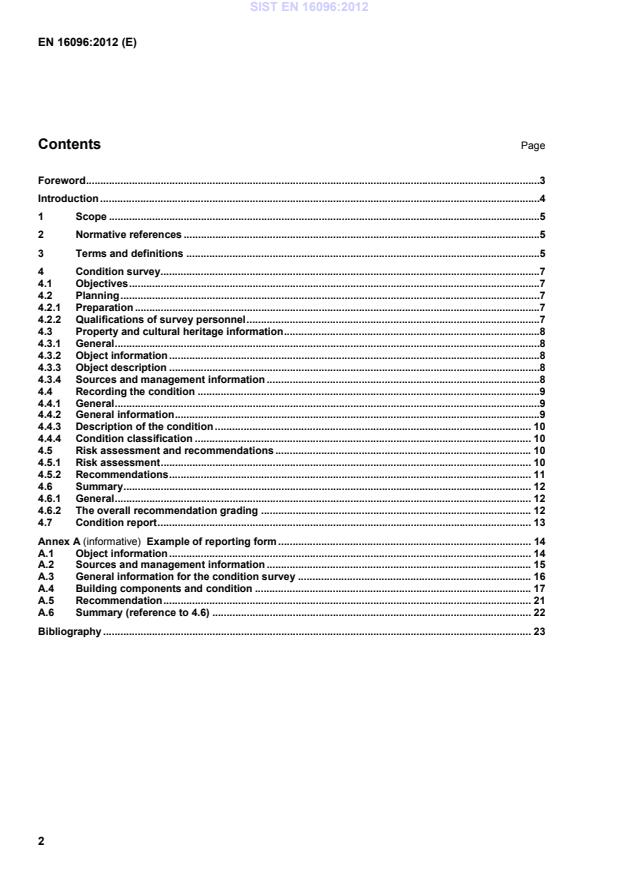
Example of reporting form . 14A.1 Object information . 14A.2 Sources and management information . 15A.3 General information for the condition survey . 16A.4 Building components and condition . 17A.5 Recommendation . 21A.6 Summary (reference to 4.6) . 22Bibliography . 23 SIST EN 16096:2012
It encompasses evaluation of the condition of a building or other structure mainly by visual observation, together – when necessary – with simple measurements. The relevant data and documentation on the built cultural heritage should be collected and included in the report. This European Standard can be applied to all built cultural heritage such as buildings, ruins, bridges and other standing structures. Built cultural heritage comprises both protected and non-protected significant buildings and structures. Archaeological sites and cultural landscapes are not dealt with in this standard. This European Standard does not specify how to carry out a diagnosis (3.7) of the built cultural heritage. For listed/protected immovable heritage, specific national rules for expert documentation and works may apply. This European Standard may be applied in order to: a) identify maintenance measures and the need for further investigation and diagnostics of damage; b) define procurement needs and the requirement for detailed specification; c) provide a unified method to obtain comparative data, when carrying out a condition survey for a group of buildings or a region. 2 Normative references Not applicable. 3 Terms and definitions For the purposes of this document, the following terms and definitions apply. 3.1 condition physical state of an object at a particular time Note 1 to entry: Assessment of the state of an object depends on the context and thus on the reason why the assessment is being made. [SOURCE: EN 15898:2011] 3.2 condition class categorisation of the condition 3.3 condition report record of condition for a specific purpose, dated and authored Note 1 to entry: A condition report normally results from a condition survey. [SOURCE: EN 15898:2011] SIST EN 16096:2012
For large or complex sites consisting of multiple structures, the surveyor shall clearly define the structure(s) which are included in the survey. A system for identifying and locating the individual objects shall be included. When surveying a ruin, the purpose is to maintain it in its ruined state. This should be confirmed by the involved parties. The involved parties, natural persons or legal entities, shall be informed of the condition survey and the necessary permits for access to the entire built cultural heritage shall be obtained. Measures to guarantee the safety of the surveyor during inspection shall be specified. 4.2.2 Qualifications of survey personnel Condition surveys on built cultural heritage should be performed by professionals. The surveyor(s) should have knowledge of traditional materials, construction techniques and decay processes. For larger and more complex surveys extended across various fields, interdisciplinary cooperation is necessary for a condition survey. SIST EN 16096:2012
...