


EN 17183:2018
(Main)Characterization of sludge - Evaluation of sludge density
General Information
- Abstract
This document specifies a method for the determination of the sludge (bulk) density. The procedure to determine density of the liquid and of the solid fractions of a suspension is described in Annex C.
This document is applicable to sludge suspensions from:
- storm water handling;
- urban wastewater collecting systems;
- urban wastewater treatment plants;
- treating industrial wastewater similar to urban wastewater [7];
- water supply treatment plants.
This method is also applicable to sludge suspensions from other origin, provided the necessary verifications are done.
- Status
- Published
- Publication Date
- 18-Dec-2018
- Withdrawal Date
- 29-Jun-2019
- Technical Committee
- CEN/TC 308 - Characterization of sludges
- Drafting Committee
- CEN/TC 308/WG 1 - Characterization methods
- Current Stage
- 9093 - Decision to confirm - Review Enquiry
- Start Date
- 06-Jun-2024
- Completion Date
- 23-Sep-2026
Overview
EN 17183:2018 (CEN) - "Characterization of sludge - Evaluation of sludge density" specifies a laboratory method for measuring sludge (bulk) density. The standard covers measurement of the whole suspension and, in Annex C, procedures to determine the density of the liquid and solid fractions separately. It applies to sludge suspensions from stormwater handling, urban wastewater collection systems, urban wastewater treatment plants, water-supply treatment plants and industrial wastewaters similar to urban wastewater.
Key topics and technical requirements
- Principle: Density is determined from measured mass and a calibrated volume (pycnometer, wide‑opening bottle or graduated cylinder) under controlled temperature.
- Apparatus: calibrated pycnometer or wide‑opening bottle/graduate, balance with at least 0.001 g precision, thermometer with 0.1 °C precision, and conventional lab equipment.
- Procedure essentials:
- Determine pycnometer volume and empty weight.
- Fill with sludge to the marked volume (avoid air/gas bubbles), weigh sludge + container.
- Use a control liquid (usually distilled water) as required and repeat measurements three times; report the average.
- Annex C details separation and density measurement of liquid and solid fractions (liquid separated per EN 872).
- Temperature control: Tests must be carried out at stable temperature and the temperature recorded. Annex A provides distilled water density vs temperature (15–25 °C) to support corrections or checks.
- Precision and validation: Interlaboratory trials reported mean bulk densities for representative sludges and quantified precision:
- Sludges with low–moderate solids (samples A–C): repeatability stdev range ~0.21%–0.90% (mean 0.49%); reproducibility ~0.25%–1.15% (mean 0.63%).
- High‑solids sludge (~40%) showed higher variability due to filling difficulties (repeatability 2.62%, reproducibility 3.80%).
- Reporting: Test report must reference EN 17183, identify the sample, describe sample preparation, provide results and any deviations or factors affecting results.
Applications
- Process engineers and laboratory technicians in wastewater treatment and water works use sludge density data to:
- Design and optimize sedimentation, flotation, thickeners and centrifuges.
- Estimate sludge volume for transport/storage and calculate transport costs.
- Model sludge fluid dynamics (e.g., pipeline head loss, reactor performance).
- Assess sludge dewaterability and stabilization state by comparing solid and liquid phase densities.
- Useful for regulatory monitoring, research labs, and consultants involved in sludge characterization and sludge management planning.
Related standards (applicable)
- EN 872 (separation of liquid fraction)
- EN 16720‑1 (sludge flowability - extrusion tube)
- EN ISO 17892‑2 / EN ISO 17892‑3 (soil density/porosity methods - referenced as alternatives for difficult samples)
- ISO 5725‑2 (precision evaluation methods)
Keywords: sludge density, bulk density, pycnometer, sludge characterization, wastewater treatment, sludge suspension, density measurement.
Relations
- Effective Date
- 28-Jan-2026
Get Certified
Connect with accredited certification bodies for this standard

CIS Institut d.o.o.
Personal Protective Equipment (PPE) certification body. Notified Body NB-2890 for EU Regulation 2016/425 PPE.

Kiwa BDA Testing
Building and construction product certification.
Kmetijski inštitut Slovenije
Agricultural Institute of Slovenia. Soil testing, plant health, agricultural product analysis.
Sponsored listings
Frequently Asked Questions
EN 17183:2018 is a standard published by the European Committee for Standardization (CEN). Its full title is "Characterization of sludge - Evaluation of sludge density". This standard covers: This document specifies a method for the determination of the sludge (bulk) density. The procedure to determine density of the liquid and of the solid fractions of a suspension is described in Annex C. This document is applicable to sludge suspensions from: - storm water handling; - urban wastewater collecting systems; - urban wastewater treatment plants; - treating industrial wastewater similar to urban wastewater [7]; - water supply treatment plants. This method is also applicable to sludge suspensions from other origin, provided the necessary verifications are done.
This document specifies a method for the determination of the sludge (bulk) density. The procedure to determine density of the liquid and of the solid fractions of a suspension is described in Annex C. This document is applicable to sludge suspensions from: - storm water handling; - urban wastewater collecting systems; - urban wastewater treatment plants; - treating industrial wastewater similar to urban wastewater [7]; - water supply treatment plants. This method is also applicable to sludge suspensions from other origin, provided the necessary verifications are done.
EN 17183:2018 is classified under the following ICS (International Classification for Standards) categories: 13.030.20 - Liquid wastes. Sludge. The ICS classification helps identify the subject area and facilitates finding related standards.
EN 17183:2018 has the following relationships with other standards: It is inter standard links to EN 16720-1:2016. Understanding these relationships helps ensure you are using the most current and applicable version of the standard.
EN 17183:2018 is available in PDF format for immediate download after purchase. The document can be added to your cart and obtained through the secure checkout process. Digital delivery ensures instant access to the complete standard document.
Standards Content (Sample)
2003-01.Slovenski inštitut za standardizacijo. Razmnoževanje celote ali delov tega standarda ni dovoljeno.Karakterizacija blata - Vrednotenje gostote blataBeurteilung der SchlammdichteCaractérisation des boues - Evaluation de la masse volumique des bouesCharacterization of sludge - Evaluation of sludge density13.030.20Liquid wastes. SludgeICS:Ta slovenski standard je istoveten z:EN 17183:2018SIST EN 17183:2019en,fr,de01-april-2019SIST EN 17183:2019SLOVENSKI
STANDARD
EUROPEAN STANDARD NORME EUROPÉENNE EUROPÄISCHE NORM
EN 17183
December
t r s z ICS
s uä r u rä t r English Version
Characterization of sludge æ Evaluation of sludge density Caractérisation des boues æ Evaluation de la masse volumique des boues
Beurteilung der Schlammdichte This European Standard was approved by CEN on
s { October
t r s zä
egulations which stipulate the conditions for giving this European Standard the status of a national standard without any alterationä Upætoædate lists and bibliographical references concerning such national standards may be obtained on application to the CENæCENELEC Management Centre or to any CEN memberä
translation under the responsibility of a CEN member into its own language and notified to the CENæCENELEC Management Centre has the same status as the official versionsä
CEN members are the national standards bodies of Austriaá Belgiumá Bulgariaá Croatiaá Cyprusá Czech Republicá Denmarká Estoniaá Finlandá Former Yugoslav Republic of Macedoniaá Franceá Germanyá Greeceá Hungaryá Icelandá Irelandá Italyá Latviaá Lithuaniaá Luxembourgá Maltaá Netherlandsá Norwayá Polandá Portugalá Romaniaá Serbiaá Slovakiaá Sloveniaá Spainá Swedená Switzerlandá Turkey and United Kingdomä
EUROPEAN COMMITTEE FOR STANDARDIZATION COMITÉ EUROPÉEN DE NORMALISATION EUROPÄISCHES KOMITEE FÜR NORMUNG
CEN-CENELEC Management Centre:
Rue de la Science 23,
B-1040 Brussels
t r s z CEN All rights of exploitation in any form and by any means reserved worldwide for CEN national Membersä Refä Noä EN
s y s z uã t r s z ESIST EN 17183:2019
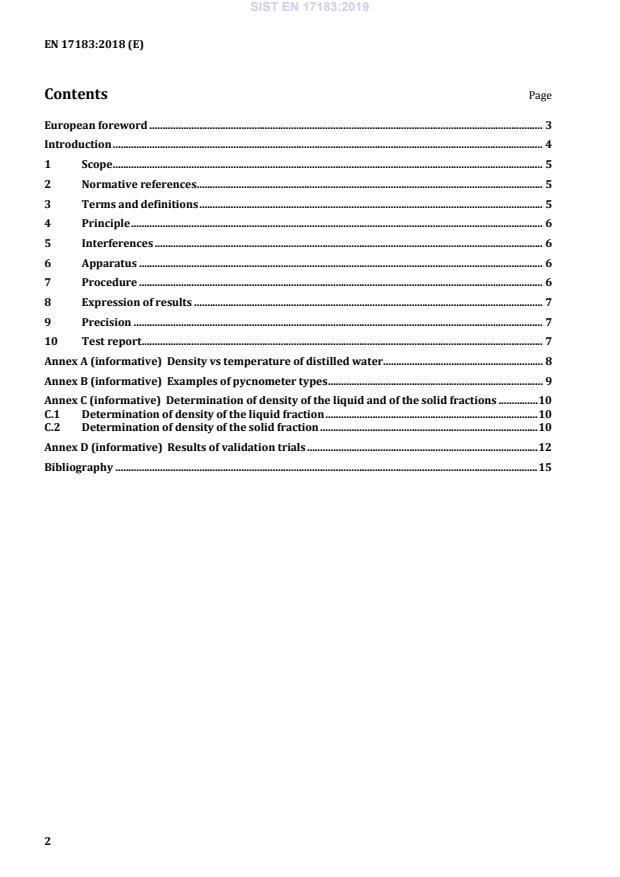
Density vs temperature of distilled water . 8 Annex B (informative)
Examples of pycnometer types . 9 Annex C (informative)
Determination of density of the liquid and of the solid fractions . 10 C.1 Determination of density of the liquid fraction . 10 C.2 Determination of density of the solid fraction . 10 Annex D (informative)
Results of validation trials . 12 Bibliography . 15
IEC Electropedia: available at http://www.electropedia.org/
ISO Online browsing platform: available at http://www.iso.org/obp 3.1 (bulk) density mass of material divided by the total volume it occupies 3.2 pycnometer instrument for measuring the density of substances/materials, consisting in a volume-calibrated glass container, often provided with a thermometer and/or a close-fitting ground glass stopper 3.3 relative density ratio of the density of a substance/material to that of a standard substance/material (usually water) SIST EN 17183:2019
Pycnometer or wide opening bottle of known volume, or graduated cylinder (see Annex B). 6.2
Balance with precision of 0,001 g at least. 6.3
Graduated cylinders and other conventional lab equipment/accessories. 6.4
Thermometer with precision of 0,1 °C at least. 7 Procedure During the test the temperature shall be kept constant (e.g. thermostat controlled room or bath) and the value given in the test report. 7.1
Note or verify/determine the net volume capacity V, in cm3, of the pycnometer by using a control W. 7.2
Determine weight PP, in g, of the empty pycnometer, after drying. 7.3
Fill the pycnometer with the sludge suspension not above the marked limit of volume of the instrument. In case of highly concentrated or low flowable suspensions (se
...