


FprCEN/TR 18442
(Main)Stationary source emissions - Diffuse emissions measurement methods - Overview of standards and other documents
General Information
- Abstract
This document gives information on the measurement methods that can be used for the characterization of atmospheric diffuse emissions of gases and particulate matters, from industrial and intensive agriculture sources. It describes
- the existing standards and other documents in the field of diffuse emissions from stationary sources with their scope/field of application and
- identifies the gaps and needs in standardized methods.
- Status
- Not Published
- Publication Date
- 02-Dec-2026
- Technical Committee
- CEN/TC 264 - Air quality
- Current Stage
- 5020 - Submission to Vote - Formal Approval
- Start Date
- 13-Aug-2026
- Due Date
- 17-Jun-2026
- Completion Date
- 13-Aug-2026

Overview
FprCEN/TR 18442 is a technical report developed by the European Committee for Standardization (CEN), under Technical Committee CEN/TC 264 "Air quality." This document provides a comprehensive overview of measurement methods and associated standards for the characterization of atmospheric diffuse emissions-specifically gases and particulate matter-originating from stationary industrial and intensive agricultural sources. FprCEN/TR 18442 systematically catalogs existing standards, guidelines, and other regulatory documents applicable to diffuse emissions, and identifies current gaps and needs in standardization.
Diffuse emissions, as defined in this context, are releases of pollutants that are not emitted via controlled point sources like stacks, but rather from numerous, often less-defined sources such as vents, equipment leaks, or open surfaces. Monitoring and controlling such emissions is vital for effective environmental protection and for regulatory compliance with European and national legislation.
Key Topics
Diffuse Emissions and Their Sources
- Focus on emissions from non-point sources, including fugitive emissions and area sources at industrial and agricultural facilities.
- Differentiation between diffuse, fugitive, and channelled emissions.
Measurement Methods
- Techniques are grouped into measurements at the source (e.g., test chambers, optical gas imaging) and measurements in the emission plume downwind.
- Methods include Reverse Dispersion Modelling (RDM), Leak Detection and Repair (LDAR), Differential Absorption Lidar (DIAL), Solar Occultation Flux (SOF), and optical remote sensing.
Standards Landscape
- Detailed overview of existing European, national (French, German), and U.S. EPA standards addressing diffuse emissions.
- Summary of emerging and draft standards, highlighting ongoing efforts to address gaps, particularly concerning methane emissions.
Regulatory Framework
- Reference to the Industrial Emissions Directive (IED) 2010/75/EU and its recent amendments, highlighting the role of Best Available Techniques (BATs), BAT Reference Documents (BREFs), and Emission Limit Values (ELVs).
- Discussion of legislative requirements for leak detection and repair (LDAR) and environmental permitting.
Applications
FprCEN/TR 18442 is valuable for organizations seeking to understand, implement, or comply with regulations regarding atmospheric diffuse emissions. This includes:
Industrial Installations
- Oil refineries, petrochemical plants, chemical manufacturers, and facilities handling volatile organic compounds (VOCs) or methane.
- Application of standardized measurement techniques for VOCs, methane, particulate matter (PM10, PM2.5), and odorous compounds.
Intensive Agriculture
- Livestock farming operations and agricultural processing plants managing emissions from buildings and open sources.
Environmental Consultancies and Test Laboratories
- Guidance in selecting and implementing appropriate measurement methods and compiling emission reports as part of environmental management systems or due diligence.
Regulatory Authorities
- Reference for setting monitoring requirements and for the evaluation or approval of compliance measurement strategies under environmental permitting processes.
Related Standards
Key documents referenced in FprCEN/TR 18442 include:
- EN 15446: Measurement of fugitive VOC emissions from process equipment.
- EN 17628: Determination of diffuse VOC emissions using various direct and optical methods.
- EN 13725: Determination of odour concentration and emission rate by dynamic olfactometry.
- Pr CEN/TS 18393: Detection of fugitive emissions using Optical Gas Imaging (OGI) (in development).
- CEN/TS 264225: Standard method to determine diffuse methane emissions (in progress).
- VDI 4285 and VDI 4210 series: German guidelines on diffuse emission measurement and remote sensing.
- US EPA OTM-10, OTM-33A/B: U.S. methods for mobile and plume-based emission monitoring.
These standards collectively provide a framework for robust, comparable, and compliant measurement of diffuse emissions, supporting industry, regulators, and service providers in environmental management and reporting.
Frequently Asked Questions
FprCEN/TR 18442 is a draft published by the European Committee for Standardization (CEN). Its full title is "Stationary source emissions - Diffuse emissions measurement methods - Overview of standards and other documents". This standard covers: This document gives information on the measurement methods that can be used for the characterization of atmospheric diffuse emissions of gases and particulate matters, from industrial and intensive agriculture sources. It describes - the existing standards and other documents in the field of diffuse emissions from stationary sources with their scope/field of application and - identifies the gaps and needs in standardized methods.
This document gives information on the measurement methods that can be used for the characterization of atmospheric diffuse emissions of gases and particulate matters, from industrial and intensive agriculture sources. It describes - the existing standards and other documents in the field of diffuse emissions from stationary sources with their scope/field of application and - identifies the gaps and needs in standardized methods.
FprCEN/TR 18442 is available in PDF format for immediate download after purchase. The document can be added to your cart and obtained through the secure checkout process. Digital delivery ensures instant access to the complete standard document.
Standards Content (Sample)
SLOVENSKI STANDARD
01-september-2026
Emisije nepremičnih virov - Merilne metode za ubežne emisije - Pregled
standardov in drugih dokumentov
Stationary source emissions - Diffuse emissions measurement methods - Overview of
standards and other documents
Emissionen aus stationären Quellen - Methoden zur Messung diffuser Emissionen -
Übersicht über Normen und andere Dokumente
Ta slovenski standard je istoveten z: FprCEN/TR 18442
ICS:
13.040.40 Emisije nepremičnih virov Stationary source emissions
2003-01.Slovenski inštitut za standardizacijo. Razmnoževanje celote ali delov tega standarda ni dovoljeno.
FINAL DRAFT
TECHNICAL REPORT
RAPPORT TECHNIQUE
TECHNISCHER REPORT
August 2026
ICS
English Version
Stationary source emissions - Diffuse emissions
measurement methods - Overview of standards and other
documents
Emissionen aus stationären Quellen - Methoden zur
Messung diffuser Emissionen - Übersicht über Normen
und andere Dokumente
This draft Technical Report is submitted to CEN members for Vote. It has been drawn up by the Technical Committee CEN/TC
264.
CEN members are the national standards bodies of Austria, Belgium, Bulgaria, Croatia, Cyprus, Czech Republic, Denmark, Estonia,
Finland, France, Germany, Greece, Hungary, Iceland, Ireland, Italy, Latvia, Lithuania, Luxembourg, Malta, Netherlands, Norway,
Poland, Portugal, Republic of North Macedonia, Romania, Serbia, Slovakia, Slovenia, Spain, Sweden, Switzerland, Türkiye and
United Kingdom.
Recipients of this draft are invited to submit, with their comments, notification of any relevant patent rights of which they are
aware and to provide supporting documentation.
Warning : This document is not a Technical Report. It is distributed for review and comments. It is subject to change without
notice and shall not be referred to as a Technical Report.
EUROPEAN COMMITTEE FOR STANDARDIZATION
COMITÉ EUROPÉEN DE NORMALISATION
EUROPÄISCHES KOMITEE FÜR NORMUNG
CEN-CENELEC Management Centre: Rue de la Science 23, B-1040 Brussels
© 2026 CEN All rights of exploitation in any form and by any means reserved Ref. No. FprCEN/TR 18442:2026 E
worldwide for CEN national Members.
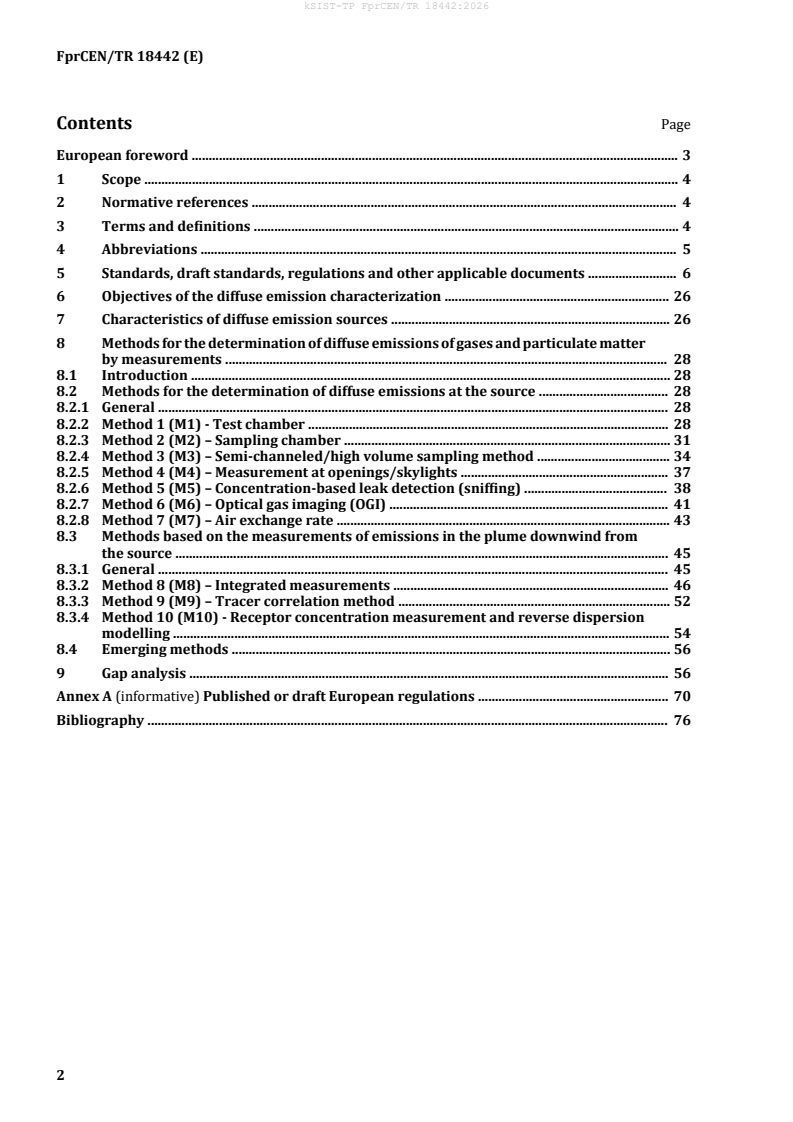
Contents Page
European foreword . 3
1 Scope . 4
2 Normative references . 4
3 Terms and definitions . 4
4 Abbreviations . 5
5 Standards, draft standards, regulations and other applicable documents . 6
6 Objectives of the diffuse emission characterization . 26
7 Characteristics of diffuse emission sources . 26
8 Methods for the determination of diffuse emissions of gases and particulate matter
by measurements . 28
8.1 Introduction . 28
8.2 Methods for the determination of diffuse emissions at the source . 28
8.2.1 General . 28
8.2.2 Method 1 (M1) - Test chamber . 28
8.2.3 Method 2 (M2) – Sampling chamber . 31
8.2.4 Method 3 (M3) – Semi-channeled/high volume sampling method . 34
8.2.5 Method 4 (M4) – Measurement at openings/skylights . 37
8.2.6 Method 5 (M5) – Concentration-based leak detection (sniffing) . 38
8.2.7 Method 6 (M6) – Optical gas imaging (OGI) . 41
8.2.8 Method 7 (M7) – Air exchange rate . 43
8.3 Methods based on the measurements of emissions in the plume downwind from
the source . 45
8.3.1 General . 45
8.3.2 Method 8 (M8) – Integrated measurements . 46
8.3.3 Method 9 (M9) – Tracer correlation method . 52
8.3.4 Method 10 (M10) - Receptor concentration measurement and reverse dispersion
modelling . 54
8.4 Emerging methods . 56
9 Gap analysis . 56
Annex A (informative) Published or draft European regulations . 70
Bibliography . 76
European foreword
This document (FprCEN/TR 18442:2026) has been prepared by Technical Committee CEN/TC 264, "Air
quality", the secretariat of which is held by DIN.
This document is currently submitted to the Vote on TR.
1 Scope
This document provides an overview of existing standards and other documents at international level
in the field of diffuse emissions. It provides information on the measurement and detection methods
that can be used for the characterization of atmospheric diffuse emissions of gases and particulate
matter, from industrial and intensive agriculture sources. It aims at:
— describing the existing standards and other documents in the field of diffuse emissions from
stationary sources with their scope/field of application and
— identifying the gaps and needs in standardized methods.
All methods are based on concentration measurements of chemical species, with the exception of optical
gas imaging, which is predominantly a visualization technique. The techniques and methods described
in this document include measurements and measurements combined with modelling techniques.
The methods summarized in this document are grouped based on measuring at the source or in the
plume downwind from the source.
2 Normative references
There are no normative references in this document.
3 Terms and definitions
For the purposes of this document, the following terms and definitions apply.
ISO and IEC maintain terminological databases for use in standardization at the following addresses:
• IEC Electropedia: available at http://www.electropedia.org/
• ISO Online browsing platform: available at http://www.iso.org/obp
3.1
emission
discharge of substances into the atmosphere
Note 1 to entry: This term comprises four types of emission (3.1) sources:
— Accounted channelled emissions (from monitored stacks)
— Unaccounted channelled emissions (from, e.g. vents, flares)
— Fugitive emissions (leaks from, e.g. valves, seals)
— Area emissions (from, e.g. water treatment basins, coke storage)
[SOURCE: EN 17628:2022, 3.10]
3.2
channelled emission
emission (3.1) of pollutants to air through an emission point such as a stack
3.3
diffuse emission
emission (3.1) to the atmosphere from an identified site or facility, not specifically directed to identified
stack emission points
Note 1 to entry: This term comprises the sum of various unaccounted channelled emissions, fugitive emissions
and area emissions.
Note 2 to entry: This term can include a combination of individual emission sources within an area of interest
some of which can be channelled e.g. vents, fugitive and area sources. It usually excludes point sources such as
emission stacks that are directly monitored.
[SOURCE: EN 17628: 2022, 3.12 modified - Addition of note 2]
3.4
fugitive emission
emission (3.1) to the atmosphere caused by loss of tightness of an item which is designed to be tight
[SOURCE: EN 15446:2008, 3.1]
3.5
emission factor
ratio of the rate at which an air pollutant is emitted as a result of some activity, to the rate of that activity
EXAMPLE The mass, in kilograms, of particulate emitted per tonne of coal burned, the mass, in kilograms, of
NOx per tonne of clinker produced in a country per year, or the mass, in tonnes, of CO2 emitted per megajoule of
energy produced.
Note 1 to entry: An emission factor differs from a mass emission rate, the latter has specific dimensions of mass
divided by time.
[SOURCE: ISO 11771:2010 [1] , 2.1 adapted - Notes 1, 2 and 3 removed.]
3.6
remote sensing method
measurement method that determines a measurand in the open atmosphere without extractive
sampling and at a spatial distance to the measurement device
3.7
tracer gas
gas which is added to the air or the exhaust gas and can be measured at very low concentrations in order
to investigate air movement
Note 1 to entry: Tracer gas is often referred to as indicator gas.
3.8
component
assembly or mechanical part of an item of main equipment
Note 1 to entry: Examples are fitting, flange, pump, seal, valve.
[SOURCE: EN 17628:2022, 3.7]
3.9
reverse/inverse dispersion modelling
use of atmospheric dispersion models to determine source parameters such as emission rate and source
location from measured downwind concentrations and meteorological data
4 Abbreviations
The Table 1 lists the abbreviations and their meanings.
Table 1 — Abbreviations
Abbreviation Meaning
BATs Best Available Techniques
BATCs Best Availaible Techniques Conclusions
BREF BAT REFerence document
DIAL Differential Absorption Lidar
DOAS Differential Optical Absorption Spectroscopy
ELVs Emission Limit Values
EPA Environmental Protection Agency
FID Flame-Ionization Detector
FTIR Fourier Transform InfraRed spectroscopy
IED Industrial Emission Directive
IR InfraRed
LDAR Leak Detection And Repair
LIDAR LIght Detection And Range
OGI Optical Gas Imaging
PID Photo-Ionisation Detector
POP Persistant Organic Polluant
RDM Reverse Dispersion Modelling
SOF Solar Occultation Flux
TC Tracer Correlation
UAV Unmanned Aerial Vehicle
VOCs Volatile Organic Compounds
5 Standards, draft standards, regulations and other applicable documents
The main regulatory document to consider is the European Directive 2024/1785/EU of 24 April 2024
amending Directive 2010/75/EU on industrial and livestock rearing emissions (integrated pollution
prevention and control) and Council Directive 1999/31/EC on the landfill of waste. The IED aims to
achieve a high level of environmental protection by preventing and reducing air and water pollution
from industrial and agricultural emissions. The IED, and the associated indüstry-specific reference
documents, describe the BATs (Best Available Techniques) in BAT Reference Documents (BREFs) and
their associated BAT Conclusions (BATCs). BATCs provide the ranges of Emission Limit Values (ELVs)
for air and water, which are used by national and local authorities to set permits for a wide range of
activities. The BATC documents also prescribe European standards for measurement and detection of
emissions to air and water.
The Table A.1 in Annex A describes the BREFs for which BATs on diffuse emissions are mentioned, and
the typical diffuse sources identified in the BREFs.
Table 2 lists European standards, draft European standards, national standards and other documents
dealing with the characterization of atmospheric diffuse emissions.
Table 3 lists European standards, draft European standards, national standards and other documents
that can be useful references.
Table 2 — Standards and other documents describing methods for the characterisation of atmospheric diffuse emissions
Reference Title Level/status Scope/information
EN 15445 (October 2008) Fugitive and diffuse emissions of European standard This standard specifies a Reverse Dispersion Modelling (RDM) method to qualify
common concern to industry sectors - the fugitive emission rates of diffuse fine and coarse dust sources of industrial plants
Qüalification of fugitive dust sources or areas. The application needs calculations using a dispersion model, and the
by Reverse Dispersion Modelling definition of a sampling experimental set-up taking into account field data such as
number, height and width of diffuse dust sources, sampling distances, and
meteorological information.
The RDM method does not allow qüantification in absolute figüres of the dust
emission rates because of an undetermined accuracy depending on various site
conditions, but it is a tool which enables each industrial plant to identify its dust
sources that emit the most, and then to implement actions reducing their importance
by self-control and related improvement process as part of environmental
management.
In this framework, the RDM method should not be used to control or verify any
compliance with air quality threshold global values which might be contained in an
operating permit, or to carry out comparison between different plants belonging to
the same industrial sector.
EN 15446 Fugitive and diffuse emissions of European standard This standard applies to the measurement of fugitive emissions of volatile organic
common concern to industry sectors - compounds (VOCs) from process equipment. The method is based on US EPA 21.
(March 2008)
Measurement of fugitive emission of The leak sources include, but are not limited to, valves, flanges and other
vapours generating from equipment connections, pressure relief devices, process drains, open-ended valves, pump and
and piping leaks compressor seal systems, agitator seals, and access door seals. It does not apply to
instrument tubing connections. This standard applies to all products of which at
least 20 % wt has a vapour pressure higher than 0,3 kPa at 20 °C. For the petroleum
industry, this includes all light products and excludes kerosene and all heavier
products. The standard is based on the measurement of the gas concentration at the
interface of a leak. This concentration is measured with a portable instrument. It is
converted to a mass emission rate by use of a set of correlations. The scope of this
standard includes the complete data processing, from the initial concentration
measurement up to the generation of an emission report over a reporting period
(which is generally one year). This standard does not prescribe the number of
potential emission points that should be screened each year nor the frequency at
which these points should be screened. This sampling strategy shall indeed take into
Reference Title Level/status Scope/information
account the plant characteristics and the required level of control over fugitive
emissions.
Optical methods are currently under development to ease the detection of leaks in
plants and use of this standard in conjunction with these methods might be possible.
In any case, measurements shall be performed according to the requirements of this
standard. To enable direct qüantification of total fugitive emissions based only on
these methods, a subsequent revision of this standard is needed.
EN 17628 Fugitive and diffuse emissions of European standard This document specifies the framework for determining emissions to the
common concern to industry atmosphere of Volatile Organic Compounds (VOCs). It specifies a system of methods
(April 2022)
sectors — Standard method to to detect and/or identify and/or quantify VOC emissions from industrial sources.
determine diffuse emissions of volatile These methods include Optical Gas Imaging (OGI), Differential Absorption Lidar
organic compounds into the (DIAL), Solar Occultation Flux (SOF), Tracer Correlation (TC), and Reverse
atmosphere Dispersion Modelling (RDM). It specifies the methodologies for carrying out all the
above, and also the performance requirements and capabilities of the direct
monitoring methods, the requirements for the results and their measurement
uncertainties.
This document specifically addresses, but is not restricted to, the petrochemicals,
oil refining, and chemical industries receiving, processing, storing, and/or exporting
of VOCs, and includes the emissions of VOCs from the natural gas processing/
conditioning industry and the storage of natural gas and similar fuels. The methods
specified in this document have been validated at onshore facilities. This document
is applicable to diffuse VOC emissions to atmosphere but not to the emissions of
VOCs into water and into solid materials such as soils. It is complementary to EN
15446 [9], the standardized method for the detection, localization of sources
(individual leaks from equipment and piping), and qüantification of fugitive VOC
emissions within the scope of a Leak Detection and Repair Programme (LDAR). This
document has been validated for non-methane VOCs, but the methodology is in
principle applicable to methane and other gases. This document specifies methods
to determine (detect, identify and/or quantify) VOC emissions during the periods
of monitoring. It does not address the extrapolation of emissions to time periods
beyond the monitoring period
Reference Title Level/status Scope/information
EN 13725 Stationary source emissions - European Standard This document specifies an objective method for the determination of the odour
Determination of odour concentration concentration of a gaseous sample using dynamic olfactometry with human
(February 2022)
by dynamic olfactometry and odour assessors. The document also specifies a method for the determination of the odour
emission rate emission rate from stationary sources, in particular: a) point sources (conveyed or
ducted emissions); b) active area sources (e.g. biofilters). The primary application
of this document is to provide a common basis for evaluation of odour emissions.
Annex M (informative) - Sampling of passive area sources
This standard does not prescribe a standard method for measuring the specific
odour emission rate for passive area sources, expressed in the measurement unit
ouE/m2/s, because no standard meteorological or operational conditions for odour
emission measurement for passive area sources could be defined. In this informative
annex the useful information which was generated in the drafting process of this
standard is summarized, intended to provide a starting point for future development
of a standard method.
Reference Title Level/status Scope/information
Pr CEN/TS 18393 Fugitive and diffuse emissions of Draft European standard This document has been developed to provide detailed guidance on the use of optical
common concern to industry sectors gas imaging (OGI) cameras for visualising leaks of vapours and gases that can be
(In progress)
— Detection of fugitive emission of detected using their spectral properties in the infrared (IR) region of the electro-
vapours generating from equipment magnetic spectrum.
and piping leaks using Optical Gas
European legislation for a set of industrial activities requires the operators of
Imaging (OGI)
affected installations to put in place a leak detection and repair (LDAR) programme
to risk-assess, identify and either eliminate or reduce fugitive and other diffuse
emissions of certain vapours and gases that are harmful to human health and the
environment.
Under legislation, certain categories of industrial installations within the sectors for
energy, waste management, oil and gas refining, and the chemical sectors must have
a LDAR programme. LDAR required by legislation specifies the use of OGI cameras
to detect leaks.
Although legislation does not currently prescribe OGI within LDAR programmes for
other types of industrial activity, the technique is still a powerful tool for visualising
leaks of gases and vapours with have an infrared absorption profile that OGI cameras
can detect. These activities include, but are not limited to: small anaerobic digestion
plants; landfill-gas infrastructure, and; natural-gas distribution systems.
OGI cameras have proven to be an effective detection technique, where an IR sensor
is used to visualise emissions of volatile organic compounds (VOCs), methane and
other compounds (e.g. SF , NH ), which cannot normally be seen by the human eye.
6 3
This document focuses on the use of OGI cameras dedicated to leak detection of
VOCs, and methane. OGI cameras can also be utilised for detecting other types of
emissions, e.g. venting or non-fugitive diffuse emissions.
Although qüantification of VOC emissions it is not yet established as a proven
technique, OGI cameras enable the user to see emissions. In some cases, it is possible
to make a comparative assessment between small, medium and large emissions.
Investigations are underway to determine how effective OGI cameras are for making
systematic estimates of the quantity of emissions, although this document is
restricted to OGI as a leak detection technique.
Reference Title Level/status Scope/information
The strength of an OGI camera is that it allows many components to be inspected in
a relatively short time, making this camera a powerful instrument for making
fugitive emissions visible and then controlling them. Although OGI cameras are
highly portable and readily deployed and seem to be easy to use they require users
to be trained and süfficiently experience to be proficient.
A typical deployment would use the OGI cameras to detect the larger leaks or as a
complement of a conventional LDAR programme by enabling screening of
components inaccessible to point sampling technique according to EN 15446,
commonly known as “sniffing”, and applied to the framework described in EN 17628.
Reference Title Level/status Scope/information
CEN/TS 264225 Fugitive and diffuse emissions of European standard This document has been developed to provide a framework for the selection and
common concern to industry use of monitoring methods to quantify the emission to the air of methane (CH ) from
(In progress)
sectors — Standard method to
diffuse sources, in particular due to the extraction, storage, transfer and handling
determine diffuse emissions of CH
4 (loading/unloading) of gas containing methane, within certain industrial sectors
into the atmosphere (e.g. oil and gas, bio methane, waste, intensive agriculture) and other activities (e.g.
landfill). The European Standard EN 17628 has primarily been developed for VOC
detection and qüantification.
This document is a follow-up of EN 17628 and addresses specific monitoring
techniques able to quantify methane emissions.
Emissions of methane from anthropogenic, biogenic and other natural sources
contribute to global warming, because methane is a powerful greenhouse gas second
only to carbon dioxide in its overall contribution to climate change. It is responsible
for about a third of current climate warming. In addition, methane is a significant
contributor to the formation of tropospheric ozone, a potent air pollutant that causes
serious health problems.
Better determination of the anthropogenic contribution can help to reduce these
impacts. A wide range of human activities can give rise to emissions (e.g. extraction,
transport, storage and distribution of methane containing products, etc.). Emission
sources can be complex and diffuse sources are difficült to determine accurately.
Their determination has hitherto required the use of specific measurement and
estimation methods not subject to standardization. By setting out appropriate
standardization criteria and demonstrating their use with certain techniques, the
determination of diffuse methane should be improved, assisting the management of
emissions and consequential benefits.
EN 17628 has been validated for non-methane VOCs, but the methodology is in
principle applicable to methane and other gases. According to the importance of
methane emissions and variety of technical solutions, this document for methane
needs to be better defined.
Reference Title Level/status Scope/information
GA X 43-138 Stationary source emissions - Diffuse National (France) Diffuse atmospheric emissions can greatly contribute to the overall emissions of an
emissions at skylights - industrial site. Various French industrial sectors are concerned by this, and there
(November 2014)
Recommendations for the are various kinds of sources.
implementation of the measurement
These include buildings with openings (windows, skylights, roof domes, static
method
ventilators, louvres, etc.) in which "hot" industrial processes are performed. Due to
the thermal gradient in the building between the emission points inside the building
and the openings that are generally located in the upper section of the building, they
are liable to be points for diffuse emissions of the substances discharged by the
implemented processes.
One method used to obtain the mass flow rate of each opening is to measure the
concentrations of the studied species and discharge velocities and take account of
the surface of each opening to the outside. Integrating the sum of these mass flows
for each of the surfaces is the building's source term.
The first diffuse emission characterization tests involving taking samples at
skylights date back to the 70s and 80s. This method, also used by some French testing
laboratories to characterize these types of emissions, has not since been the subject
of a normative reference at French or European level. As a result, practices are fairly
inconsistent between test laboratories and operators, and therefore do not generate
comparable data.
This document provides guideline for managing the implementation of this method
and guaranteeing the quality of the services provided in this area and the
comparability of the results given, via compliance with performance criteria.
This document, in line with EN 15259:2007 [2], aims to establish a number of
recommendations relating to:
- specifications prior to measurements;
- the observation phase on site, the process(es) conducted on site and the
intervention conditions;
Reference Title Level/status Scope/information
- site intervention, in terms of the techniques and the measurement methods to be
implemented and the measurement strategy (number of instrumented points,
measurement duration, etc.);
- the use and processing of the results in the measurement report.
The aim of this document is to explain how to use this method and set out the
requirements to guarantee the quality of the services provided.
This document applies to diffuse emission measurements at skylights for:
- a request to implement measurements;
- a request for a measurement delivery;
- implementation of the measurements;
- processing the measurement results.
VDI 4285-1 Determination of diffusive emissions National (Germany) VDI 4285 describes the basic concept of methods for measuring emissions from
by measurements - Basic concepts diffuse sources. For the purposes of this guideline, diffuse sources are all sources
(June 2005)
that are not conducted sources. The waste gas stream is not conducted in a duct and
therefore the emissions cannot be measured on the basis of the guidelines VDI 2066
Part 1 or VDI 4200. The determination of emissions from diffuse sources, as
described in guideline VDI 4285, is based on the determination of substance
concentrations and meteorological parameters, combined with a computational
model where appropriate. Measurements at diffuse sources are carried out at the
interface with the atmosphere or after the pollutants of interest have entered the
atmosphere. While the guideline VDI 3790 describes diffuse sources and the
possibilities of emission estimation and control, the present guideline deals with the
determination of diffuse emissions by measurements.
Reference Title Level/status Scope/information
VDI 4285-2 Determination of diffusive emissions National (Germany) This standard establishes methods for the determination of diffuse emissions from
by measurements - Industrial halls and industrial and livestock buildings. It allows the determination of emission rates by
(March 2011)
livestock farming indirect and direct methods. In the case of direct methods, the emission
measurement is carried out directly at the source and is always based on the
measurement of the volume flow and the concentration. Indirect methods involve
measuring emissions at a certain distance from the diffuse source, taking into
account the meteorological boundary conditions. Diffuse emissions from areas
around the halls or buildings that are part of the installation are not covered by this
guidance, nor are diffuse emissions of particulate matter. The use of this guideline
requires knowledge of guideline VDI 4285 part 1, which describes the basic concepts
for the determination of diffuse emissions by measurement.
VDI 4285-3 Determination of diffusive emissions National (Germany) This standard describes methods for the determination and qüantification of
by measurements - Qüantification of diffusely emitted particulate matter such as PM10 and PM2.5 from industrial
(November 2015)
diffusive emissions of particulate installations, including agricultural sources. It complements and details the
matter from industrial plants requirements of VDI 4285 Part 1, which specifies the general principles for the
including agricultural sources determination of diffusive emissions. Procedures for the identification of sources
and different approaches for the determination of the emission rate of relevant
diffuse sources are presented. For the purposes of this standard, diffuse sources
include industrial installations that emit particulate matter from non-conductive
sources, such as the exhaust air of an industrial hall during production processes or
the handling and transport of dust-emitting materials. In addition, diffuse dust
emissions may occur from agricultural sources, such as large livestock operations
or arable land. This guideline allows the analysis of the chemical speciation of these
particles. It can also be applied to bioaerosols when direct methods are used. This
standard is intended for anyone involved in the planning, performance or evaluation
of measurements for the determination of diffusely emitted particulate matter such
as PM10 and PM2,5 from industrial installations, including agricultural sources. The
contents of this standard can be used as a reference by clients and contractors alike,
for example in the formulation of requirements and performance specifications for
such investigations.
Reference Title Level/status Scope/information
VDI 4210-1 Remote sensing - Atmospheric National (Germany) The series of Guidelines VDI 4210 explains the mechanism of lidar systems and
measurements with LIDAR . VDI/DIN describes how the systems must be handled in order to provide valid measurements.
(June 1999)
manual Air Pollution Prevention In addition, performance characteristics are defined and specified and examples of
Volume 5: Analysis and Measurement typical application are shown. The present Part 1 of the Guideline series VDI 4210
Methods. describes differential Absorption and Scattering, or DAS, lidar. DAS lidar is a depth-
resolving technique; synonymously with DAS lidar, the term DIAL (DIfferential
Absorption Lidar) is also used in the literature.
US EPA OTM-10 Development of US EPA OTM-10 for National (US) In 2006, the U.S. Environmental Protection Agency posted a new test method on its
Landfill Applications website called OTM-10 which describes direct measurement of pollutant mass
(September 2009)
emission flüx from area sources using ground-based optical remote sensing. The
method has validated application to relatively small, bounded area sources but
additional guidance is needed for large area sources, such as landfills, where the
emission zone can exceed the size of optical configüration leading to difficülties in
relating measured flüxes to emissions per unit area. This paper presents the findings
of
a series of tracer release experiments conducted by U.S. EPA and Waste Management
designed to improve the understanding of OTM-10 in landfill applications. OTM-10
plume capture efficiency data acquired at a variety of landfill sites under a range of
meteorological conditions and measurement configürations are presented.
Experiments indicate an overall capture efficiency factor of 0.81 with a standard
deviation of 0.33. Lower capture efficiencies from side slope releases are noted
(0.69).
The combined data set is analysed for factors inflüencing capture efficiency. A
multiple linear regression is used to model the capture efficiency as a function of
primary parameters including distance of the tracer release from the observing
plane and wind speed. A simplified model based on the regression analysis is
described and its use for approximating the area contributing to flüx is presented.
Reference Title Level/status Scope/information
US EPA OTM-33 Mobile Measurement Method Series National (US) This test method relates to the general practice of using instrumented, ground-based
vehicles to acquire information on air pollutant sources located in proximity to the
(November 2014)
driving route. Through specific sub-methods of OTM-33, source emissions
assessments ranging from near-field inspection of small fugitive releases to whole
facility mass emission rate measurements can be executed.
Geospatial measurement of air pollution (GMAP) is a general term referring to the
use of fast response instruments and precise global positioning systems (GPS) in
mobile formats to spatio-temporally resolve air pollution patterns in a variety of use
scenarios. General “mobile measurement” or GMAP applications can utilize many
different instrumentation and mobility schemes to investigate numerous air quality
questions on a range of spatial scales.
Under OTM-33, a mobile inspection vehicle is fitted with requisite instrumentation
as specified in the sub-method and controlling quality assurance procedures to allow
acquisition and analysis of spatially and temporally resolved emissions
information from areas around sources of air pollutants including gas phase criteria
pollutants, particulate matter and ültra-fine particles, volatile organic compounds
(VOCs), hazardous air pollutants (HAPs), and greenhouse gases (GHGs).
US EPA OTM-33A Discovery/Characterization of Near- National (US) OTM-33A is the first sub-method developed in the series and a draft including
Field Fugitive Sources engineering designs is posted on EPA’s Technology Transfer Network. OTM-33A is
(January 2014)
applicable to near ground-level sources that are small in spatial extent and are
located in close proximity (generally < 150 m) of the driving route. OTM-33A is
designed to be a rapidly executed inspection approach that does not require
deployment of fixed equipment or site-specific modelling. Figure 1 shows two
examples of OTM-33A CM, detection of benzene emission in a refinery (1A) and
discovery of a large hydrogen sulphide emission in an urban area (1B). These
surveys, performed by EPA GMAP vehicles, are but a few of numerous examples of
mobile leak detection that are emerging including multiple research and commercial
efforts to find methane leaks in natural gas distribution systems.
Reference Title Level/status Scope/information
US EPA OTM-33B Mobile Tracer Correlation National (US) Draft method OTM-33B (in development) differs from OTM-33A in the manner in
which source emissions are qüantified and in class of sources that can be measured.
(June 2015)
OTM-33B focuses on an EQ technique called mobile tracer correlation and aims to
describe a relatively standardized version of this approach already in use by a
number of research groups. The approach centers on controlled release of one or
more atmospheric tracer gases with simultaneous downwind measurement of the
emitted source plume and metered tracer with the source emissions rate
determined through a simple ratio analysis. The technique has been demonstrated
using a variety of tracer gases and CMIs to investigate emissions from landfills and
other sources.33-47 Whereas OTM-33A is designed to be a self-contained, rapidly
executed inspection approach for point-like near-field sources, OTM-33B can be
applied to both large and small sources. OTM-33B, is however more invasive with a
higher execution burden, requiring site access and placement and operation of
controlled tracer gas release gear. Whereas OTM-33A-use limitations are significant
and EQ accuracy expectation is modest, OTM-33B employs the known release rate
of the tracer to effectively eliminate atmospheric dispersion transport uncertainties
and in principle, allowing high accuracy (< +/-15%) EQ to be obtained.
US EPA 21 Determination of Volatile organic National (US) This method is applicable for the determination of VOC leaks from process
compounds leaks. equipment. These sources include, but are not limited to, valves, flanges and other
(August 2017)
connections, pumps and compressors, pressure relief devices, process drains, open-
ended valves, pump and compressor seal system degassing vents, accumulator
vessel vents, agitator seals, and access door seals. A portable instrument is used to
detect VOC leaks from individual sources. The instrument detector type is not
specified, but it must meet the specifications and performance criteria contained in
Section 6.0. A leak definition concentration based on a reference compound is
specified in each applicable regulation. This method is intended to locate and classify
leaks only, and is not to be used as a direct measure of mass emission rate from
individual sources.
Reference Title Level/status Scope/information
40 CFR Part 60 Subpart Standards of Performance for Crude National (US) This subpart establishes emission standards and compliance schedules for the
OOOOa (June 2016) Oil and Natural Gas Facilities for Which control of the pollutant greenhouse gases (GHG). The greenhouse gas standard in
Construction, Modification or this subpart is in the form of a limitation on emissions of methane from affected
Reconstruction Commenced After facilities in the crude oil and natural gas source category that commence
September 18, 2015 and On or Before construction, modification, or reconstruction after September 18, 2015. This
December 6, 2022 subpart also establishes emission standards and compliance schedules for the
control of volatile organic compounds (VOC) and sulfur dioxide (SO2) emissions
from affected facilities in the crude oil and natural gas source category that
commence construction, modification, or reconstruction after September 18, 2015,
and on or before December 6, 2022.
NTA 8399 (2015) Air quality - Guidelines for detection of National (NL) NTA 8399 provides guidelines for the detection of diffuse VOC emissions using
diffuse VOC emissions with optical optical gas imaging (OGI). The NTA focusses on portable, passive, optical camera
gas imaging systems that enable volatile organic compounds to be made visible in real time. Non-
portable, stationary systems that do not allow such flexible use are not included in
the scope of this NTA, as these systems often have their own specific scopes. Different
users may have different reasons for using OGI. In general, safety, the environment
and loss of product are the drivers for applying OGI. OGI can be used in different
ways (see also annex C): - as part of an LDAR (leak detection and repair) programme;
- to visualize diffuse VOC emissions of storage tanks; - to visualize diffuse VOC
emissions that are released while loading operations; - other applications. This NTA
lays down the requirements the IR camera shall meet and the method to be followed
to enable reliable statements to be made. Annex D of the NTA contains examples of
inspection forms for recording OGI measurements on storage tanks. In addition to
the obligatory emission calculations (e.g. E-PRTR (European Pollutant Release and
Transfer Register) or environmental annual reports) a measurement protocol based
on the Handboek emissiefactoren [Emission Factors Handbook] [4] can be used for
the measurements on storage tanks. If OGI is used for monitoring emissions from
tanks pursuant to legislation and regulations, the measurement protocol to be used
will have to be coordinated with the authorities. Using the IR camera as a measuring
instrument for the LDAR programme is not in keeping with the Dutch Meetprotocol
voor lekverliezen [Measurement protocol for leakage losses] [3] and the authorities
will have to authorize this as part of their permit activities. This NTA does not include
a measurement protocol for conducting LDAR measurements based on OGI.
Reference Title Level/status Scope/information
VDI 4321 Diffuse emissions - Optical gas imaging National (Germany) The standard defines a uniform procedure for the application of gas cameras and
for the inspection of installations - supplementary measurement methods for the detection of leaks at biogas plants.
(Decembe
...