

prEN ISO 17078-1
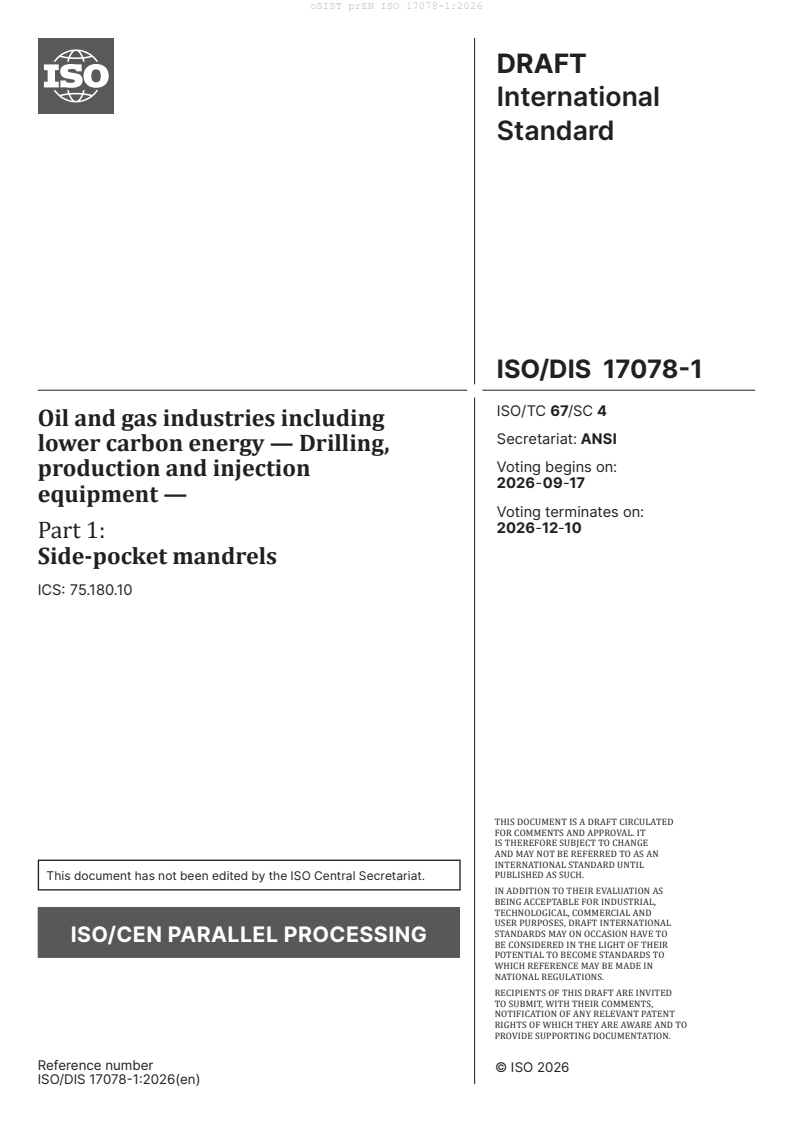
(Main)Oil and gas industries including lower carbon energy - Drilling, production and injection equipment - Part 1: Side-pocket mandrels (ISO/DIS 17078-1:2026)
- Abstract
ISO 17078:2004 provides requirements for side-pocket mandrels used in the petroleum and natural gas industry. This part of ISO 17078 includes specifying, selecting, designing, manufacturing, quality control, testing, and preparation for shipping of side-pocket mandrels.
This part of ISO 17078:2004 does not address nor include requirements for end connections between the side-pocket mandrels and the well conduit. The installation and retrieval of side-pocket mandrels is outside the scope of this part of ISO 17078:2004. Additionally, this part of ISO 17078:2004 does not include specifications for centre-set mandrels, or mandrels that employ or support tubing-retrievable flow control devices.
This part of ISO 17078:2004 does not include gas-lift or any other flow-control valves or devices, latches, and/or associated wire line equipment that can or cannot be covered in other ISO specifications.
The side-pocket mandrels to which this part of ISO 17078:2004 refers are independent devices that can accept installation of flow-control or other devices down-hole.
- Status
- Not Published
- Publication Date
- 06-Mar-2028
- Current Stage
- 4020 - Submission to enquiry - Enquiry
- Start Date
- 17-Sep-2026
- Completion Date
- 17-Sep-2026


prEN ISO 17078-1 is a draft CEN standard for side-pocket mandrels used in the oil and gas industries, including lower carbon energy applications. It specifies requirements for selecting, designing, manufacturing, quality control, testing, and preparation for shipping of these downhole devices, mainly for manufacturers, suppliers, purchasers, and engineers. It supplements API Spec 19G1, 2nd edition (2019), so users read it as an addition to that base specification.
What does prEN ISO 17078-1 specify?
prEN ISO 17078-1 covers side-pocket mandrels used in petroleum and natural gas service, including standard designs and HPHT equipment for the wellbore conditions identified in the document. It sets out how these mandrels are specified, selected, built, checked, tested, and shipped.
| Clause / part | What it covers |
|---|---|
| 1 Scope | What side-pocket mandrels are covered and what is outside scope |
| 2 Normative references | The standards that become part of the requirements |
| 3 Terms and definitions | The defined term used with this document |
| 4 Supplements to API Spec 19G1 | The extra requirements that modify the base specification |
| Bibliography | Related reference material |
The scope excludes end connections to the well conduit, installation and retrieval, center-set mandrels, mandrels that support tubing-retrievable flow control devices, non-metallic pressure-containment versions, and gas-lift or other flow-control valves, latches, and associated wireline equipment. In practice, this means the document is for the mandrel body and its specified properties, not the surrounding completion hardware or running tools.
What are the key requirements of prEN ISO 17078-1?
prEN ISO 17078-1 is mainly a supplement to API Spec 19G1, 2nd edition (2019). The document keeps the API base requirements and then adds targeted rules for quality management, CO2 service, surface-hardened layers, and packaging.
Base requirements and quality management
Clause 4.1 says the requirements in API Spec 19G1 apply, except where this document adds its own requirements. For quality management, prEN ISO 17078-1 uses ISO 9000 instead of API Q1. In practice, suppliers need to align their quality vocabulary and documentation with ISO 9000 when working to this standard.
Materials for high CO2 service
Clauses 4.2.1 and 4.2.2 add material-selection requirements for CO2 gas injection and gas production wells where the CO2 environment is high enough to meet the conditions stated in the document. In those cases, selected materials shall comply with ISO 17348. For users, this means material approvals need to be checked against CO2 service before a mandrel is accepted for that duty.
Surface-hardened layer testing
Clause 4.2.3 adds checks for surface hardness, microstructural characteristics, and the thickness of the surface-hardened layer. The layer thickness is measured in accordance with ISO 18203. In practice, this pushes testing beyond a simple hardness check and requires metallurgical evidence for the hardened zone.
Packaging for shipping
Clause 4.2.4 adds packaging requirements for side-pocket mandrels. They must be packed to prevent impact and collision damage to critical components during transport, and any special packaging requirements must be agreed in writing between the supplier/manufacturer and the user/purchaser. This matters because shipping damage can affect fit, sealing, or downhole reliability before installation even begins.
HPHT and special-service application
The scope states that the document also addresses HPHT equipment and refers to API TR 1PER15K-1 for high-pressure, high-temperature verification and validation. For projects in severe wellbore conditions, this tells the reader that the standard is not limited to ordinary service.
What terms does prEN ISO 17078-1 define?
Clause 3 adopts the terms and definitions from API Spec 19G1 and adds one defined term.
- sour service - exposure to oilfield environments that contain enough H2S to cause cracking of materials by specific mechanisms.
- side-pocket mandrel - the independent device covered by the document, able to accept downhole flow-control or other devices.
- HPHT - high pressure and/or high temperature equipment or wellbore conditions, used in the scope for more severe service.
- API Q1 - the quality system reference that this document replaces with ISO 9000 for its own use.
- CO2-containing environments - gas injection or gas production environments where the document adds material-selection controls through ISO 17348.
Who uses prEN ISO 17078-1?
Manufacturers and suppliers use prEN ISO 17078-1 when designing, building, testing, and packaging side-pocket mandrels. Purchasers and operators use it when writing procurement requirements and checking whether a mandrel is suitable for a particular well.
Quality managers, inspection teams, and test laboratories use it for quality control evidence, material selection records, metallurgical testing, and shipping checks. It is relevant in petroleum and natural gas work, especially where CO2 service or HPHT service affects the choice of materials and the acceptance of the product.
What changed in prEN ISO 17078-1 from the previous edition?
prEN ISO 17078-1 cancels and replaces ISO 17078-1:2004 and incorporates ISO 17078-1:2004/Amd 1:2010. The foreword states these changes:
- The document was fully reorganized.
- Supplementary requirements for material selection in high CO2-containing environments were added.
- Supplementary requirements for testing the thickness of the surface-hardened layer were added.
- Supplementary requirements for tool packaging were added.
- The edition was updated to reference the current API Spec 19G1, 2nd edition (2019).
Which standards are used with prEN ISO 17078-1?
| Standard | What it contributes |
|---|---|
| API Spec 19G1, 2nd edition (2019) | The base side-pocket mandrel requirements that this document supplements |
| ISO 9000 | Quality management fundamentals and vocabulary, used here instead of API Q1 |
| ISO 17348 | Material selection for high CO2 service in casing, tubing, and downhole equipment |
| ISO 18203 | Method for determining the thickness of surface-hardened layers |
| API TR 1PER15K-1 | Protocol for verification and validation of HPHT equipment |
| ISO 15156-1:2020 | Source used for the definition of sour service |
What does the prEN ISO 17078-1 document contain?
The document contains the scope, normative references, terms and definitions, and a technical clause of supplements to API Spec 19G1. The technical content focuses on material selection for CO2 service, measurement of surface-hardened layer thickness, and packaging for transport.
It also includes the front matter and bibliography, which help readers place the standard in the ISO/CEN process and find related documents. For implementation work, the most useful parts are Clause 4 and the referenced methods in ISO 17348 and ISO 18203.
Relations
- Effective Date
- 18-Sep-2024
- Effective Date
- 18-Sep-2024
Get Certified
Connect with accredited certification bodies for this standard

Element Materials Technology
Materials testing and product certification.

ABS Group Brazil
ABS Group certification services in Brazil.

ABS Quality Evaluations Inc.
American Bureau of Shipping quality certification.
Sponsored listings
Frequently Asked Questions
prEN ISO 17078-1 is a draft published by the European Committee for Standardization (CEN). Its full title is "Oil and gas industries including lower carbon energy - Drilling, production and injection equipment - Part 1: Side-pocket mandrels (ISO/DIS 17078-1:2026)". This standard covers: ISO 17078:2004 provides requirements for side-pocket mandrels used in the petroleum and natural gas industry. This part of ISO 17078 includes specifying, selecting, designing, manufacturing, quality control, testing, and preparation for shipping of side-pocket mandrels. This part of ISO 17078:2004 does not address nor include requirements for end connections between the side-pocket mandrels and the well conduit. The installation and retrieval of side-pocket mandrels is outside the scope of this part of ISO 17078:2004. Additionally, this part of ISO 17078:2004 does not include specifications for centre-set mandrels, or mandrels that employ or support tubing-retrievable flow control devices. This part of ISO 17078:2004 does not include gas-lift or any other flow-control valves or devices, latches, and/or associated wire line equipment that can or cannot be covered in other ISO specifications. The side-pocket mandrels to which this part of ISO 17078:2004 refers are independent devices that can accept installation of flow-control or other devices down-hole.
ISO 17078:2004 provides requirements for side-pocket mandrels used in the petroleum and natural gas industry. This part of ISO 17078 includes specifying, selecting, designing, manufacturing, quality control, testing, and preparation for shipping of side-pocket mandrels. This part of ISO 17078:2004 does not address nor include requirements for end connections between the side-pocket mandrels and the well conduit. The installation and retrieval of side-pocket mandrels is outside the scope of this part of ISO 17078:2004. Additionally, this part of ISO 17078:2004 does not include specifications for centre-set mandrels, or mandrels that employ or support tubing-retrievable flow control devices. This part of ISO 17078:2004 does not include gas-lift or any other flow-control valves or devices, latches, and/or associated wire line equipment that can or cannot be covered in other ISO specifications. The side-pocket mandrels to which this part of ISO 17078:2004 refers are independent devices that can accept installation of flow-control or other devices down-hole.
prEN ISO 17078-1 is classified under the following ICS (International Classification for Standards) categories: 75.180.10 - Exploratory, drilling and extraction equipment. The ICS classification helps identify the subject area and facilitates finding related standards.
prEN ISO 17078-1 has the following relationships with other standards: It is inter standard links to EN ISO 17078-1:2004, EN ISO 17078-1:2004/A1:2010. Understanding these relationships helps ensure you are using the most current and applicable version of the standard.
prEN ISO 17078-1 is available in PDF format for immediate download after purchase. The document can be added to your cart and obtained through the secure checkout process. Digital delivery ensures instant access to the complete standard document.
Standards Content (Sample)
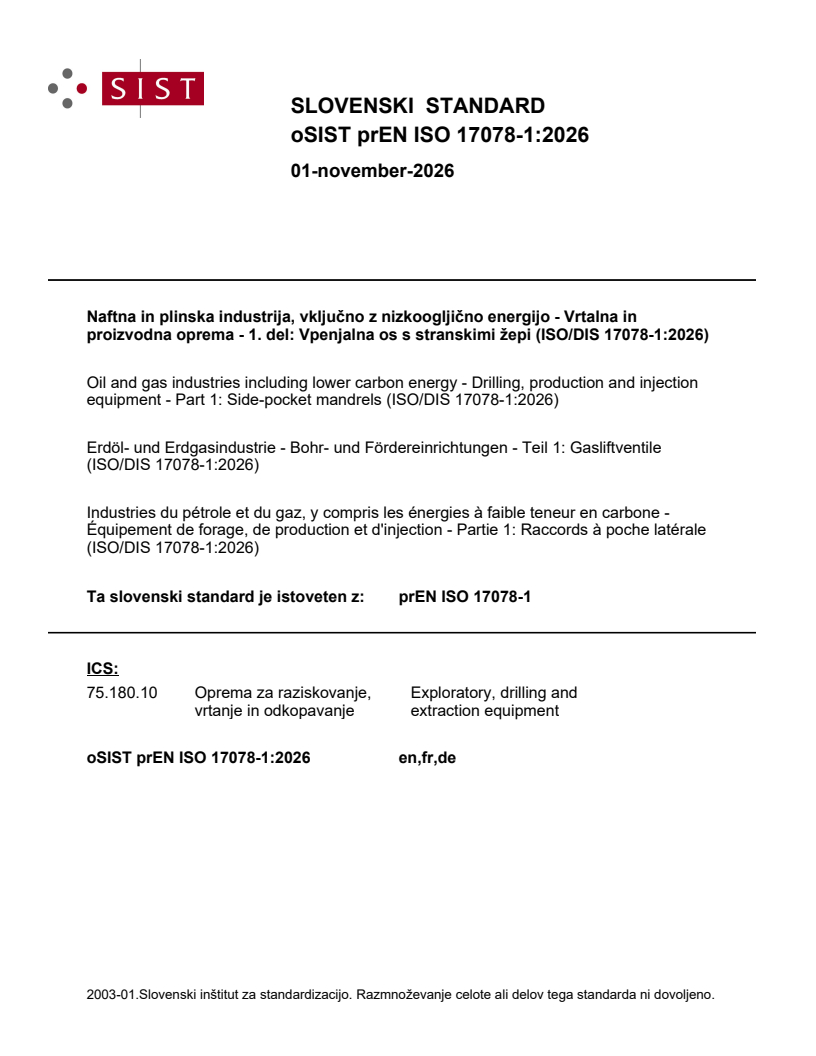
SLOVENSKI STANDARD
01-november-2026
Naftna in plinska industrija, vključno z nizkoogljično energijo - Vrtalna in
proizvodna oprema - 1. del: Vpenjalna os s stranskimi žepi (ISO/DIS 17078-1:2026)
Oil and gas industries including lower carbon energy - Drilling, production and injection
equipment - Part 1: Side-pocket mandrels (ISO/DIS 17078-1:2026)
Erdöl- und Erdgasindustrie - Bohr- und Fördereinrichtungen - Teil 1: Gasliftventile
(ISO/DIS 17078-1:2026)
Industries du pétrole et du gaz, y compris les énergies à faible teneur en carbone -
Équipement de forage, de production et d'injection - Partie 1: Raccords à poche latérale
(ISO/DIS 17078-1:2026)
Ta slovenski standard je istoveten z: prEN ISO 17078-1
ICS:
75.180.10 Oprema za raziskovanje, Exploratory, drilling and
vrtanje in odkopavanje extraction equipment
2003-01.Slovenski inštitut za standardizacijo. Razmnoževanje celote ali delov tega standarda ni dovoljeno.
DRAFT
International
Standard
ISO/DIS 17078-1
ISO/TC 67/SC 4
Oil and gas industries including
Secretariat: ANSI
lower carbon energy — Drilling,
Voting begins on:
production and injection
2026-09-17
equipment —
Voting terminates on:
2026-12-10
Part 1:
Side-pocket mandrels
ICS: 75.180.10
THIS DOCUMENT IS A DRAFT CIRCULATED
FOR COMMENTS AND APPROVAL. IT
IS THEREFORE SUBJECT TO CHANGE
AND MAY NOT BE REFERRED TO AS AN
INTERNATIONAL STANDARD UNTIL
PUBLISHED AS SUCH.
This document has not been edited by the ISO Central Secretariat.
IN ADDITION TO THEIR EVALUATION AS
BEING ACCEPTABLE FOR INDUSTRIAL,
TECHNOLOGICAL, COMMERCIAL AND
USER PURPOSES, DRAFT INTERNATIONAL
STANDARDS MAY ON OCCASION HAVE TO
ISO/CEN PARALLEL PROCESSING
BE CONSIDERED IN THE LIGHT OF THEIR
POTENTIAL TO BECOME STANDARDS TO
WHICH REFERENCE MAY BE MADE IN
NATIONAL REGULATIONS.
RECIPIENTS OF THIS DRAFT ARE INVITED
TO SUBMIT, WITH THEIR COMMENTS,
NOTIFICATION OF ANY RELEVANT PATENT
RIGHTS OF WHICH THEY ARE AWARE AND TO
PROVIDE SUPPORTING DOCUMENTATION.
Reference number
ISO/DIS 17078-1:2026(en)
DRAFT
ISO/DIS 17078-1:2026(en)
International
Standard
ISO/DIS 17078-1
ISO/TC 67/SC 4
Oil and gas industries including
Secretariat: ANSI
lower carbon energy — Drilling,
Voting begins on:
production and injection
equipment —
Voting terminates on:
Part 1:
Side-pocket mandrels
ICS: 75.180.10
THIS DOCUMENT IS A DRAFT CIRCULATED
FOR COMMENTS AND APPROVAL. IT
IS THEREFORE SUBJECT TO CHANGE
AND MAY NOT BE REFERRED TO AS AN
INTERNATIONAL STANDARD UNTIL
PUBLISHED AS SUCH.
This document has not been edited by the ISO Central Secretariat.
IN ADDITION TO THEIR EVALUATION AS
BEING ACCEPTABLE FOR INDUSTRIAL,
© ISO 2026
TECHNOLOGICAL, COMMERCIAL AND
USER PURPOSES, DRAFT INTERNATIONAL
All rights reserved. Unless otherwise specified, or required in the context of its implementation, no part of this publication may
STANDARDS MAY ON OCCASION HAVE TO
ISO/CEN PARALLEL PROCESSING
be reproduced or utilized otherwise in any form or by any means, electronic or mechanical, including photocopying, or posting on
BE CONSIDERED IN THE LIGHT OF THEIR
the internet or an intranet, without prior written permission. Permission can be requested from either ISO at the address below
POTENTIAL TO BECOME STANDARDS TO
WHICH REFERENCE MAY BE MADE IN
or ISO’s member body in the country of the requester.
NATIONAL REGULATIONS.
ISO copyright office
RECIPIENTS OF THIS DRAFT ARE INVITED
CP 401 • Ch. de Blandonnet 8
TO SUBMIT, WITH THEIR COMMENTS,
CH-1214 Vernier, Geneva
NOTIFICATION OF ANY RELEVANT PATENT
Phone: +41 22 749 01 11
RIGHTS OF WHICH THEY ARE AWARE AND TO
PROVIDE SUPPORTING DOCUMENTATION.
Email: copyright@iso.org
Website: www.iso.org
Published in Switzerland Reference number
ISO/DIS 17078-1:2026(en)
ii
ISO/DIS 17078-1:2026(en)
Contents Page
Foreword .iv
Introduction .v
1 Scope . 1
2 Normative references . 1
3 Terms and definitions . 1
4 Supplements to API Spec 19G1, 2nd edition (2019) . 2
4.1 General requirements .2
4.2 Technical specification .2
Bibliography . 4
iii
ISO/DIS 17078-1:2026(en)
Foreword
ISO (the International Organization for Standardization) is a worldwide federation of national standards
bodies (ISO member bodies). The work of preparing International Standards is normally carried out through
ISO technical committees. Each member body interested in a subject for which a technical committee
has been established has the right to be represented on that committee. International organizations,
governmental and non-governmental, in liaison with ISO, also take part in the work. ISO collaborates closely
with the International Electrotechnical Commission (IEC) on all matters of electrotechnical standardization.
The procedures used to develop this document and those intended for its further maintenance are described
in the ISO/IEC Directives, Part 1. In particular, the different approval criteria needed for the different types
of ISO documents should be noted. This document was drafted in accordance with the editorial rules of the
ISO/IEC Directives, Part 2 (see www.iso.org/directives).
Attention is drawn to the possibility that some of the elements of this document may be the subject of patent
rights. ISO shall not be held responsible for identifying any or all such patent rights. Details of any patent
rights identified during the development of the document will be in the Introduction and/or on the ISO list of
patent declarations received (see www.iso.org/patents).
Any trade name used in this document is information given for the convenience of users and does not
constitute an endorsement.
For an explanation of the voluntary nature of standards, the meaning of ISO specific terms and expressions
related to conformity assessment, as well as information about ISO's adherence to the World Trade
Organization (WTO) principles in the Technical Barriers to Trade (TBT), see www.iso.org/iso/foreword.html.
This document was prepared by Technical Committee ISO/TC 67, Oil and gas industries including lower carbon
energy, Subcommittee SC 4, Drilling, production and injection equipment, in collaboration with the European
Committee for Standardization (CEN) Technical Committee CEN/TC 12, Oil and gas industries including lower
carbon energy, in accordance with the Agreement on technical coope
...