


EN 1143-2:2014
(Main)Secure storage units - Requirements, classification and methods of tests for resistance to burglary - Part 2: Deposit systems
General Information
- Abstract
This European Standard specifies requirements and tests methods for deposit systems, and classifies the systems according to their burglary resistance and their resistance to the theft of deposits.
This European Standard comprises two types of deposit system:
- Night safes which provide depositing services for the customers of financial institutions without giving access to the content of the night safe.
- Deposit safes which enable the personnel of a company to place money or valuables in safe custody without giving access to the content of the deposit safe. The installation condition for deposit safe according to this European Standard is that the depositing functions are installed inside the premises of the company and are only disposable for the personnel of the company.
NOTE Parts of a deposit system are a receiving unit, an input unit and in some cases, a chute.
This European Standard includes design requirements for deposit systems controlled by programmable controllers and for the software for these. Controller hardware testing is restricted to mechanical or electromechanical attacks of electric motors, sensors, coils and similar devices; but software testing as attempts to influence controller software or controller hardware is not part of this standard.
Deposit systems may have devices for functions such as user identification and/or counting and registration of money. Tests of and requirements for classification of such functions are not included.
This European Standard does not cover protection of persons using the deposit system or the prevention of fraud committed by operators of the deposit system.
- Status
- Withdrawn
- Publication Date
- 06-May-2014
- Withdrawal Date
- 22-Sep-2026
- Technical Committee
- CEN/TC 263 - Secure storage of cash, valuables and data media
- Drafting Committee
- CEN/TC 263/WG 1 - Burglary resistance
- Current Stage
- 9960 - Withdrawal effective - Withdrawal
- Start Date
- 14-Aug-2024
- Completion Date
- 23-Sep-2026

Relations
- Effective Date
- 13-May-2014
- Effective Date
- 28-Jan-2023
- Effective Date
- 28-Jan-2026
- Effective Date
- 28-Jan-2026
- Effective Date
- 28-Jan-2026
- Effective Date
- 28-Jan-2026
- Effective Date
- 28-Jan-2026
Get Certified
Connect with accredited certification bodies for this standard

CIS Institut d.o.o.
Personal Protective Equipment (PPE) certification body. Notified Body NB-2890 for EU Regulation 2016/425 PPE.

Kiwa BDA Testing
Building and construction product certification.
Kmetijski inštitut Slovenije
Agricultural Institute of Slovenia. Soil testing, plant health, agricultural product analysis.
Sponsored listings
Frequently Asked Questions
EN 1143-2:2014 is a standard published by the European Committee for Standardization (CEN). Its full title is "Secure storage units - Requirements, classification and methods of tests for resistance to burglary - Part 2: Deposit systems". This standard covers: This European Standard specifies requirements and tests methods for deposit systems, and classifies the systems according to their burglary resistance and their resistance to the theft of deposits. This European Standard comprises two types of deposit system: - Night safes which provide depositing services for the customers of financial institutions without giving access to the content of the night safe. - Deposit safes which enable the personnel of a company to place money or valuables in safe custody without giving access to the content of the deposit safe. The installation condition for deposit safe according to this European Standard is that the depositing functions are installed inside the premises of the company and are only disposable for the personnel of the company. NOTE Parts of a deposit system are a receiving unit, an input unit and in some cases, a chute. This European Standard includes design requirements for deposit systems controlled by programmable controllers and for the software for these. Controller hardware testing is restricted to mechanical or electromechanical attacks of electric motors, sensors, coils and similar devices; but software testing as attempts to influence controller software or controller hardware is not part of this standard. Deposit systems may have devices for functions such as user identification and/or counting and registration of money. Tests of and requirements for classification of such functions are not included. This European Standard does not cover protection of persons using the deposit system or the prevention of fraud committed by operators of the deposit system.
This European Standard specifies requirements and tests methods for deposit systems, and classifies the systems according to their burglary resistance and their resistance to the theft of deposits. This European Standard comprises two types of deposit system: - Night safes which provide depositing services for the customers of financial institutions without giving access to the content of the night safe. - Deposit safes which enable the personnel of a company to place money or valuables in safe custody without giving access to the content of the deposit safe. The installation condition for deposit safe according to this European Standard is that the depositing functions are installed inside the premises of the company and are only disposable for the personnel of the company. NOTE Parts of a deposit system are a receiving unit, an input unit and in some cases, a chute. This European Standard includes design requirements for deposit systems controlled by programmable controllers and for the software for these. Controller hardware testing is restricted to mechanical or electromechanical attacks of electric motors, sensors, coils and similar devices; but software testing as attempts to influence controller software or controller hardware is not part of this standard. Deposit systems may have devices for functions such as user identification and/or counting and registration of money. Tests of and requirements for classification of such functions are not included. This European Standard does not cover protection of persons using the deposit system or the prevention of fraud committed by operators of the deposit system.
EN 1143-2:2014 is classified under the following ICS (International Classification for Standards) categories: 13.310 - Protection against crime. The ICS classification helps identify the subject area and facilitates finding related standards.
EN 1143-2:2014 has the following relationships with other standards: It is inter standard links to EN 1143-2:2001, EN 1143-2:2024, EN 1300:2023, EN ISO/IEC 17025:2017, EN 1143-1:2012, EN 4529-003:2006, EN ISO 13000-1:2005. Understanding these relationships helps ensure you are using the most current and applicable version of the standard.
EN 1143-2:2014 is available in PDF format for immediate download after purchase. The document can be added to your cart and obtained through the secure checkout process. Digital delivery ensures instant access to the complete standard document.
Standards Content (Sample)
2003-01.Slovenski inštitut za standardizacijo. Razmnoževanje celote ali delov tega standarda ni dovoljeno.Varnostne shranjevalne enote - Zahteve, klasifikacija in metode preskušanja protivlomne odpornosti - 2. del: Depozitni sistemiWertbehältnisse - Anforderungen, Klassifizierung und Methoden zur Prüfung des Widerstandes gegen Einbruchdiebstahl - Teil 2: Deposit-SystemeUnités de stockage en lieux sûrs - Exigences, classification et méthodes d'essai pour la résistance à l'effraction - Partie 2: Systèmes de dépôtSecure storage units - Requirements, classification and methods of tests for resistance to burglary - Part 2: Deposit systems35.220.99Druge naprave za shranjevanje podatkovOther data storage devices13.310Varstvo pred kriminalomProtection against crimeICS:Ta slovenski standard je istoveten z:EN 1143-2:2014SIST EN 1143-2:2014en,fr,de01-julij-2014SIST EN 1143-2:2014SLOVENSKI
STANDARDSIST EN 1143-2:20021DGRPHãþD
EUROPEAN STANDARD NORME EUROPÉENNE EUROPÄISCHE NORM
EN 1143-2
May 2014 ICS 13.310 Supersedes EN 1143-2:2001English Version
Secure storage units - Requirements, classification and methods of tests for resistance to burglary - Part 2: Deposit systems
Unités de stockage en lieux sûrs - Exigences, classification et méthodes d'essai pour la résistance à l'effraction - Partie 2: Systèmes de dépôt
Wertbehältnisse - Anforderungen, Klassifizierung und Methoden zur Prüfung des Widerstandes gegen Einbruchdiebstahl - Teil 2: Deposit-Systeme This European Standard was approved by CEN on 20 December 2013.
CEN members are bound to comply with the CEN/CENELEC Internal Regulations which stipulate the conditions for giving this European Standard the status of a national standard without any alteration. Up-to-date lists and bibliographical references concerning such national standards may be obtained on application to the CEN-CENELEC Management Centre or to any CEN member.
This European Standard exists in three official versions (English, French, German). A version in any other language made by translation under the responsibility of a CEN member into its own language and notified to the CEN-CENELEC Management Centre has the same status as the official versions.
CEN members are the national standards bodies of Austria, Belgium, Bulgaria, Croatia, Cyprus, Czech Republic, Denmark, Estonia, Finland, Former Yugoslav Republic of Macedonia, France, Germany, Greece, Hungary, Iceland, Ireland, Italy, Latvia, Lithuania, Luxembourg, Malta, Netherlands, Norway, Poland, Portugal, Romania, Slovakia, Slovenia, Spain, Sweden, Switzerland, Turkey and United Kingdom.
EUROPEAN COMMITTEE FOR STANDARDIZATION
COMITÉ EUROPÉEN DE NORMALISATION EUROPÄISCHES KOMITEE FÜR NORMUNG
CEN-CENELEC Management Centre:
Avenue Marnix 17,
B-1000 Brussels © 2014 CEN All rights of exploitation in any form and by any means reserved worldwide for CEN national Members. Ref. No. EN 1143-2:2014 ESIST EN 1143-2:2014
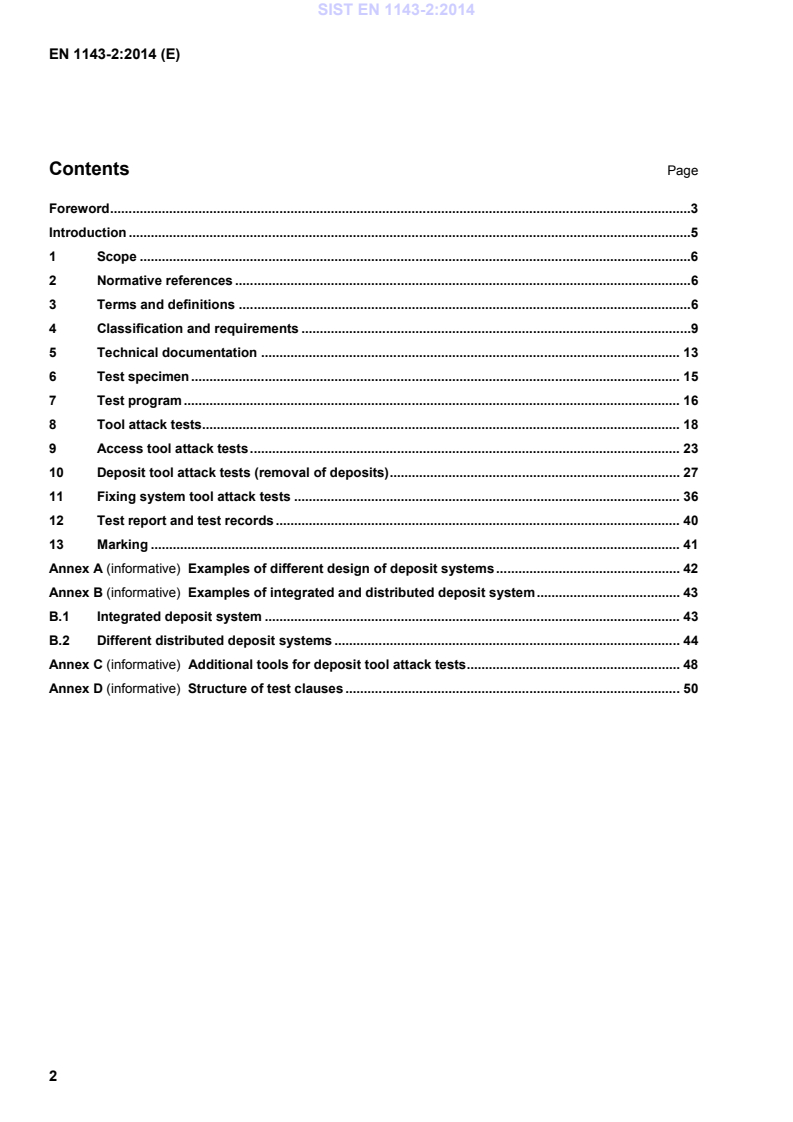
Examples of different design of deposit systems . 42 Annex B (informative)
Examples of integrated and distributed deposit system . 43 B.1 Integrated deposit system . 43 B.2 Different distributed deposit systems . 44 Annex C (informative)
Additional tools for deposit tool attack tests . 48 Annex D (informative)
Structure of test clauses . 50
The input unit of this system is intended to be used only by the employees and not be placed in a public area. 3.1.3 night safe deposit system whose security requirements relate to use by financial institutions for providing a secure receiving service for customer deposits without having to unlock the receiving unit door Note 1 to entry:
The input unit of this system are intended to be used by the customers of financial institutions and can be placed in a public area. 3.1.4 receiving unit secure storage unit with openings necessary to accommodate a deposit system 3.1.5 internal space interior of the receiving unit which is bounded by the inside surfaces and the boltwork cover plate(s) of the door of the receiving unit body and excluding parts of the chute or input unit (if any) inside the receiving unit 3.1.6 design capacity usable internal space for storing deposits 3.1.7 input unit user-access facility into which deposits are placed for passing into the receiving unit Note 1 to entry: Access to input units may be controlled by locks or devices that may provide identification of the depositor. Note 2 to entry: In this context ‘input unit’ refers to the device intended for deposit items, as opposed to the input unit for locks in EN 1300. 3.1.8 chute optional connection between input unit and receiving unit through which the deposit passes 3.1.9 deposit item placed into the input unit and intended for passing into the receiving unit Note 1 to entry: The deposit may be money or valuables that are deposited in special containers, bags or envelopes, or single bank notes or bunches of bank notes. 3.1.10 integrated deposit system deposit system controlled by programmable controllers in which the physical deposit sequences cannot be changed through links to devices outside the receiving unit Note 1 to entry: For an example of integrated deposit system, see Annex B. SIST EN 1143-2:2014
The basic grade limits are the same as those of EN 1143–1 where applicable. a All additional requirements for EX respective GAS shall be fulfilled.
4.2 General requirements 4.2.1 Holes in protection material There shall be no holes through the protection material of an input unit or chute other than those necessary for user identification (e.g. locks, card readers, etc.), cables, and insertion of deposits. SIST EN 1143-2:2014
forcea Qty
Class EX GAS D-0 30 30 –- –- 30 18 1 A D-I 50 30 –- –- 30 18 1 A D-II (EX, GAS) 80 50 4 4 50 22 1 A D-III (EX, GAS)
120 80 6 6 50 22 1 B D-IV (EX, GAS) 180 120 9 9 50 22 2 B D-V (EX, GAS) 270 180 14 14 50 22 2 B a For Grade D-0 to Grade D-III applicable force is maximum 50 kN. For Grade D-IV and Grade D-V applicable force is maximum 100 kN. (See 11.1 and 11.2) Table 3 — Minimum requirements for night safe (N) receiving unit Grade Tool attack resistance values Requirements are expressed in Resistance Units (RU) Locks according to EN 1300 Complete Access Partial Access Fixing system General Options Test without force Test with forcea Qty Class
EX GAS N-II (EX, GAS) 80 50 4 4 50 22 1 A N-III (EX, GAS)
120 80 6 6 50 22 1 B N-IV (EX, GAS) 180 120 9 9 50 22 2 B N-V (EX, GAS) 270 180 14 14 50 22 2 B N-VI (EX, GAS) 400 270 20 20 70 22 2 C N-VII (EX, GAS) 600 400 30 30 120 22 2 C N-VIII (EX, GAS) 825 550 41 41 160 22 2 C N-IX (EX, GAS) 1050 700 53 53 210 22 2 C N-X (EX, GAS) 1350 900 68 68 280 22 2 C a For Grade N-II to Grade N-III applicable force is maximum 50 kN. For Grade N-IV to Grade N-X applicable force is maximum 100 kN. (See 11.1 and 11.2) 4.4 System requirements 4.4.1 General System requirements are related to the resistance of removal of one or more deposits from the system under conditions specified under Clause 10 for different types of deposit tool attack tests. SIST EN 1143-2:2014
...