


FprEN ISO 16924
(Main)Natural gas fuelling stations - Liquefied natural gas (LNG) stations for fuelling road vehicles (ISO/FDIS 16924:2025)
Natural gas fuelling stations - Liquefied natural gas (LNG) stations for fuelling road vehicles (ISO/FDIS 16924:2025)
ISO 16924:2016 specifies the design, construction, operation, maintenance and inspection of stations for fuelling liquefied natural gas (LNG) to vehicles, including equipment, safety and control devices.
ISO 16924:2016 also specifies the design, construction, operation, maintenance and inspection of fuelling stations for using LNG as an onsite source for fuelling CNG to vehicles (LCNG fuelling stations), including safety and control devices of the station and specific LCNG fuelling station equipment.
NOTE Specific CNG equipment is dealt with in ISO 16923.
ISO 16924:2016 is applicable to fuelling stations receiving LNG and other liquefied methane-rich gases that comply with local applicable gas composition regulation or with the gas quality requirements of ISO 13686.
ISO 16924:2016 includes all equipment from the LNG storage tank filling connection up to the fuelling nozzle on the vehicle. The LNG storage tank filling connection itself and the vehicle fuelling nozzle are not covered in this document.
ISO 16924:2016 includes fuelling stations having the following characteristics:
- private access;
- public access (self-service or assisted);
- metered dispensing and non metered dispensing;
- fuelling stations with fixed LNG storage;
- fuelling stations with mobile LNG storage;
- movable fuelling stations;
- mobile fuelling stations;
- multi-fuel stations.
Gasfüllanlagen - LNG Füllanlagen zur Betankung von Fahrzeugen (ISO/FDIS 16924:2025)
Dieses Dokument legt Anforderungen an die Ausführung, die Konstruktion, den Betrieb, die Instandhaltung und die Inspektion von Tankstellen für verflüssigtes Erdgas (LNG, en: liquefied natural gas) zur Betankung von Fahrzeugen fest, einschließlich der Ausrüstung und Sicherheits- und Steuer- und Kontrollvorrichtungen. Dieses Dokument beschreibt zudem die Ausführung, die Konstruktion, den Betrieb, die Instandhaltung und die Inspektion von Tankstellen für die Verwendung von verflüssigtem Erdgas (LNG) als Quelle vor Ort zur Bereitstellung von komprimiertem Erdgas (CNG, en: compressed natural gas) für Fahrzeuge, meist LCNG-Tankstellen (Tankstellen für komprimiertes Erdgas aus LNG, LCNG (en: liquefied-to-compressed natural gas)) genannt, einschließlich Sicherheits- und Steuer- und Kontrollvorrichtungen der Tankstelle und eine für LCNG-Tankstellen spezifische Ausrüstung fest.
ANMERKUNG Die spezifische CNG-Ausrüstung wird in ISO 16923 behandelt.
Dieses Dokument gilt für Tankstellen, die LNG oder andere verflüssigte methanreiche Gase wie Bio-LNG aufnehmen, die den anwendbaren örtlichen Bestimmungen über die Gaszusammensetzung oder den Qualitätsanforderungen für Gas nach ISO 13686 entsprechen.
Dieses Dokument erfasst die gesamte Ausrüstung, vom Entladungsanschluss des LNG-Speichertanks bis hin zur (aber nicht einschließlich der) Füllkupplung am Fahrzeug. Der Entladungsanschluss des LNG-Speichertanks und die Füllkupplung am Fahrzeug selbst werden in diesem Dokument jedoch nicht behandelt.
Dieses Dokument gilt für Tankstellen mit den folgenden Eigenschaften:
privater Zugang;
öffentlicher Zugang (Selbstbedienung oder mit Tankwart-Service);
Zapfsäulen mit oder ohne Zählwerk;
Tankstellen mit fester LNG-Speicherung;
Tankstellen mit mobiler LNG-Speicherung;
bewegliche Tankstellen;
mobile Tankstellen;
Multikraftstoff-Tankstellen.
Dieses Dokument gilt nicht für:
Ausrüstungsteile, Rohrleitungen oder dem Gasdruckregler nachgelagerte Rohre bei geschlossenen Boil-Off-Gas-Systemen;
Ausrüstung zur Verflüssigung.
Stations-service de gaz naturel - Stations GNL pour le ravitaillement de véhicules (ISO/FDIS 16924:2025)
L'ISO 16924:2016 spécifie la conception, la construction, l'exploitation, la maintenance et l'inspection des stations-service de gaz naturel liquéfié (GNL) pour véhicules, dont les équipements et les dispositifs de sécurité et de contrôle.
L'ISO 16924:2016 spécifie également la conception, la construction, l'exploitation, la maintenance et l'inspection des stations-service de gaz naturel liquéfié (GNL) servant également de site de ravitaillement des véhicules en gaz naturel comprimé (GNC), appelées stations-service de GNLC (gaz naturel liquéfié/comprimé), en couvrant les dispositifs de sécurité et de contrôle des stations et les équipements propres aux stations-service GNLC.
NOTE Les équipements propres aux stations de GNC sont couverts par l'ISO 16923.
L'ISO 16924:2016 s'applique aux stations-service ravitaillées en GNL et autres gaz liquéfiés riches en méthane conformes à la réglementation locale applicable aux compositions gazeuses ou aux exigences en matière de qualité des gaz de l'ISO 13686.
L'ISO 16924:2016 couvre tous les équipements, du connecteur pour le dépotage de GNL dans réservoir de stockage GNL au pistolet de ravitaillement destiné aux réservoirs des véhicules. Le connecteur de ravitaillement du réservoir et le pistolet de ravitaillement des véhicules à proprement dits ne sont pas couverts par ce document.
L'ISO 16924:2016 couvre toutes les stations-service présentant les caractéristiques suivantes:
- accès privé;
- accès public (self-service ou avec assistance);
- borne de distribution de carburant avec ou sans compteur;
- stations-service avec stockage de GNL fixe;
- stations-service avec stockage mobile de GNL;
- stations-service transportables;
- stations-service mobiles;
- stations-service multi-carburants.
Polnilne postaje za oskrbo z zemeljskim plinom - Postaje za oskrbo vozil z utekočinjenim zemeljskim plinom (LNG) (ISO/FDIS 16924:2025)
General Information
Relations
Standards Content (Sample)
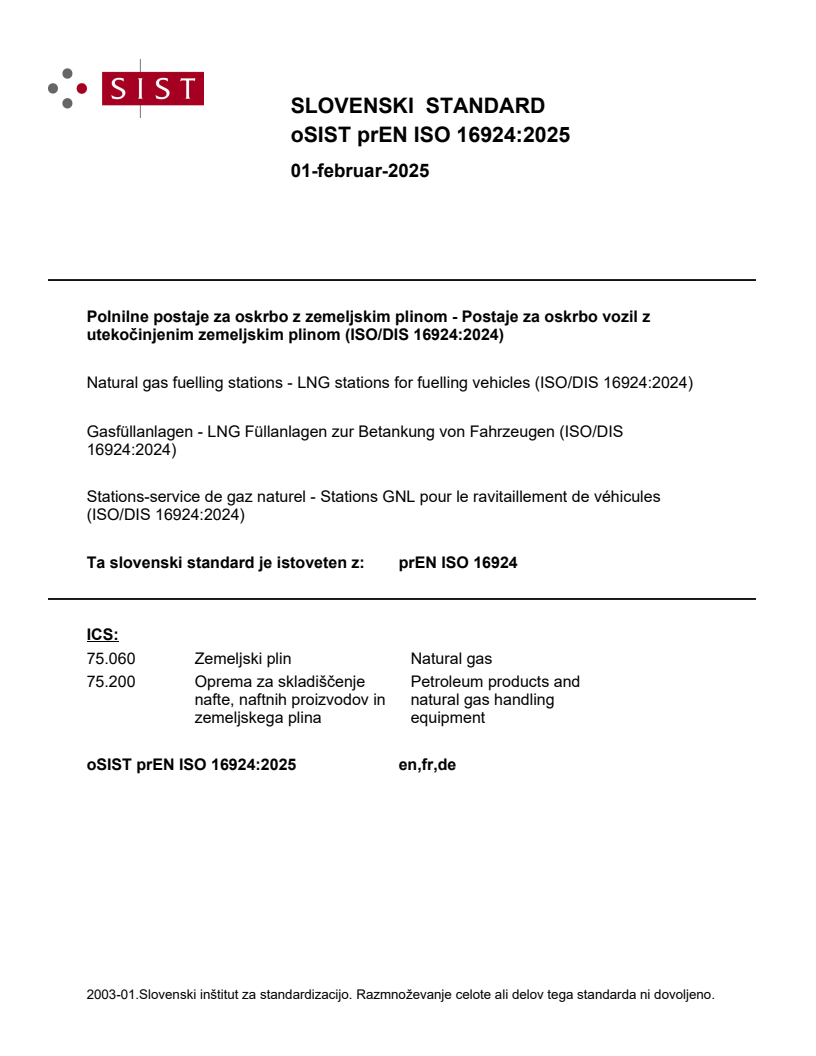
SLOVENSKI STANDARD
oSIST prEN ISO 16924:2025
01-februar-2025
Polnilne postaje za oskrbo z zemeljskim plinom - Postaje za oskrbo vozil z
utekočinjenim zemeljskim plinom (ISO/DIS 16924:2024)
Natural gas fuelling stations - LNG stations for fuelling vehicles (ISO/DIS 16924:2024)
Gasfüllanlagen - LNG Füllanlagen zur Betankung von Fahrzeugen (ISO/DIS
16924:2024)
Stations-service de gaz naturel - Stations GNL pour le ravitaillement de véhicules
(ISO/DIS 16924:2024)
Ta slovenski standard je istoveten z: prEN ISO 16924
ICS:
75.060 Zemeljski plin Natural gas
75.200 Oprema za skladiščenje Petroleum products and
nafte, naftnih proizvodov in natural gas handling
zemeljskega plina equipment
oSIST prEN ISO 16924:2025 en,fr,de
2003-01.Slovenski inštitut za standardizacijo. Razmnoževanje celote ali delov tega standarda ni dovoljeno.
oSIST prEN ISO 16924:2025
oSIST prEN ISO 16924:2025
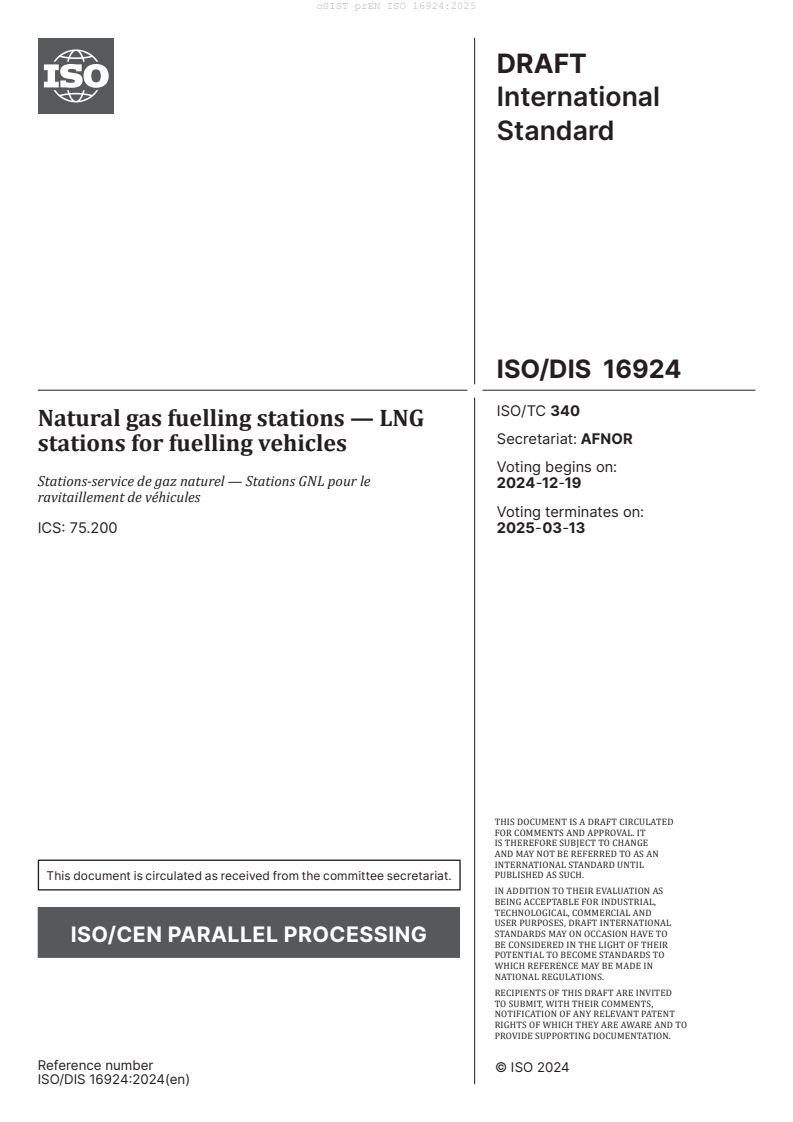
DRAFT
International
Standard
ISO/DIS 16924
ISO/TC 340
Natural gas fuelling stations — LNG
Secretariat: AFNOR
stations for fuelling vehicles
Voting begins on:
Stations-service de gaz naturel — Stations GNL pour le
2024-12-19
ravitaillement de véhicules
Voting terminates on:
ICS: 75.200 2025-03-13
THIS DOCUMENT IS A DRAFT CIRCULATED
FOR COMMENTS AND APPROVAL. IT
IS THEREFORE SUBJECT TO CHANGE
AND MAY NOT BE REFERRED TO AS AN
INTERNATIONAL STANDARD UNTIL
PUBLISHED AS SUCH.
This document is circulated as received from the committee secretariat.
IN ADDITION TO THEIR EVALUATION AS
BEING ACCEPTABLE FOR INDUSTRIAL,
TECHNOLOGICAL, COMMERCIAL AND
USER PURPOSES, DRAFT INTERNATIONAL
STANDARDS MAY ON OCCASION HAVE TO
ISO/CEN PARALLEL PROCESSING
BE CONSIDERED IN THE LIGHT OF THEIR
POTENTIAL TO BECOME STANDARDS TO
WHICH REFERENCE MAY BE MADE IN
NATIONAL REGULATIONS.
RECIPIENTS OF THIS DRAFT ARE INVITED
TO SUBMIT, WITH THEIR COMMENTS,
NOTIFICATION OF ANY RELEVANT PATENT
RIGHTS OF WHICH THEY ARE AWARE AND TO
PROVIDE SUPPORTING DOCUMENTATION.
Reference number
ISO/DIS 16924:2024(en)
oSIST prEN ISO 16924:2025
DRAFT
ISO/DIS 16924:2024(en)
International
Standard
ISO/DIS 16924
ISO/TC 340
Natural gas fuelling stations — LNG
Secretariat: AFNOR
stations for fuelling vehicles
Voting begins on:
Stations-service de gaz naturel — Stations GNL pour le
ravitaillement de véhicules
Voting terminates on:
ICS: 75.200
THIS DOCUMENT IS A DRAFT CIRCULATED
FOR COMMENTS AND APPROVAL. IT
IS THEREFORE SUBJECT TO CHANGE
AND MAY NOT BE REFERRED TO AS AN
INTERNATIONAL STANDARD UNTIL
PUBLISHED AS SUCH.
This document is circulated as received from the committee secretariat.
IN ADDITION TO THEIR EVALUATION AS
BEING ACCEPTABLE FOR INDUSTRIAL,
© ISO 2024
TECHNOLOGICAL, COMMERCIAL AND
USER PURPOSES, DRAFT INTERNATIONAL
All rights reserved. Unless otherwise specified, or required in the context of its implementation, no part of this publication may
STANDARDS MAY ON OCCASION HAVE TO
ISO/CEN PARALLEL PROCESSING
be reproduced or utilized otherwise in any form or by any means, electronic or mechanical, including photocopying, or posting on
BE CONSIDERED IN THE LIGHT OF THEIR
the internet or an intranet, without prior written permission. Permission can be requested from either ISO at the address below
POTENTIAL TO BECOME STANDARDS TO
WHICH REFERENCE MAY BE MADE IN
or ISO’s member body in the country of the requester.
NATIONAL REGULATIONS.
ISO copyright office
RECIPIENTS OF THIS DRAFT ARE INVITED
CP 401 • Ch. de Blandonnet 8
TO SUBMIT, WITH THEIR COMMENTS,
CH-1214 Vernier, Geneva
NOTIFICATION OF ANY RELEVANT PATENT
Phone: +41 22 749 01 11
RIGHTS OF WHICH THEY ARE AWARE AND TO
PROVIDE SUPPORTING DOCUMENTATION.
Email: copyright@iso.org
Website: www.iso.org
Published in Switzerland Reference number
ISO/DIS 16924:2024(en)
ii
oSIST prEN ISO 16924:2025
ISO/DIS 16924:2024(en)
Contents Page
Foreword .vii
1 Scope . 1
2 Normative references . 1
3 Terms and definitions . 3
4 Abbreviated terms . 10
5 Risk management . 10
5.1 Risk assessment .10
5.1.1 General .10
5.1.2 Protection against overpressure .11
5.1.3 Static electricity .11
5.2 Fire protection .11
5.2.1 Hazardous area classification.11
5.2.2 Sources of ignition . 12
5.2.3 Fire fighting . 12
5.3 Explosion protection measures . 12
6 General design requirements .13
6.1 General . 13
6.1.1 Design philosophy . 13
6.1.2 Buildings and civil works . 13
6.1.3 Installation and construction .14
6.2 Site layout . 15
6.2.1 Separation distances . 15
6.2.2 Traffic management . . 15
6.2.3 Security . .16
6.2.4 Requirements for location of equipment .16
6.3 Environmental considerations .16
6.3.1 Noise attenuation .16
6.3.2 Prevention of venting of natural gas .16
7 Fuel supply to the fuelling station . 17
7.1 Application .17
7.2 Equipment compatibility .17
7.3 Filling connector .17
7.4 Requirements for filling .18
7.4.1 General requirements .18
7.4.2 Prevention of overpressurization and overfilling .19
7.5 Prevention of back flow .19
7.6 Bleed connections .19
7.7 Draining of liquid from the LNG storage tank .19
7.8 LNG tanker .19
7.8.1 Immobility . .19
7.8.2 Anti-drive-away equipment . 20
7.8.3 Turning off the engine . 20
7.8.4 Equalizing the potentials . 20
8 Storage .20
8.1 LNG storage . 20
8.1.1 Design and construction . 20
8.1.2 Safety requirements . 22
8.1.3 Installation guidance . 25
8.2 CNG buffer storage . 26
9 Pumps and compressors .26
9.1 Connection of LNG pumps to the LNG storage tank . 26
9.1.1 General . 26
iii
oSIST prEN ISO 16924:2025
ISO/DIS 16924:2024(en)
9.1.2 NPSH requirements .27
9.1.3 Vapour return .27
9.1.4 Protection against weather .27
9.1.5 Accessibility .27
9.2 LNG centrifugal pump (including ancillaries) .27
9.2.1 General provisions .27
9.2.2 Liquid inlet to the centrifugal pump .27
9.2.3 Centrifugal pump design .27
9.2.4 Vibration . 28
9.2.5 Detection of shaft seal leak . 28
9.2.6 Detection of cavitation . 28
9.3 LNG reciprocating pump for LCNG fuelling stations (including ancillaries) . 28
9.3.1 General provisions . 28
9.3.2 Liquid supplied to the reciprocating pump . 28
9.3.3 Design . 28
9.3.4 Vibration . 28
9.3.5 Pulsation . 29
9.4 Commonalities for LNG centrifugal and reciprocating pumps . 29
9.4.1 Suction line . 29
9.4.2 Instrumentation. 29
9.4.3 Markings of a pump . 29
9.4.4 Instructions . 30
9.5 Natural gas compressor. 30
10 Dispensers .30
10.1 LNG dispensers . 30
10.1.1 General requirements . 30
10.1.2 Breakaway system . .32
10.1.3 Fuelling hoses .32
10.1.4 Fuelling nozzles . 33
10.1.5 Dispenser enclosure . 34
10.1.6 Other requirements . 34
10.2 CNG dispensers . 35
11 Vaporizers and heaters .35
11.1 Application . 35
11.2 Design of vaporizers and heaters . 35
11.3 Ambient air vaporizer . 36
11.3.1 General . 36
11.3.2 Defrosting . 36
11.3.3 Aluminium vaporizers . 36
11.4 Electric vaporizer/heater .37
11.5 Water bath vaporizer .37
11.6 Fired vaporizers .37
11.7 Remotely heated vaporizers .37
12 Odorization .37
12.1 General requirements .37
12.2 High-pressure odorizer. 38
12.3 Safety. 38
12.4 Monitoring . 38
12.5 Odorant. 39
12.5.1 Dynamics of function . 39
13 Pipework.39
13.1 General . 39
13.2 Pipework design . 39
13.2.1 General . 39
13.2.2 Overground pipework . 40
13.2.3 Underground pipework . 40
13.2.4 Pipework in ducts . 40
iv
oSIST prEN ISO 16924:2025
ISO/DIS 16924:2024(en)
13.2.5 Flexible connections . . .41
14 Electrical equipment and wiring . 41
14.1 General .41
14.2 Main considerations.41
14.2.1 Grounding .41
14.2.2 Lightning .41
14.2.3 Contact with live parts . . .41
14.2.4 Cables . .41
14.2.5 Static electricity .42
14.3 Other considerations .42
14.3.1 Interface .42
14.3.2 Primary seal .42
14.3.3 Additional seal .42
14.3.4 Conduit seals .42
14.3.5 Detection vents .43
15 Instrumentation and control system .43
15.1 General .43
15.2 Gas detectors .43
15.3 Flame detectors .43
15.4 Pressure gauges .43
15.5 Temperature sensors .43
15.6 Manual emergency shutdown devices .43
15.7 Uninterruptible Power Supply Unit (UPS) . 44
16 Emergency shutdown .44
16.1 Application . 44
16.2 Procedure . 44
16.3 Activation . 44
16.4 ESD action .45
16.5 Reset .45
17 Special configurations .45
17.1 Movable LNG fuelling station .45
17.1.1 General requirements .45
17.1.2 Anchoring .45
17.1.3 Containment . 46
17.2 Mobile LNG fuelling station . 46
17.2.1 General requirements . 46
17.2.2 Anchoring . 46
17.2.3 Containment . 46
17.2.4 Design . 46
17.2.5 Additional requirements for operation . 46
18 Testing and commissioning . 47
18.1 Testing .47
18.1.1 Electrical testing .47
18.1.2 Pressure strength testing .47
18.1.3 Leak testing.47
18.2 Commissioning . 48
18.2.1 General provisions . 48
18.2.2 Purging . 48
18.2.3 Functional testing . 48
18.2.4 First filling of the LNG storage tank and other components . 48
19 Operations .49
19.1 LNG tanker unloading . 49
19.2 Fuelling procedure . 49
19.3 Safety signs . 49
19.3.1 General on identification labels . 49
19.3.2 Equipment marking . 50
v
oSIST prEN ISO 16924:2025
ISO/DIS 16924:2024(en)
19.4 Equipment and pipework identification . 50
19.5 Training .51
19.6 Installation and operating instructions .51
19.7 Emergency plan .52
19.8 Maintaining the emergency shutdown .52
20 Inspection and maintenance .52
20.1 Inspection .52
20.1.1 General requirements .52
20.1.2 Inspection and testing of electrical systems . 53
20.1.3 Inspection and re-testing of the safety relief valves . 53
20.1.4 Safety and fire protection equipment . 53
20.2 Maintenance . 54
20.2.1 Preventive maintenance planning . 54
20.2.2 Maintenance procedures. 54
20.2.3 Maintenance safety . 54
20.2.4 Draining of the LNG storage tank . 54
Annex A (informative) Examples of hazardous zones classification .55
Annex B (normative) Separation distances .59
Annex C (informative) Example flow diagram of an LNG fuelling station .63
Annex D (informative) Example flow diagram of an LCNG fuelling station .64
Annex E (informative) Example flow diagram of an LNG and LCNG fuelling station .65
Annex F (informative) Process requirements for the effective cryogenic pump operation .66
Annex G (informative) Recommendations for installation of a centrifugal pump . 67
Annex H (informative) Recommendations for centrifugal pump design .68
Annex I (informative) Recommendations for installation of a reciprocating pump .69
Annex J (informative) Recommendations on the content of the cryogenic pump operation
instructions .71
Annex K (informative) LNG identification mark of an LNG fuelling station .73
Annex L (informative) Explosion-proof Static Grounding Control System . 74
Bibliography .75
vi
oSIST prEN ISO 16924:2025
ISO/DIS 16924:2024(en)
Foreword
ISO (the International Organization for Standardization) is a worldwide federation of national standards
bodies (ISO member bodies). The work of preparing International Standards is normally carried out through
ISO technical committees. Each member body interested in a subject for which a technical committee
has been established has the right to be represented on that committee. International organizations,
governmental and non-governmental, in liaison with ISO, also take part in the work. ISO collaborates closely
with the International Electrotechnical Commission (IEC) on all matters of electrotechnical standardization.
The procedures used to develop this document and those intended for its further maintenance are described
in the ISO/IEC Directives, Part 1. In particular the different approval criteria needed for the different types
of ISO documents should be noted. This document was drafted in accordance with the editorial rules of the
ISO/IEC Directives, Part 2 (see www.iso.org/directives).
Attention is drawn to the possibility that some of the elements of this document may be the subject of patent
rights. ISO shall not be held responsible for identifying any or all such patent rights. Details of any patent
rights identified during the development of the document will be in the Introduction and/or on the ISO list of
patent declarations received (see www.iso.org/patents).
Any trade name used in this document is information given for the convenience of users and does not
constitute an endorsement.
For an explanation on the meaning of ISO specific terms and expressions related to conformity assessment,
as well as information about ISO's adherence to the World Trade Organization (WTO) principles in the
Technical Barriers to Trade (TBT) see
...
Questions, Comments and Discussion
Ask us and Technical Secretary will try to provide an answer. You can facilitate discussion about the standard in here.