


prEN 4915-001
(Main)Aerospace series - Hermetically sealed relays 2PDT, 4PDT and 6PDT — Part 001: Technical specification
Aerospace series - Hermetically sealed relays 2PDT, 4PDT and 6PDT — Part 001: Technical specification
This document specifies the general characteristics, the conditions for qualification, acceptance and quality assurance, as well as the test programs and groups for non-latching electromagnetic, hermetically sealed relays intended for use in a temperature range from - 55 °C to 125 °C continuous.
Luft- und Raumfahrt - Hermetisch abgedichtete Relais, zwei-, vier- und sechspolige Wechselschalter - Teil 001: Technische Lieferbedingungen
Dieses Dokument legt die allgemeinen Eigenschaften, die Bedingungen für die Qualifizierung, Abnahme und Qualitätssicherung sowie die Prüfprogramme und -gruppen für nicht einrastende elektromagnetische, herme
tisch dichte Relais fest, die für den Einsatz in einem Temperaturbereich von −55°C bis 125°C kontinuierlich vorgesehen sind.
Série aérospatiale - Relais hermétiques 2PDT, 4PDT et 6PDT - Partie 001 : Spécification technique
Le présent document spécifie les caractéristiques générales, les conditions de qualification, de réception et d'assurance qualité, ainsi que les programmes et les groupes d'essais des relais hermétiques sans verrouillage destinés à une utilisation dans une plage de températures comprises entre -55 °C et 125 °C continu.
Aeronavtika - Hermetično zaprti releji 2PDT, 4PDT in 6PDT - 001. del: Tehnične specifikacije
General Information
Standards Content (Sample)
SLOVENSKI STANDARD
01-januar-2026
Aeronavtika - Hermetično zaprti releji 2PDT, 4PDT in 6PDT - 001. del: Tehnične
specifikacije
Aerospace series - Hermetically sealed relays 2PDT, 4PDT and 6PDT - Part 001:
Technical specification
Luft- und Raumfahrt - Hermetisch abgedichtete Relais, zwei-, vier- und sechspolige
Wechselschalter - Teil 001: Technische Lieferbedingungen
Ta slovenski standard je istoveten z: prEN 4915-001
ICS:
29.120.70 Releji Relays
49.060 Letalska in vesoljska Aerospace electric
električna oprema in sistemi equipment and systems
2003-01.Slovenski inštitut za standardizacijo. Razmnoževanje celote ali delov tega standarda ni dovoljeno.
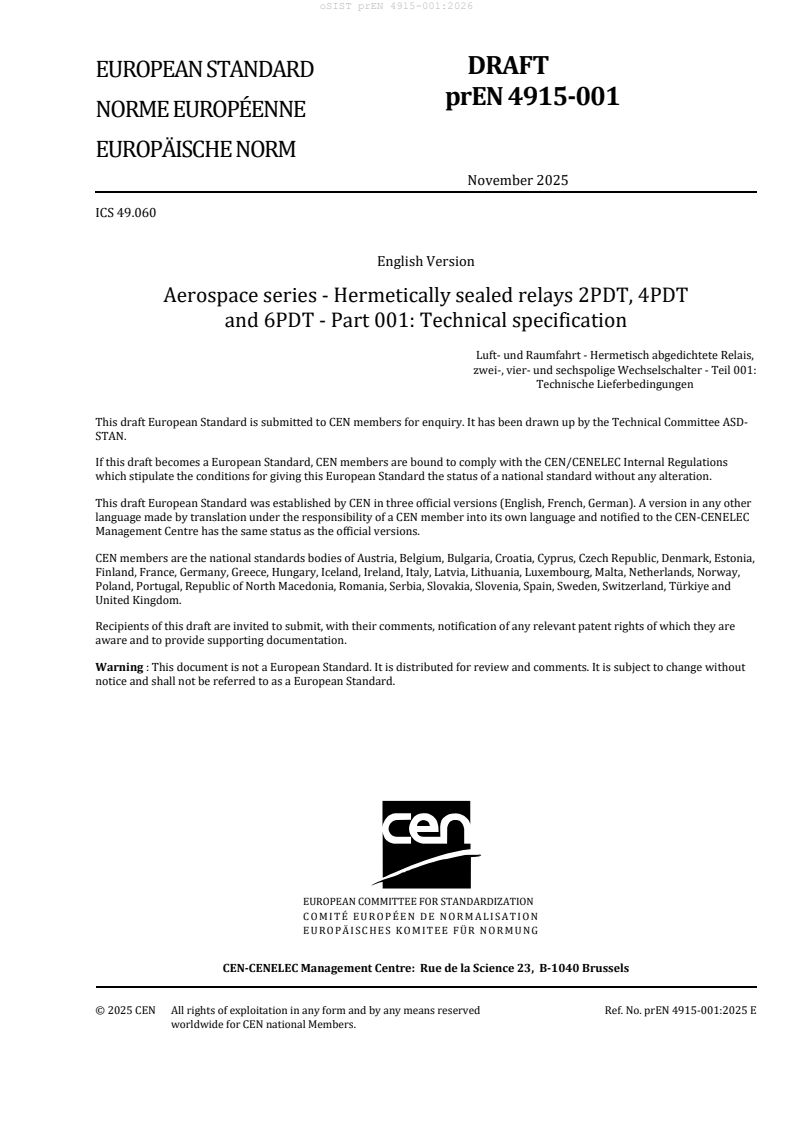
DRAFT
EUROPEAN STANDARD
NORME EUROPÉENNE
EUROPÄISCHE NORM
November 2025
ICS 49.060
English Version
Aerospace series - Hermetically sealed relays 2PDT, 4PDT
and 6PDT - Part 001: Technical specification
Luft- und Raumfahrt - Hermetisch abgedichtete Relais,
zwei-, vier- und sechspolige Wechselschalter - Teil 001:
Technische Lieferbedingungen
This draft European Standard is submitted to CEN members for enquiry. It has been drawn up by the Technical Committee ASD-
STAN.
If this draft becomes a European Standard, CEN members are bound to comply with the CEN/CENELEC Internal Regulations
which stipulate the conditions for giving this European Standard the status of a national standard without any alteration.
This draft European Standard was established by CEN in three official versions (English, French, German). A version in any other
language made by translation under the responsibility of a CEN member into its own language and notified to the CEN-CENELEC
Management Centre has the same status as the official versions.
CEN members are the national standards bodies of Austria, Belgium, Bulgaria, Croatia, Cyprus, Czech Republic, Denmark, Estonia,
Finland, France, Germany, Greece, Hungary, Iceland, Ireland, Italy, Latvia, Lithuania, Luxembourg, Malta, Netherlands, Norway,
Poland, Portugal, Republic of North Macedonia, Romania, Serbia, Slovakia, Slovenia, Spain, Sweden, Switzerland, Türkiye and
United Kingdom.
Recipients of this draft are invited to submit, with their comments, notification of any relevant patent rights of which they are
aware and to provide supporting documentation.
Warning : This document is not a European Standard. It is distributed for review and comments. It is subject to change without
notice and shall not be referred to as a European Standard.
EUROPEAN COMMITTEE FOR STANDARDIZATION
COMITÉ EUROPÉEN DE NORMALISATION
EUROPÄISCHES KOMITEE FÜR NORMUNG
CEN-CENELEC Management Centre: Rue de la Science 23, B-1040 Brussels
© 2025 CEN All rights of exploitation in any form and by any means reserved Ref. No. prEN 4915-001:2025 E
worldwide for CEN national Members.
Contents Page
European foreword . 4
Introduction . 5
1 Scope . 6
2 Normative references . 6
3 Terms and definitions . 7
3.1 General. 7
3.2 prefixes for the values applicable to relays. 8
3.3 Terms relating to time . 10
4 Characteristics . 12
4.1 Construction . 12
4.1.1 Material parts . 12
4.1.2 Metal parts. 13
4.1.3 Insulants . 13
4.1.4 Magnet wire . 13
4.1.5 Plated finishes . 13
4.1.6 Case grounding . 13
4.1.7 Leakage current paths . 13
4.1.8 Mounting . 14
4.1.9 Pin out . 14
4.1.10 Seal . 14
4.2 Electricals . 14
4.2.1 Coil . 14
4.2.2 Stabilization of permanent magnet . 16
4.2.3 Rating contact. 16
4.2.4 Circuit diagram . 16
4.2.5 Diode . 16
4.2.6 Type designation . 16
5 Design, characteristics and requirement . 16
6 Test . 17
6.1 General requirements . 17
6.2 Normal environmental conditions for tests . 17
6.2.2 Electric wiring . 17
6.3 Tests according to EN 4914-100 . 18
7 Qualification test description, sample and group definition . 20
7.1 General. 20
7.2 Sample and group definition for qualification . 21
7.3 Qualification tests . 23
7.4 Verification tests . 25
7.5 Screening test . 25
7.6 Batch acceptance . 26
7.7 Periodic tests to maintain qualification . 27
8 Quality assurance . 27
9 Designation and marking . 27
9.1 General principle of designation . 27
9.2 Marking . 28
10 Delivery conditions . 28
11 Packaging . 28
12 Storage . 28
12.1 Storage conditions . 28
12.2 Storage duration . 29
Bibliography . 30
European foreword
This document (prEN 4915-001:2025) has been prepared by ASD-STAN.
After enquiries and votes carried out in accordance with the rules of this Association, this document has
received the approval of the National Associations and the Official Services of the member countries of
ASD-STAN, prior to its presentation to CEN.
This document is currently submitted to the CEN Enquiry.
Introduction
This family of relays is derived from MIL-PRF-83536, MIL-PRF-6106, ASNE, ABS, ECS and CECC, with
which it is intermateable and interchangeable.
This specification covers the general requirements for non-latching electromagnetic, hermetically
sealed relays for use in aircraft.
These relays are designed to operate over the full range from low level to power switching with contact
ratings up to 25 A alternating current (AC) or direct current (DC).
1 Scope
This document specifies the general characteristics, the conditions for qualification, acceptance and
quality assurance, as well as the test programs and groups for non-latching electromagnetic,
hermetically sealed relays intended for use in a temperature range from - 55 °C to 125 °C continuous.
2 Normative references
The following documents are referred to in the text in such a way that some or all of their content
constitutes requirements of this document. For dated references, only the edition cited applies. For
undated references, the latest edition of the referenced document (including any amendments) applies.
EN 2282, Aerospace series — Characteristics of aircraft electrical supplies
EN 3155-001, Aerospace series — Electrical contacts used in elements of connection — Part 001:
Technical specification
EN 4914-100, Aerospace series — Test procedures for electromechanical all-or-nothing relays
EN 4915-010 Aerospace series — Hermetically sealed 2PDT, 4PDT and 6PDT, 10 AMP — Part 010:
Product standard
EN 9133, Aerospace series — Quality Management Systems — Qualification procedure for aerospace
standard products
EN IEC 60068-2-17, Environmental testing — Part 2-17: Tests — Test Q: Sealing
MIL-HDBK-454:2021, General Guidelines for Electronic Equipment
This document is currently under development.
Published by Department of Defense (DoD), available at: https://assist.dla.mil/online/start/.
3 Terms and definitions
For the purposes of this document, the terms and definitions given in EN 4914-100, EN 4915-010 and
the following apply.
ISO and IEC maintain terminology databases for use in standardization at the following addresses:
— ISO Online browsing platform: available at https://www.iso.org/obp/
— IEC Electropedia: available at https://www.electropedia.org/
3.1 General
3.1.1
electromechanical relay
electrical relay in which the designed response is developed by the relative movement of mechanical
elements under the action of a current in the input circuit(s)
3.1.2
all-or-nothing relay
electrical relay which is intended to be energized by a quantity, whose value is either:
— higher than that at which it operates;
— or lower than that at which it releases
Note 1 to entry: The adjective “all-or-nothing” can be deleted when no ambiguity may occur.
3.1.3
monostable relay
electrical relay which, having responded to an input energizing quantity and having changed its
condition, returns to its previous condition when the quantity is removed
3.1.4
polarized relay
change of condition of which depends upon the direction of its input energizing quantity
3.1.5
non-polarized relay
change of condition of which does not depend upon the direction of its input energizing quantity
3.1.6
hermetically sealed relay
sealed relay having an enhanced level of sealing, assuring time constant better than 2 × 10⁶ s
Note 1 to entry: This shall be according to EN IEC 60068-2-17.
3.1.7
release condition
specified condition of the relay when it is not energized
3.1.8
operate condition
specified condition of the relay when it is energized in a specified manner
3.1.9
to operate
relay operates when it changes from its release condition to its operate condition
3.1.10
to release
relay releases when it changes from its operate condition to its release condition
3.1.11
to change over
relay changes over when it operates or releases
3.1.12
to cycle
relay cycles when it operates and then releases, or vice versa
3.1.13
make contact
contact which is closed when the relay is in its operate condition and which is opened when the relay is
in its release condition
3.1.14
break contact
contact which is opened when the relay is in its operate condition and which is closed when the relay is
in its release condition
3.1.15
change-over contact
combination of two contact circuits including three contact members, one of them being common to the
two contact circuits. When one of these contact circuits is open, the other is closed and vice versa
3.1.16
change-over make-before-break contact
one contact circuit of which makes before the other breaks
3.1.17
change-over break-before-make contact
one contact circuit of which breaks before the other makes
3.2 prefixes for the values applicable to relays
Values may be defined as rated, actual (“just”), test (“must”) or characteristic value and identified as
such by using one of these words as a prefix. The prefixes are also applicable to timing values
3.2.1
rated value
value of a quantity assigned, generally by a manufacturer, for a specified operating condition of a relay
3.2.2
actual (“just”) value
value of a quantity determined by measurement on a single relay when it just performs a specified
function
3.2.3
test (“must”) value
value of a quantity with which, during tests, the relay is required to perform or not to perform a
specified function
3.2.4
characteristic value
value of a quantity with which, throughout its lifetime or a specified number of cycles, the relay is
required to comply with a specified requirement
3.2.5
energizing quantity
electrical quantity (either current or voltage or power) which alone, or in combination with other such
quantities applied to a relay under specified conditions, enables it to fulfil its purpose
3.2.6
operative range of an energizing quantity
range of values of an energizing quantity for which the relay under specified conditions is able to
perform its intended function(s) according to the specified requirements
3.2.7
magnetic preconditioning value
value of the energizing quantity at which the relay attains a defined magnetic condition.
Note 1 to entry: For polarized relays, distinction is made between preconditioning in forward (operate) direction,
and preconditioning in reverse direction
3.2.8
non-operate value
value of the energizing quantity at which a relay does not operate. operate value: Value of the
energizing quantity at which a relay operates
3.2.9
non-release value
value of the energizing quantity at which a relay does not release. release value: Value of the energizing
quantity at which a relay release
3.2.10
non-revert value
value of the energizing quantity at which the relay, being in an operate condition, does not release by
increasing the value of this energizing quantity
3.2.11
non-revert-reverse value
value of the energizing quantity at which the relay, being in a release condition, does not operate by
increasing the value of this energizing quantity
3.2.12
reverse polarity value
value of the energizing quantity of reverse polarity at which a polarized monostable relay does not
operate
3.2.13
contact current
current which a relay contact carries before opening or after closing
3.2.14
contact voltage
voltage between the contact members before dosing or after opening
3.2.15
limiting continuous current
highest value of the current (RMS. if AC), which a previously closed contact circuit is capable of carrying
continuously
3.2.16
contact noise
spurious voltage which appears across the terminals of a closed contact
3.2.17
contact tip
contact point
conductive part of a contact member designed to co-act with another to close the contact circuit
3.2.18
contact gap
gap between the contact tips (points) under specified conditions when the contact circuit is open
3.2.19
contact force
force which two contact tips (points) exert against each other in the closed position under specified
conditions
3.3 Terms relating to time
The operate time, release time, transfer time and bridging time, as defined hereunder, do not include
bounce time. The operate time covers the closing time of a make contact and the opening time of a
break contact. The release time covers the opening time of a make contact and the closing time of a
break contact.
3.3.1
operate time
relay which is in the release condition the time interval between the instant
Note 1 to entry: A specified value of the input energizing value is applied and the first closing (or opening) of the
contact circuit.
Note 2 to entry: When the relay has several output circuits, the timing should be taken for the last to break
and/or last to make, unless otherwise specified.
3.3.2
release time
relay which is in the operate condition the time interval between the instant
Note 1 to entry: A specified value of the input energizing value is removed and the first opening (or closing) of the
contact circuit.
Note 2 to entry: When the relay has several output circuits, the timing should be taken for the last to break
and/or last to make, unless otherwise specified.
3.3.3
transfer time
time interval during which both contact circuits are open
3.3.4
bridging time
time interval during which both contact circuits are closed
3.3.5
bounce time
contact which is closing (opening) its circuit, the time interval between the instant when the contact
circuit first closes (opens) and the instant when the circuit is finally closed (opened)
3.3.6
time to stable closed (open) condition; stabilization time
time interval between the instant when a specified value of the input energizing quantity is applied and
the instant when a contact is closed (open) and fulfils specified requirements
3.3.7
minimum time of operate energization
minimum duration of application of rated operate value required to ensure that the contact circuit
fulfils specified requirements
3.3.8
contact time difference
difference between the maximum value of the operate (release) time and the minimum value of the
operate (release) time
3.3.9
coil transient suppression device
device connected to the relay coil to limit its back e.m.f. to a prescribed value
3.3.10
characteristics for operating, release and bounce time
Key:
contact break bounce duration
1 switch closure 7
switch opening
2 operating time 8
release time
3 transfer time 9
release time characteristic
4 operating time characteristic 10
contact make bounce duration
5 dynamic contact resistance effect 11
6 contact closing bounce duration (make bounce)
Figure 1
4 Characteristics
4.1 Construction
4.1.1 Material parts
Materials used externally shall be fungus inert (according to Guideline 4 of MIL-HDBK-454), self-
extinguishing, and shall not support combustion, nor give off noxious gases in harmful quantities.
Materials used internally shall not give off gases in quantities sufficient to cause explosion of sealed
enclosures, cause contamination of the contacts or other parts of the relay that will adversely affect life
or reliability, or form current carrying tracks when subjected to any of the tests specified herein.
Ceramic used for external surfaces shall be glazed.
The use of silicone or silicone compounds for any purpose is prohibited.
The selection of materials shall be such as to provide maximum she
...
Questions, Comments and Discussion
Ask us and Technical Secretary will try to provide an answer. You can facilitate discussion about the standard in here.