


EN 15984:2011
(Main)Petroleum industry and products - Determination of composition of refinery heating gas and calculation of carbon content and calorific value - Gas chromatography method
General Information
- Abstract
This European Standard defines a chromatographic analysis for the determination of the composition of fuel gases, as used in refineries refining heating gas. These results are used to calculate the carbon content and lower caloric value. With this gas chromatographic analysis, an overall of 23 components are determined in concentrations as typically found in refineries.
Water is not analysed. The results represent dry fuel gas.
NOTE 1 Depending on the equipment used, there is a possibility to determine higher hydrocarbons as well.
NOTE 2 For the purposes of this European Standard, the terms "% (V/V)" is used to represent the volume fraction (φ).
IMPORTANT - This standard does not purport to address all of the safety problems associated with its use. It is the responsibility of the user of this standard to establish appropriate safety and health practices and determine the applicability of regulatory limitations.
- Status
- Withdrawn
- Publication Date
- 19-Apr-2011
- Withdrawal Date
- 22-Sep-2026
- Technical Committee
- CEN/TC 19 - Petroleum products, lubricants and related products
- Drafting Committee
- CEN/TC 19/WG 9 - Chromatographic test methods
- Current Stage
- 9960 - Withdrawal effective - Withdrawal
- Start Date
- 09-Aug-2017
- Completion Date
- 23-Sep-2026

Relations
- Effective Date
- 16-Aug-2017
Get Certified
Connect with accredited certification bodies for this standard

Element Materials Technology
Materials testing and product certification.

ABS Group Brazil
ABS Group certification services in Brazil.

ABS Quality Evaluations Inc.
American Bureau of Shipping quality certification.
Sponsored listings
Frequently Asked Questions
EN 15984:2011 is a standard published by the European Committee for Standardization (CEN). Its full title is "Petroleum industry and products - Determination of composition of refinery heating gas and calculation of carbon content and calorific value - Gas chromatography method". This standard covers: This European Standard defines a chromatographic analysis for the determination of the composition of fuel gases, as used in refineries refining heating gas. These results are used to calculate the carbon content and lower caloric value. With this gas chromatographic analysis, an overall of 23 components are determined in concentrations as typically found in refineries. Water is not analysed. The results represent dry fuel gas. NOTE 1 Depending on the equipment used, there is a possibility to determine higher hydrocarbons as well. NOTE 2 For the purposes of this European Standard, the terms "% (V/V)" is used to represent the volume fraction (φ). IMPORTANT - This standard does not purport to address all of the safety problems associated with its use. It is the responsibility of the user of this standard to establish appropriate safety and health practices and determine the applicability of regulatory limitations.
This European Standard defines a chromatographic analysis for the determination of the composition of fuel gases, as used in refineries refining heating gas. These results are used to calculate the carbon content and lower caloric value. With this gas chromatographic analysis, an overall of 23 components are determined in concentrations as typically found in refineries. Water is not analysed. The results represent dry fuel gas. NOTE 1 Depending on the equipment used, there is a possibility to determine higher hydrocarbons as well. NOTE 2 For the purposes of this European Standard, the terms "% (V/V)" is used to represent the volume fraction (φ). IMPORTANT - This standard does not purport to address all of the safety problems associated with its use. It is the responsibility of the user of this standard to establish appropriate safety and health practices and determine the applicability of regulatory limitations.
EN 15984:2011 is classified under the following ICS (International Classification for Standards) categories: 75.160 - Fuels; 75.160.30 - Gaseous fuels. The ICS classification helps identify the subject area and facilitates finding related standards.
EN 15984:2011 has the following relationships with other standards: It is inter standard links to EN 15984:2017. Understanding these relationships helps ensure you are using the most current and applicable version of the standard.
EN 15984:2011 is available in PDF format for immediate download after purchase. The document can be added to your cart and obtained through the secure checkout process. Digital delivery ensures instant access to the complete standard document.
Standards Content (Sample)
2003-01.Slovenski inštitut za standardizacijo. Razmnoževanje celote ali delov tega standarda ni dovoljeno.PHWRGDMineralölindustrie und -produkte - Bestimmung der Zusammensetzung von Heizgas für Raffinerien und Berechnung des Kohlenstoffgehaltes und des Heizwertes - Gaschromatographisches VerfahrenIndustries et produits pétroliers - Détermination de la composition des gaz combustibles de raffinerie, de leur pouvoir calorifique et de leur teneur en carbone - Méthode par chromatographie en phase gazeusePetroleum industry and products - Determination of composition of refinery heating gas and calculation of carbon content and calorific value - Gas chromatography method75.160.30Plinska gorivaGaseous fuelsICS:Ta slovenski standard je istoveten z:EN 15984:2011SIST EN 15984:2011en,fr,de01-julij-2011SIST EN 15984:2011SLOVENSKI
STANDARD
EUROPEAN STANDARD NORME EUROPÉENNE EUROPÄISCHE NORM
EN 15984
April 2011 ICS 75.160 English Version
Petroleum industry and products -Determination of composition of refinery heating gas and calculation of carbon content and calorific value - Gas chromatography method
Industries et produits pétroliers - Détermination de la composition des gaz combustibles de raffinerie, de leur pouvoir calorifique et de leur teneur en carbone - Méthode par chromatographie en phase gazeuse
Mineralölindustrie und -produkte - Bestimmung der Zusammensetzung von Heizgas für Raffinerien und Berechnung des Kohlenstoffgehaltes und des Heizwertes -Gaschromatographisches Verfahren This European Standard was approved by CEN on 9 March 2011.
CEN members are bound to comply with the CEN/CENELEC Internal Regulations which stipulate the conditions for giving this European Standard the status of a national standard without any alteration. Up-to-date lists and bibliographical references concerning such national standards may be obtained on application to the CEN-CENELEC Management Centre or to any CEN member.
This European Standard exists in three official versions (English, French, German). A version in any other language made by translation under the responsibility of a CEN member into its own language and notified to the CEN-CENELEC Management Centre has the same status as the official versions.
CEN members are the national standards bodies of Austria, Belgium, Bulgaria, Croatia, Cyprus, Czech Republic, Denmark, Estonia, Finland, France, Germany, Greece, Hungary, Iceland, Ireland, Italy, Latvia, Lithuania, Luxembourg, Malta, Netherlands, Norway, Poland, Portugal, Romania, Slovakia, Slovenia, Spain, Sweden, Switzerland and United Kingdom.
EUROPEAN COMMITTEE FOR STANDARDIZATION
COMITÉ EUROPÉEN DE NORMALISATION EUROPÄISCHES KOMITEE FÜR NORMUNG
Management Centre:
Avenue Marnix 17,
B-1000 Brussels © 2011 CEN All rights of exploitation in any form and by any means reserved worldwide for CEN national Members. Ref. No. EN 15984:2011: ESIST EN 15984:2011
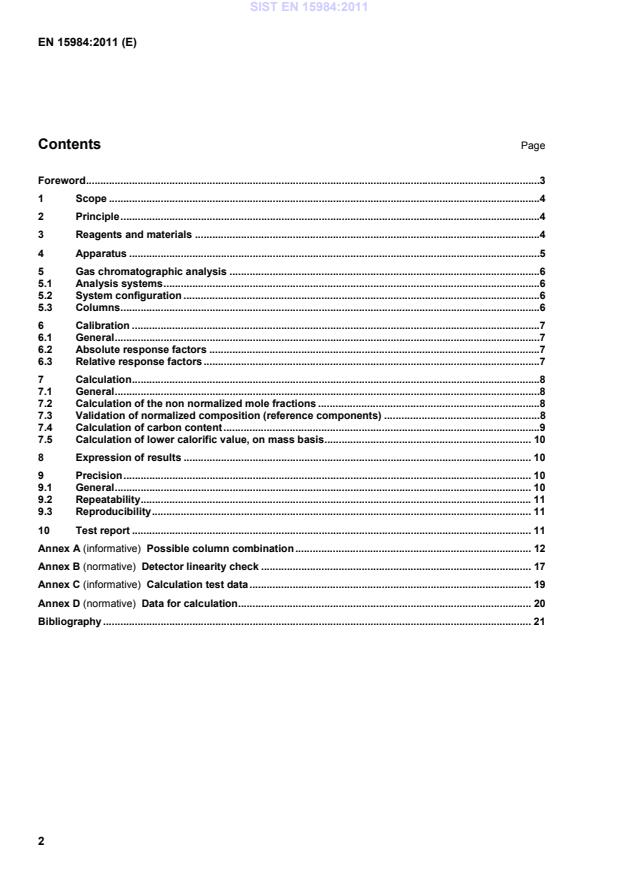
Possible column combination . 12Annex B (normative)
Detector linearity check . 17Annex C (informative)
Calculation test data . 19Annex D (normative)
Data for calculation. 20Bibliography . 21 SIST EN 15984:2011
With this gas chromatographic analysis, an overall of 23 refinery heating gas components are determined in concentrations as typically found in refineries (see Table 1 for further details). Water is not analysed. The results represent dry gases. NOTE 1 Depending on the equipment used, there is a possibility to determine higher hydrocarbons as well. NOTE 2 For the purposes of this European Standard, the terms “% (V/V)” is used to represent the volume fraction (3). IMPORTANT — This standard does not purport to address all of the safety problems associated with its use. It is the responsibility of the user of this standard to establish appropriate safety and health practices and determine the applicability of regulatory limitations. 2 Principle This standard defines a procedure that is used to determine all components that are present in a typical refinery heating gas, as indicated in Table 1.
NOTE The composition range in which each component can be analyzed does depend on the actual sample composition as higher amounts of a certain component may affect the detection range of other components eluting close by. The general ranges which apply to all the individual components are: Hydrocarbons from 0,01 (mol/100 mol) up to 100 (mol/100 mol); Non-condensable gases from 0,02 (mol/100 mol) up to 100 (mol/100 mol); For hydrogen sulfide a range between 0,1 (mol/100 mol) up to 10 (mol/100 mol) has been found applicable. Three different analysis systems are necessary; they may be built in three separate gas chromatographs, or be integrated into one. Depending on the configuration, hydrocarbons with more than five carbon atoms are reported as a sum parameter. The composition of the refinery heating gas is used to calculate the carbon content and the calorific value. A typical procedure is described hereafter. A configuration is acceptable when the determination gives the precision as described in Clause 9. 3 Reagents and materials 3.1 Gases. 3.1.1 Hydrogen, with a minimum purity of 99,995 % (V/V). 3.1.2 Helium, with a minimum purity of 99,995 % (V/V). 3.1.3 Nitrogen, with a minimum purity of 99,995 % (V/V). 3.1.4 Air, free of oil and water. 3.1.5 Argon, as alternative for analysis system 2, with a minimum purity of 99,995 % (V/V). SIST EN 15984:2011
4 Apparatus 4.1 Usual laboratory apparatus and glassware. 4.2 Gas chromatographic apparatus, consisting of at least three separation systems able to work simultaneously in one gas chromatograph, with a Thermal Conductivity Detector (TCD) and Flame Ionization Detector (FID) that should be available, and confirming to the requirements as given in Clause 5. SIST EN 15984:2011
A gas flow control system and gas sampling valves and switching valves are used.
Means for quantification shall be provided. NOTE Optionally a vaporizer may be used. 5.3 Columns A combination of packed and capillary columns is possible.
It shall be ascertained that a quantitative separation of all the components that need to be determined (see Table 1) is possible and that the summed total of C5+ is quantitative. Adequate separation is required between the components on all three separation systems. If cyclopropane can be determined, it shall be summed to propene. An example for a typical configuration is given in Annex A. SIST EN 15984:2011
...