


EN 16473:2014
(Main)Firefighters helmets - Helmets for technical rescue
General Information
- Abstract
This European Standard specifies the minimum requirements for technical rescue helmets. These helmets are intended to protect the upper head mainly against the effects of mechanical hazards such as impact and penetration, flame, electrical and chemical hazards whilst conducting technical rescue and associated activities.
Technical rescues involves work associated with the environments and conditions associated with operational scenarios such as but not limited to those found during road traffic collisions and when working in and around collapsed structures often for extended periods of time after natural disasters (flood, earthquake, etc.)
Requirements for marking and information to be supplied by the manufacturer are included.
Helmets for use whilst firefighting in buildings and other structures or in wildland firefighting environments, are not covered by this European Standard, see EN 443 and EN 16471.
Helmets for use in water rescue operations using craft are also not covered by this European Standard.
Protection of the face, eyes, ears and neck may require additional items of PPE, which are not covered by this European Standard.
- Status
- Published
- Publication Date
- 16-Dec-2014
- Technical Committee
- CEN/TC 158 - Head protection
- Drafting Committee
- CEN/TC 158/WG 3 - Firefighters helmets
- Current Stage
- 9093 - Decision to confirm - Review Enquiry
- Start Date
- 25-May-2021
- Completion Date
- 23-Sep-2026
- Directive
- Harmonized Standard2016/425 - Regulation (EU) 2016/425 of the European Parliament and of the Council of 9 March 2016 on personal protective equipment and repealing Council Directive 89/686/EECOJ Ref: C, C 113 OJ Date: 27-Mar-2018
Not Harmonized89/686/EEC - Personal protective equipment (PPE)OJ Ref: C, C 412 OJ Date: 11-Dec-2015


Overview - EN 16473:2014 (Firefighters helmets - Helmets for technical rescue)
EN 16473:2014 is a CEN European Standard that defines minimum performance, testing and marking requirements for helmets used in technical rescue. It targets helmets intended to protect the upper head against mechanical hazards (impact, penetration), flame, electrical and chemical exposure encountered during technical rescue operations - for example at road traffic collisions, railway incidents, collapsed structures and post-disaster search & rescue. The standard specifies manufacturer information and marking requirements and supports the essential requirements of relevant EU PPE directives.
Note: EN 16473 covers technical rescue helmets only. Helmets specifically for structural firefighting or wildland firefighting are excluded (see EN 443 and EN 16471). Water‑craft rescue helmets are also excluded. Face, eye, ear and neck protection may require additional PPE beyond this standard.
Key topics and technical requirements
EN 16473 sets out practical performance areas and referenced test methods. Major topics include:
- Materials and construction - shell, liners and accessory attachment points; control of projections.
- Retention system - design, effectiveness and strength requirements to keep the helmet in place during operations.
- Shock absorption - crown and lateral impact performance to reduce transmitted forces to the head.
- Penetration resistance & high‑speed particles - protection against sharp or high‑velocity threats.
- Flame resistance - resistance of shell, retention components and accessories to ignition and heat.
- Thermal resistance & lateral crushing - performance under sustained loads and compressive forces.
- Electrical properties - conductive headform and surface insulation tests for electrical hazard exposure.
- Resistance to liquid chemicals - materials compatibility and resistance to contact with hazardous fluids.
- Field of vision & visors - optical and dimensional requirements for safe operational visibility.
- Conditioning and practical performance - UV, solvent, thermal and wet conditioning plus real‑world wearer tests.
- Marking and manufacturer information - required labels and user/safety information supplied with the helmet.
Referenced test standards include EN 13087 (parts 1–8), EN 168, EN 960, EN ISO 13688 and EN 14458 among others.
Applications - who uses EN 16473:2014
- Helmet manufacturers & designers - to develop compliant technical rescue helmets.
- Procurement officers & safety managers - to specify and select helmets for firefighting, rescue teams, EMS and emergency responders.
- Test laboratories & conformity assessors - to perform standardized testing and certification.
- Regulators & standardization bodies - for harmonized safety requirements across Europe.
Related standards
- EN 443 - Structural firefighting helmets (building firefighting)
- EN 16471 - Wildland firefighting helmets
- EN 14458, EN 168, EN 13087 series, EN ISO 13688 - referenced test and protective clothing/eye‑protection standards
EN 16473 helps ensure technical rescue helmets deliver balanced protection, durability and usability for emergency responders working in demanding, variable environments.
Relations
- Effective Date
- 25-Aug-2026
- Effective Date
- 25-Aug-2026
- Effective Date
- 22-Jul-2026
- Effective Date
- 22-Jul-2026
- Effective Date
- 22-Jul-2026
- Effective Date
- 22-Jul-2026
- Refers
ISO 6344-1:1998 - Coated abrasives — Grain size analysis — Part 1: Grain size distribution test - Effective Date
- 09-Feb-2026
- Effective Date
- 28-Jan-2026
- Effective Date
- 28-Jan-2026
- Effective Date
- 28-Jan-2026
- Effective Date
- 28-Jan-2026
- Effective Date
- 28-Jan-2026
- Effective Date
- 28-Jan-2026
- Effective Date
- 28-Jan-2026
- Effective Date
- 28-Jan-2026
Get Certified
Connect with accredited certification bodies for this standard

CIS Institut d.o.o.
Personal Protective Equipment (PPE) certification body. Notified Body NB-2890 for EU Regulation 2016/425 PPE.

Kiwa BDA Testing
Building and construction product certification.
Kmetijski inštitut Slovenije
Agricultural Institute of Slovenia. Soil testing, plant health, agricultural product analysis.
Sponsored listings
Frequently Asked Questions
EN 16473:2014 is a standard published by the European Committee for Standardization (CEN). Its full title is "Firefighters helmets - Helmets for technical rescue". This standard covers: This European Standard specifies the minimum requirements for technical rescue helmets. These helmets are intended to protect the upper head mainly against the effects of mechanical hazards such as impact and penetration, flame, electrical and chemical hazards whilst conducting technical rescue and associated activities. Technical rescues involves work associated with the environments and conditions associated with operational scenarios such as but not limited to those found during road traffic collisions and when working in and around collapsed structures often for extended periods of time after natural disasters (flood, earthquake, etc.) Requirements for marking and information to be supplied by the manufacturer are included. Helmets for use whilst firefighting in buildings and other structures or in wildland firefighting environments, are not covered by this European Standard, see EN 443 and EN 16471. Helmets for use in water rescue operations using craft are also not covered by this European Standard. Protection of the face, eyes, ears and neck may require additional items of PPE, which are not covered by this European Standard.
This European Standard specifies the minimum requirements for technical rescue helmets. These helmets are intended to protect the upper head mainly against the effects of mechanical hazards such as impact and penetration, flame, electrical and chemical hazards whilst conducting technical rescue and associated activities. Technical rescues involves work associated with the environments and conditions associated with operational scenarios such as but not limited to those found during road traffic collisions and when working in and around collapsed structures often for extended periods of time after natural disasters (flood, earthquake, etc.) Requirements for marking and information to be supplied by the manufacturer are included. Helmets for use whilst firefighting in buildings and other structures or in wildland firefighting environments, are not covered by this European Standard, see EN 443 and EN 16471. Helmets for use in water rescue operations using craft are also not covered by this European Standard. Protection of the face, eyes, ears and neck may require additional items of PPE, which are not covered by this European Standard.
EN 16473:2014 is classified under the following ICS (International Classification for Standards) categories: 13.340.20 - Head protective equipment. The ICS classification helps identify the subject area and facilitates finding related standards.
EN 16473:2014 has the following relationships with other standards: It is inter standard links to ISO 1817:2005, ISO 17493:2000, EN 13087-7:2000, EN 960:2006, EN 13087-3:2000, EN 13087-1:2000, ISO 6344-1:1998, EN 13087-2:2012, EN 1811:1998, EN 13087-5:2012, EN 1811:2023, EN 13087-8:2000, EN 14458:2004, EN 168:2001, EN 13087-4:2012. Understanding these relationships helps ensure you are using the most current and applicable version of the standard.
EN 16473:2014 is associated with the following European legislation: EU Directives/Regulations: 2016/425, 89/686/EEC; Standardization Mandates: M/031. When a standard is cited in the Official Journal of the European Union, products manufactured in conformity with it benefit from a presumption of conformity with the essential requirements of the corresponding EU directive or regulation.
EN 16473:2014 is available in PDF format for immediate download after purchase. The document can be added to your cart and obtained through the secure checkout process. Digital delivery ensures instant access to the complete standard document.
Standards Content (Sample)
2003-01.Slovenski inštitut za standardizacijo. Razmnoževanje celote ali delov tega standarda ni dovoljeno.Feuerwehrhelme - Helme für technische RettungCasques de sapeurs-pompiers - Casques pour les opérations de secours techniqueFirefighters helmets - Helmets for technical rescue13.340.20Varovalna oprema za glavoHead protective equipment13.220.10Gašenje požaraFire-fightingICS:Ta slovenski standard je istoveten z:EN 16473:2014SIST EN 16473:2015en,fr,de01-februar-2015SIST EN 16473:2015SLOVENSKI
STANDARD
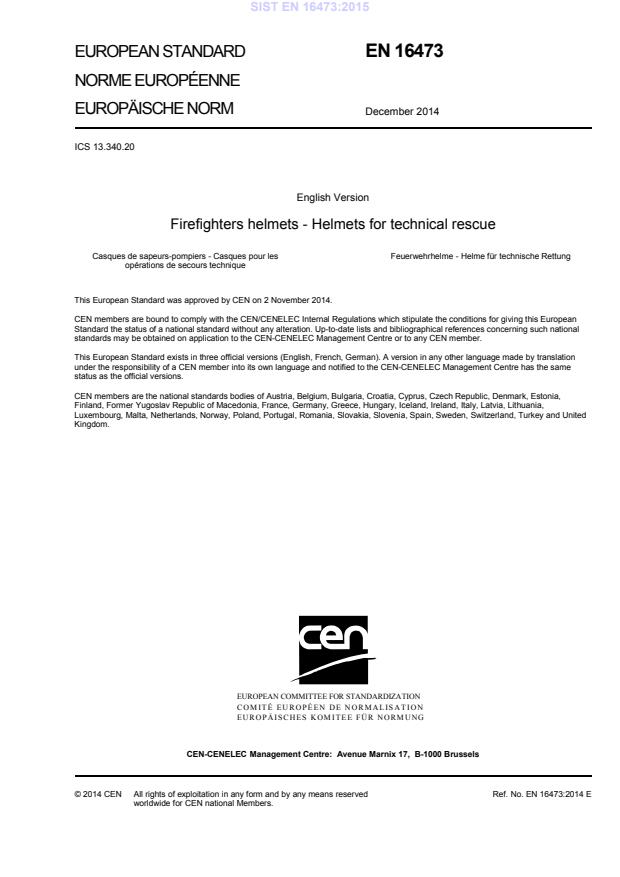
EUROPEAN STANDARD NORME EUROPÉENNE EUROPÄISCHE NORM
EN 16473
December 2014 ICS 13.340.20 English Version
Firefighters helmets - Helmets for technical rescue
Casques de sapeurs-pompiers - Casques pour les opérations de secours technique
Feuerwehrhelme - Helme für technische Rettung This European Standard was approved by CEN on 2 November 2014.
CEN members are bound to comply with the CEN/CENELEC Internal Regulations which stipulate the conditions for giving this European Standard the status of a national standard without any alteration. Up-to-date lists and bibliographical references concerning such national standards may be obtained on application to the CEN-CENELEC Management Centre or to any CEN member.
This European Standard exists in three official versions (English, French, German). A version in any other language made by translation under the responsibility of a CEN member into its own language and notified to the CEN-CENELEC Management Centre has the same status as the official versions.
CEN members are the national standards bodies of Austria, Belgium, Bulgaria, Croatia, Cyprus, Czech Republic, Denmark, Estonia, Finland, Former Yugoslav Republic of Macedonia, France, Germany, Greece, Hungary, Iceland, Ireland, Italy, Latvia, Lithuania, Luxembourg, Malta, Netherlands, Norway, Poland, Portugal, Romania, Slovakia, Slovenia, Spain, Sweden, Switzerland, Turkey and United Kingdom.
EUROPEAN COMMITTEE FOR STANDARDIZATION
COMITÉ EUROPÉEN DE NORMALISATION EUROPÄISCHES KOMITEE FÜR NORMUNG
CEN-CENELEC Management Centre:
Avenue Marnix 17,
B-1000 Brussels © 2014 CEN All rights of exploitation in any form and by any means reserved worldwide for CEN national Members. Ref. No. EN 16473:2014 ESIST EN 16473:2015
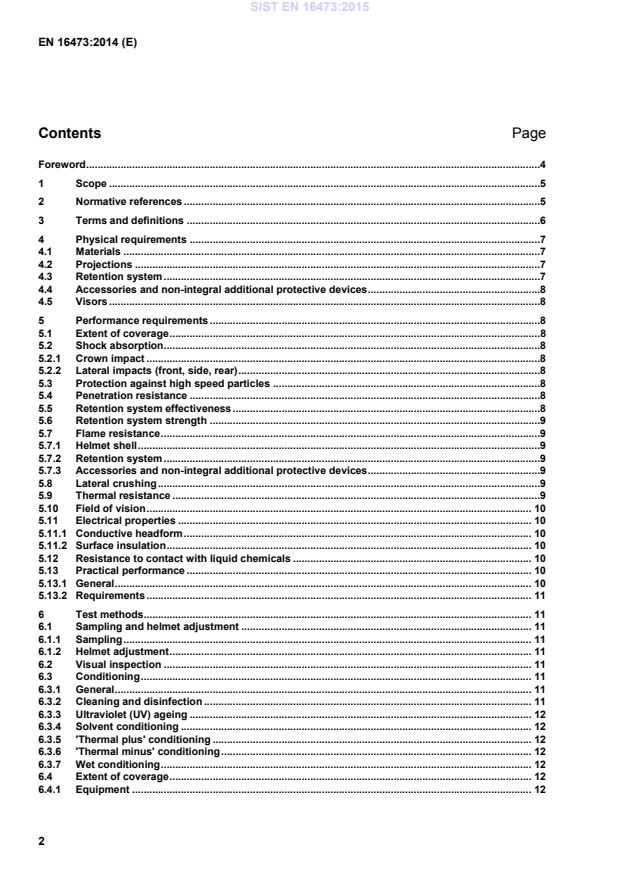
Conditioning and testing schedule . 20 Annex ZA (informative)
Relationship between this European Standard and the Essential Requirements of EU Directive 89/686/EEC . 22
Lamp brackets, cable clips, badges and trims.
1) ISO 1817:2005 is replaced by ISO 1817:2011, Rubber, vulcanized or thermoplastic — Determination of the effect of liquids. SIST EN 16473:2015
Mesh visors, ear defenders, neck-guard and safety goggles. 4 Physical requirements 4.1 Materials For those parts of the helmet coming, or that may come, into contact with the skin the material used shall not be subject to any known appreciable alteration from contact with sweat or with substances likely to be found in toiletries. Materials shall not be used which are known to cause skin disorders or other adverse effects on health. Examples for documents that can be presented as evidence of chemical innocuousness are given in the note. NOTE The following list of documents is given for information and as examples of documents to be examined: a)
materials specifications; b) safety data sheets relating to the materials; c) information relating to the suitability of the materials for use with food, in medical devices, or other relevant applications; d) information relating to toxicological, allergenic, carcinogenic, toxic to reproduction or mutagenic investigations on the materials; e) information relating to ecotoxicological and other environmental investigations on the materials. The examination should determine whether the claim that the materials are suitable for use in the protective helmet is justified. Particular attention needs to be paid to the presence of plasticisers, unreacted components, heavy metals, impurities and the chemical identity of pigments and dyes. All metallic materials which could come into prolonged contact with the skin (e.g. studs, fittings) shall have a release of Nickel of less than 0,5 µg/cm3 per week, when tested according to EN 1811. Substances recommended for cleaning, maintenance or disinfection shall have no adverse effect on the helmet and shall be not known to be likely to have any adverse effect upon the wearer, when applied in accordance with the manufacturer’s instructions. Materials shall conform to the relevant requirements of EN ISO 13688 4.2 Projections There shall be no sharp edges, roughness or projections on any part of the helmet, which are likely to cause injury to the wearer, in contact or potential contact with the wearer when the helmet is worn. Test according to 6.16. 4.3 Retention system The helmet shall be fitted with a retention system, including a chinstrap. The chinstrap shall be adjustable in length. SIST EN 16473:2015
...