


EN 12845:2015+A1:2019
(Main + Amendment)Fixed firefighting systems - Automatic sprinkler systems - Design, installation and maintenance
General Information
- Abstract
This European Standard specifies requirements and gives recommendations for the design, installation and maintenance of fixed fire sprinkler systems in buildings and industrial plants, and particular requirements for sprinkler systems that are integral to measures for the protection of life.
This European Standard covers only the types of sprinkler specified in EN 12259 1 (see Annex L).
The requirements and recommendations of this European Standard are also applicable to any addition, extension, repair or other modification to a sprinkler system. They are not applicable to water spray or deluge systems.
It covers the classification of hazards, provision of water supplies, components to be used, installation and testing of the system, maintenance, and the extension of existing systems, and identifies construction details of buildings which are the minimum necessary for satisfactory performance of sprinkler systems complying with this European Standard.
This European Standard does not cover water supplies to systems other than sprinklers. Its requirements can be used as guidance for other fixed firefighting extinguishing systems, provided that any specific requirements for other firefighting extinguishing supplies are taken into account.
This European Standard is intended for use by those concerned with purchasing, designing, installing, testing, inspecting, approving, operating and maintaining automatic sprinkler systems, in order that such equipment will function as intended throughout its life.
This European Standard is intended only for fixed fire sprinkler systems in buildings and other premises on land. Although the general principles might well apply to other uses (e.g. maritime use). For these other uses additional considerations should be taken into account.
The requirements are not valid for automatic sprinkler systems on ships, in aircraft, on vehicles and mobile fire appliances or for below ground systems in the mining industry.
Sprinkler system design deviations might be allowed when such deviations have been shown to provide a level of protection at least equivalent to this European Standard, for example by means of full-scale fire testing where appropriate, and where the design criteria have been fully documented.
- Status
- Withdrawn
- Publication Date
- 17-Dec-2019
- Withdrawal Date
- 22-Sep-2026
- Technical Committee
- CEN/TC 191 - Fixed firefighting systems
- Drafting Committee
- CEN/TC 191/WG 5 - Sprinkler systems
- Current Stage
- 9960 - Withdrawal effective - Withdrawal
- Start Date
- 01-Apr-2026
- Completion Date
- 23-Sep-2026



Overview
EN 12845:2015+A1:2019 / EN 12845:2015+A1:2019 is the European standard for fixed firefighting systems - automatic sprinkler systems. It specifies requirements and recommendations for the design, installation, testing and maintenance of automatic sprinkler systems in buildings and industrial plants. The standard aims to ensure sprinkler systems perform reliably to protect life and property and applies to new systems as well as additions, extensions, repairs or modifications. It covers only the sprinkler types specified in EN 12259-1 and excludes deluge/water spray systems and mobile or transport uses (ships, aircraft, vehicles) and below-ground mining systems.
Key technical topics and requirements
- Hazard classification - guidance for classifying occupancies and fire hazards (Light, Ordinary, High Hazard; storage configurations and high-hazard storage specifics).
- Hydraulic design criteria - pre-calculated and calculated system approaches, including design parameters for LH, OH, HHP and HHS systems and cases with in-rack sprinklers.
- Water supplies - acceptable supply types (town mains, storage tanks, pressure tanks, inexhaustible sources), required capacity, refill/continuity considerations and isolation arrangements.
- Pumps and pump sets - performance characteristics, multiple pump arrangements, housing and suction conditions.
- Components and installation - requirements for sprinkler components (per EN 12259-1), layout drawings, minimum construction details needed for satisfactory performance, protection of concealed spaces and permitted exceptions.
- Testing, commissioning and maintenance - procedures for testing water supplies and system components, ongoing inspection and maintenance to ensure lifecycle performance.
- Documentation and contract planning - design documentation, summary schedules and responsibilities for purchasers, designers and installers.
- Deviations and equivalence - allows design deviations only when equivalent protection is demonstrated (for example by full‑scale fire testing) and fully documented.
Practical applications
- Design and specification of automatic sprinkler systems for commercial buildings, warehouses, factories and other land-based premises.
- Installation and commissioning of new sprinkler systems, or extensions and repairs to existing systems.
- Basis for acceptance testing, routine inspection and maintenance programs to meet regulatory or insurer requirements.
- Guidance for fire engineers evaluating protection strategies and for building owners seeking compliant fire suppression solutions.
Who should use this standard
- Fire protection designers and hydraulic engineers
- Installation contractors and testing/commissioning teams
- Facility managers, building owners and operators
- Inspectors, approval authorities and insurers
- Purchasers specifying sprinkler systems
Related standards
- EN 12259-1 (sprinkler components) - referenced for permitted sprinkler types.
- National adoptions (e.g., SIST EN 12845) implement the European standard for local use.
Keywords: SIST EN 12845, EN 12845:2015+A1:2020, automatic sprinkler systems, sprinkler design, sprinkler installation, sprinkler maintenance, fire protection standards, hydraulic design, water supply for sprinklers, hazard classification.
Relations
- Effective Date
- 20-Jan-2026
- Effective Date
- 18-Jan-2023
- Effective Date
- 09-Oct-2019
- Effective Date
- 08-Apr-2026
- Effective Date
- 08-Apr-2026
- Effective Date
- 08-Apr-2026
- Effective Date
- 08-Apr-2026
- Effective Date
- 08-Apr-2026
- Effective Date
- 09-Feb-2026
- Effective Date
- 09-Feb-2026
- Effective Date
- 09-Feb-2026
- Effective Date
- 09-Feb-2026
- Effective Date
- 09-Feb-2026
- Effective Date
- 09-Feb-2026
- Effective Date
- 09-Feb-2026
Get Certified
Connect with accredited certification bodies for this standard

CIS Institut d.o.o.
Personal Protective Equipment (PPE) certification body. Notified Body NB-2890 for EU Regulation 2016/425 PPE.

Kiwa BDA Testing
Building and construction product certification.
Kmetijski inštitut Slovenije
Agricultural Institute of Slovenia. Soil testing, plant health, agricultural product analysis.
Sponsored listings
Frequently Asked Questions
EN 12845:2015+A1:2019 is a standard published by the European Committee for Standardization (CEN). Its full title is "Fixed firefighting systems - Automatic sprinkler systems - Design, installation and maintenance". This standard covers: This European Standard specifies requirements and gives recommendations for the design, installation and maintenance of fixed fire sprinkler systems in buildings and industrial plants, and particular requirements for sprinkler systems that are integral to measures for the protection of life. This European Standard covers only the types of sprinkler specified in EN 12259 1 (see Annex L). The requirements and recommendations of this European Standard are also applicable to any addition, extension, repair or other modification to a sprinkler system. They are not applicable to water spray or deluge systems. It covers the classification of hazards, provision of water supplies, components to be used, installation and testing of the system, maintenance, and the extension of existing systems, and identifies construction details of buildings which are the minimum necessary for satisfactory performance of sprinkler systems complying with this European Standard. This European Standard does not cover water supplies to systems other than sprinklers. Its requirements can be used as guidance for other fixed firefighting extinguishing systems, provided that any specific requirements for other firefighting extinguishing supplies are taken into account. This European Standard is intended for use by those concerned with purchasing, designing, installing, testing, inspecting, approving, operating and maintaining automatic sprinkler systems, in order that such equipment will function as intended throughout its life. This European Standard is intended only for fixed fire sprinkler systems in buildings and other premises on land. Although the general principles might well apply to other uses (e.g. maritime use). For these other uses additional considerations should be taken into account. The requirements are not valid for automatic sprinkler systems on ships, in aircraft, on vehicles and mobile fire appliances or for below ground systems in the mining industry. Sprinkler system design deviations might be allowed when such deviations have been shown to provide a level of protection at least equivalent to this European Standard, for example by means of full-scale fire testing where appropriate, and where the design criteria have been fully documented.
This European Standard specifies requirements and gives recommendations for the design, installation and maintenance of fixed fire sprinkler systems in buildings and industrial plants, and particular requirements for sprinkler systems that are integral to measures for the protection of life. This European Standard covers only the types of sprinkler specified in EN 12259 1 (see Annex L). The requirements and recommendations of this European Standard are also applicable to any addition, extension, repair or other modification to a sprinkler system. They are not applicable to water spray or deluge systems. It covers the classification of hazards, provision of water supplies, components to be used, installation and testing of the system, maintenance, and the extension of existing systems, and identifies construction details of buildings which are the minimum necessary for satisfactory performance of sprinkler systems complying with this European Standard. This European Standard does not cover water supplies to systems other than sprinklers. Its requirements can be used as guidance for other fixed firefighting extinguishing systems, provided that any specific requirements for other firefighting extinguishing supplies are taken into account. This European Standard is intended for use by those concerned with purchasing, designing, installing, testing, inspecting, approving, operating and maintaining automatic sprinkler systems, in order that such equipment will function as intended throughout its life. This European Standard is intended only for fixed fire sprinkler systems in buildings and other premises on land. Although the general principles might well apply to other uses (e.g. maritime use). For these other uses additional considerations should be taken into account. The requirements are not valid for automatic sprinkler systems on ships, in aircraft, on vehicles and mobile fire appliances or for below ground systems in the mining industry. Sprinkler system design deviations might be allowed when such deviations have been shown to provide a level of protection at least equivalent to this European Standard, for example by means of full-scale fire testing where appropriate, and where the design criteria have been fully documented.
EN 12845:2015+A1:2019 is classified under the following ICS (International Classification for Standards) categories: 13.220.20 - Fire protection. The ICS classification helps identify the subject area and facilitates finding related standards.
EN 12845:2015+A1:2019 has the following relationships with other standards: It is inter standard links to EN 12845:2015+A2:2026, EN 12845:2015, EN 12845:2015/FprA1:2019, ISO 65:1981, ISO 3046-1:2002, ISO 3046-6:1990, ISO 3046-5:2001, ISO 3046-3:2006, EN 60332-1-2:2004/A12:2020, EN 60332-1-1:2004, EN 60332-1-3:2004, EN 60332-1-2:2004/A1:2015, EN IEC 60947-1:2021, EN 60623:2017, EN 50342-2:2019. Understanding these relationships helps ensure you are using the most current and applicable version of the standard.
EN 12845:2015+A1:2019 is available in PDF format for immediate download after purchase. The document can be added to your cart and obtained through the secure checkout process. Digital delivery ensures instant access to the complete standard document.
Standards Content (Sample)
SLOVENSKI STANDARD
01-februar-2020
Nadomešča:
SIST EN 12845:2015
SIST EN 12845:2015/AC:2016
Vgrajene naprave za gašenje - Avtomatski sprinklerski sistemi - Projektiranje,
vgradnja in vzdrževanje
Fixed firefighting systems - Automatic sprinkler systems - Design, installation and
maintenance
Ortsfeste Brandbekämpfungsanlagen - Automatische Sprinkleranlagen - Planung,
Installation und Instandhaltung
Installations fixes de lutte contre l‘incendie - Systèmes d’extinction automatique du type
sprinkleur - Conception, installation et maintenance
Ta slovenski standard je istoveten z: EN 12845:2015+A1:2019
ICS:
13.220.10 Gašenje požara Fire-fighting
2003-01.Slovenski inštitut za standardizacijo. Razmnoževanje celote ali delov tega standarda ni dovoljeno.
EN 12845:2015+A1
EUROPEAN STANDARD
NORME EUROPÉENNE
December 2019
EUROPÄISCHE NORM
ICS 13.220.20 Supersedes EN 12845:2015
English Version
Fixed firefighting systems - Automatic sprinkler systems -
Design, installation and maintenance
Installations fixes de lutte contre l'incendie - Systèmes Ortsfeste Brandbekämpfungsanlagen - Automatische
d'extinction automatique du type sprinkleur - Sprinkleranlagen - Planung, Installation und
Conception, installation et maintenance Instandhaltung
This European Standard was approved by CEN on 20 December 2014 and includes Amendment 1 approved by CEN on 2 October
2019.
CEN members are bound to comply with the CEN/CENELEC Internal Regulations which stipulate the conditions for giving this
European Standard the status of a national standard without any alteration. Up-to-date lists and bibliographical references
concerning such national standards may be obtained on application to the CEN-CENELEC Management Centre or to any CEN
member.
This European Standard exists in three official versions (English, French, German). A version in any other language made by
translation under the responsibility of a CEN member into its own language and notified to the CEN-CENELEC Management
Centre has the same status as the official versions.
CEN members are the national standards bodies of Austria, Belgium, Bulgaria, Croatia, Cyprus, Czech Republic, Denmark, Estonia,
Finland, France, Germany, Greece, Hungary, Iceland, Ireland, Italy, Latvia, Lithuania, Luxembourg, Malta, Netherlands, Norway,
Poland, Portugal, Republic of North Macedonia, Romania, Serbia, Slovakia, Slovenia, Spain, Sweden, Switzerland, Turkey and
United Kingdom.
EUROPEAN COMMITTEE FOR STANDARDIZATION
COMITÉ EUROPÉEN DE NORMALISATION
EUROPÄISCHES KOMITEE FÜR NORMUNG
CEN-CENELEC Management Centre: Rue de la Science 23, B-1040 Brussels
© 2019 CEN All rights of exploitation in any form and by any means reserved Ref. No. EN 12845:2015+A1:2019 E
worldwide for CEN national Members.
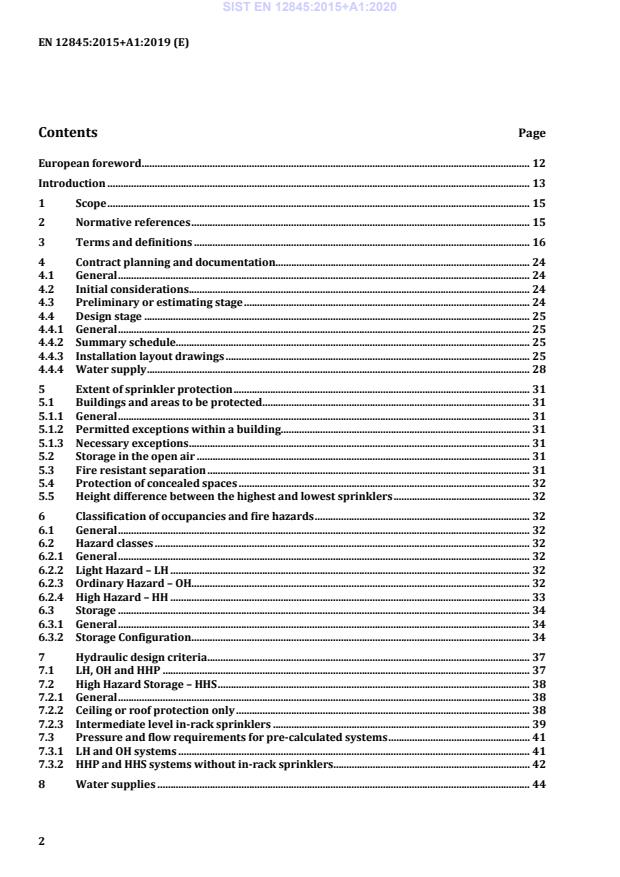
Contents Page
European foreword . 12
Introduction . 13
1 Scope . 15
2 Normative references . 15
3 Terms and definitions . 16
4 Contract planning and documentation. 24
4.1 General . 24
4.2 Initial considerations . 24
4.3 Preliminary or estimating stage . 24
4.4 Design stage . 25
4.4.1 General . 25
4.4.2 Summary schedule. 25
4.4.3 Installation layout drawings . 25
4.4.4 Water supply . 28
5 Extent of sprinkler protection . 31
5.1 Buildings and areas to be protected . 31
5.1.1 General . 31
5.1.2 Permitted exceptions within a building. 31
5.1.3 Necessary exceptions . 31
5.2 Storage in the open air . 31
5.3 Fire resistant separation . 31
5.4 Protection of concealed spaces . 32
5.5 Height difference between the highest and lowest sprinklers . 32
6 Classification of occupancies and fire hazards . 32
6.1 General . 32
6.2 Hazard classes . 32
6.2.1 General . 32
6.2.2 Light Hazard – LH . 32
6.2.3 Ordinary Hazard – OH. 32
6.2.4 High Hazard – HH . 33
6.3 Storage . 34
6.3.1 General . 34
6.3.2 Storage Configuration . 34
7 Hydraulic design criteria . 37
7.1 LH, OH and HHP . 37
7.2 High Hazard Storage – HHS . 38
7.2.1 General . 38
7.2.2 Ceiling or roof protection only . 38
7.2.3 Intermediate level in-rack sprinklers . 39
7.3 Pressure and flow requirements for pre-calculated systems . 41
7.3.1 LH and OH systems . 41
7.3.2 HHP and HHS systems without in-rack sprinklers. 42
8 Water supplies . 44
8.1 General . 44
8.1.1 Duration . 44
8.1.2 Continuity . 44
8.1.3 Frost protection. 44
8.2 Maximum water pressure. 44
8.3 Connections for other services . 45
8.4 Housing of equipment for water supplies . 46
8.5 Test facility devices . 46
8.5.1 General . 46
8.5.2 At pump house . 47
8.5.3 At control valve sets . 47
8.6 Water supply test . 47
8.6.1 General . 47
8.6.2 Storage tank and pressure tank supplies . 47
8.6.3 Town main, booster pump, elevated private reservoir and gravity tank supplies . 48
9 Type of water supply . 48
9.1 General . 48
9.2 Town mains . 48
9.3 Storage tanks . 48
9.3.1 General . 48
9.3.2 Water volume . 49
9.3.3 Refill rates for full capacity tanks . 50
9.3.4 Reduced capacity tanks . 50
9.3.5 Effective capacity of tanks and dimensions of suction chambers . 52
9.3.6 Strainers . 53
9.4 Inexhaustible sources – settling and suction chambers . 53
9.5 Pressure tanks . 56
9.5.1 General . 56
9.5.2 Housing . 56
9.5.3 Minimum capacity (water) . 56
9.5.4 Air pressure and contents . 56
9.5.5 Charging with air and water . 57
9.5.6 Control and safety equipment . 57
9.6 Choice of water supply . 57
9.6.1 Single water supplies . 57
9.6.2 Superior single water supplies . 58
9.6.3 Duplicate water supplies . 58
9.6.4 Combined water supplies . 58
9.7 Isolation of water supply . 59
10 Pumps . 59
10.1 General . 59
10.2 Multiple pump arrangements . 59
10.3 Compartments for pumpsets . 60
10.3.1 General . 60
10.3.2 Sprinkler protection . 60
10.3.3 Temperature . 60
10.3.4 Ventilation . 60
10.4 Maximum temperature of water supply . 60
10.5 Valves and accessories . 60
10.6 Suction conditions . 61
10.6.1 General . 61
10.6.2 Suction pipe . 61
10.7 Performance characteristics . 64
10.7.1 Pre-calculated systems – LH and OH . 64
10.7.2 Pre-calculated systems – HHP and HHS with no in-rack sprinklers . 65
10.7.3 Calculated systems . 66
10.7.4 Pressure and water capacity of boosted town mains . 67
10.7.5 Pressure switches . 67
10.8 Electrically driven pumpsets . 67
10.8.1 General . 67
10.8.2 Electricity supply . 67
10.8.3 Main switchboard . 68
10.8.4 Installation between the main switchboard and the pump controller. 68
10.8.5 Pump controller . 69
10.8.6 Monitoring of pump operation . 69
10.9 Diesel engine driven pumpsets . 69
10.9.1 General . 69
10.9.2 Engines . 69
10.9.3 Cooling system . 70
10.9.4 Air filtration . 70
10.9.5 Exhaust system . 70
10.9.6 Fuel, fuel tank and fuel feed pipes . 70
10.9.7 Starting mechanism. 71
10.9.8 Electric starter motor batteries . 72
10.9.9 Battery chargers . 72
10.9.10 Siting of batteries and chargers . 72
10.9.11 Starter alarm indication . 72
10.9.12 Tools and spare parts . 73
10.9.13 Engine tests and exercising . 73
11 Installation type and size . 74
11.1 Wet pipe installations . 74
11.1.1 General . 74
11.1.2 Protection against freezing . 74
11.1.3 Size of installations . 74
11.2 Dry pipe installations . 75
11.2.1 General . 75
11.2.2 Size of installations . 75
11.3 Alternate installations . 75
11.3.1 General . 75
11.3.2 Size of installations . 76
11.4 Pre-action installations . 76
11.4.1 General . 76
11.4.2 Automatic detection system . 76
11.4.3 Size of installations . 77
11.5 Subsidiary dry pipe or alternate extension . 77
11.5.1 General . 77
11.5.2 Size of subsidiary extensions . 77
11.6 Subsidiary water spray extension . 77
12 Spacing and location of sprinklers . 77
12.1 General . 77
12.2 Maximum area of coverage per sprinkler . 78
12.3 Minimum distance between sprinklers . 80
12.4 Location of sprinklers in relation to building construction . 80
12.5 Intermediate sprinklers in HH occupancies. 86
12.5.1 General . 86
12.5.2 Maximum vertical distance between sprinklers at intermediate levels . 86
12.5.3 Horizontal position of sprinklers at intermediate levels . 86
12.5.4 Numbers of rows of sprinklers at each level . 88
12.5.5 HHS intermediate sprinklers in non-shelved racks . 88
12.5.6 HHS intermediate sprinklers below solid or slatted shelves in racks (ST5 and ST6) . 89
13 Pipe sizing and layout . 90
13.1 General . 90
13.2 Calculation of pressure losses in pipework . 90
13.2.1 Pipe friction loss . 90
13.2.2 Static pressure difference . 91
13.2.3 Velocity . 91
13.2.4 Pressure loss through fittings and valves . 91
13.2.5 Accuracy of calculations . 92
13.3 Pre-calculated systems . 93
13.3.1 General . 93
13.3.2 Location of Design Points . 93
13.3.3 Light Hazard - LH . 94
13.3.4 Ordinary Hazard - OH . 96
13.3.5 High hazard - HHP and HHS (except intermediate level sprinklers) . 97
13.4 Fully calculated systems . 106
13.4.1 Design density . 106
13.4.2 Locations of the area of operation . 107
13.4.3 Shape of the area of operation . 107
13.4.4 Minimum sprinkler discharge pressure . 110
13.4.5 Minimum pipe diameters . 110
14 Sprinkler design characteristics and uses . 111
14.1 General . 111
14.2 Sprinkler types and application . 111
14.2.1 General . 111
14.2.2 Ceiling, flush, recessed and concealed pattern . 112
14.2.3 Sidewall pattern . 112
14.2.4 Flat spray pattern . 112
14.3 Flow from sprinklers . 112
14.4 Sprinkler temperature ratings . 113
14.5 Sprinkler thermal sensitivity . 114
14.5.1 General . 114
14.5.2 Interaction with other measures . 114
14.6 Sprinkler guards . 114
14.7 Sprinkler water shields . 114
14.8 Sprinkler rosettes . 115
14.9 Corrosion protection of sprinklers . 115
15 Valves . 115
15.1 Control valve set . 115
15.2 Stop valves . 115
15.3 Ring main valves . 115
15.4 Drain valves . 115
15.5 Test valves . 116
15.5.1 Alarm and pump start test valves . 116
15.5.2 Remote test valves . 117
15.6 Flushing connections . 117
15.7 Pressure gauges . 117
15.7.1 General . 117
15.7.2 Water supply connections. 117
15.7.3 Control valve set . 117
15.7.4 Removal . 118
16 Alarms and alarm devices . 118
16.1 Water flow alarms . 118
16.1.1 General . 118
16.1.2 Water motor and gong . 118
16.1.3 Piping to water motor. 118
16.2 Electrical water flow and pressure switches . 118
16.2.1 General . 118
16.2.2 Water flow alarm switches . 118
16.2.3 Dry and pre-action systems . 119
16.3 Fire brigade and remote central station alarm connection . 119
17 Pipework . 119
17.1 General . 119
17.1.1 Underground piping . 119
17.1.2 Above ground piping . 119
17.1.3 Welding of steel pipe . 119
17.1.4 Flexible pipes and joints . 120
17.1.5 Concealment. 120
17.1.6 Protection against fire and mechanical damage . 120
17.1.7 Painting . 120
17.1.8 Drainage . 120
17.1.9 Copper pipe . 121
17.2 Pipe supports . 121
17.2.1 General . 121
17.2.2 Spacing and location . 121
17.2.3 Design . 122
17.3 Pipework in concealed spaces . 122
17.3.1 General . 122
17.3.2 False ceilings above OH occupancies . 122
17.3.3 All other cases . 123
18 Signs, notices, and information . 123
18.1 Block plan . 123
18.2 Signs and notices . 123
18.2.1 Location plate . 123
18.2.2 Signs for stop valves . 123
18.2.3 Control valve set . 123
18.2.4 Water supply connections to other services . 124
18.2.5 Suction and booster pumps . 124
18.2.6 Electric switches and control panels . 124
18.2.7 Testing and operating devices . 125
19 Commissioning . 125
19.1 Commissioning tests . 125
19.1.1 Pipework . 125
19.1.2 Equipment . 125
19.1.3 Water supplies . 126
19.2 Completion certificate and documents . 126
20 Maintenance . 126
20.1 General . 126
20.1.1 Introduction. 126
20.1.2 Programmed work . 126
20.1.3 Precautions while carrying out work . 126
20.1.4 Replacement sprinklers . 126
20.2 User's programme of inspection and checking . 127
20.2.1 General . 127
20.2.2 Weekly routine . 127
20.2.3 Monthly routine . 128
20.3 Service, testing and maintenance sch
...