


EN 12341:2014
(Main)Ambient air - Standard gravimetric measurement method for the determination of the PM10 or PM2,5 mass concentration of suspended particulate matter
General Information
- Abstract
This European Standard describes a standard method for determining the PM10 or PM2,5 mass concentrations of suspended particulate matter in ambient air by sampling the particulate matter on filters and weighing them by means of a balance.
Measurements are performed with samplers with inlet designs as specified in Annex A, operating at a nominal flow rate of 2,3 m3/h, over a nominal sampling period of 24 h. Measurement results are expressed in µg/m3, where the volume of air is the volume at ambient conditions near the inlet at the time of sampling.
The range of application of this European Standard is from approximately 1 µg/m3 (i.e. the limit of detection of the standard measurement method expressed as its uncertainty) up to 150 µg/m3 for PM10 and 120 µg/m3 for PM2,5.
NOTE 1 Although the European Standard is not validated for higher concentrations, its range of application could well be extended to ambient air concentrations up to circa 200 µg/m3 when using suitable filter materials (see 5.1.4).
This European Standard describes procedures and gives requirements for the use of so-called sequential samplers, equipped with a filter changer, suitable for extended stand-alone operation. Sequential samplers are commonly used throughout the European Union for the measurement of concentrations in ambient air of PM10 or PM2,5. However, this European Standard does not exclude the use of single-filter samplers.
This European Standard does not give procedures for the demonstration of equivalence of other sampler types, e.g. equipped with a different aerosol classifier and/or operating at different flow rates. Such procedures and requirements are given in detail in the Guide to the Demonstration of Equivalence of Ambient Air Monitoring Methods [11] and for automated continuous PM monitors (see CEN/TS 16450:2013).
The present European Standard represents an evolution of earlier European Standards (EN 12341:1998 and EN 14907:2005) through the development of the 2,3 m3/h sampler to include constraints on the filter temperature during and after sampling and the ability to monitor temperatures at critical points in the sampling system. It is recommended that when equipment is procured it complies fully with the present European Standard. However, older versions of these 2,3 m3/h samplers that do not employ sheath air cooling, the ability to cool filters after sampling, or the ability to monitor temperatures at critical points in the sampling system have a special status in terms of their use as reference samplers. Historical results obtained using these samplers will remain valid. These samplers can still be used for monitoring purposes and for equivalence trials, provided that a well justified additional allowance is made to their uncertainties (see Annex B).
In addition, three specific sampling systems - the -long nozzle - 2,3 m3/h sampler and the 68 m3/h sampler for PM10 in EN 12341:1998, and the 30 m3/h PM2,5 inlet in EN 14907:2005 - also have a special status in terms of their use as reference samplers. Historical results obtained using these samplers will remain valid. These samplers can still be used for monitoring purposes and for equivalence trials, provided that a well-justified additional allowance is made to their uncertainties (see Annex B).
Other sampling systems, as described in Annex B of this European Standard, can be used provided that a well justified additional allowance is made to their uncertainties as derived from equivalence tests.
NOTE 2 By evaluating existing data it has been shown that these samplers give results for PM10 and PM2,5 that are equivalent to those obtained by application of this European Standard. Results are shown in Annex B.
This European Standard also provides guidance for the selection and testing of filters with the aim of reducing the measurement uncertainty of the results obtained when applying this European Standard.
- Status
- Withdrawn
- Publication Date
- 20-May-2014
- Withdrawal Date
- 22-Sep-2026
- Technical Committee
- CEN/TC 264 - Air quality
- Current Stage
- 9960 - Withdrawal effective - Withdrawal
- Start Date
- 09-Aug-2023
- Completion Date
- 23-Sep-2026
- Directive
- Not Harmonized1999/30/EC - Limit values for sulphur dioxide, nitrogen dioxide and oxides of nitrogen, particulate matter and lead in ambient air
Not Harmonized96/62/EC - Ambient air quality assessment and management

Relations
- Effective Date
- 28-May-2014
- Effective Date
- 16-May-2012
- Effective Date
- 19-Jan-2023
- Effective Date
- 09-Feb-2026
- Effective Date
- 28-Jan-2026
- Effective Date
- 28-Jan-2026
Get Certified
Connect with accredited certification bodies for this standard

CIS Institut d.o.o.
Personal Protective Equipment (PPE) certification body. Notified Body NB-2890 for EU Regulation 2016/425 PPE.

Kiwa BDA Testing
Building and construction product certification.
Kmetijski inštitut Slovenije
Agricultural Institute of Slovenia. Soil testing, plant health, agricultural product analysis.
Sponsored listings
Frequently Asked Questions
EN 12341:2014 is a standard published by the European Committee for Standardization (CEN). Its full title is "Ambient air - Standard gravimetric measurement method for the determination of the PM10 or PM2,5 mass concentration of suspended particulate matter". This standard covers: This European Standard describes a standard method for determining the PM10 or PM2,5 mass concentrations of suspended particulate matter in ambient air by sampling the particulate matter on filters and weighing them by means of a balance. Measurements are performed with samplers with inlet designs as specified in Annex A, operating at a nominal flow rate of 2,3 m3/h, over a nominal sampling period of 24 h. Measurement results are expressed in µg/m3, where the volume of air is the volume at ambient conditions near the inlet at the time of sampling. The range of application of this European Standard is from approximately 1 µg/m3 (i.e. the limit of detection of the standard measurement method expressed as its uncertainty) up to 150 µg/m3 for PM10 and 120 µg/m3 for PM2,5. NOTE 1 Although the European Standard is not validated for higher concentrations, its range of application could well be extended to ambient air concentrations up to circa 200 µg/m3 when using suitable filter materials (see 5.1.4). This European Standard describes procedures and gives requirements for the use of so-called sequential samplers, equipped with a filter changer, suitable for extended stand-alone operation. Sequential samplers are commonly used throughout the European Union for the measurement of concentrations in ambient air of PM10 or PM2,5. However, this European Standard does not exclude the use of single-filter samplers. This European Standard does not give procedures for the demonstration of equivalence of other sampler types, e.g. equipped with a different aerosol classifier and/or operating at different flow rates. Such procedures and requirements are given in detail in the Guide to the Demonstration of Equivalence of Ambient Air Monitoring Methods [11] and for automated continuous PM monitors (see CEN/TS 16450:2013). The present European Standard represents an evolution of earlier European Standards (EN 12341:1998 and EN 14907:2005) through the development of the 2,3 m3/h sampler to include constraints on the filter temperature during and after sampling and the ability to monitor temperatures at critical points in the sampling system. It is recommended that when equipment is procured it complies fully with the present European Standard. However, older versions of these 2,3 m3/h samplers that do not employ sheath air cooling, the ability to cool filters after sampling, or the ability to monitor temperatures at critical points in the sampling system have a special status in terms of their use as reference samplers. Historical results obtained using these samplers will remain valid. These samplers can still be used for monitoring purposes and for equivalence trials, provided that a well justified additional allowance is made to their uncertainties (see Annex B). In addition, three specific sampling systems - the -long nozzle - 2,3 m3/h sampler and the 68 m3/h sampler for PM10 in EN 12341:1998, and the 30 m3/h PM2,5 inlet in EN 14907:2005 - also have a special status in terms of their use as reference samplers. Historical results obtained using these samplers will remain valid. These samplers can still be used for monitoring purposes and for equivalence trials, provided that a well-justified additional allowance is made to their uncertainties (see Annex B). Other sampling systems, as described in Annex B of this European Standard, can be used provided that a well justified additional allowance is made to their uncertainties as derived from equivalence tests. NOTE 2 By evaluating existing data it has been shown that these samplers give results for PM10 and PM2,5 that are equivalent to those obtained by application of this European Standard. Results are shown in Annex B. This European Standard also provides guidance for the selection and testing of filters with the aim of reducing the measurement uncertainty of the results obtained when applying this European Standard.
This European Standard describes a standard method for determining the PM10 or PM2,5 mass concentrations of suspended particulate matter in ambient air by sampling the particulate matter on filters and weighing them by means of a balance. Measurements are performed with samplers with inlet designs as specified in Annex A, operating at a nominal flow rate of 2,3 m3/h, over a nominal sampling period of 24 h. Measurement results are expressed in µg/m3, where the volume of air is the volume at ambient conditions near the inlet at the time of sampling. The range of application of this European Standard is from approximately 1 µg/m3 (i.e. the limit of detection of the standard measurement method expressed as its uncertainty) up to 150 µg/m3 for PM10 and 120 µg/m3 for PM2,5. NOTE 1 Although the European Standard is not validated for higher concentrations, its range of application could well be extended to ambient air concentrations up to circa 200 µg/m3 when using suitable filter materials (see 5.1.4). This European Standard describes procedures and gives requirements for the use of so-called sequential samplers, equipped with a filter changer, suitable for extended stand-alone operation. Sequential samplers are commonly used throughout the European Union for the measurement of concentrations in ambient air of PM10 or PM2,5. However, this European Standard does not exclude the use of single-filter samplers. This European Standard does not give procedures for the demonstration of equivalence of other sampler types, e.g. equipped with a different aerosol classifier and/or operating at different flow rates. Such procedures and requirements are given in detail in the Guide to the Demonstration of Equivalence of Ambient Air Monitoring Methods [11] and for automated continuous PM monitors (see CEN/TS 16450:2013). The present European Standard represents an evolution of earlier European Standards (EN 12341:1998 and EN 14907:2005) through the development of the 2,3 m3/h sampler to include constraints on the filter temperature during and after sampling and the ability to monitor temperatures at critical points in the sampling system. It is recommended that when equipment is procured it complies fully with the present European Standard. However, older versions of these 2,3 m3/h samplers that do not employ sheath air cooling, the ability to cool filters after sampling, or the ability to monitor temperatures at critical points in the sampling system have a special status in terms of their use as reference samplers. Historical results obtained using these samplers will remain valid. These samplers can still be used for monitoring purposes and for equivalence trials, provided that a well justified additional allowance is made to their uncertainties (see Annex B). In addition, three specific sampling systems - the -long nozzle - 2,3 m3/h sampler and the 68 m3/h sampler for PM10 in EN 12341:1998, and the 30 m3/h PM2,5 inlet in EN 14907:2005 - also have a special status in terms of their use as reference samplers. Historical results obtained using these samplers will remain valid. These samplers can still be used for monitoring purposes and for equivalence trials, provided that a well-justified additional allowance is made to their uncertainties (see Annex B). Other sampling systems, as described in Annex B of this European Standard, can be used provided that a well justified additional allowance is made to their uncertainties as derived from equivalence tests. NOTE 2 By evaluating existing data it has been shown that these samplers give results for PM10 and PM2,5 that are equivalent to those obtained by application of this European Standard. Results are shown in Annex B. This European Standard also provides guidance for the selection and testing of filters with the aim of reducing the measurement uncertainty of the results obtained when applying this European Standard.
EN 12341:2014 is classified under the following ICS (International Classification for Standards) categories: 13.040.20 - Ambient atmospheres; 61.040 - Headgear. Clothing accessories. Fastening of clothing. The ICS classification helps identify the subject area and facilitates finding related standards.
EN 12341:2014 has the following relationships with other standards: It is inter standard links to EN 12341:1998, EN 14907:2005, EN 12341:2023, ISO/IEC Guide 98-3:2008, EN 16913:2017, EN 16909:2017. Understanding these relationships helps ensure you are using the most current and applicable version of the standard.
EN 12341:2014 is associated with the following European legislation: EU Directives/Regulations: 1999/30/EC, 2008/50/EC, 96/62/EC; Standardization Mandates: M/003, M/286, M/503, M/EXP. When a standard is cited in the Official Journal of the European Union, products manufactured in conformity with it benefit from a presumption of conformity with the essential requirements of the corresponding EU directive or regulation.
EN 12341:2014 is available in PDF format for immediate download after purchase. The document can be added to your cart and obtained through the secure checkout process. Digital delivery ensures instant access to the complete standard document.
Standards Content (Sample)
2003-01.Slovenski inštitut za standardizacijo. Razmnoževanje celote ali delov tega standarda ni dovoljeno.VQHAußenluft - Gravimetrisches Standardmessverfahren für die Bestimmung der PM10- oder PM2,5-Massenkonzentration des SchwebstaubesAir ambiant - Méthode normalisée de mesurage gravimétrique pour la détermination de la concentration massique MP10 ou MP2,5 de matière particulaire en suspensionAmbient air - Standard gravimetric measurement method for the determination of the PM10 or PM2,5 mass concentration of suspended particulate matter13.040.20Kakovost okoljskega zrakaAmbient atmospheresICS:Ta slovenski standard je istoveten z:EN 12341:2014SIST EN 12341:2014en,fr,de01-julij-2014SIST EN 12341:2014SLOVENSKI
STANDARDSIST EN 14907:2005SIST EN 12341:20001DGRPHãþD
EUROPEAN STANDARD NORME EUROPÉENNE EUROPÄISCHE NORM
EN 12341
May 2014 ICS 13.040.20 Supersedes EN 12341:1998, EN 14907:2005
English Version
Ambient air - Standard gravimetric measurement method for the determination of the PM10 or PM2,5 mass concentration of suspended particulate matter
Air ambiant - Méthode normalisée de mesurage gravimétrique pour la détermination de la concentration massique MP10 ou MP2,5 de matière particulaire en suspension
Außenluft - Gravimetrisches Standardmessverfahren für die Bestimmung der PM10- oder PM2,5-Massenkonzentration des Schwebstaubes This European Standard was approved by CEN on 10 April 2014.
CEN members are bound to comply with the CEN/CENELEC Internal Regulations which stipulate the conditions for giving this European Standard the status of a national standard without any alteration. Up-to-date lists and bibliographical references concerning such national standards may be obtained on application to the CEN-CENELEC Management Centre or to any CEN member.
This European Standard exists in three official versions (English, French, German). A version in any other language made by translation under the responsibility of a CEN member into its own language and notified to the CEN-CENELEC Management Centre has the same status as the official versions.
CEN members are the national standards bodies of Austria, Belgium, Bulgaria, Croatia, Cyprus, Czech Republic, Denmark, Estonia, Finland, Former Yugoslav Republic of Macedonia, France, Germany, Greece, Hungary, Iceland, Ireland, Italy, Latvia, Lithuania, Luxembourg, Malta, Netherlands, Norway, Poland, Portugal, Romania, Slovakia, Slovenia, Spain, Sweden, Switzerland, Turkey and United Kingdom.
EUROPEAN COMMITTEE FOR STANDARDIZATION
COMITÉ EUROPÉEN DE NORMALISATION
EUROPÄISCHES KOMITEE FÜR NORMUNG
CEN-CENELEC Management Centre:
Avenue Marnix 17,
B-1000 Brussels © 2014 CEN All rights of exploitation in any form and by any means reserved worldwide for CEN national Members. Ref. No. EN 12341:2014 E SIST EN 12341:2014
Page
Foreword .4
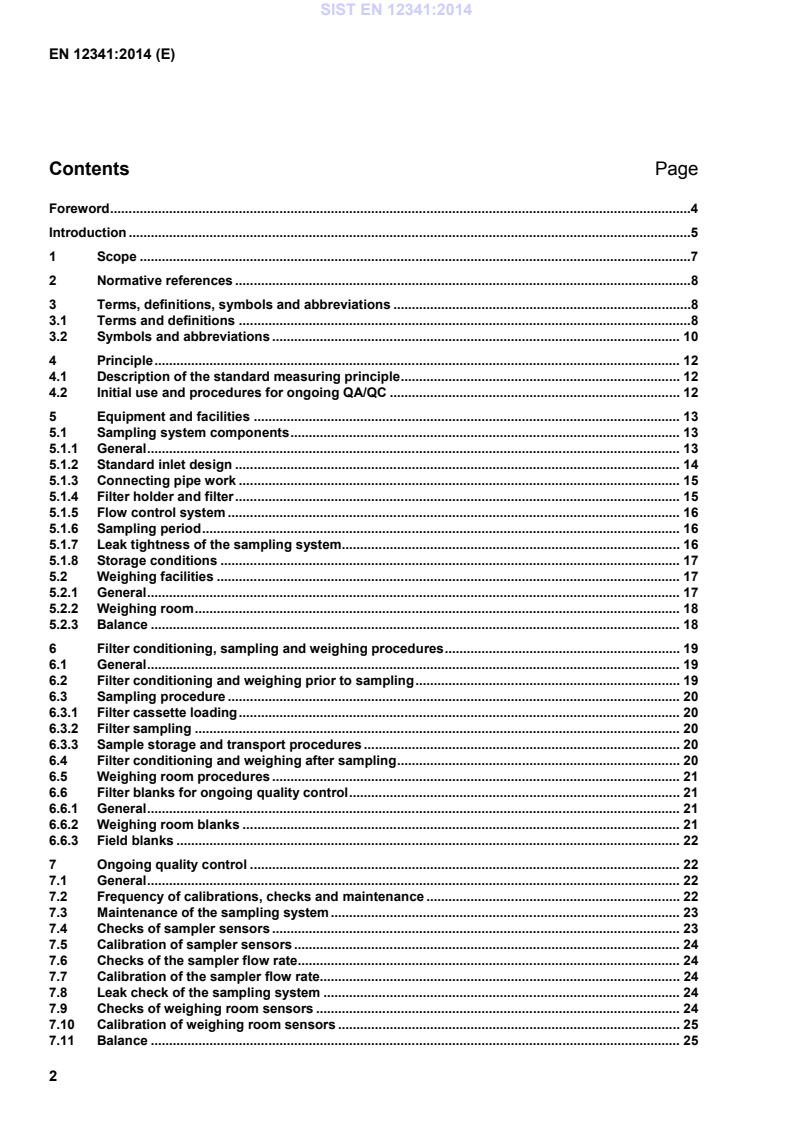
Introduction .5 1 Scope .7 2 Normative references .8 3 Terms, definitions, symbols and abbreviations .8 3.1 Terms and definitions .8 3.2 Symbols and abbreviations . 10 4 Principle . 12 4.1 Description of the standard measuring principle . 12 4.2 Initial use and procedures for ongoing QA/QC . 12 5 Equipment and facilities . 13 5.1 Sampling system components . 13 5.1.1 General . 13 5.1.2 Standard inlet design . 14 5.1.3 Connecting pipe work . 15 5.1.4 Filter holder and filter . 15 5.1.5 Flow control system . 16 5.1.6 Sampling period . 16 5.1.7 Leak tightness of the sampling system. 16 5.1.8 Storage conditions . 17 5.2 Weighing facilities . 17 5.2.1 General . 17 5.2.2 Weighing room . 18 5.2.3 Balance . 18 6 Filter conditioning, sampling and weighing procedures . 19 6.1 General . 19 6.2 Filter conditioning and weighing prior to sampling . 19 6.3 Sampling procedure . 20 6.3.1 Filter cassette loading . 20 6.3.2 Filter sampling . 20 6.3.3 Sample storage and transport procedures . 20 6.4 Filter conditioning and weighing after sampling . 20 6.5 Weighing room procedures . 21 6.6 Filter blanks for ongoing quality control . 21 6.6.1 General . 21 6.6.2 Weighing room blanks . 21 6.6.3 Field blanks . 22 7 Ongoing quality control . 22 7.1 General . 22 7.2 Frequency of calibrations, checks and maintenance . 22 7.3 Maintenance of the sampling system . 23 7.4 Checks of sampler sensors . 23 7.5 Calibration of sampler sensors . 24 7.6 Checks of the sampler flow rate . 24 7.7 Calibration of the sampler flow rate. 24 7.8 Leak check of the sampling system . 24 7.9 Checks of weighing room sensors . 24 7.10 Calibration of weighing room sensors . 25 7.11 Balance . 25 SIST EN 12341:2014
Design drawing of standard inlet for the sampling of PM10 and PM2,5 . 34 Annex B (normative)
Other samplers . 35 Annex C (informative)
Scheme of PM standard sampler . 44 Annex D (informative)
Suitability tests for filters. 45 Annex E (normative)
Initial suitability testing of weighing facilities . 47 Annex F (informative)
Results of experimental work . 48 Annex G (informative)
Impactor efficiency . 50 Bibliography . 52
— EU European Union — GDE Guide to the Demonstration of Equivalence of Ambient Air Monitoring Methods — GUM Guide to the Expression of Uncertainty in Measurement — JCGM Joint Committee for Guides in Metrology — PM Particulate Matter — POM Polyoxymethylene — PTFE Polytetrafluoroethylene — QA/QC Quality Assurance / Quality Control — RH Relative Humidity — RM Reference Method(ology) SIST EN 12341:2014
Design/performance characteristic Requirement a Subclause 1 Sampler design The sampler shall be designed in a way that it is possible to check and calibrate all sensors important to ensure the correct performance of the sampler. The manual of the sampler shall contain instructions on how to access the sensors.
2 Inlet design As prescribed 5.1.2 3 Temperature of filter during sampling Within 5 °C of ambient temperature for ambient temperatures ≥ 20 °C 5.1.4 4 Nominal flow rate 2,3 m3/h at ambient conditions 5.1.5 5 Constancy of sample volumetric flow ≤ 2,0 % sampling time (averaged flow) ≤ 5,0 % rated flow (instantaneous flow) 5.1.5 6 Leak tightness of the sampling system 3L ≤ 1,0 % of sample flow rate 5.1.7 7 Single-filter sampling period 24 h ± 1 h 5.1.6 8 Uncertainty (95 % confidence) of sampling ≤ 5 min 5.1.6 SIST EN 12341:2014
12 Temperature of storage of sampled filters in the instrument Shall not induce additional losses of semi-volatile constituents of PM 5.1.8; 6.3.3 13 Recording of operational parameters Measuring systems based on sequential samplers shall be able to transmit operational states by status signals of – at minimum – the following parameters: – flow rate (instantaneous and average) – pressure drop across the filter, if necessary – sampling time and sample volume – air temperature in filter section – temperature of filter storage.
14 Effect of failure of mains voltage Instrument parameters shall be secured against loss. On return of mains voltage the instrument shall automatically resume functioning.
15 Effect of abortion of sampling due to high pressure drop over the filter Instruments with filter changers shall have the ability to restart automatically with a new filter if the previous filter sample was aborted due to a high pressure drop across the filter.
a The ranges given for the parameters need not to be reduced for the calibration uncertainties of the sensors used for their control.
5.1.2 Standard inlet design A standard drawing of the inlet design for the sampling of PM10 and PM2,5 is given in Annex A. The inlet shall be made of an inert, non-corroding, electrically conducting material such as stainless steel or anodized aluminium or aluminium alloy. SIST EN 12341:2014
The filters shall be made of glass fibre, quartz fibre, PTFE or PTFE coated glass fibre. The suitability of specific types and brands of filters may depend on: — (variations in) the filter composition, e.g. (variations in) the fraction of binder used; — the integrity of the filter at filter handling; — the maximum pressure drop over the filter at which the flow rate can be maintained at its nominal level; — the period(s) and relative humidity(ies) used for filter conditioning before sampling. SIST EN 12341:2014
is pressure difference determined for the time interval ∆t; P0
is pressure at time t0; Vsys
is estimated total volume of the system (dead volume) ; ∆t
is time interval needed for the pressure rise.
The maximum of the three leak rates determined shall be calculated. The complete sampling system shall be checked for tightness. 5.1.7.3 Volumetric method Compared to the low-pressure method, this method gives rise to higher uncertainties. Consequently, its use should be restricted to exceptional cases. Only if it is technically impossible to measure the low pressure, the leak rate can be determined by measuring flow rates at the inlet and outlet of the flow path. 5.1.8 Storage conditions Users of this European Standard shall carefully consider and implement suitable temperature conditions for storage of sampled filters, such that loss of volatile and semi-volatile materials is minimized over the storage period. Storage conditions shall also
...