


EN 14682:2004
(Main)Safety of children's clothing - Cords and drawstrings on children's clothing - Specifications
General Information
- Abstract
This document specifies requirements for cords and drawstrings for children's clothing, including disguise costumes and skiwear, up to the age of 14 years.
Within the scope of this document it is not possible to cover all potential hazards that may create an unsafe garment.
Conversely, identifiable specific hazards in certain styles/design of garment may not present a risk for certain age groups.
NOTE It is recommended that an individual risk assessment be carried out on any garment in order to ensure that it does not present a hazard to the wearer.
This document does not apply to:
a) child use and care articles such as, nappies and soother holders;
b) shoes, boots and similar footwear;
c) gloves, hats, scarves
d) neckties designed to be worn with a shirt or blouse;
e) belts and braces;
f) religious clothing that may be worn all the time, and celebratory clothing such as that worn at civil or religious ceremonies or regional or national festivals;
g) specialist sportswear and activity wear generally worn for limited periods and under supervision for example rugby shorts, wet suits, and dancewear except where those garments are commonly worn as day wear or night wear;
h) theatrical costumes used for theatrical performances.
5) belts and braces;
6) religious clothing that may be worn all the time, and celebratory clothing such as that worn at civil or religious ceremonies or regional or national festivals;
7) specialist sportswear and activity wear generally worn for limited periods and under supervision for example rugby shorts, wet suits, and dancewear except where those garments are commonly worn as day wear or night wear;
8) theatrical costumes.
- Status
- Withdrawn
- Publication Date
- 21-Dec-2004
- Withdrawal Date
- 04-Dec-2007
- Technical Committee
- CEN/TC 248 - Textiles and textile products
- Drafting Committee
- CEN/TC 248/WG 20 - Safety of children's clothing
- Current Stage
- 9960 - Withdrawal effective - Withdrawal
- Start Date
- 05-Dec-2007
- Completion Date
- 05-Dec-2007
- Directive
- Harmonized Standard2001/95/EC - General product safetyOJ Ref: C, C 171 OJ Date: 22-Jul-2006

Relations
- Effective Date
- 22-Dec-2008
Frequently Asked Questions
EN 14682:2004 is a standard published by the European Committee for Standardization (CEN). Its full title is "Safety of children's clothing - Cords and drawstrings on children's clothing - Specifications". This standard covers: This document specifies requirements for cords and drawstrings for children's clothing, including disguise costumes and skiwear, up to the age of 14 years. Within the scope of this document it is not possible to cover all potential hazards that may create an unsafe garment. Conversely, identifiable specific hazards in certain styles/design of garment may not present a risk for certain age groups. NOTE It is recommended that an individual risk assessment be carried out on any garment in order to ensure that it does not present a hazard to the wearer. This document does not apply to: a) child use and care articles such as, nappies and soother holders; b) shoes, boots and similar footwear; c) gloves, hats, scarves d) neckties designed to be worn with a shirt or blouse; e) belts and braces; f) religious clothing that may be worn all the time, and celebratory clothing such as that worn at civil or religious ceremonies or regional or national festivals; g) specialist sportswear and activity wear generally worn for limited periods and under supervision for example rugby shorts, wet suits, and dancewear except where those garments are commonly worn as day wear or night wear; h) theatrical costumes used for theatrical performances. 5) belts and braces; 6) religious clothing that may be worn all the time, and celebratory clothing such as that worn at civil or religious ceremonies or regional or national festivals; 7) specialist sportswear and activity wear generally worn for limited periods and under supervision for example rugby shorts, wet suits, and dancewear except where those garments are commonly worn as day wear or night wear; 8) theatrical costumes.
This document specifies requirements for cords and drawstrings for children's clothing, including disguise costumes and skiwear, up to the age of 14 years. Within the scope of this document it is not possible to cover all potential hazards that may create an unsafe garment. Conversely, identifiable specific hazards in certain styles/design of garment may not present a risk for certain age groups. NOTE It is recommended that an individual risk assessment be carried out on any garment in order to ensure that it does not present a hazard to the wearer. This document does not apply to: a) child use and care articles such as, nappies and soother holders; b) shoes, boots and similar footwear; c) gloves, hats, scarves d) neckties designed to be worn with a shirt or blouse; e) belts and braces; f) religious clothing that may be worn all the time, and celebratory clothing such as that worn at civil or religious ceremonies or regional or national festivals; g) specialist sportswear and activity wear generally worn for limited periods and under supervision for example rugby shorts, wet suits, and dancewear except where those garments are commonly worn as day wear or night wear; h) theatrical costumes used for theatrical performances. 5) belts and braces; 6) religious clothing that may be worn all the time, and celebratory clothing such as that worn at civil or religious ceremonies or regional or national festivals; 7) specialist sportswear and activity wear generally worn for limited periods and under supervision for example rugby shorts, wet suits, and dancewear except where those garments are commonly worn as day wear or night wear; 8) theatrical costumes.
EN 14682:2004 is classified under the following ICS (International Classification for Standards) categories: 61.020 - Clothes; 97.190 - Equipment for children. The ICS classification helps identify the subject area and facilitates finding related standards.
EN 14682:2004 has the following relationships with other standards: It is inter standard links to EN 14682:2007. Understanding these relationships helps ensure you are using the most current and applicable version of the standard.
EN 14682:2004 is associated with the following European legislation: EU Directives/Regulations: 2001/95/EC; Standardization Mandates: M/309. When a standard is cited in the Official Journal of the European Union, products manufactured in conformity with it benefit from a presumption of conformity with the essential requirements of the corresponding EU directive or regulation.
EN 14682:2004 is available in PDF format for immediate download after purchase. The document can be added to your cart and obtained through the secure checkout process. Digital delivery ensures instant access to the complete standard document.
Standards Content (Sample)
2003-01.Slovenski inštitut za standardizacijo. Razmnoževanje celote ali delov tega standarda ni dovoljeno.Safety of children's clothing - Cords and drawstrings on children's clothing - SpecificationsSécurité des vetements d'enfants - Cordons et cordons coulissants - SpécificationsSicherheit von Kinderbekleidung - Kordeln und Zugbänder an Kinderbekleidung - AnforderungenTa slovenski standard je istoveten z:EN 14682:2004SIST EN 14682:2005en97.19061.020ICS:SLOVENSKI
STANDARDSIST EN 14682:200501-marec-2005
EUROPEAN STANDARDNORME EUROPÉENNEEUROPÄISCHE NORMEN 14682December 2004ICS 61.020; 97.190English versionSafety of children's clothing - Cords and drawstrings onchildren's clothing - SpecificationsSécurité des vêtements d'enfants - Cordons et cordonscoulissants - SpécificationsSicherheit von Kinderbekleidung - Kordeln und Zugbänderan Kinderbekleidung - AnforderungenThis European Standard was approved by CEN on 22 November 2004.CEN members are bound to comply with the CEN/CENELEC Internal Regulations which stipulate the conditions for giving this EuropeanStandard the status of a national standard without any alteration. Up-to-date lists and bibliographical references concerning such nationalstandards may be obtained on application to the Central Secretariat or to any CEN member.This European Standard exists in three official versions (English, French, German). A version in any other language made by translationunder the responsibility of a CEN member into its own language and notified to the Central Secretariat has the same status as the officialversions.CEN members are the national standards bodies of Austria, Belgium, Cyprus, Czech Republic, Denmark, Estonia, Finland, France,Germany, Greece, Hungary, Iceland, Ireland, Italy, Latvia, Lithuania, Luxembourg, Malta, Netherlands, Norway, Poland, Portugal, Slovakia,Slovenia, Spain, Sweden, Switzerland and United Kingdom.EUROPEAN COMMITTEE FOR STANDARDIZATIONCOMITÉ EUROPÉEN DE NORMALISATIONEUROPÄISCHES KOMITEE FÜR NORMUNGManagement Centre: rue de Stassart, 36
B-1050 Brussels© 2004 CENAll rights of exploitation in any form and by any means reservedworldwide for CEN national Members.Ref. No. EN 14682:2004: E
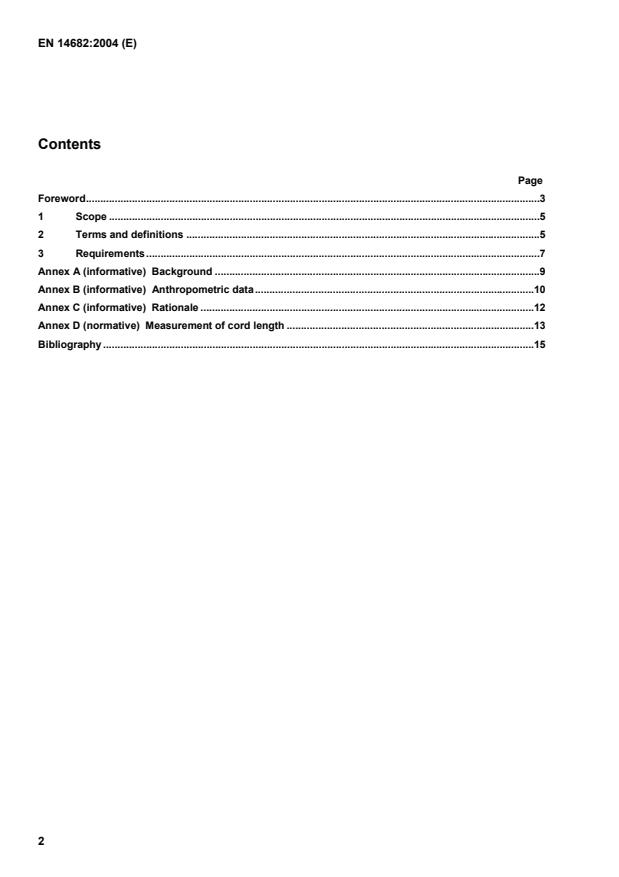
Background.9 Annex B (informative)
Anthropometric data.10 Annex C (informative)
Rationale.12 Annex D (normative)
Measurement of cord length.13 Bibliography.15
This document has been prepared under a mandate given to CEN by the European Commission and the European Free Trade Association. According to the CEN/CENELEC Internal Regulations, the national standards organizations of the following countries are bound to implement this European Standard: Austria, Belgium, Cyprus, Czech Republic, Denmark, Estonia, Finland, France, Germany, Greece, Hungary, Iceland, Ireland, Italy, Latvia, Lithuania, Luxembourg, Malta, Netherlands, Norway, Poland, Portugal, Slovakia, Slovenia, Spain, Sweden, Switzerland and United Kingdom.
Entrapment of cords and strings from the waist and lower hems of garments in moving vehicles such as 'bus doors, ski lifts and bicycles resulting in severe injuries or death from being dragged along or run over by the vehicle. In addition elasticated hood or neck cords have resulted in a number of facial injuries. Children’s clothing sold in the EU is usually sold by height as the primary measurement, sometimes with age as an additional indicator. Clothing for babies (up to around 1 year of age) is generally sold by length of the baby although some countries use the baby's weight. All chest, waist, and hip measurements are secondary measurements.
1 Scope This document specifies requirements for cords and drawstrings for children's clothing, including disguise costumes and skiwear, up to the age of 14 years.
Within the scope of this document it is not possible to cover all potential hazards that may create an unsafe garment. Conversely, identifiable specific hazards in certain styles/design of garment may not present a risk for certain age groups. NOTE It is recommended that an individual risk assessment be carried out on any garment in order to ensure that it does not present a hazard to the wearer. This document does not apply to: a) child use and care articles such as, nappies and soother holders; b) shoes, boots and similar footwear; c) gloves, hats, scarves d) neckties designed to be worn with a shirt or blouse; e) belts and braces;
f) religious clothing that may be worn all the time, and celebratory clothing such as that worn at civil or religious ceremonies or regional or national festivals; g) specialist sportswear and activity wear generally worn for limited periods and under supervision, for example rugby shorts, wet suits, and dancewear, except where those garments are commonly worn as day wear or night wear; h) theatrical costumes used for theatrical performances. 2 Terms and definitions For the purposes of this document, the following terms and definitions apply. 2.1 young child person aged from birth to age 7 years (that is 6 years and 11 months) which includes all children up to and including a height of 134 cm
2.2 older child and young person person aged from 7 years up to age 14 years (that is up to 13 years and 11 months) which includes all boys of height greater than 134 cm up to 182 cm and girls of height greater than 134 cm up to 176 cm 2.3 children's clothing all garments intended by design, production route or selling route to be worn by children up to age of 14 years, including all garments intended for boys up to height 182 cm and for girls up to 176 cm
NOTE 1 The protruding length of the drawstring may increase when closure is effected. NOTE 2 For some garments a drawstring may be a loop with a tightening device rather than a single length with two ends that may or may not be tied. 2.5 functional cord cord, chain, ribbon, string or tape of any textile or non-textile material with or without embellishment, such as toggle, pom-pom, feather or bead, of fixed length, which is used, to adjust the size of the opening, or part of the garment or to fasten the garment itself 2.6 decorative cord non-functional cord, chain, ribbon, string or tape of any textile or non-textile material with or without embellishment such as toggle, pom-pom, feather, or bead, of fixed length and not intended to be used to adjust the size of the garment opening or fasten the garment itself 2.7
elastic cord cords containing yarns of rubber or elastodiene or elastane polymer or similar, having high extensibility and complete or near complete recovery.
2.8 shoulder strap functional cord joining the front and back of a garment top
together, which is close fitting and passes over the shoulder
2.9 halter neck cord functional cord worn round the back of the neck holding the garment (for example dress, blouse or bikini) top leaving the shoulder and back bare 2.10
sash drawstring, decorative or functional cord of textile material of not less than 30 mm in width worn round the waist of a garment and tied in a bow.
2.11 stirrup narrow strip of textile or non-textile material attached to the lower hem of a trouser such that it passes under the foot or shoe to create a close fit to wearer 2.12 toggle
wooden, plastic, metal or otherwise composed piece attached to or present on, a drawstring, functional cord or decorative cord.
NOTE Toggles may or may not be functional 2.13
loop cord or narrow strip of fabric curved in shape, which
may be fixed or adjustable in length, where both ends are attached to the garment
General
3.1.1 The ends of drawstrings,
...