


EN 16643:2016
(Main)Rubber and plastics hoses and hose assemblies - Non-bonded fluoroplastic lined (e.g. PTFE) hoses and hose assemblies for liquid and gaseous chemicals - Specification
General Information
- Abstract
This European Standard specifies requirements for three types of non-bonded fluoroplastic lined hoses and hose assemblies with convoluted or smooth linings designed to convey liquid or gaseous chemical substances, hereinafter termed the “chemicals conveyed”. These hoses and hose assemblies can be used for pharmaceutical, biotechnology and industrial applications as detailed in Clause 5.
The hose assemblies are intended for use with chemicals conveyed in the temperature range of −70°C to +260°C and for a working pressure up to 205 bar ).
NOTE 1 This standard sets out requirements for these hoses and hose assemblies to ensure that users are not exposed to danger from fire or explosion and that the environment is protected against contamination or damage.
NOTE 2 Other working pressures than those given above can be agreed with the manufacturer provided the physical properties of the hose assembly materials conform to Clause 8, the hose and hose assembly performance requirements conform to Clause 9 and the hose assembly electrical properties conform to Clause 10.
NOTE 3 Other diameters than those given in this standard can be agreed with the manufacturer provided the physical properties of the hose assembly materials conform to Clause 8, the hose and hose assembly performance requirements conform to Clause 9 and the hose assembly electrical properties conform to Clause 10.
NOTE 4 This standard also provides guidance on the storage of hose assemblies (Clause 15).
NOTE 5 The attention of users is drawn to Annex G concerning the working temperature range which can be affected by the chemical(s) to be conveyed in the hoses and hose assemblies.
NOTE 6 The attention of users is drawn to Annex G concerning the selection of materials for lining, helix wire (if applicable), electrical bonding wire (if applicable), braid reinforcement and cover (if applicable) related to the chemical(s) to be conveyed by the hoses and hose assemblies.
- Status
- Published
- Publication Date
- 16-Aug-2016
- Withdrawal Date
- 27-Feb-2017
- Technical Committee
- CEN/TC 218 - Rubber and plastics hoses and hose assemblies
- Current Stage
- 9093 - Decision to confirm - Review Enquiry
- Start Date
- 12-May-2022
- Completion Date
- 23-Sep-2026

Overview
EN 16643:2016 is a CEN European Standard that specifies requirements for non‑bonded fluoroplastic lined (e.g. PTFE) hoses and hose assemblies used to convey liquid and gaseous chemicals. It covers three lining types (convoluted or smooth) and defines materials, construction, performance, electrical and storage requirements for assemblies intended for pharmaceutical, biotechnology and industrial chemical transfer. The standard addresses use in the temperature range −70 °C to +260 °C and for working pressures up to 205 bar (other pressures/diameters may be agreed with the manufacturer when Clauses 8–10 requirements are met).
Key topics and technical requirements
- Materials & construction (Clause 6, Clause 8): Requirements for fluoroplastic linings (e.g. PTFE), optional helix wire, electrical bonding wires, braid reinforcement and covers; selection guidance tied to chemicals conveyed (Annex G).
- Design types: Specifies three hose types (Type SE, Type SC, Type C) with dimension, bend-radius and concentricity criteria (Clause 4, Clause 7; tables provide dimensional limits).
- Performance & safety (Clause 9): Pressure, vacuum resistance, leakworthiness and mechanical performance requirements to reduce risk of fire, explosion or environmental contamination.
- Electrical properties (Clause 10): Bonding and static-dissipative lining/cover requirements to manage electrostatic hazards during chemical transfer.
- Testing & quality control: Type tests, routine and production acceptance tests and test frequency (Annex A, Annex B); specific normative tests include proof-pressure for lining (Annex C), weep and permeation tests (Annex F, Annex H), flammability (Annex I) and flexibility (Rolling U, Annex J).
- Marking & documentation (Clause 14, Clause 13): Requirements for marking hoses and assemblies and content of test reports.
- Storage guidance (Clause 15): Admissible storage time and storage conditions to maintain integrity.
Applications and users
- Practical for chemical transfer systems in pharmaceuticals, biotechnology, chemical processing, laboratory services, and industrial plants.
- Target users: hose and hose‑assembly manufacturers, purchasers and specifiers, safety engineers, quality managers, and regulatory/compliance teams seeking standards for chemical‑resistant PTFE‑lined flexible hoses.
Related standards and notes
- EN 16643 references multiple normative and informative annexes for testing and acceptance criteria; it complements other hose and fluid‑handling standards (refer to relevant CEN/ISO documents when specifying fittings, connectors or plant system requirements).
- Users should consult Annex G for chemical compatibility and Annex H for permeation behavior when selecting lining materials for specific chemicals.
Keywords: EN 16643:2016, fluoroplastic lined hoses, PTFE hoses, non‑bonded hose assemblies, chemical transfer, hose performance, hose testing, electrostatic bonding, pharmaceutical hoses.
Relations
- Effective Date
- 25-Aug-2026
- Effective Date
- 28-Jan-2026
- Effective Date
- 28-Jan-2026
- Refers
EN 4855-02:2020 - Aerospace series - ECO efficiency of catering equipment - Part 02: Oven equipment - Effective Date
- 28-Jan-2026
- Effective Date
- 28-Jan-2026
- Effective Date
- 28-Jan-2026
- Effective Date
- 28-Jan-2026
- Effective Date
- 28-Jan-2026
- Effective Date
- 28-Jan-2026
- Effective Date
- 28-Jan-2026
Get Certified
Connect with accredited certification bodies for this standard

Institut za varilstvo d.o.o. (Welding Institute)
Slovenia's leading welding institute since 1952. ISO 3834, EN 1090, pressure equipment certification, NDT personnel, welder qualification. Only IIW Au
Sponsored listings
Frequently Asked Questions
EN 16643:2016 is a standard published by the European Committee for Standardization (CEN). Its full title is "Rubber and plastics hoses and hose assemblies - Non-bonded fluoroplastic lined (e.g. PTFE) hoses and hose assemblies for liquid and gaseous chemicals - Specification". This standard covers: This European Standard specifies requirements for three types of non-bonded fluoroplastic lined hoses and hose assemblies with convoluted or smooth linings designed to convey liquid or gaseous chemical substances, hereinafter termed the “chemicals conveyed”. These hoses and hose assemblies can be used for pharmaceutical, biotechnology and industrial applications as detailed in Clause 5. The hose assemblies are intended for use with chemicals conveyed in the temperature range of −70°C to +260°C and for a working pressure up to 205 bar ). NOTE 1 This standard sets out requirements for these hoses and hose assemblies to ensure that users are not exposed to danger from fire or explosion and that the environment is protected against contamination or damage. NOTE 2 Other working pressures than those given above can be agreed with the manufacturer provided the physical properties of the hose assembly materials conform to Clause 8, the hose and hose assembly performance requirements conform to Clause 9 and the hose assembly electrical properties conform to Clause 10. NOTE 3 Other diameters than those given in this standard can be agreed with the manufacturer provided the physical properties of the hose assembly materials conform to Clause 8, the hose and hose assembly performance requirements conform to Clause 9 and the hose assembly electrical properties conform to Clause 10. NOTE 4 This standard also provides guidance on the storage of hose assemblies (Clause 15). NOTE 5 The attention of users is drawn to Annex G concerning the working temperature range which can be affected by the chemical(s) to be conveyed in the hoses and hose assemblies. NOTE 6 The attention of users is drawn to Annex G concerning the selection of materials for lining, helix wire (if applicable), electrical bonding wire (if applicable), braid reinforcement and cover (if applicable) related to the chemical(s) to be conveyed by the hoses and hose assemblies.
This European Standard specifies requirements for three types of non-bonded fluoroplastic lined hoses and hose assemblies with convoluted or smooth linings designed to convey liquid or gaseous chemical substances, hereinafter termed the “chemicals conveyed”. These hoses and hose assemblies can be used for pharmaceutical, biotechnology and industrial applications as detailed in Clause 5. The hose assemblies are intended for use with chemicals conveyed in the temperature range of −70°C to +260°C and for a working pressure up to 205 bar ). NOTE 1 This standard sets out requirements for these hoses and hose assemblies to ensure that users are not exposed to danger from fire or explosion and that the environment is protected against contamination or damage. NOTE 2 Other working pressures than those given above can be agreed with the manufacturer provided the physical properties of the hose assembly materials conform to Clause 8, the hose and hose assembly performance requirements conform to Clause 9 and the hose assembly electrical properties conform to Clause 10. NOTE 3 Other diameters than those given in this standard can be agreed with the manufacturer provided the physical properties of the hose assembly materials conform to Clause 8, the hose and hose assembly performance requirements conform to Clause 9 and the hose assembly electrical properties conform to Clause 10. NOTE 4 This standard also provides guidance on the storage of hose assemblies (Clause 15). NOTE 5 The attention of users is drawn to Annex G concerning the working temperature range which can be affected by the chemical(s) to be conveyed in the hoses and hose assemblies. NOTE 6 The attention of users is drawn to Annex G concerning the selection of materials for lining, helix wire (if applicable), electrical bonding wire (if applicable), braid reinforcement and cover (if applicable) related to the chemical(s) to be conveyed by the hoses and hose assemblies.
EN 16643:2016 is classified under the following ICS (International Classification for Standards) categories: 23.040.70 - Hoses and hose assemblies. The ICS classification helps identify the subject area and facilitates finding related standards.
EN 16643:2016 has the following relationships with other standards: It is inter standard links to ISO 1817:2015, EN ISO 1402:2021, EN ISO 7233:2021, EN 4855-02:2020, EN 10088-3:2014, EN ISO 4671:2022, EN ISO 8330:2022, EN ISO 10619-1:2018, EN ISO 20568-2:2017, EN ISO 8031:2009. Understanding these relationships helps ensure you are using the most current and applicable version of the standard.
EN 16643:2016 is available in PDF format for immediate download after purchase. The document can be added to your cart and obtained through the secure checkout process. Digital delivery ensures instant access to the complete standard document.
Standards Content (Sample)
2003-01.Slovenski inštitut za standardizacijo. Razmnoževanje celote ali delov tega standarda ni dovoljeno.6SHFLILNDFLMDGummi- und Kunststoffschläuche und -schlauchleitungen - Fluorkunststoffbeschichtete (z. B. PTFE) Nicht-Verbundschläuche und -schlauchleitungen für flüssige und gasförmige Chemikalien - AnforderungenTuyaux et assemblages flexibles en caoutchouc et en matières plastiques - Tuyaux non-liés revêtus de fluoroplastique (par exemple PTFE) pour substances chimiques liquides ou gazeuses - SpécificationsRubber and plastics hoses and hose assemblies - Non-bonded fluoroplastic lined (e.g. PTFE) hoses and hose assemblies for liquid and gaseous chemicals - Specification23.040.70Gumene cevi in armatureHoses and hose assembliesICS:Ta slovenski standard je istoveten z:EN 16643:2016SIST EN 16643:2016en,fr,de01-oktober-2016SIST EN 16643:2016SLOVENSKI
STANDARD
EUROPEAN STANDARD NORME EUROPÉENNE EUROPÄISCHE NORM
EN 16643
August
t r s x ICS
t uä r v rä y r English Version
Rubber and plastics hoses and hose assemblies æ Nonæassemblies for liquid and gaseous chemicals æ SpecificationTuyaux et flexibles en caoutchouc et en matières plastiques æ Tuyaux nonæliés revêtus de fluoroplastique liquides ou gazeuses æ Spécifications
Gummiæ und Kunststoffschläuche und æfür flüssige und gasförmige Chemikalien æ Anforderungen This European Standard was approved by CEN on
s w June
t r s xä
egulations which stipulate the conditions for giving this European Standard the status of a national standard without any alterationä Upætoædate lists and bibliographical references concerning such national standards may be obtained on application to the CENæCENELEC Management Centre or to any CEN memberä
translation under the responsibility of a CEN member into its own language and notified to the CENæCENELEC Management Centre has the same status as the official versionsä
CEN members are the national standards bodies of Austriaá Belgiumá Bulgariaá Croatiaá Cyprusá Czech Republicá Denmarká Estoniaá Finlandá Former Yugoslav Republic of Macedoniaá Franceá Germanyá Greeceá Hungaryá Icelandá Irelandá Italyá Latviaá Lithuaniaá Luxembourgá Maltaá Netherlandsá Norwayá Polandá Portugalá Romaniaá Slovakiaá Sloveniaá Spainá Swedená Switzerlandá Turkey andUnited Kingdomä
EUROPEAN COMMITTEE FOR STANDARDIZATION COMITÉ EUROPÉEN DE NORMALISATION EUROPÄISCHES KOMITEE FÜR NORMUNG
CEN-CENELEC Management Centre:
Avenue Marnix 17,
B-1000 Brussels
t r s x CEN All rights of exploitation in any form and by any means reserved worldwide for CEN national Membersä Refä Noä EN
s x x v uã t r s x ESIST EN 16643:2016
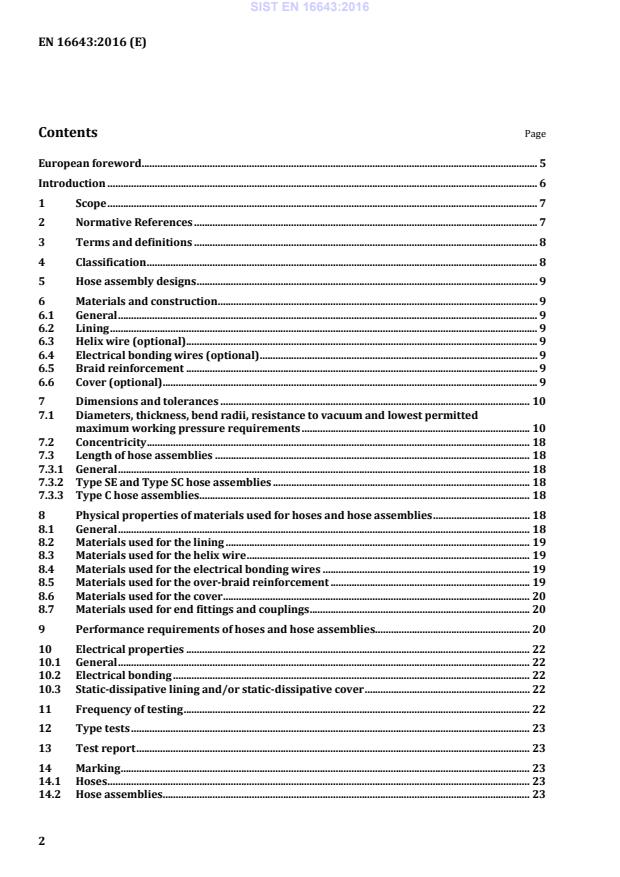
Test frequency for type tests and routine tests . 25 Annex B (informative)
Production acceptance tests . 27 Annex C (normative)
Proof pressure test for fluoroplastic lining . 28 Annex D (informative)
Couplings and fittings . 29 D.1 General . 29 D.2 Fluoroplastic lined end fittings . 29 Annex E (normative)
Yield orientation index . 30 Annex F (normative)
Weep test . 31 F.1 General . 31 F.2 Test pieces . 31 F.3 Apparatus . 31 F.4 Test method . 31 Annex G (informative)
Resistance to chemicals conveyed . 32 Annex H (informative)
Permeability to gas . 33 H.1 General . 33 H.2 Test pieces . 33 H.3 Apparatus . 33 H.4 Test method . 33 Annex I (normative)
Flame resistance test . 36 I.1 Test pieces . 36 I.2 Apparatus . 36 I.3 Test method . 36 Annex J (normative)
Hose flexibility - Rolling U test . 38 J.1 General . 38 J.2 Test pieces . 38 J.3 Apparatus . 38 J.4 Test method . 38 Annex K (informative)
Environmental checklist . 41 Bibliography . 43
Tables Table 1 — Dimension requirements, Type SE lining hoses without and with cover . 11 Table 2 — Maximum working pressure requirements, Type SE lining hoses without and with cover for two typical braid reinforcements . 12 Table 3 — Dimension requirements, Type SC lining hoses without and with cover . 13 Table 4 — Maximum working pressure requirements, Type SC lining hoses without and with cover for three typical braid reinforcements . 14 Table 5 — Dimension requirements for manufacturing method 1, Type C lining hoses without and with cover . 15 Table 6 — Dimension requirements for manufacturing method 2, Type C lining hoses without and with cover . 16 SIST EN 16643:2016
Figures Figure H.1 — Arrangement for helium permeation test . 35 Figure I.1 — Arrangement for flammability test . 37 Figure J.1 — Rolling U test piece . 39 Figure J.2 — Typical arrangement of Rolling U test equipment . 40
« y r ¹C to
ª t x r ¹C and for a working pressure up to
t r w bar1). NOTE 1 This standard sets out requirements for these hoses and hose assemblies to ensure that users are not exposed to danger from fire or explosion and that the environment is protected against contamination or damage. NOTE 2 Other working pressures than those given above can be agreed with the manufacturer provided the physical properties of the hose assembly materials conform to Clause 8, the hose and hose assembly performance requirements conform to Clause 9 and the hose assembly electrical properties conform to Clause 10. NOTE 3 Other diameters than those given in this standard can be agreed with the manufacturer provided the physical properties of the hose assembly materials conform to Clause 8, the hose and hose assembly performance requirements conform to Clause 9 and the hose assembly electrical properties conform to Clause 10. NOTE 4 This standard also provides guidance on the storage of hose assemblies (Clause 15). NOTE 5 The attention of users is drawn to Annex G concerning the working temperature range which can be affected by the chemical(s) to be conveyed in the hoses and hose assemblies. NOTE 6 The attention of users is drawn to Annex G concerning the selection of materials for lining, helix wire (if applicable), electrical bonding wire (if applicable), braid reinforcement and cover (if applicable) related to the chemical(s) to be conveyed by the hoses and hose assemblies. 2 Normative References The following documents, in whole or in part, are normatively referenced in this document and are indispensable for its application. For dated references, only the edition cited applies. For undated references, the latest edition of the referenced document (including any amendments) applies. EN 10088-3:2014, Stainless steels — Part 3: Technical delivery conditions for semi-finished products, bars, rods, wire, sections and bright products of corrosion resisting steels for general purposes EN ISO 1402, Rubber and plastics hoses and hose assemblies — Hydrostatic testing (ISO 1402) EN ISO 4671, Rubber and plastics hoses and hose assemblies — Methods of measurement of the dimensions of hoses and the lengths of hose assemblies (ISO 4671) EN ISO 7233, Rubber and plastics hoses and hose assemblies — Determination of resistance to vacuum (ISO 7233) EN ISO 8031:2009, Rubber and plastics hoses and hose assemblies — Determination of electrical resistance and conductivity (ISO 8031:2009) EN ISO 8330, Rubber and plastics hoses and hose assemblies — Vocabulary (ISO 8330)
1) 1 bar = 0,1 MPa. SIST EN 16643:2016
À per assembly between end fittings, AND >108
À between lining and end fittings AND
µ s r8
À between cover and end fittings 4 Classification Hoses and hose assemblies for this application shall be divided into three types according to how the hose fluoroplastic lining is constructed/formed: — Type SE smoothbore (externally smooth): the hose lining is internally and externally smooth (parallel) in this document referred to as Smoothbore (externally smooth). — Type SC smoothbore (externally convoluted): the hose lining is internally smooth and externally convoluted in this document referred to as Smoothbore (externally convoluted). — Type C convoluted or corrugated: hose lining is internally and externally convoluted with the convolution running helically to the lining axis. Hoses and hose assemblies for this application shall be divided into eight grades: — Grade I: electrically insulated (no electrical bonding AND no static-dissipative layers), — Grade M: electrically bonded without static-dissipative lining or cover, — Grade
À-L: static-dissipative lining without electrical bonding, — Grade
À-C: static-dissipative cover without electrical bonding, — Grade
À-CL: static-dissipative cover and lining without electrical bonding, — -L: electrically bonded and static-dissipative lining, — -C: electrically bonded and static-dissipative cover, SIST EN 16643:2016
or Table 6 (depending on lining type). Minimum bend radius shall be equal to or less than the values given in Table 1, Table 3, Table 5 or Table 6 (depending on lining type). Maximum working pressures (MWP’s) shall be equal to or greater than the values given in Table 2, Table 4 or Table 7 (depending on lining type). Type C hoses may exhibit differences in flow rate and flexibility for a given nominal bore size and these differences are primarily influenced by inside diameter and shape of the convolutions. To provide scope for manufacturers to tailor flexibility and flow rates for a given nominal bore size Tables for two forms of Type C hose are provided in Tables 5 and 6, which are referred to as manufacturing methods 1 and 2 respectively. These manufacturing methods could be proprietary and therefore are not described or specified within this standard. To obtain specific flow rate and flexibility data the hose manufacturer should be consulted. SIST EN 16643:2016
mm Outsidea diameter mm min. Bend radius mm min. Resistanceb to vacuum bar lining cover 3,2 3,1 ±0,1 Braid 0,6 - 5,3 40
«0,9 Cover 0,4 6,1 5 4,7 ±0,2 Braid 0,6 - 7 60 Cover 0,4 7,8 6,3 6,3 ±0,4 Braid 0,6 - 8,4 80 Cover 0,5 9,4 8 8 ±0,6 Braid 0,6 - 10 100 Cover 0,5 11 10 10 ±0,9 Braid 0,6 - 11,7 130 Cover 0,6 12,9 13 13 ±1,1 Braid 0,7 - 14,8 170 Cover 0,6 16 16 16 ±1,1 Braid 0,7 - 18 200 Cover 0,8 19,6 19 19 ±1,2 Braid 0,7 - 21,1 230 Cover 0,8 22,7 25 25 ±1,2 Braid 0,9 - 27,6 320 Cover 0,8 29,2 a Minimum outside diameter assumes one layer of stainless steel braid reinforcement and minimum lining thickness shown, with and without cover. For other braid reinforcement materials and/or multiple braid reinforcement layers and/or thicker lining consult hose manufacturer for outside diameter and tolerances. b Ability to withstand the internal vacuum specified and shall conform to the requirements specified in Table 9. For resistance to vacuum at higher temperatures consult hose manufacturer. SIST EN 16643:2016
«0,9 Cover 0,7 10,5 8 7,8 Braid 0,9 - 10,2 19 Cover 0,7 11,6 10 9,7 ±0,5 Braid 1,0 - 12,6 25 Cover 1,1 14,8 13 13,1 ±0,7 Braid 1,2 - 16,4 60 Cover 1,1 18,6 16 16,2 Braid 1,6 - 20,3 60 Cover 1,4 23,1 19 19,3 Braid 1,6 - 23,8 60 Cover 1,4 26,2 22 22,1 Braid 1,7 - 27,5 60 Cover 1,6 30,7 25 25,7 Braid 1,7 - 30,8 100 Cover 1,6 34,0 32 32,2 Braid 2,2 - 38,0 135 Cover 1,6 41,2 35 34,8 Braid 2,4 - 42,3 135 Cover 2,0 46,3 38 38,5 ±0,8 Braid 2,6 - 46,2 170 Cover 2,0 50,2 48 47,4 Braid 3,1 - 56,4 190 Cover 2,0 60,4 50 51,1 ±0,9 Braid 3,3 - 60,3 210 Cover 2,0 64,3 a Lining thickness is measured from inside smooth bore of lining to outside diameter of convolutions. Lining thickness between external convolutions will be less than that shown above. b Minimum outside diameter assumes one layer of stainless steel braid reinforcement and minimum lining thickness shown, with and without cover. For other braid reinforcement materials and/or multiple braid reinforcement layers and/or thicker lining consult hose manufacturer for outside diameter and tolerances. c Ability to withstand the internal vacuum specified and shall conform to the requirements specified in Table 9. For resistance to vacuum at higher temperatures consult hose manufacturer. SIST EN 16643:2016
«0,9 Cover 0,7 12,4 30 10 9,7 ±2,6 Braid 0,6 - 11,7 25 Cover 1,1 13,9 40 12 12,1 Braid 0,6 - 14,9 40 Cover 1,1 17,1 60 15 15,1 Braid 0,7 - 19,6 50 Cover 1,4 22,4 70 19 18,3 Braid 0,7 - 21,9 55 Cover 1,4 24,7 80 21 21,3 Braid 0,7 - 26,0 65 Cover 1,6 29,2 95 25 24,3 ±3 Braid 0,9 - 30,0 70 Cover 1,6 33,2 105 30 29,8 Braid 0,9 - 34,6 85 Cover 1,6 38,0 125 32 32,1 Braid 0,9 - 36,8 85 Cover 1,6 40,0 125 34 34,0 Braid 1,1 - 41,5 115 Cover 1,8 45,5 150 38 38,0 Braid 1,1 - 43,5 120 Cover 2,0 47,5 160 45 44,5 Braid 1,1 - 53,3 140 Cover 2,0 57,3 210 50 50,0 Braid 1,2 - 57,5 140 Cover 2,0 61,5 210 54 53,5 Braid 1,2 - 63,0 180 Cover 2,0 67,0 270 63 63,0 ±3,5 Braid 1,5 - 73,0 230 Cover 2,2 77,4 345 75 75,0 Braid 1,6 - 86,0 260 Cover 2,4 90,8 350 98 98,0 Braid 1,8 - 117,0 400 Cover 2,4 121,8 500 SIST EN 16643:2016
diameter mm Tolerance mm Outer Layer Minimum thickness mm Outsideb diameter mm min. Bend radius mm min. Resistancec
to vacuum bar Lining cover 10 6,3 ±2 Braid 0,6 - 11,5 25
«0,9 Cover 0,7 12,9 40 12 9,5 Braid 0,6 - 15,0 40 Cover 1,1 17,2 60 15 11,2 Braid 0,7 - 17,5 50 Cover 1,4 20,3 70 19 15,0 Braid 0,7 - 21,0 55 Cover 1,4 23,8 80 20 15,7 ±2,6 Braid 0,7 - 21,9 55 Cover 1,4 24,7 80 25 21,5 ±3 Braid 0,9 - 28,8 70 Cover 1,6 32,0 105 32 27,5 Braid 0,9 - 36,0 85 Cover 1,6 39,2 125 38 30,0 Braid 1,1 - 41,5 120 Cover 1,6 44,7 160 40 31,8 Braid 1,1 - 43,5 120 Cover 2,0 47,5 160 50 43,0 Braid 1,2 - 55,0 140 Cover 2,0 59,0 210 63 51,8 ±3,5 Braid 1,5 - 69,0 230 Cover 2,2 73,4 345 65 53,8 Braid 1,5 - 71,0 230 Cover 2,2 75,4 345 75 59,0 Braid 1,6 - 82,0 260 SIST EN 16643:2016
7.2 Concentricity When determined in accordance with EN ISO 4671, the concentricity, based on a total indicator reading between the internal diameter and the outside surface of the various layers (e.g. lining, braid reinforcement, cover) or complete hose, shall be
¶ 10 % of average wall thickness. 7.3 Length of hose assemblies 7.3.1 General The length of the hose assembly shall be the intended installed length measured from sealing surfaces of the end fittings. NOTE Unlike rubber hose assemblies, fluoropolymer hose assemblies can be difficult to stretch if shorter than the intended installed length. 7.3.2 Type SE and Type SC hose assemblies For all hose assembly lengths the tolerance shall be “(+2/-0)%” If closer tolerances are required consult with hose assembly manufacturer. 7.3.3 Type C hose assemblies For all hose assembly lengths the tolerance shall be “(+5/-0)%” If closer tolerances are required, consult with hose assembly manufacturer. 8 Physical properties of materials used for hoses and hose assemblies 8.1 General The physical properties of the fluoroplastic lining shall conform to the values given in Table 8, when tested in accordance with the methods listed in Table 8. For Type SE linings, tests shall be carried out on SIST EN 16643:2016
< 12,5 mm 8.2 Materials used for the lining The lining shall be made from the following materials capable of use at temperatures up to 260
¹Cã — PTFE, PFA, FEP NOTE
The nature of some chemicals could limit the maximum temperature of use to less than 260
¹Cä When a static-dissipative lining is required, high purity carbon black shall be incorporated into either an inner co-extruded layer of the lining or in the whole lining. The amount of high purity carbon black added shall be less than 2,5 % (EC Directive 2007/19/EC) and shall be carefully distributed within the lining ensuring no carbon agglomerates, lumps, blisters or other defects are formed which would impair the expected use. 8.3 Materials used for the helix wire The helix shall consist of stainless steel wire, in accordance with EN 10088-3:2014 steel numbers X2CrNi19-11, X5CrNiMo17-12-2, X2CrNiMo17-12-2 or X3CrNiMo17-13-3. 8.4 Materials used for the electrical bonding wires The electrical bonding wires shall consist of NiCu30 or a similar low electrical resistance, corrosion resistant material. 8.5 Materials used for the over-braid reinforcement Metallic over-braid reinforcement shall consist of stainless steel wire, in accordance with EN 10088-3:2014, steel numbers X2CrNi19-11, X5CrNiMo17-12-2, X2CrNiMo17-12-2 or X3CrNiMo17-13-3. SIST EN 16643:2016
¶ 0,25 (standard sintering)
¶ 0,1 (high quality sintering) Annex E Weep pressure (PTFE lining) %
· 60 (standard sintering)
· 70 (high quality sintering) Annex F Proof test pressure (Fluoroplastic lining) — No leakage or other signs of weakness at 75 % of theoretical burst pressure Annex C Burst pressurea — Minimum four times the maximum working pressure EN ISO 1402 Proof test pressure (Hose assembly) — No leakage or other signs of weakness at 1,5 × the working pressure EN ISO 1402 Change in length at proof test pressure at
« rá { bar vacuum % Maximum allowed All Types 0 to +10 All Types
r to
« s r EN ISO 1402 Twist at proof test pressure
Maximum allowed
8 EN ISO 1402 Resistance to vacuum, According to Tables 1, 3, 5 and 6 for 10 min — No failure and no collapse of hose or lining EN ISO 7233 Flame resistance (Not applicable where plastic braid reinforcement forms the outer layer of the hose) — a) Burning with a naked flame to cease within 20 s of removal of the burner; b) no further glowing visible 2 min after removal of the burner; c) hose shall show no sign of leakage Annex I Electrical properties
À > 108/assembly-I-grade < 102/assembly-M-grade 103 to 108b /assembly all
À-grades EN ISO 8031:2009 Clause 6 EN ISO 8031:2009 Clause 4 EN ISO 8031:2009 Clause 7 Bending test At minimum bend radius with atmospheric internal pressure, deformation of the external hose diameter (T/D) % < 10 EN ISO 10619-1 Method A1 Hose flexibility (Rolling U test) cycles
· 100 000 Annex J a Burst pressure is affected by the temperature of the chemical(s) conveyed for example at temperatures above 130
¹C the burst pressure (and consequently the maximum working pressure) of PTFE lined hoses will reduce. Consult with hose manufacturer for changes to hose burst pressure and maximum working pressure at high temperatures. b An upper limit of 108 ority of circumstances but should be avoided in the unusual circumstance of using a hose immediately downstream of a
...