

EN 18268:2026
(Main)Chemicals used for treatment of water intended for human consumption - Antiscalants for membranes - Citric acid
- Abstract
This document is applicable to citric acid used as an antiscalant for membranes in the treatment of water intended for human consumption. It describes the characteristics and specifies the requirements and the corresponding analytical methods for citric acid. It gives information on its use as an antiscalant for membranes in water treatment.
General information on citric acid is given in Annex A (informative).
- Status
- Not Published
- Publication Date
- 15-Dec-2026
- Technical Committee
- CEN/TC 164 - Water supply
- Drafting Committee
- CEN/TC 164/WG 9 - Drinking water treatment
- Current Stage
- 5060 - Closure of Vote - Formal Approval
- Start Date
- 22-Oct-2026
- Due Date
- 08-Apr-2027
- Completion Date
- 22-Oct-2026

EN 18268:2026 is a CEN standard for citric acid used as an antiscalant for membranes in the treatment of water intended for human consumption. It specifies the product description, purity requirements, analytical methods, sampling, labelling, transport and storage information for suppliers, laboratories, water treatment operators and buyers.
What does EN 18268:2026 specify?
EN 18268:2026 applies to citric acid used as an antiscalant for membranes in drinking water treatment. It sets out the product characteristics, the purity criteria, the test methods to check them, and practical guidance for handling and use.
The document is organized into clauses on scope, normative references, terms and definitions, product description, purity criteria, test methods, and labelling, transportation and storage. It also includes two annexes: one with general information on citric acid and one with safety rules.
| Annex | What it covers |
|---|---|
| Annex A | General information on citric acid, including origin, manufacture, use and dosing context |
| Annex B | General rules relating to safety, including handling and emergency actions |
What are the key requirements of EN 18268:2026?
EN 18268:2026 is mainly a product specification. The most important requirements are the identity of the material, its minimum purity, the limits for common impurities, the metal limits, the sampling approach, and the handling and storage conditions.
Product identity and form
Clause 4 identifies citric acid by chemical name, common names, molecular data and registry identifiers. It recognises both anhydrous citric acid and citric acid monohydrate, and it allows solid and aqueous commercial forms.
For a buyer or quality manager, this means the standard is not only about one physical form. A specification or incoming inspection needs to match the form actually supplied, especially when comparing dry product and liquid product.
Purity and composition
Clause 5 sets minimum citric acid content for the different commercial forms. It also sets limits for sulfate, fluoride and oxalates, and it gives limits for antimony, arsenic, cadmium, chromium, lead, mercury, nickel and selenium.
In practice, this is the core acceptance check for supply and batch release. The limits help users confirm that the product is suitable for membrane use in water treatment and that unwanted contaminants are controlled.
Analytical methods and sampling
Clause 6 requires sampling in accordance with ISO 8213, with ISO 3165 and ISO 6206 used as guidance. It also requires a representative sample, clear labelling of the sample and retention of reference samples for the claimed shelf life.
For testing, the standard gives separate procedures for impurity analysis and metal determination. It uses EN ISO 3696 water of grade 2 for general analysis and grade 3 for metal analysis, which matters because water quality can affect low-level measurements.
Impurity and metal testing
Clause 6 links sulfate to ISO 2997 and fluoride to ISO 3360. Oxalate is determined by a prescribed procedure, while the metals are measured by atomic absorption or related instrumental methods, including EN ISO 5961, EN 1233, EN ISO 11969, ISO/TS 17379-2, EN ISO 11885 and EN ISO 12846.
This lets laboratories use named methods instead of inventing their own. It also means results can be compared between suppliers and across different laboratories.
Labelling, transport and storage
Clause 7 covers delivery forms, marking, safety labelling, transport status and storage conditions. It states that citric acid is not classified as dangerous goods for transport under RID, ADR, IMDG or IATA, and it gives the information that should appear on the marking.
The storage guidance is practical: use plastics or stainless steel, keep containers closed, protect liquid product from direct light, and avoid incompatible materials and conditions that can affect product quality.
Who uses EN 18268:2026?
EN 18268:2026 is used by citric acid manufacturers, water treatment chemical suppliers, laboratory staff, membrane system operators and buyers who specify chemicals for drinking water treatment. It is also relevant to quality managers checking batch conformity and to regulators or auditors who review product documentation.
In practice, these users rely on the standard to define what to test, how to sample, what to label, and how to store the product so that its specified quality is maintained.
Which standards are used with EN 18268:2026?
EN 18268:2026 depends on several reference methods and sampling standards.
- ISO 8213 - sampling techniques for solid chemical products
- ISO 3165 - safety in sampling of industrial chemical products
- ISO 6206 - sampling vocabulary
- EN ISO 3696 - water quality for analytical laboratory use
- ISO 2997 - sulfate determination
- ISO 3360 - fluoride determination
- EN 1233 - chromium determination
- EN ISO 5961 - cadmium determination
- EN ISO 11885 - selected elements by ICP-OES
- EN ISO 12846 - mercury determination
- ISO 8288:1986 - cobalt, nickel, copper, zinc, cadmium and lead by flame AAS
- ISO/TS 17379-2 - selenium determination
- EN ISO 11969 - arsenic determination
These references give the test and sampling framework that supports the product specification.
What does the EN 18268:2026 document contain?
EN 18268:2026 contains product identification data, physical and chemical property information, purity criteria, test procedures, and packaging, labelling and storage guidance. It also includes an informative annex with origin and use information for citric acid, including its manufacture by fermentation with Aspergillus niger and its use in offline membrane cleaning and antiscaling.
The analytical part includes methods for sulfate, fluoride, oxalate and a group of metals, plus a calculation approach for reporting elemental results on a dry-product basis. The safety annex gives first aid, spill response and fire information for handling the material in practice.
Get Certified
Connect with accredited certification bodies for this standard

ECOCERT
Organic and sustainability certification.

CIS Institut d.o.o.
Personal Protective Equipment (PPE) certification body. Notified Body NB-2890 for EU Regulation 2016/425 PPE.

Eurofins Food Testing Global
Global leader in food, environment, and pharmaceutical product testing.
Sponsored listings
Frequently Asked Questions
EN 18268:2026 is a draft published by the European Committee for Standardization (CEN). Its full title is "Chemicals used for treatment of water intended for human consumption - Antiscalants for membranes - Citric acid". This standard covers: This document is applicable to citric acid used as an antiscalant for membranes in the treatment of water intended for human consumption. It describes the characteristics and specifies the requirements and the corresponding analytical methods for citric acid. It gives information on its use as an antiscalant for membranes in water treatment. General information on citric acid is given in Annex A (informative).
This document is applicable to citric acid used as an antiscalant for membranes in the treatment of water intended for human consumption. It describes the characteristics and specifies the requirements and the corresponding analytical methods for citric acid. It gives information on its use as an antiscalant for membranes in water treatment. General information on citric acid is given in Annex A (informative).
EN 18268:2026 is classified under the following ICS (International Classification for Standards) categories: 13.060.20 - Drinking water; 71.100.80 - Chemicals for purification of water. The ICS classification helps identify the subject area and facilitates finding related standards.
EN 18268:2026 is available in PDF format for immediate download after purchase. The document can be added to your cart and obtained through the secure checkout process. Digital delivery ensures instant access to the complete standard document.
Standards Content (Sample)
SLOVENSKI STANDARD
oSIST prEN 18268:2026
01-januar-2026
Kemikalije, ki se uporabljajo za pripravo pitne vode - Sredstva proti apnencu na
membranah - Citronska kislina
Chemicals used for treatment of water intended for human consumption - Antiscalants
for membranes - Citric Acid
Produkte zur Aufbereitung von Wasser für den menschlichen Gebrauch - Antikalkmittel
für Membranen - Zitronensäure
Produits chimiques utilisés pour le traitement de l’eau destinée à la consommation
humaine - Produits antitartres pour membranes - acide citrique
Ta slovenski standard je istoveten z: prEN 18268
ICS:
13.060.20 Pitna voda Drinking water
71.100.80 Kemikalije za čiščenje vode Chemicals for purification of
water
oSIST prEN 18268:2026 en,fr,de
2003-01.Slovenski inštitut za standardizacijo. Razmnoževanje celote ali delov tega standarda ni dovoljeno.
oSIST prEN 18268:2026
oSIST prEN 18268:2026
DRAFT
EUROPEAN STANDARD
prEN 18268
NORME EUROPÉENNE
EUROPÄISCHE NORM
November 2025
ICS 71.100.80
English Version
Chemicals used for treatment of water intended for human
consumption - Antiscalants for membranes - Citric Acid
Produits chimiques utilisés pour le traitement de l'eau Produkte zur Aufbereitung von Wasser für den
destinée à la consommation humaine - Produits menschlichen Gebrauch - Antikalkmittel für
antitartres pour membranes - acide citrique Membranen - Zitronensäure
This draft European Standard is submitted to CEN members for enquiry. It has been drawn up by the Technical Committee
CEN/TC 164.
If this draft becomes a European Standard, CEN members are bound to comply with the CEN/CENELEC Internal Regulations
which stipulate the conditions for giving this European Standard the status of a national standard without any alteration.
This draft European Standard was established by CEN in three official versions (English, French, German). A version in any other
language made by translation under the responsibility of a CEN member into its own language and notified to the CEN-CENELEC
Management Centre has the same status as the official versions.
CEN members are the national standards bodies of Austria, Belgium, Bulgaria, Croatia, Cyprus, Czech Republic, Denmark, Estonia,
Finland, France, Germany, Greece, Hungary, Iceland, Ireland, Italy, Latvia, Lithuania, Luxembourg, Malta, Netherlands, Norway,
Poland, Portugal, Republic of North Macedonia, Romania, Serbia, Slovakia, Slovenia, Spain, Sweden, Switzerland, Türkiye and
United Kingdom.
Recipients of this draft are invited to submit, with their comments, notification of any relevant patent rights of which they are
aware and to provide supporting documentation.
Warning : This document is not a European Standard. It is distributed for review and comments. It is subject to change without
notice and shall not be referred to as a European Standard.
EUROPEAN COMMITTEE FOR STANDARDIZATION
COMITÉ EUROPÉEN DE NORMALISATION
EUROPÄISCHES KOMITEE FÜR NORMUNG
CEN-CENELEC Management Centre: Rue de la Science 23, B-1040 Brussels
© 2025 CEN All rights of exploitation in any form and by any means reserved Ref. No. prEN 18268:2025 E
worldwide for CEN national Members.
oSIST prEN 18268:2026
prEN 18268:2025(E)
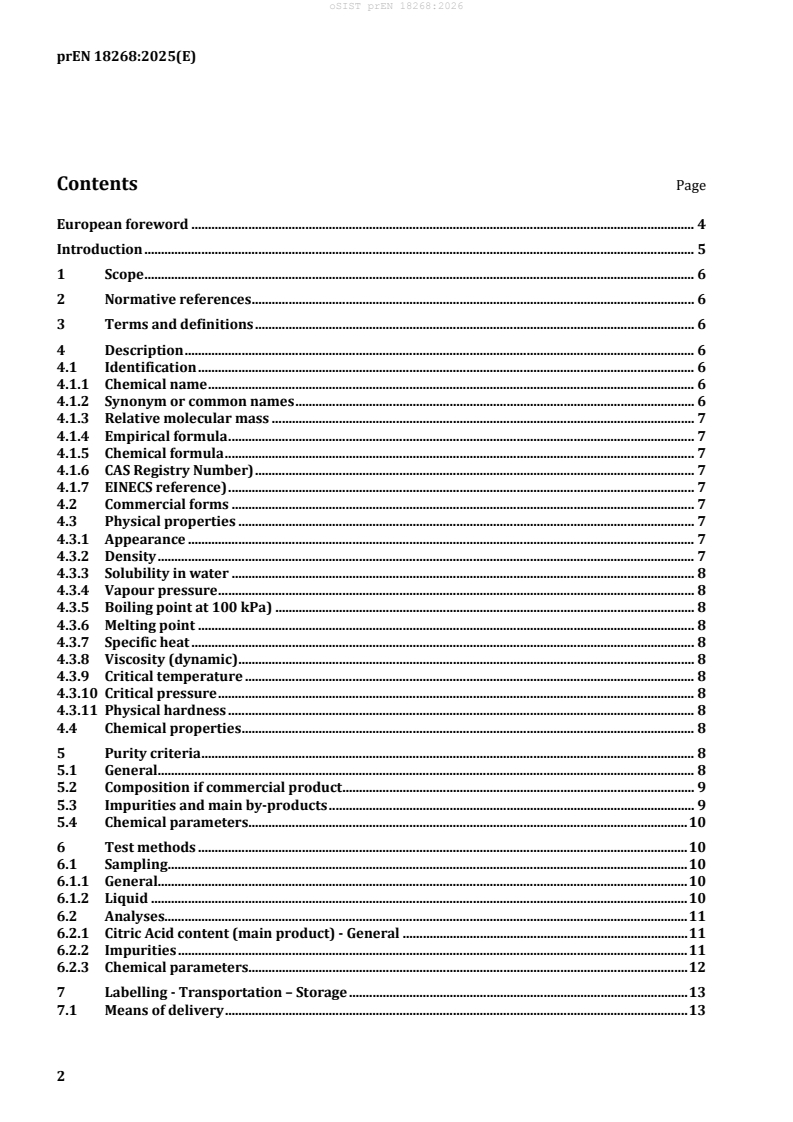
Contents Page
European foreword . 4
Introduction . 5
1 Scope . 6
2 Normative references . 6
3 Terms and definitions . 6
4 Description . 6
4.1 Identification . 6
4.1.1 Chemical name . 6
4.1.2 Synonym or common names . 6
4.1.3 Relative molecular mass . 7
4.1.4 Empirical formula . 7
4.1.5 Chemical formula . 7
4.1.6 CAS Registry Number) . 7
4.1.7 EINECS reference) . 7
4.2 Commercial forms . 7
4.3 Physical properties . 7
4.3.1 Appearance . 7
4.3.2 Density . 7
4.3.3 Solubility in water . 8
4.3.4 Vapour pressure . 8
4.3.5 Boiling point at 100 kPa) . 8
4.3.6 Melting point . 8
4.3.7 Specific heat . 8
4.3.8 Viscosity (dynamic) . 8
4.3.9 Critical temperature . 8
4.3.10 Critical pressure . 8
4.3.11 Physical hardness . 8
4.4 Chemical properties . 8
5 Purity criteria . 8
5.1 General. 8
5.2 Composition if commercial product . 9
5.3 Impurities and main by-products . 9
5.4 Chemical parameters. 10
6 Test methods . 10
6.1 Sampling . 10
6.1.1 General. 10
6.1.2 Liquid . 10
6.2 Analyses. 11
6.2.1 Citric Acid content (main product) - General . 11
6.2.2 Impurities . 11
6.2.3 Chemical parameters. 12
7 Labelling - Transportation – Storage . 13
7.1 Means of delivery . 13
oSIST prEN 18268:2026
prEN 18268:2025 (E)
7.2 Risk and safety labelling according to the EU legislation[2]) . 14
7.3 Transportation regulations and labelling . 14
7.4 Marking . 14
7.5 Storage . 14
7.5.1 Material . 14
7.5.2 Long term stability . 14
7.5.3 Storage incompatibilities . 14
Annex A (informative) General information on citric acid . 15
Annex B (normative) General rules relating to safety . 17
Bibliography . 18
oSIST prEN 18268:2026
prEN 18268:2025(E)
European foreword
This document (prEN 18268:2025) has been prepared by Technical Committee CEN/TC 164 “Water
Supply”, the secretariat of which is held by AFNOR.
This document is currently submitted to the CEN Enquiry.
oSIST prEN 18268:2026
prEN 18268:2025 (E)
Introduction
In respect of potential adverse effects on the quality of water intended for human consumption, caused
by the products covered by this document:
a) this document provides no information as to whether the products may be used without restriction
in any of the Member States of the EU or EFTA;
b) it should be noted that, while awaiting the adoption of verifiable European criteria, existing national
regulations concerning the use and/or the characteristics of these products remain in force.
NOTE 1 Conformity with this document does not confer or imply acceptance or approval of the products in any
of the Member States of the EU, EFTA, or other European countries that are part of CEN.
The use of the product covered by this document is subject to regulation or control by National
Authorities.
NOTE 2 Attention is also drawn to citric acid products used as food additives meeting the high purity requirements
[3].
of E330 citric acid
WARNING – The use of this document may involve hazardous materials, operations and equipment. This
document does not purport to address all the safety problems associated with its use. It is the
responsibility of the user of this document to establish appropriate safety and health practices and
determine the applicability of regulatory limitations prior to use.
oSIST prEN 18268:2026
prEN 18268:2025(E)
1 Scope
This document is applicable to citric acid used as an antiscalant for membranes in the treatment of water
intended for human consumption. It describes the characteristics and specifies the requirements and the
corresponding analytical methods for citric acid. It gives information on its use as an antiscalant for
membranes in water treatment. It also provides guidance relating to safe handling and use (see Annex B).
2 Normative references
The following documents, in whole or in part, are normatively referenced in this document and are
indispensable for its application. For dated references, only the edition cited applies. For undated
references, the latest edition of the referenced document (including any amendments) applies.
EN 1233, Water quality — Determination of chromium — Atomic absorption spectrometric methods
EN ISO 3696, Water for analytical laboratory use - Specification and test methods (ISO 3696)
EN ISO 5961, Water quality - Determination of cadmium by atomic absorption spectrometry (ISO 5961)
EN ISO 11885, Water quality - Determination of selected elements by inductively coupled plasma optical
emission spectrometry (ICP-OES) (ISO 11885)
EN ISO 12846, Water quality - Determination of mercury - Method using atomic absorption spectrometry
(AAS) with and without enrichment (ISO 12846)
ISO 3165, Sampling of chemical products for industrial use — Safety in sampling
ISO 6206, Chemical products for industrial use — Sampling — Vocabulary
ISO 8213, Chemical products for industrial use — Sampling techniques — Solid chemical products in the
form of particles varying from powders to coarse lumps
ISO 8288:1986, Water quality — Determination of cobalt, nickel, copper, zinc, cadmium and lead — Flame
atomic absorption spectrometric methods
ISO/TS 17379-2, Water quality — Determination of selenium — Part 2: Method using hydride generation
atomic absorption spectrometry (HG-AAS)
3 Terms and definitions
No terms and definitions are listed in this document.
4 Description
4.1 Identification
4.1.1 Chemical name
2-hydroxypropane-1,2,3-tricarboxylic acid
4.1.2 Synonym or common names
Citric Acid
Citric Acid Anhydrous
oSIST prEN 18268:2026
prEN 18268:2025 (E)
Citric Acid Monohydrate
4.1.3 Relative molecular mass
Citric Acid Anhydrous: 192,12
Citric Acid Monohydrate: 210,14
4.1.4 Empirical formula
C H O
6 8 7
C H O .H O
6 8 7 2
4.1.5 Chemical formula
C H O
6 8 7
Figure 1 — Chemical formula
4.1.6 CAS Registry Number )
Citric Acid Anhydrous 77-92-9
Citric Acid Monohydrate: 5949-29-1
4.1.7 EINECS reference )
Citric Acid Anhydrous 201-069-1
Citric Acid Monohydrate 691-328-9
4.2 Commercial forms
Citric Acid is available in a number of different forms (see 4.3.1).
Different commercial forms, anhydrous solids, monohydrate solid or dissolved in water are possible.
Commercial, stable aqueous solutions are available at a minimum 45 % weight/weight Citric Acid. All
concentrations mentioned refer to the active matter (active acid) and shall be calculated accordingly.
4.3 Physical properties
4.3.1 Appearance
Solid: The product is a colourless / white powder or crystalline granulate.
Liquid: The product is a clear, colourless solution.
4.3.2 Density
Solid: The bulk density of the product varies from 750 g/dm3 to 900 g/dm3.
...