


EN 12102:2013
(Main)Air conditioners, liquid chilling packages, heat pumps and dehumidifiers with electrically driven compressors for space heating and cooling - Measurement of airborne noise - Determination of the sound power level
General Information
- Abstract
This European Standard establishes requirements for determining, in accordance with a standardized procedure, the sound power level emitted into the surrounding air by air conditioners, heat pumps, liquid chilling packages with electrically driven compressors when used for space heating and/or cooling, including water cooled multisplit systems, as described in EN 14511 and dehumidifiers as described in EN 810.
This European Standard also covers the measurement of the sound power level of evaporatively-cooled condenser air conditioners, as defined in EN 15218. However, the measurement should be done without external water feeding and these units will thus be considered as the other air conditioners covered by EN 14511.
It is emphasised that this measurement standard only refers to airborne noise.
This European Standard offers ways to determine the sound power level of units. Some of them are specifically adapted to provide results with low uncertainties, by using laboratory class acoustic methods and highly controlled working conditions. Those measurements are suitable for certification, labelling and marking purposes.
In some cases, the target and/or the environment of the measurements do not allow such precision-class methods. This European Standard also offers ways to assess sound power levels with acceptable accuracy even though acoustic methods and/or working conditions are not laboratory-type, e.g. in situ or quality control measurements.
This European Standard gives two classes of measurements and results, according to the test environment:
- Class A measurements correspond to controlled working conditions (standard or application rating conditions). It is defined by the respect to the tolerances of Table 2 and should be used for the conformity to requirements of the Commission Regulation (EC) No 206/2012 of 6 March 2012 implementing Directive 2009/125/EC of the European Parliament and of the Council with regard to ecodesign requirements for air conditioners
- Class B measurements correspond to the case where the range defined by the tolerances of Table 2 cannot be fulfilled.
In both classes, precision or engineering class acoustic methods should be applied. The choice of the acoustic measurement method is done in accordance with EN ISO 3740 and EN ISO 9614 depending on the type of surrounding acoustic fields (diffuse or free field, enclosed or open space), and the available instrumentation. Whatever the current working conditions, the reference of acoustic standard should be reported, with explicit mention of its accuracy class.
The use of EN ISO 3746 and EN ISO 3747 as survey grade methods are not recommended due to the high level of uncertainties. Their use is only allowed for non controlled environments.
Three methods for determining the sound power levels are specified in order to avoid unduly restricting existing facilities and experience:
- the first methodology is based on reverberation room measurement (see EN ISO 3741, EN ISO 3743 and EN ISO 3747 in some favourable cases when the engineering grade can be fulfilled);
- the second method is based on measurements in an essentially free field over a reflecting plane (see EN ISO 3744 and EN ISO 3745);
- the third method is based on sound intensity measurement (see EN ISO 9614) in preferably free field environment.
The references in this European Standard to EN ISO 3743 should be understood as EN ISO 3743-1 or EN ISO 3743-2 as well.
The necessity to regulate the test conditions obviously leads to recommend test methods implemented in acoustically designed (enclosed) spaces, such as EN ISO 3741, EN ISO 3743, EN ISO 3745 and also EN ISO 9614 when implemented in an enclosed space.
The open spaces should be covered only in specific cases, e.g. when the size or the power of the unit under test cannot be managed by standard test rooms. Suitable test methods are EN ISO 3744 and EN ISO 9614.
- Status
- Withdrawn
- Publication Date
- 30-Jul-2013
- Withdrawal Date
- 16-Sep-2026
- Technical Committee
- CEN/TC 113 - Heat pumps and air conditioning units
- Current Stage
- 9960 - Withdrawal effective - Withdrawal
- Start Date
- 29-Nov-2017
- Completion Date
- 17-Sep-2026
- Directive
- Not Harmonized2009/125/EC - Directive 2009/125/EC of the European Parliament and of the Council of 21 October 2009 establishing a framework for the setting of ecodesign requirements for energy-related products
Harmonized Standard206/2012 - Commission Regulation (EU) No 206/2012 of 6 March 2012 implementing Directive 2009/125/EC of the European Parliament and of the Council with regard to ecodesign requirements for air conditioners and comfort fansOJ Ref: C, C 110 OJ Date: 11-Apr-2014


Relations
- Effective Date
- 01-Aug-2012
- Effective Date
- 06-Dec-2017
- Effective Date
- 22-Apr-2026
- Effective Date
- 18-Mar-2026
- Effective Date
- 28-Jan-2026
- Effective Date
- 28-Jan-2026
- Effective Date
- 28-Jan-2026
- Effective Date
- 28-Jan-2026
- Effective Date
- 28-Jan-2026
- Effective Date
- 28-Jan-2026
- Effective Date
- 28-Jan-2026
- Effective Date
- 28-Jan-2026
- Effective Date
- 28-Jan-2026
- Effective Date
- 28-Jan-2026
- Effective Date
- 28-Jan-2026
Get Certified
Connect with accredited certification bodies for this standard

DNV
DNV is an independent assurance and risk management provider.

Lloyd's Register
Lloyd's Register is a global professional services organisation specialising in engineering and technology.

DIBt (Deutsches Institut für Bautechnik)
German Institute for Building Technology.
Sponsored listings
Frequently Asked Questions
EN 12102:2013 is a standard published by the European Committee for Standardization (CEN). Its full title is "Air conditioners, liquid chilling packages, heat pumps and dehumidifiers with electrically driven compressors for space heating and cooling - Measurement of airborne noise - Determination of the sound power level". This standard covers: This European Standard establishes requirements for determining, in accordance with a standardized procedure, the sound power level emitted into the surrounding air by air conditioners, heat pumps, liquid chilling packages with electrically driven compressors when used for space heating and/or cooling, including water cooled multisplit systems, as described in EN 14511 and dehumidifiers as described in EN 810. This European Standard also covers the measurement of the sound power level of evaporatively-cooled condenser air conditioners, as defined in EN 15218. However, the measurement should be done without external water feeding and these units will thus be considered as the other air conditioners covered by EN 14511. It is emphasised that this measurement standard only refers to airborne noise. This European Standard offers ways to determine the sound power level of units. Some of them are specifically adapted to provide results with low uncertainties, by using laboratory class acoustic methods and highly controlled working conditions. Those measurements are suitable for certification, labelling and marking purposes. In some cases, the target and/or the environment of the measurements do not allow such precision-class methods. This European Standard also offers ways to assess sound power levels with acceptable accuracy even though acoustic methods and/or working conditions are not laboratory-type, e.g. in situ or quality control measurements. This European Standard gives two classes of measurements and results, according to the test environment: - Class A measurements correspond to controlled working conditions (standard or application rating conditions). It is defined by the respect to the tolerances of Table 2 and should be used for the conformity to requirements of the Commission Regulation (EC) No 206/2012 of 6 March 2012 implementing Directive 2009/125/EC of the European Parliament and of the Council with regard to ecodesign requirements for air conditioners - Class B measurements correspond to the case where the range defined by the tolerances of Table 2 cannot be fulfilled. In both classes, precision or engineering class acoustic methods should be applied. The choice of the acoustic measurement method is done in accordance with EN ISO 3740 and EN ISO 9614 depending on the type of surrounding acoustic fields (diffuse or free field, enclosed or open space), and the available instrumentation. Whatever the current working conditions, the reference of acoustic standard should be reported, with explicit mention of its accuracy class. The use of EN ISO 3746 and EN ISO 3747 as survey grade methods are not recommended due to the high level of uncertainties. Their use is only allowed for non controlled environments. Three methods for determining the sound power levels are specified in order to avoid unduly restricting existing facilities and experience: - the first methodology is based on reverberation room measurement (see EN ISO 3741, EN ISO 3743 and EN ISO 3747 in some favourable cases when the engineering grade can be fulfilled); - the second method is based on measurements in an essentially free field over a reflecting plane (see EN ISO 3744 and EN ISO 3745); - the third method is based on sound intensity measurement (see EN ISO 9614) in preferably free field environment. The references in this European Standard to EN ISO 3743 should be understood as EN ISO 3743-1 or EN ISO 3743-2 as well. The necessity to regulate the test conditions obviously leads to recommend test methods implemented in acoustically designed (enclosed) spaces, such as EN ISO 3741, EN ISO 3743, EN ISO 3745 and also EN ISO 9614 when implemented in an enclosed space. The open spaces should be covered only in specific cases, e.g. when the size or the power of the unit under test cannot be managed by standard test rooms. Suitable test methods are EN ISO 3744 and EN ISO 9614.
This European Standard establishes requirements for determining, in accordance with a standardized procedure, the sound power level emitted into the surrounding air by air conditioners, heat pumps, liquid chilling packages with electrically driven compressors when used for space heating and/or cooling, including water cooled multisplit systems, as described in EN 14511 and dehumidifiers as described in EN 810. This European Standard also covers the measurement of the sound power level of evaporatively-cooled condenser air conditioners, as defined in EN 15218. However, the measurement should be done without external water feeding and these units will thus be considered as the other air conditioners covered by EN 14511. It is emphasised that this measurement standard only refers to airborne noise. This European Standard offers ways to determine the sound power level of units. Some of them are specifically adapted to provide results with low uncertainties, by using laboratory class acoustic methods and highly controlled working conditions. Those measurements are suitable for certification, labelling and marking purposes. In some cases, the target and/or the environment of the measurements do not allow such precision-class methods. This European Standard also offers ways to assess sound power levels with acceptable accuracy even though acoustic methods and/or working conditions are not laboratory-type, e.g. in situ or quality control measurements. This European Standard gives two classes of measurements and results, according to the test environment: - Class A measurements correspond to controlled working conditions (standard or application rating conditions). It is defined by the respect to the tolerances of Table 2 and should be used for the conformity to requirements of the Commission Regulation (EC) No 206/2012 of 6 March 2012 implementing Directive 2009/125/EC of the European Parliament and of the Council with regard to ecodesign requirements for air conditioners - Class B measurements correspond to the case where the range defined by the tolerances of Table 2 cannot be fulfilled. In both classes, precision or engineering class acoustic methods should be applied. The choice of the acoustic measurement method is done in accordance with EN ISO 3740 and EN ISO 9614 depending on the type of surrounding acoustic fields (diffuse or free field, enclosed or open space), and the available instrumentation. Whatever the current working conditions, the reference of acoustic standard should be reported, with explicit mention of its accuracy class. The use of EN ISO 3746 and EN ISO 3747 as survey grade methods are not recommended due to the high level of uncertainties. Their use is only allowed for non controlled environments. Three methods for determining the sound power levels are specified in order to avoid unduly restricting existing facilities and experience: - the first methodology is based on reverberation room measurement (see EN ISO 3741, EN ISO 3743 and EN ISO 3747 in some favourable cases when the engineering grade can be fulfilled); - the second method is based on measurements in an essentially free field over a reflecting plane (see EN ISO 3744 and EN ISO 3745); - the third method is based on sound intensity measurement (see EN ISO 9614) in preferably free field environment. The references in this European Standard to EN ISO 3743 should be understood as EN ISO 3743-1 or EN ISO 3743-2 as well. The necessity to regulate the test conditions obviously leads to recommend test methods implemented in acoustically designed (enclosed) spaces, such as EN ISO 3741, EN ISO 3743, EN ISO 3745 and also EN ISO 9614 when implemented in an enclosed space. The open spaces should be covered only in specific cases, e.g. when the size or the power of the unit under test cannot be managed by standard test rooms. Suitable test methods are EN ISO 3744 and EN ISO 9614.
EN 12102:2013 is classified under the following ICS (International Classification for Standards) categories: 17.140.20 - Noise emitted by machines and equipment; 27.080 - Heat pumps; 91.140.30 - Ventilation and air-conditioning systems. The ICS classification helps identify the subject area and facilitates finding related standards.
EN 12102:2013 has the following relationships with other standards: It is inter standard links to EN 12102:2008, EN 12102-1:2017, EN 810:1997, EN ISO 3744:2026, EN ISO 3743-2:2019, EN 14511-1:2013, EN 14511-3:2013, EN ISO 9614-2:1996, EN ISO 3741:2010, EN ISO 9614-3:2009, EN ISO 3743-1:2010, EN ISO 3744:2010, EN 15218:2013, EN ISO 3740:2019, EN ISO 9614-1:2009. Understanding these relationships helps ensure you are using the most current and applicable version of the standard.
EN 12102:2013 is associated with the following European legislation: EU Directives/Regulations: 2009/125/EC, 206/2012; Standardization Mandates: M/488, M/495. When a standard is cited in the Official Journal of the European Union, products manufactured in conformity with it benefit from a presumption of conformity with the essential requirements of the corresponding EU directive or regulation.
EN 12102:2013 is available in PDF format for immediate download after purchase. The document can be added to your cart and obtained through the secure checkout process. Digital delivery ensures instant access to the complete standard document.
Standards Content (Sample)
2003-01.Slovenski inštitut za standardizacijo. Razmnoževanje celote ali delov tega standarda ni dovoljeno.Klimageräte, Flüssigkeitskühlsätze, Wärmepumpen und Entfeuchter mit elektrisch angetriebenen Verdichtern zur Raumbeheizung und -kühlung - Messung der Luftschallemissionen - Bestimmung des SchallleistungspegelsClimatiseurs, groupes refroidisseurs de liquide, pompes à chaleur et déshumidificateurs avec compresseur entraîné par moteur électrique pour le chauffage et la réfrigération - Mesure de bruit aérien émis - Détermination du niveau de puissance acoustiqueAir conditioners, liquid chilling packages, heat pumps and dehumidifiers with electrically driven compressors for space heating and cooling - Measurement of airborne noise - Determination of the sound power level27.080Heat pumps91.140.30VLVWHPLVentilation and air-conditioning17.140.20Emisija hrupa naprav in opremeNoise emitted by machines and equipment23.120QDSUDYHVentilators. Fans. Air-conditionersICS:Ta slovenski standard je istoveten z:EN 12102:2013SIST EN 12102:2014en,fr,de01-januar-2014SIST EN 12102:2014SLOVENSKI
STANDARDSIST EN 12102:20081DGRPHãþD
EUROPEAN STANDARD NORME EUROPÉENNE EUROPÄISCHE NORM
EN 12102
July 2013 ICS 17.140.20; 27.080; 91.140.30 Supersedes EN 12102:2008English Version
Air conditioners, liquid chilling packages, heat pumps and dehumidifiers with electrically driven compressors for space heating and cooling - Measurement of airborne noise - Determination of the sound power level
Climatiseurs, groupes refroidisseurs de liquide, pompes à chaleur et déshumidificateurs avec compresseur entraîné par moteur électrique pour le chauffage et la réfrigération - Mesure de bruit aérien émis - Détermination du niveau de puissance acoustique
Klimageräte, Flüssigkeitskühlsätze, Wärmepumpen und Entfeuchter mit elektrisch angetriebenen Verdichtern zur Raumbeheizung und -kühlung - Messung der Luftschallemissionen - Bestimmung des Schallleistungspegels This European Standard was approved by CEN on 30 May 2013.
CEN members are bound to comply with the CEN/CENELEC Internal Regulations which stipulate the conditions for giving this European Standard the status of a national standard without any alteration. Up-to-date lists and bibliographical references concerning such national standards may be obtained on application to the CEN-CENELEC Management Centre or to any CEN member.
This European Standard exists in three official versions (English, French, German). A version in any other language made by translation under the responsibility of a CEN member into its own language and notified to the CEN-CENELEC Management Centre has the same status as the official versions.
CEN members are the national standards bodies of Austria, Belgium, Bulgaria, Croatia, Cyprus, Czech Republic, Denmark, Estonia, Finland, Former Yugoslav Republic of Macedonia, France, Germany, Greece, Hungary, Iceland, Ireland, Italy, Latvia, Lithuania, Luxembourg, Malta, Netherlands, Norway, Poland, Portugal, Romania, Slovakia, Slovenia, Spain, Sweden, Switzerland, Turkey and United Kingdom.
EUROPEAN COMMITTEE FOR STANDARDIZATION
COMITÉ EUROPÉEN DE NORMALISATION EUROPÄISCHES KOMITEE FÜR NORMUNG
Management Centre:
Avenue Marnix 17,
B-1000 Brussels © 2013 CEN All rights of exploitation in any form and by any means reserved worldwide for CEN national Members. Ref. No. EN 12102:2013: ESIST EN 12102:2014
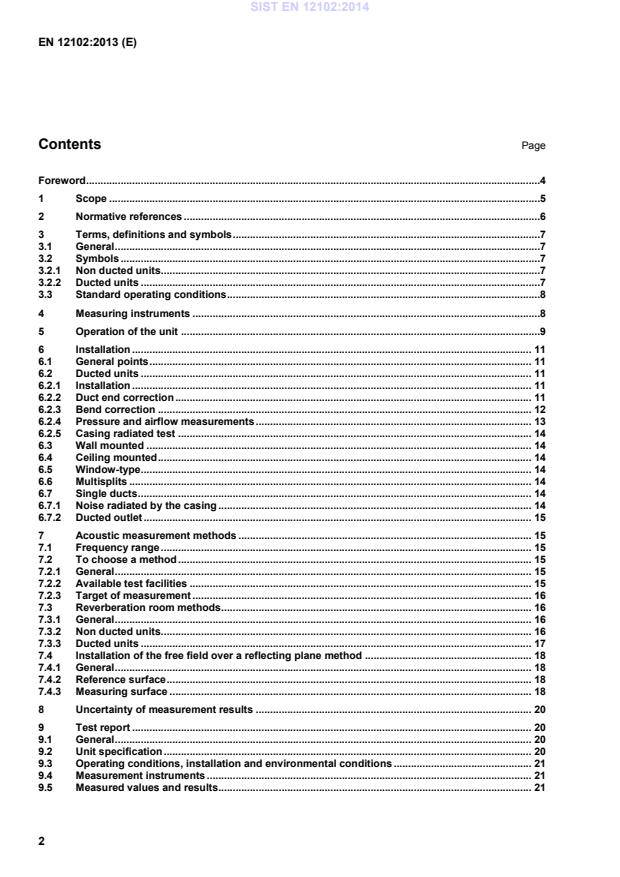
Specific measurement for variable speed units . 23 A.1 General requirements . 23 A.2 Test mode . 23 A.3 Measurements process . 23 Annex ZA (informative)
Relationship between this European Standard and the requirements of Commission Regulation (EC) No 206/2012 . 24 Bibliography . 25
It is emphasised that this measurement standard only refers to airborne noise.
This European Standard offers ways to determine the sound power level of units. Some of them are specifically adapted to provide results with low uncertainties, by using laboratory class acoustic methods and highly controlled working conditions. Those measurements are suitable for certification, labelling and marking purposes.
In some cases, the target and/or the environment of the measurements do not allow such precision-class methods. This European Standard also offers ways to assess sound power levels with acceptable accuracy even though acoustic methods and/or working conditions are not laboratory-type, e.g. in situ or quality control measurements. This European Standard gives two classes of measurements and results, according to the test environment:
Class A measurements correspond to controlled working conditions (standard or application rating conditions). It is defined by the respect to the tolerances of Table 2 and should be used for the conformity to requirements of the Commission Regulation (EC) No 206/2012 of 6 March 2012 implementing Directive 2009/125/EC of the European Parliament and of the Council with regard to ecodesign requirements for air conditioners Class B measurements correspond to the case where the range defined by the tolerances of Table 2 cannot be fulfilled. In both classes, precision or engineering class acoustic methods should be applied. The choice of the acoustic measurement method is done in accordance with EN ISO 3740 and EN ISO 9614 depending on the type of surrounding acoustic fields (diffuse or free field, enclosed or open space), and the available instrumentation. Whatever the current working conditions, the reference of acoustic standard should be reported, with explicit mention of its accuracy class. The use of EN ISO 3746 and EN ISO 3747 as survey grade methods are not recommended due to the high level of uncertainties. Their use is only allowed for non controlled environments. Three methods for determining the sound power levels are specified in order to avoid unduly restricting existing facilities and experience: the first methodology is based on reverberation room measurement (see EN ISO 3741, EN ISO 3743 and EN ISO 3747 in some favourable cases when the engineering grade can be fulfilled);
the second method is based on measurements in an essentially free field over a reflecting plane (see EN ISO 3744 and EN ISO 3745);
the third method is based on sound intensity measurement (see EN ISO 9614) in preferably free field environment. SIST EN 12102:2014
The open spaces should be covered only in specific cases, e.g. when the size or the power of the unit under test cannot be managed by standard test rooms. Suitable test methods are EN ISO 3744 and EN ISO 9614.
NOTE
Intensity measurement methods are quite robust and are well suited for tests to be done in environments without or with a light acoustic treatment (the better the acoustic treatment, the easier the implementation). 2 Normative references The following documents, in whole or in part, are normatively referenced in this document and are indispensable for its application. For dated references, only the edition cited applies. For undated references, the latest edition of the referenced document (including any amendments) applies. EN 15218:2013, Air conditioners and liquid chilling packages with evaporatively cooled condenser and with electrically driven compressors for space cooling - Terms, definitions, test conditions, test methods and requirements EN 810:1997, Dehumidifiers with electrically driven compressors — Rating tests, marking, operational requirements and technical data sheet EN 14511-1:2013, Air conditioners, liquid chilling packages and heat pumps with electrically driven compressors for space heating and cooling — Part 1: Terms, definitions and classification EN 14511-2:2013, Air conditioners, liquid chilling packages and heat pumps with electrically driven compressors for space heating and cooling — Part 2: Test conditions EN 14511-3:2013, Air conditioners, liquid chilling packages and heat pumps with electrically driven compressors for space heating and cooling — Part 3: Test methods EN 14511-4:2013, Air conditioners, liquid chilling packages and heat pumps with electrically driven compressors for space heating and cooling — Part 4: Operating requirements, marking and instructions EN ISO 3740, Acoustics — Determination of sound power levels of noise sources — Guidelines for the use of basic standards (ISO 3740) EN ISO 3741, Acoustics — Determination of sound power levels and sound energy levels of noise sources using sound pressure — Precision methods for reverberation test rooms (ISO 3741) EN ISO 3743-1, Acoustics — Determination of sound power levels and sound energy levels of noise sources using sound pressure — Engineering methods for small, movable sources in reverberant fields — Part 1: Comparison method for hard-walled test rooms (ISO 3743-1) EN ISO 3743-2, Acoustics — Determination of sound power levels of noise sources using sound pressure - Engineering methods for small, movable sources in reverberant fields — Part 2: Methods for special reverberation test rooms (ISO 3743-2) EN ISO 3744, Acoustics — Determination of sound power levels and sound energy levels of noise sources using sound pressure — Engineering methods for an essentially free field over a reflecting plane (ISO 3744) EN ISO 3747, Acoustics — Determination of sound power levels and sound energy levels of noise sources using sound pressure — Engineering/survey methods for use in situ in a reverberant environment (ISO 3747) SIST EN 12102:2014
- temperature inlet/outlet °C ± 0,3 K
- volume flow m3/s ± 3 % Air
- dry bulb temperature °C ± 0,5 K
- wet bulb temperature °C ± 0,8 K
- static pressure difference Pa ± 8 Pa (∆p ≤ 100 Pa)
± 8 % (∆p > 100 Pa)
- volume flow m³/s ± 10 % Refrigerant
- pressure at compressor outlet kPa ± 3 %
- temperature °C ± 1 K Concentration
- heat transfer medium % ± 6 % Electrical quantities
- voltage V ± 1 % Rotation speed
min-1 ± 1 %
Wet bulb temperature measurement involves the generation of air flow around a wet thermometer which may generate unwanted noise in the sound power measurement. It is then recommended to preferably determine relative humidity or dew point instead. Suitable windshields are recommended to be fitted on microphones if they have to be affected by air velocity (above about 2 m/s) which may be produced by the appliance to be tested or by the laboratory facilities. Adjustment should be made to the measured sound pressure levels to compensate for any alteration in the sensitivity of shielded microphones. Above 10 m/s, windshields are usually not efficient enough and care shall SIST EN 12102:2014
- inlet temperature ± 1 K ± 1,5 K
- ∆ T ± 1 K ± 1,5 K
- volume flow ± 5 % ± 10 % Air
-inlet temperature (dry bulb or wet bulb) ± 2 K a
± 3 K
- HR ± 10 % ± 15 %
- rpm of fan ± 3 % ± 6 % Airflow
- Static pressure difference
- ± 8 Pa for ∆P ≤ 100 Pa
± 10 % otherwise
- Air
...