


EN 18199:2026
(Main)Leather - Essential requirements for leather traceability
General Information
- Abstract
This document sets the minimum essential elements of traceability and evidence of verification to be present in a leather traceability system, kept by organizations along the animal-to-leather supply chain. It is applicable to all types of leather.
This document defines the requirements and related evidence for establishing the traceability of leather back to the originating farms or hunting area.
This document can be applied to any organization operating within the leather value chain.
- Status
- Published
- Publication Date
- 25-Aug-2026
- Technical Committee
- CEN/TC 289 - Leather
- Current Stage
- 6060 - Definitive text made available (DAV) - Publishing
- Start Date
- 26-Aug-2026
- Due Date
- 13-May-2026
- Completion Date
- 26-Aug-2026

Overview
EN 18199:2026 - Leather: Essential Requirements for Leather Traceability is a European standard developed by CEN to define the minimum essential elements and verification requirements for leather traceability systems. It applies across the entire animal-to-leather supply chain and to all types of leather, from raw material to finished goods. The aim is to enable organizations in the leather value chain to establish effective traceability methods, linking leather products back to their originating farm or hunting area and supporting compliance with regulatory and sustainability demands.
With growing consumer and regulatory focus on sustainability, ethical sourcing, animal welfare, and transparency, leather traceability has become a crucial topic in the industry. EN 18199:2026 outlines the framework and minimum data requirements for organizations, promoting standardized traceability systems across the sector.
Key Topics
Chain of Custody Models
The standard defines acceptable chain of custody models. Mass balance and book-and-claim approaches are not acceptable for hides, skins, and leather. Material segregation at batch level is the minimum requirement, while systems preserving product identity are preferred.Traceability Levels
There are three levels of traceability:- Level 1: Minimum requirements for all animal, hide, skin, and leather types.
- Level 2: Supplementary documentation, including geolocation data, for bovine materials entering or leaving the EU for compliance with applicable regulations (e.g., EUDR).
- Level 3: Enhanced traceability for advanced sustainability claims.
Information and Evidence
Organizations must collect, retain, and provide evidence such as invoices, delivery notes, geolocation data, due diligence statements, and product descriptions. Depending on traceability level, further documentation, such as sustainability-related certificates or audit reports, may be needed.System Requirements
Traceability systems may be manual or electronic but must clearly outline:- Organizational activities in the supply chain
- Material handling and storage procedures
- Roles and responsibilities regarding traceability data
- Internal audit and compliance measures
- Data retention policies (minimum of 5 years)
Coordination and Verification
All supply chain participants should synchronize traceability systems, supporting each stage with verifiable links and information. Organizations should provide robust verification processes to demonstrate due diligence and compliance when requested.
Applications
EN 18199:2026 is applicable to any organization involved in the leather value chain, including:
- Tanners and manufacturers
- Traders and distributors
- Raw material suppliers, farms, and hunting operators
- Finished product manufacturers and retailers
Practical applications include:
- Documenting the origin of leather materials for ethical and sustainable sourcing
- Supporting compliance with EU regulations such as the EU Deforestation-free Regulation (EUDR)
- Facilitating sustainability claims through evidence-based traceability
- Improving supply chain transparency for business partners and consumers
- Ensuring readiness for due diligence audits and market access requirements
By following EN 18199:2026, businesses can mitigate risks associated with supply chain opacity, support sustainability initiatives, and bolster reputation with traceable, verifiable sourcing data.
Related Standards
Organizations implementing EN 18199:2026 should also consider the following related standards:
- EN 15987: Leather - Terminology – Key definitions for the leather trade
- ISO 22095: Chain of custody - General terminology and models
- Regulation (EU) 2023/1115 (EUDR): Requirements on deforestation-free products
- UNECE UN-CEFACT Leather Value Chain Reports: Coverage of processes, sustainability, and data requirements
EN 18199:2026 supports harmonization in the leather sector and provides a structured approach to meeting increasingly strict supply chain traceability and sustainability requirements. Adherence to this standard helps organizations build robust, compliant, and auditable leather traceability systems.
Get Certified
Connect with accredited certification bodies for this standard

Control Union Certifications
Global certification for agriculture and sustainability.

Hohenstein Institut
Textile testing and certification.

Bureau Veritas Bangladesh
Bureau Veritas certification services in Bangladesh.
Sponsored listings
Frequently Asked Questions
EN 18199:2026 is a standard published by the European Committee for Standardization (CEN). Its full title is "Leather - Essential requirements for leather traceability". This standard covers: This document sets the minimum essential elements of traceability and evidence of verification to be present in a leather traceability system, kept by organizations along the animal-to-leather supply chain. It is applicable to all types of leather. This document defines the requirements and related evidence for establishing the traceability of leather back to the originating farms or hunting area. This document can be applied to any organization operating within the leather value chain.
This document sets the minimum essential elements of traceability and evidence of verification to be present in a leather traceability system, kept by organizations along the animal-to-leather supply chain. It is applicable to all types of leather. This document defines the requirements and related evidence for establishing the traceability of leather back to the originating farms or hunting area. This document can be applied to any organization operating within the leather value chain.
EN 18199:2026 is classified under the following ICS (International Classification for Standards) categories: 59.140.30 - Leather and furs. The ICS classification helps identify the subject area and facilitates finding related standards.
EN 18199:2026 is available in PDF format for immediate download after purchase. The document can be added to your cart and obtained through the secure checkout process. Digital delivery ensures instant access to the complete standard document.
Standards Content (Sample)
SLOVENSKI STANDARD
01-oktober-2026
Usnje - Bistvene zahteve za sledljivost usnja
Leather - Essential requirements for leather traceability
Leder - Grundlegende Anforderungen für die Rückverfolgbarkeit von Leder
Cuir - Exigences essentielles relatives à la traçabilité des cuirs
Ta slovenski standard je istoveten z: EN 18199:2026
ICS:
59.140.30 Usnje in krzno Leather and furs
2003-01.Slovenski inštitut za standardizacijo. Razmnoževanje celote ali delov tega standarda ni dovoljeno.
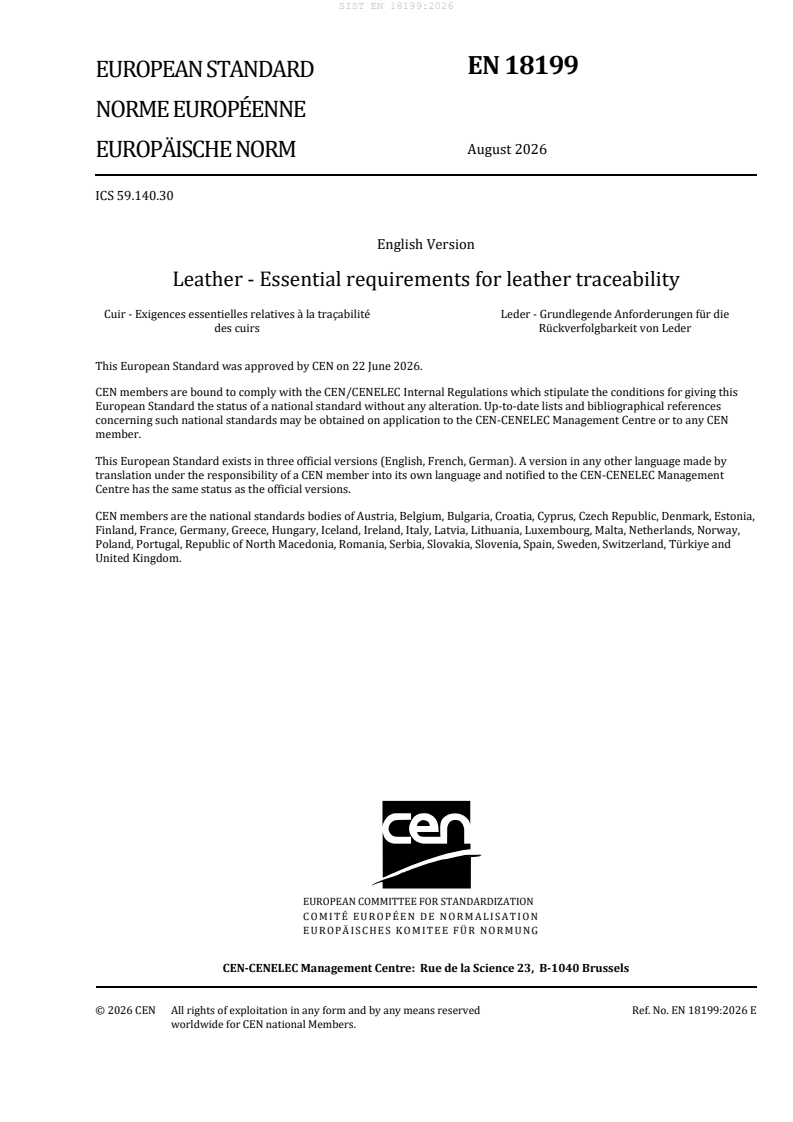
EN 18199
EUROPEAN STANDARD
NORME EUROPÉENNE
August 2026
EUROPÄISCHE NORM
ICS 59.140.30
English Version
Leather - Essential requirements for leather traceability
Cuir - Exigences essentielles relatives à la traçabilité Leder - Grundlegende Anforderungen für die
des cuirs Rückverfolgbarkeit von Leder
This European Standard was approved by CEN on 22 June 2026.
CEN members are bound to comply with the CEN/CENELEC Internal Regulations which stipulate the conditions for giving this
European Standard the status of a national standard without any alteration. Up-to-date lists and bibliographical references
concerning such national standards may be obtained on application to the CEN-CENELEC Management Centre or to any CEN
member.
This European Standard exists in three official versions (English, French, German). A version in any other language made by
translation under the responsibility of a CEN member into its own language and notified to the CEN-CENELEC Management
Centre has the same status as the official versions.
CEN members are the national standards bodies of Austria, Belgium, Bulgaria, Croatia, Cyprus, Czech Republic, Denmark, Estonia,
Finland, France, Germany, Greece, Hungary, Iceland, Ireland, Italy, Latvia, Lithuania, Luxembourg, Malta, Netherlands, Norway,
Poland, Portugal, Republic of North Macedonia, Romania, Serbia, Slovakia, Slovenia, Spain, Sweden, Switzerland, Türkiye and
United Kingdom.
EUROPEAN COMMITTEE FOR STANDARDIZATION
COMITÉ EUROPÉEN DE NORMALISATION
EUROPÄISCHES KOMITEE FÜR NORMUNG
CEN-CENELEC Management Centre: Rue de la Science 23, B-1040 Brussels
© 2026 CEN All rights of exploitation in any form and by any means reserved Ref. No. EN 18199:2026 E
worldwide for CEN national Members.
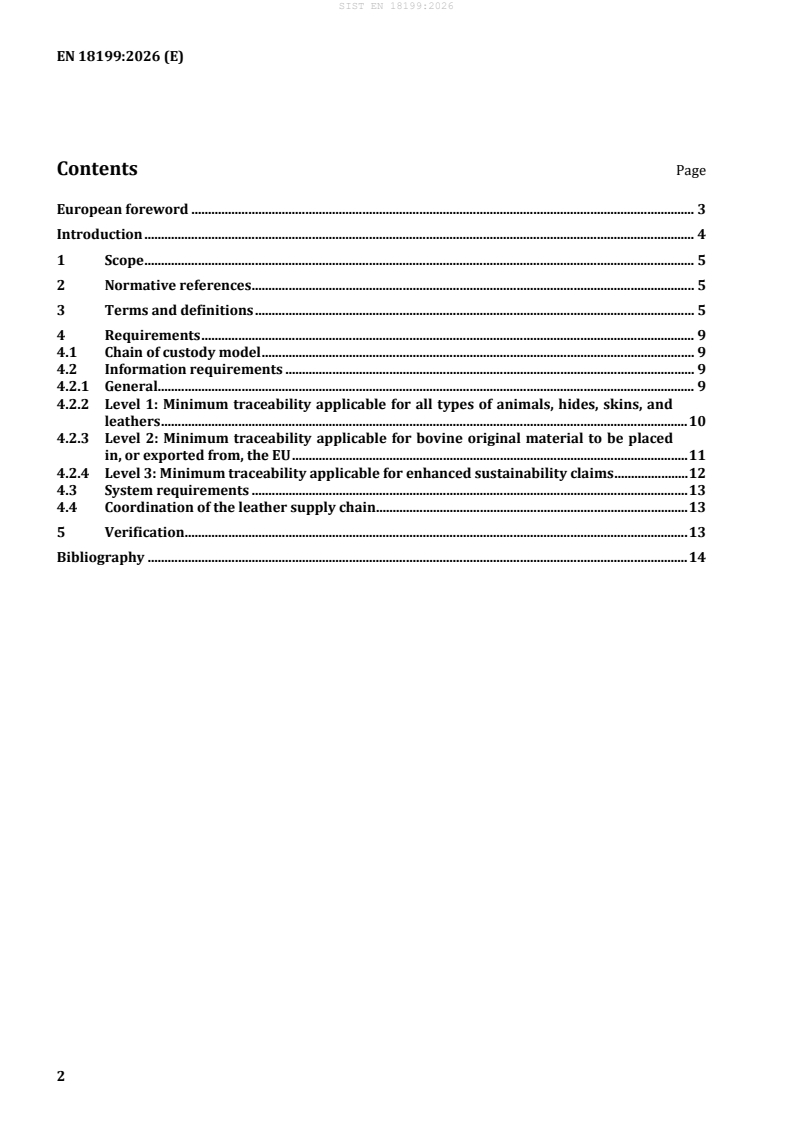
Contents Page
European foreword . 3
Introduction . 4
1 Scope . 5
2 Normative references . 5
3 Terms and definitions . 5
4 Requirements . 9
4.1 Chain of custody model . 9
4.2 Information requirements . 9
4.2.1 General. 9
4.2.2 Level 1: Minimum traceability applicable for all types of animals, hides, skins, and
leathers . 10
4.2.3 Level 2: Minimum traceability applicable for bovine original material to be placed
in, or exported from, the EU . 11
4.2.4 Level 3: Minimum traceability applicable for enhanced sustainability claims . 12
4.3 System requirements . 13
4.4 Coordination of the leather supply chain . 13
5 Verification . 13
Bibliography . 14
European foreword
This document (EN 18199:2026) has been prepared by Technical Committee CEN/TC 289 “Leather”,
the secretariat of which is held by UNI.
This European Standard shall be given the status of a national standard, either by publication of an
identical text or by endorsement, at the latest by February 2027, and conflicting national standards
shall be withdrawn at the latest by February 2027.
Attention is drawn to the possibility that some of the elements of this document may be the subject of
patent rights. CEN shall not be held responsible for identifying any or all such patent rights.
Any feedback and questions on this document should be directed to the users’ national standards body.
A complete listing of these bodies can be found on the CEN website.
According to the CEN-CENELEC Internal Regulations, the national standards organisations of the
following countries are bound to implement this European Standard: Austria, Belgium, Bulgaria,
Croatia, Cyprus, Czech Republic, Denmark, Estonia, Finland, France, Germany, Greece, Hungary, Iceland,
Ireland, Italy, Latvia, Lithuania, Luxembourg, Malta, Netherlands, Norway, Poland, Portugal, Republic of
North Macedonia, Romania, Serbia, Slovakia, Slovenia, Spain, Sweden, Switzerland, Türkiye and the
United Kingdom.
Introduction
Public and/or private stakeholders require supply chains to provide information to consumers on how,
by whom, and where products are made. Accordingly, traceability of leather back to the place of birth
and slaughter of animals whose hide/skin constitute the input material of the tanning process, and
transparency in the supply chain have become essential in the leather market. Animal welfare,
deforestation, child or forced labour, toxic-free supplies, etc. are some of the ethical considerations that
lay behind this growing trend.
Traceability constitutes a particular challenge for the leather industry, as hides and skins obtain their
identity separately from the animal at the slaughterhouse, and information on the previous lifecycle is
lost in the vast majority of cases. A proliferation of different and diverse approaches on leather
traceability risks obliging operators along the animal-to-leather supply chain to implement several
systems developed by private certification scheme owners for ascertaining the chain of custody and
resulting with audit overlaps and an increase in unproductive costs.
The present document provides the requirements agreed by the sector’s certification bodies and
scheme owners setting the minimum essential elements for leather traceability and minimum data or
information to be kept as evidence.
The document should be used by operators along the leather value chain for implementing their
traceability systems, to be verified by a robust assurance process.
1 Scope
This document sets the minimum essential elements of traceability and evidence of verification to be
present in a leather traceability system, kept by organizations along the animal-to-leather supply chain.
It is applicable to all types of leather.
This document defines the requirements and related evidence for establishing the traceability of leather
back to the originating farms or hunting area.
This document can be applied to any organization operating within the leather value chain.
2 Normative references
The following documents are referred to in the text in such a way that some or all of their content
constitutes requirements of this document. For dated references, only the edition cited applies. For
undated references, the latest edition of the referenced document (including any amendments) applies.
EN 15987, Leather - Terminology - Key definitions for the leather trade
ISO 22095, Chain of custody — General terminology and models
3 Terms and definitions
For the purposes of this document, the terms and definitions given in EN 15987, in ISO 22095 and the
following apply.
ISO and IEC maintain terminology databases for use in standardization at the following addresses:
— ISO Online browsing platform: available at https://www.iso.org/obp/
— IEC Electropedia: available at https://www.electropedia.org/
3.1
abattoir / slaughterhouse
facility where animals are sent for slaughter at end of life
3.2
animal origin
place where an animal was born
3.3
batch
quantity or consignment of animals farmed, or material processed at the same time
3.4
batch system
method whereby a group (batch) of animals/material is farmed/produced simultaneously (rather than
one at a time)
Note 1 to entry: It is up to the farmer/manufacturer to decide how big the batch will be, and how often these
batches will be processed.
Note 2 to entry: Each batch goes through the separate stages of the farming/manufacturing process together.
3.5
book and claim
chain of custody model in which the administrative record flow is not necessarily connected to the
physical flow of material or product throughout the supply chain
Note 1 to entry: This chain of custody model is also referred to as “certificate trading model” or “credit trading”.
Note 2 to entry: This is often used where the certified/specified material is not, or only with difficulty, be kept
separate from the non-certified/specified material, such as green credits in an electricity supply.
[SOURCE: ISO 22095]
3.6
chain of custody
process by which inputs and outputs and associated information are transferred, monitored and
controlled as they move through each step in the relevant supply chain
[SOURCE: ISO 22095]
3.7
deforested land
plot of forest converted to agricultural use, whether human-induced or not
[SOURCE: Regulation (EU) 2023/1115 [1], modified]
3.8
direct supplier
person, party or company that supplies goods/services directly to a person, party or company
Note 1 to entry: A company may be an organization, manufacturing facility or farm.
3.9
indirect supplier
person, party or company that supplies goods/services to another supplier as an intermediary
Note 1 to entry: A company may be an organization, manufacturing facility or farm.
3.10
farm
all places where the birth, raising and/or finishing or full life cycle of an animal takes place
3.11
birthing farm
facility where animals are born and stay with their mothers until they are weaned
3.12
finishing farm (feedlot)
facility where animals spend the last period of life, prior to slaughter, to ensure optimum weight and
health for meat production
Note 1 to entry: For cattle it is approx. 4 months before slaughter.
3.13
industrialized farm system
system that combines the characteristics of a birthing farm, rearing farm (raising farm) and finishing
farm (feedlot), and is commonly used for large volume meat production
3.14
rearing farm (raising farm)
facility where young animals are sent to continue to grow to a pre-determined age/weight
3.15
finished product manufacturer
person, party or company that transforms finished leather into final products
3.16
geolocation
geographical location of a plot of land described by means of latitude and longitude coordinates,
corresponding to at least one latitude and one longitude point and using at least six decimal digits
Note 1 to entry: For plots of land of more than four hectares used for the production of the relevant commodities
other than cattle, this shall be provided using polygons with sufficient latitude and longitude points to describe the
perimeter of each plot of land.
[SOURCE: Regulation (EU) 2023/1115 [1], modified]
3.17
hide and skin origin
place where the hide or skin is separated from the carcass
3.18
hunting area
geographic area where people are allowed to hunt wild animals, such as a forest or woodland
3.19
identity preservation
process that maintains the unique characteristics of a product throughout its supply chain
[SOURCE: ISO 22095]
3.20
mass balance
chain of custody model in which materials or products with a set of specified characteristics are mixed
according to defined criteria with materials or products without that set of characteristics
Note 1 to entry: The proportion of the input with specified characteristics only match the initial proportions
...