


EN 15410:2011
(Main)Solid recovered fuels - Methods for the determination of the content of major elements (Al, Ca, Fe, K, Mg, Na, P, Si, Ti)
General Information
- Abstract
This European Standard specifies three methods of digestion for solid recovered fuels:
a) microwave assisted digestion with hydrofluoric, nitric and hydrochloric acid mixture;
b) hot water bath digestion of with hydrofluoric, nitric and hydrochloric acid mixture, after ashing of the SRFs sample;
c) oven digestion with nitric, perchloric and hydrofluoric acid mixture.
Instrumental determination of Si, Al, K, Na, Ca, Mg, Fe, P, and Ti is performed by Inductively Coupled Plasma Spectrometry with optical detection or other suitable spectroscopic techniques such as Flame Atomic Spectroscopy.
The effectiveness of the digestion can be verified by qualitative X-ray fluorescence (XRF) analysis on the remaining residue. If necessary an alternative digestion method (among those proposed) shall be used.
XRF can be used for the analysis of Si, Al, K, Na, Ca, Mg, Fe, P, Ti, after ashing (550 °C) of the sample: other elements can be analysed by XRF provided that the concentration levels are above the instrumental detection limits of the XRF instrumentation and after proper preliminary testing.
Method a) is recommended for general use, but the amount of the test portion can be very low in case of high concentration of organic matter. Method b) is recommended for SRFs with high organic matter concentration that can be difficult to digest with the other methods.
Method c) is recommended for SRFs samples for which the other methods leave a significant insoluble residue.
All the listed methods are suitable for the determination of Si, provided that closed containers are used for sample dissolution. XRF is highly recommended for Si, P and Ti analysis.
Alternative digestion methods can be applied if their performance is proved to be comparable with those of the methods mentioned in a) to c) (see Annex C).
- Status
- Withdrawn
- Publication Date
- 06-Sep-2011
- Withdrawal Date
- 16-Sep-2026
- Technical Committee
- CEN/TC 343 - Solid Recovered Fuels
- Drafting Committee
- CEN/TC 343/WG 5 - Chemical Tests
- Current Stage
- 9960 - Withdrawal effective - Withdrawal
- Start Date
- 23-Apr-2025
- Completion Date
- 17-Sep-2026


Relations
- Effective Date
- 10-Sep-2011
- Effective Date
- 18-Jan-2023
- Effective Date
- 25-Aug-2026
- Effective Date
- 25-Aug-2026
- Effective Date
- 25-Aug-2026
- Effective Date
- 28-Jan-2026
- Effective Date
- 28-Jan-2026
- Effective Date
- 28-Jan-2026
- Effective Date
- 28-Jan-2026
- Effective Date
- 28-Jan-2026
- Effective Date
- 28-Jan-2026
- Effective Date
- 28-Jan-2026
- Effective Date
- 28-Jan-2026
- Effective Date
- 28-Jan-2026
- Effective Date
- 28-Jan-2026
Get Certified
Connect with accredited certification bodies for this standard

Element Materials Technology
Materials testing and product certification.

ABS Group Brazil
ABS Group certification services in Brazil.

ABS Quality Evaluations Inc.
American Bureau of Shipping quality certification.
Sponsored listings
Frequently Asked Questions
EN 15410:2011 is a standard published by the European Committee for Standardization (CEN). Its full title is "Solid recovered fuels - Methods for the determination of the content of major elements (Al, Ca, Fe, K, Mg, Na, P, Si, Ti)". This standard covers: This European Standard specifies three methods of digestion for solid recovered fuels: a) microwave assisted digestion with hydrofluoric, nitric and hydrochloric acid mixture; b) hot water bath digestion of with hydrofluoric, nitric and hydrochloric acid mixture, after ashing of the SRFs sample; c) oven digestion with nitric, perchloric and hydrofluoric acid mixture. Instrumental determination of Si, Al, K, Na, Ca, Mg, Fe, P, and Ti is performed by Inductively Coupled Plasma Spectrometry with optical detection or other suitable spectroscopic techniques such as Flame Atomic Spectroscopy. The effectiveness of the digestion can be verified by qualitative X-ray fluorescence (XRF) analysis on the remaining residue. If necessary an alternative digestion method (among those proposed) shall be used. XRF can be used for the analysis of Si, Al, K, Na, Ca, Mg, Fe, P, Ti, after ashing (550 °C) of the sample: other elements can be analysed by XRF provided that the concentration levels are above the instrumental detection limits of the XRF instrumentation and after proper preliminary testing. Method a) is recommended for general use, but the amount of the test portion can be very low in case of high concentration of organic matter. Method b) is recommended for SRFs with high organic matter concentration that can be difficult to digest with the other methods. Method c) is recommended for SRFs samples for which the other methods leave a significant insoluble residue. All the listed methods are suitable for the determination of Si, provided that closed containers are used for sample dissolution. XRF is highly recommended for Si, P and Ti analysis. Alternative digestion methods can be applied if their performance is proved to be comparable with those of the methods mentioned in a) to c) (see Annex C).
This European Standard specifies three methods of digestion for solid recovered fuels: a) microwave assisted digestion with hydrofluoric, nitric and hydrochloric acid mixture; b) hot water bath digestion of with hydrofluoric, nitric and hydrochloric acid mixture, after ashing of the SRFs sample; c) oven digestion with nitric, perchloric and hydrofluoric acid mixture. Instrumental determination of Si, Al, K, Na, Ca, Mg, Fe, P, and Ti is performed by Inductively Coupled Plasma Spectrometry with optical detection or other suitable spectroscopic techniques such as Flame Atomic Spectroscopy. The effectiveness of the digestion can be verified by qualitative X-ray fluorescence (XRF) analysis on the remaining residue. If necessary an alternative digestion method (among those proposed) shall be used. XRF can be used for the analysis of Si, Al, K, Na, Ca, Mg, Fe, P, Ti, after ashing (550 °C) of the sample: other elements can be analysed by XRF provided that the concentration levels are above the instrumental detection limits of the XRF instrumentation and after proper preliminary testing. Method a) is recommended for general use, but the amount of the test portion can be very low in case of high concentration of organic matter. Method b) is recommended for SRFs with high organic matter concentration that can be difficult to digest with the other methods. Method c) is recommended for SRFs samples for which the other methods leave a significant insoluble residue. All the listed methods are suitable for the determination of Si, provided that closed containers are used for sample dissolution. XRF is highly recommended for Si, P and Ti analysis. Alternative digestion methods can be applied if their performance is proved to be comparable with those of the methods mentioned in a) to c) (see Annex C).
EN 15410:2011 is classified under the following ICS (International Classification for Standards) categories: 75.160.10 - Solid fuels; 75.160.40 - Biofuels. The ICS classification helps identify the subject area and facilitates finding related standards.
EN 15410:2011 has the following relationships with other standards: It is inter standard links to CEN/TS 15410:2006, EN ISO 3884:2025, ISO 9964-1:1993, ISO 9964-2:1993, ISO 9964-3:1993, EN 13656:2020, EN ISO 21660-3:2021, EN 29048:1990, EN ISO 15586:2003, EN 28394:1990, EN ISO 21656:2021, EN ISO 12020:2000, EN 15357:2011, EN ISO 3696:1995, EN ISO 11885:2009. Understanding these relationships helps ensure you are using the most current and applicable version of the standard.
EN 15410:2011 is associated with the following European legislation: Standardization Mandates: M/325. When a standard is cited in the Official Journal of the European Union, products manufactured in conformity with it benefit from a presumption of conformity with the essential requirements of the corresponding EU directive or regulation.
EN 15410:2011 is available in PDF format for immediate download after purchase. The document can be added to your cart and obtained through the secure checkout process. Digital delivery ensures instant access to the complete standard document.
Standards Content (Sample)
2003-01.Slovenski inštitut za standardizacijo. Razmnoževanje celote ali delov tega standarda ni dovoljeno.Feste Sekundärbrennstoffe - Verfahren zur Bestimmung des Gehaltes an Hauptbestandteilen (Al, Ca, Fe, K, Mg, Na, P, Si, Ti)Combustibles solides de récupération - Méthodes pour la détermination de la teneur en élémentes majeurs (Al, Ca, Fe, K, Mg, Na, P, Si et Ti)Solid recovered fuels - Methods for the determination of the content of major elements (Al, Ca, Fe, K, Mg, Na, P, Si, Ti)75.160.10Trda gorivaSolid fuelsICS:Ta slovenski standard je istoveten z:EN 15410:2011SIST EN 15410:2011en,de01-november-2011SIST EN 15410:2011SLOVENSKI
STANDARDSIST-TS CEN/TS 15410:20071DGRPHãþD
EUROPEAN STANDARD NORME EUROPÉENNE EUROPÄISCHE NORM
EN 15410
September 2011 ICS 75.160.10 Supersedes CEN/TS 15410:2006English Version
Solid recovered fuels - Methods for the determination of the content of major elements (Al, Ca, Fe, K, Mg, Na, P, Si, Ti)
Combustibles solides de récupération - Pour la détermination de la teneur en éléments majeurs (Al, Ca, Fe, K, Mg, Na, P, Si et Ti)
Feste Sekundärbrennstoffe - Verfahren zur Bestimmung des Gehaltes an Hauptbestandteilen (Al, Ca, Fe, K, Mg, Na, P, Si, Ti) This European Standard was approved by CEN on 15 July 2011.
CEN members are bound to comply with the CEN/CENELEC Internal Regulations which stipulate the conditions for giving this European Standard the status of a national standard without any alteration. Up-to-date lists and bibliographical references concerning such national standards may be obtained on application to the CEN-CENELEC Management Centre or to any CEN member.
This European Standard exists in three official versions (English, French, German). A version in any other language made by translation under the responsibility of a CEN member into its own language and notified to the CEN-CENELEC Management Centre has the same status as the official versions.
CEN members are the national standards bodies of Austria, Belgium, Bulgaria, Croatia, Cyprus, Czech Republic, Denmark, Estonia, Finland, France, Germany, Greece, Hungary, Iceland, Ireland, Italy, Latvia, Lithuania, Luxembourg, Malta, Netherlands, Norway, Poland, Portugal, Romania, Slovakia, Slovenia, Spain, Sweden, Switzerland and United Kingdom.
EUROPEAN COMMITTEE FOR STANDARDIZATION
COMITÉ EUROPÉEN DE NORMALISATION EUROPÄISCHES KOMITEE FÜR NORMUNG
Management Centre:
Avenue Marnix 17,
B-1000 Brussels © 2011 CEN All rights of exploitation in any form and by any means reserved worldwide for CEN national Members. Ref. No. EN 15410:2011: ESIST EN 15410:2011
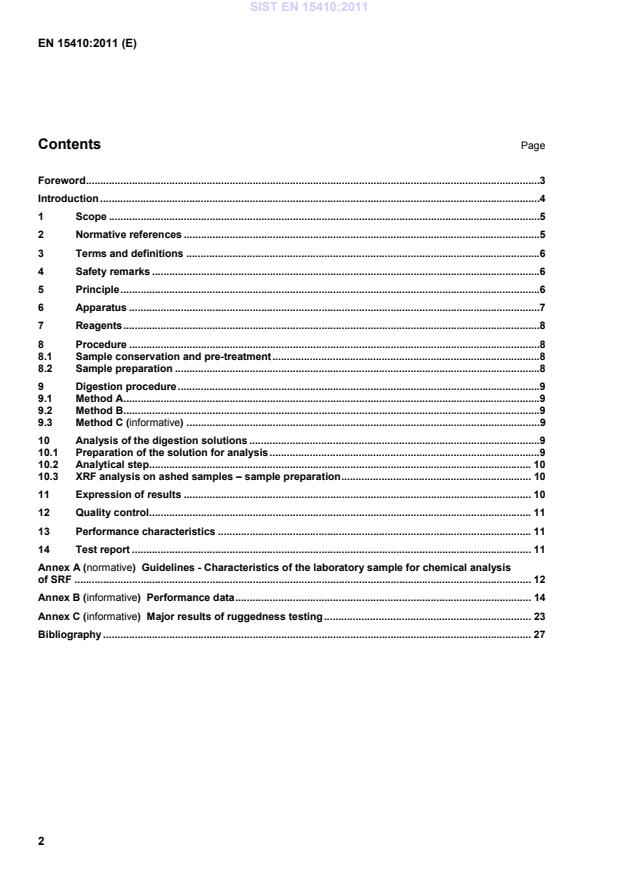
Guidelines - Characteristics of the laboratory sample for chemical analysis of SRF . 12Annex B (informative)
Performance data . 14Annex C (informative)
Major results of ruggedness testing . 23Bibliography . 27
The glassware used in the digestion procedure should be accurately pre-cleaned with 10 % nitric acid solution. SIST EN 15410:2011
Argon (Ar), with a minimum purity of 99,99 %. 8 Procedure 8.1 Sample conservation and pre-treatment The laboratory samples shall be stored according to guidelines defined in Annex A. It is advisable to contact the people performing the sampling in order to agree a procedure for the laboratory sample preparation and storage before delivering to the laboratory. In particular, any treatment procedure which can increase the temperature of the material above 40 °C should be avoided, in order to avoid significant loss of mercury or other volatile compounds. Furthermore, any possible source of contamination during the laboratory sample preparation (e.g. grinding with metallic apparatus) shall be avoided or reduced as much as possible. The laboratory sample should be stored and delivered in sealed high-density plastic containers. 8.2 Sample preparation The test portion shall be prepared from the laboratory sample according to EN 15413. In addition, for the purposes of this method, the target size should be 1 mm or below. Depending on the used digestion method, the amount of test portion ranges between 0,2 and 0,5 g. Ash sample for XRF analysis are prepared as described in the method reported in EN 15403, starting from a quantity of material to obtain the amount of ash sufficient for the analysis (ash content can be as low as few percent on dry basis). Whereas the determination is carried out on a dry basis, the moisture content shall be determined according to EN 15414-3. SIST EN 15410:2011
...