


EN ISO 21789:2022
(Main)Gas turbine applications - Safety (ISO 21789:2022)
General Information
- Abstract
This document covers the safety requirements for aero derivative and industrial gas turbine prime mover applications using liquid or gaseous fuels and the safety related control and detection systems and essential auxiliaries for all types of open cycles (simple, combined, regenerative, reheat, etc.) used in onshore and offshore applications including floating production platforms.
This document applies to mechanical, electrical, and pressure equipment components and systems necessary for the functionality of the prime mover. For example, but not limited to, a core gas turbine auxiliary gearbox, an output transmission gear box, combustion system, air filtration, gas turbine controls, oil systems, and fuel system. This document also covers integration of safety risks within the overall installation, e.g. exhaust purging or drainage.
This document details the anticipated significant hazards associated with aero derivative and industrial gas turbine prime movers and specifies the appropriate preventative measures and processes for reduction or elimination of these hazards. This document addresses the risks of injury or death to humans and risks to the environment. Equipment damage without risk to humans or the environment is not covered.
The overall objective of this document is to ensure that equipment is designed, constructed, operated and maintained throughout its life in accordance with ISO 12100:2010.
This document approaches gas turbine safety from an international perspective based on the content of existing, recognized ISO and IEC standards to the greatest extent possible. Where no ISO or IEC standard exists, other codes or standards (such as EN, NFPA, etc.) have been included.
Minimum functional safety levels cannot be addressed in this document, as minimum functional safety levels are both application and site specific.
This document excludes the following items;
— exhaust-system structural design;
— driven equipment;
— micro turbines as covered by ISO 19372:2015;
— gas turbines used primarily for direct and indirect propulsion;
— gas turbines used for mobile applications;
— special heat source applications;
— gas turbines in research and development programs;
— compressed-air energy storage plants.
Where appropriate, this document can be used to give general guidance in such applications.
This document is not applicable to machinery or safety components manufactured before the date of its publication.
- Status
- Published
- Publication Date
- 18-Oct-2022
- Technical Committee
- CEN/TC 399 - Project Committee - Gas Turbines applications - Safety
- Drafting Committee
- CEN/TC 399 - Project Committee - Gas Turbines applications - Safety
- Current Stage
- 6060 - Definitive text made available (DAV) - Publishing
- Start Date
- 19-Oct-2022
- Completion Date
- 19-Oct-2022

Overview - EN ISO 21789:2022 (Gas turbine applications - Safety)
EN ISO 21789:2022 sets out safety requirements for aero‑derivative and industrial gas turbine prime mover applications using liquid or gaseous fuels. Published by CEN and identical to ISO 21789:2022, it covers safety‑related control and detection systems, essential auxiliaries and mechanical, electrical and pressure equipment needed for the prime mover in all types of open cycles (simple, combined, regenerative, reheat, etc.) in onshore and offshore installations, including floating production platforms. The standard’s overall objective is to ensure equipment is designed, constructed, operated and maintained in accordance with ISO 12100:2010 principles.
Key topics and technical requirements
- Risk assessment and ALARP: Requires documented risk assessments and application of “as low as reasonably practicable” principles for hazards to people and the environment.
- List of significant hazards: Identifies anticipated hazards specific to aero‑derivative and industrial gas turbines and specifies risk reduction measures.
- Safety systems and controls: Covers safety‑related control and detection systems, integration with plant systems, and essential auxiliaries (fuel, oil, air filtration, gearbox, etc.).
- Mechanical & structural safety: Requirements for guarding, casings, rotor bearings, couplings, gearbox design, vibration, FOD protection, and material selection.
- Systems & installations: Guidance on inlet systems, combustion, exhaust purging/drainage integration, and hazardous‑area considerations for onshore/offshore use.
- Lifecycle considerations: Design for maintainability, lifetime, foreseeable misuse, modifications and replacement parts.
- Scope limits & exclusions: Excludes exhaust‑system structural design, driven equipment, microturbines (ISO 19372:2015), propulsion or mobile applications, research prototypes and pre‑publication machinery. Also notes that minimum functional safety levels are application/site specific and not prescribed.
Practical applications - who uses this standard
EN ISO 21789:2022 is intended for:
- OEMs and gas turbine designers specifying safety features and auxiliaries
- Plant integrators and engineering contractors for onshore and offshore installations, including floating production platforms
- Safety and reliability engineers performing risk assessments, HAZID/HAZOP and protective measures design
- Operations, maintenance and inspection teams for safe operation, servicing and modifications
- Regulatory bodies and certifiers seeking harmonized, internationally‑based safety guidance
Typical uses include design reviews, safety specifications for procurement, commissioning checklists, integration of detection and shutdown systems, and updating maintenance procedures to meet recognized safety practices.
Related standards
- ISO 12100:2010 (general machinery safety and risk reduction principles) - normative objective of EN ISO 21789
- ISO 19372:2015 (microturbines) - explicitly excluded
- Relevant ISO and IEC standards referenced within EN ISO 21789; where gaps exist, guidance may draw on other codes (EN, NFPA, etc.)
Keywords: EN ISO 21789:2022, gas turbine safety, aero‑derivative, industrial gas turbine, safety requirements, risk assessment, turbine controls, onshore offshore, ISO 12100.
Relations
- Effective Date
- 25-Aug-2026
- Effective Date
- 25-Aug-2026
- Effective Date
- 25-Aug-2026
- Effective Date
- 25-Aug-2026
- Effective Date
- 25-Aug-2026
- Effective Date
- 25-Aug-2026
- Effective Date
- 25-Aug-2026
- Effective Date
- 25-Aug-2026
- Effective Date
- 25-Aug-2026
- Effective Date
- 25-Aug-2026
- Effective Date
- 25-Aug-2026
- Effective Date
- 25-Aug-2026
- Effective Date
- 25-Aug-2026
- Effective Date
- 25-Aug-2026
- Effective Date
- 25-Aug-2026
Get Certified
Connect with accredited certification bodies for this standard

DNV
DNV is an independent assurance and risk management provider.

Lloyd's Register
Lloyd's Register is a global professional services organisation specialising in engineering and technology.
DNV Energy Systems
Energy and renewable energy certification.
Sponsored listings
Frequently Asked Questions
EN ISO 21789:2022 is a standard published by the European Committee for Standardization (CEN). Its full title is "Gas turbine applications - Safety (ISO 21789:2022)". This standard covers: This document covers the safety requirements for aero derivative and industrial gas turbine prime mover applications using liquid or gaseous fuels and the safety related control and detection systems and essential auxiliaries for all types of open cycles (simple, combined, regenerative, reheat, etc.) used in onshore and offshore applications including floating production platforms. This document applies to mechanical, electrical, and pressure equipment components and systems necessary for the functionality of the prime mover. For example, but not limited to, a core gas turbine auxiliary gearbox, an output transmission gear box, combustion system, air filtration, gas turbine controls, oil systems, and fuel system. This document also covers integration of safety risks within the overall installation, e.g. exhaust purging or drainage. This document details the anticipated significant hazards associated with aero derivative and industrial gas turbine prime movers and specifies the appropriate preventative measures and processes for reduction or elimination of these hazards. This document addresses the risks of injury or death to humans and risks to the environment. Equipment damage without risk to humans or the environment is not covered. The overall objective of this document is to ensure that equipment is designed, constructed, operated and maintained throughout its life in accordance with ISO 12100:2010. This document approaches gas turbine safety from an international perspective based on the content of existing, recognized ISO and IEC standards to the greatest extent possible. Where no ISO or IEC standard exists, other codes or standards (such as EN, NFPA, etc.) have been included. Minimum functional safety levels cannot be addressed in this document, as minimum functional safety levels are both application and site specific. This document excludes the following items; — exhaust-system structural design; — driven equipment; — micro turbines as covered by ISO 19372:2015; — gas turbines used primarily for direct and indirect propulsion; — gas turbines used for mobile applications; — special heat source applications; — gas turbines in research and development programs; — compressed-air energy storage plants. Where appropriate, this document can be used to give general guidance in such applications. This document is not applicable to machinery or safety components manufactured before the date of its publication.
This document covers the safety requirements for aero derivative and industrial gas turbine prime mover applications using liquid or gaseous fuels and the safety related control and detection systems and essential auxiliaries for all types of open cycles (simple, combined, regenerative, reheat, etc.) used in onshore and offshore applications including floating production platforms. This document applies to mechanical, electrical, and pressure equipment components and systems necessary for the functionality of the prime mover. For example, but not limited to, a core gas turbine auxiliary gearbox, an output transmission gear box, combustion system, air filtration, gas turbine controls, oil systems, and fuel system. This document also covers integration of safety risks within the overall installation, e.g. exhaust purging or drainage. This document details the anticipated significant hazards associated with aero derivative and industrial gas turbine prime movers and specifies the appropriate preventative measures and processes for reduction or elimination of these hazards. This document addresses the risks of injury or death to humans and risks to the environment. Equipment damage without risk to humans or the environment is not covered. The overall objective of this document is to ensure that equipment is designed, constructed, operated and maintained throughout its life in accordance with ISO 12100:2010. This document approaches gas turbine safety from an international perspective based on the content of existing, recognized ISO and IEC standards to the greatest extent possible. Where no ISO or IEC standard exists, other codes or standards (such as EN, NFPA, etc.) have been included. Minimum functional safety levels cannot be addressed in this document, as minimum functional safety levels are both application and site specific. This document excludes the following items; — exhaust-system structural design; — driven equipment; — micro turbines as covered by ISO 19372:2015; — gas turbines used primarily for direct and indirect propulsion; — gas turbines used for mobile applications; — special heat source applications; — gas turbines in research and development programs; — compressed-air energy storage plants. Where appropriate, this document can be used to give general guidance in such applications. This document is not applicable to machinery or safety components manufactured before the date of its publication.
EN ISO 21789:2022 is classified under the following ICS (International Classification for Standards) categories: 27.040 - Gas and steam turbines. Steam engines. The ICS classification helps identify the subject area and facilitates finding related standards.
EN ISO 21789:2022 has the following relationships with other standards: It is inter standard links to ISO 14120:2015, ISO 11925-2:2020, IEC 61000-6-4:2018, ISO 3977-9:1999, ISO 13732-3:2005, IEC 60695-1-10:2016, IEC 60695-1-11:2014, ISO 10441:2007, IEC 60079-32-2:2015, IEC 60204-11:2018, ISO 10494:2018, IEC 62305-2:2010, IEC 61000-6-2:2016, IEC 60079-13:2017, ISO 3977-3:2004. Understanding these relationships helps ensure you are using the most current and applicable version of the standard.
EN ISO 21789:2022 is associated with the following European legislation: EU Directives/Regulations: 2006/42/EC, 2014/30/EU, 2014/34/EU, 2014/35/EU, 2014/68/EU; Standardization Mandates: M/071, M/396, M/511, M/552, M/BC/CEN/92/46. When a standard is cited in the Official Journal of the European Union, products manufactured in conformity with it benefit from a presumption of conformity with the essential requirements of the corresponding EU directive or regulation.
EN ISO 21789:2022 is available in PDF format for immediate download after purchase. The document can be added to your cart and obtained through the secure checkout process. Digital delivery ensures instant access to the complete standard document.
Standards Content (Sample)
SLOVENSKI STANDARD
01-december-2022
Uporaba plinske turbine - Varnost (ISO 21789:2022)
Gas turbine applications - Safety (ISO 21789:2022)
Gasturbinenanwendungen - Sicherheit (ISO 21789:2022)
Applications des turbines à gaz - Sécurité (ISO 21789:2022)
Ta slovenski standard je istoveten z: EN ISO 21789:2022
ICS:
27.040 Plinske in parne turbine. Gas and steam turbines.
Parni stroji Steam engines
2003-01.Slovenski inštitut za standardizacijo. Razmnoževanje celote ali delov tega standarda ni dovoljeno.
EN ISO 21789
EUROPEAN STANDARD
NORME EUROPÉENNE
October 2022
EUROPÄISCHE NORM
ICS 27.040
English Version
Gas turbine applications - Safety (ISO 21789:2022)
Applications des turbines à gaz - Sécurité (ISO Gasturbinenanwendungen - Sicherheit (ISO
21789:2022) 21789:2022)
This European Standard was approved by CEN on 24 June 2022.
CEN members are bound to comply with the CEN/CENELEC Internal Regulations which stipulate the conditions for giving this
European Standard the status of a national standard without any alteration. Up-to-date lists and bibliographical references
concerning such national standards may be obtained on application to the CEN-CENELEC Management Centre or to any CEN
member.
This European Standard exists in three official versions (English, French, German). A version in any other language made by
translation under the responsibility of a CEN member into its own language and notified to the CEN-CENELEC Management
Centre has the same status as the official versions.
CEN members are the national standards bodies of Austria, Belgium, Bulgaria, Croatia, Cyprus, Czech Republic, Denmark, Estonia,
Finland, France, Germany, Greece, Hungary, Iceland, Ireland, Italy, Latvia, Lithuania, Luxembourg, Malta, Netherlands, Norway,
Poland, Portugal, Republic of North Macedonia, Romania, Serbia, Slovakia, Slovenia, Spain, Sweden, Switzerland, Türkiye and
United Kingdom.
EUROPEAN COMMITTEE FOR STANDARDIZATION
COMITÉ EUROPÉEN DE NORMALISATION
EUROPÄISCHES KOMITEE FÜR NORMUNG
CEN-CENELEC Management Centre: Rue de la Science 23, B-1040 Brussels
© 2022 CEN All rights of exploitation in any form and by any means reserved Ref. No. EN ISO 21789:2022 E
worldwide for CEN national Members.
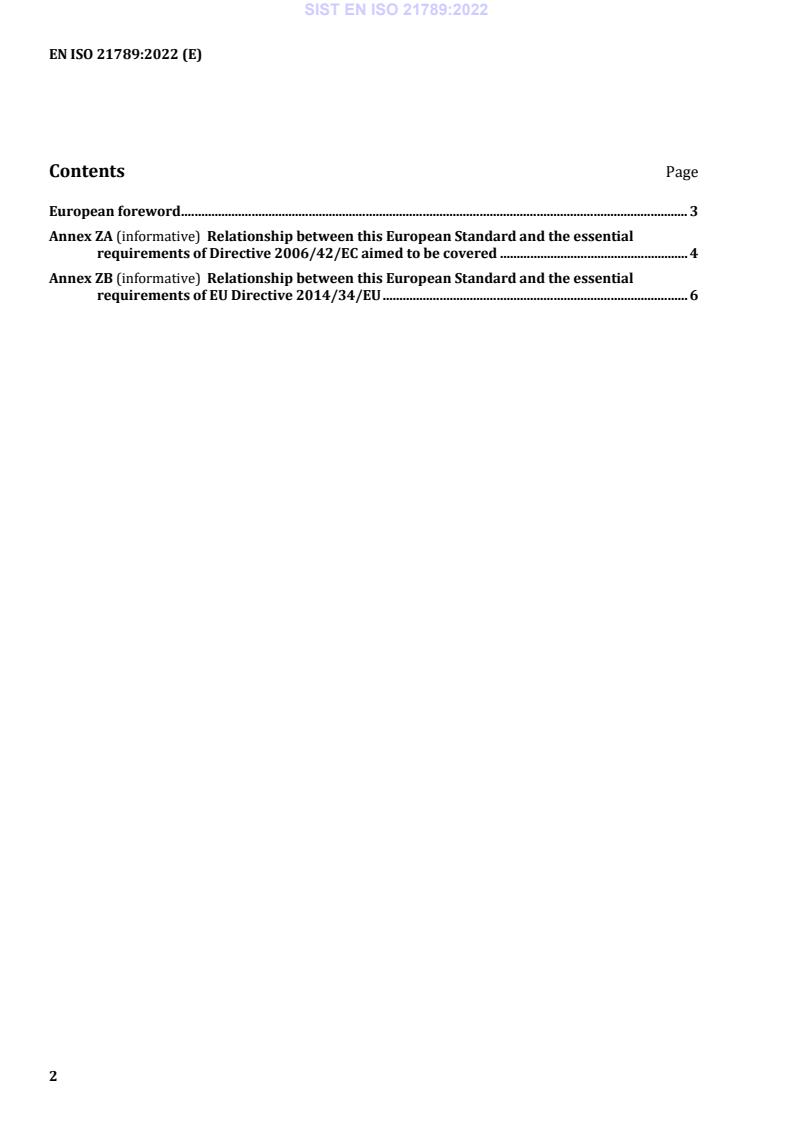
Contents Page
European foreword . 3
Annex ZA (informative) Relationship between this European Standard and the essential
requirements of Directive 2006/42/EC aimed to be covered . 4
Annex ZB (informative) Relationship between this European Standard and the essential
requirements of EU Directive 2014/34/EU . 6
European foreword
This document (EN ISO 21789:2022) has been prepared by Technical Committee ISO/TC 192 "Gas
turbines" in collaboration with Technical Committee CEN/TC 399 “Gas Turbines applications - Safety”
the secretariat of which is held by BSI.
This European Standard shall be given the status of a national standard, either by publication of an
identical text or by endorsement, at the latest by April 2023, and conflicting national standards shall be
withdrawn at the latest by April 2023.
Attention is drawn to the possibility that some of the elements of this document may be the subject of
patent rights. CEN shall not be held responsible for identifying any or all such patent rights.
This document has been prepared under a Standardization Request given to CEN by the European
Commission and the European Free Trade Association, and supports essential requirements of EU
Directive(s) / Regulation(s).
For the relationship with EU Directive(s) / Regulation(s), see informative Annex ZA and ZB, which is an
integral part of this document.
Any feedback and questions on this document should be directed to the users’ national standards
body/national committee. A complete listing of these bodies can be found on the CEN website.
According to the CEN-CENELEC Internal Regulations, the national standards organizations of the
following countries are bound to implement this European Standard: Austria, Belgium, Bulgaria,
Croatia, Cyprus, Czech Republic, Denmark, Estonia, Finland, France, Germany, Greece, Hungary, Iceland,
Ireland, Italy, Latvia, Lithuania, Luxembourg, Malta, Netherlands, Norway, Poland, Portugal, Republic of
North Macedonia, Romania, Serbia, Slovakia, Slovenia, Spain, Sweden, Switzerland, Türkiye and the
United Kingdom.
Endorsement notice
The text of ISO 21789:2022 has been approved by CEN as EN ISO 21789:2022 without any modification.
Annex ZA
(informative)
Relationship between this European Standard and the essential
requirements of Directive 2006/42/EC aimed to be covered
This European Standard has been prepared under a Commission’s standardization request “M/396
Mandate to CEN and CENELEC for Standardisation in the field of machinery" to provide one voluntary
means of conforming to essential requirements of Directive 2006/42/EC of the European Parliament
and of the Council of 17 May 2006 on machinery and amending Directive 95/16/EC (recast).
Once this standard is cited in the Official Journal of the European Union under that Directive,
compliance with the normative clauses of this standard given in Table ZA.1 confers, within the limits of
the scope of this standard, a presumption of conformity with the corresponding essential requirements
of that Directive, and associated EFTA regulations.
Table ZA.1 — Correspondence between this European Standard and Annex I
of Directive 2006/42/EC
The relevant Essential Clause(s)/sub-clause(s) of this EN Remarks/Notes
Requirements of Directive
2006/42/EC
1.1.2 5.1, 5.2, 5.5, 5.8, 7.5.2, 7.6.2, 7.7.1
1.1.3 5.23.8.4, 5.24.3, 7.7.8
1.1.4 5.14, 5.15.9, 7.6.4
1.1.5 5.8.5
1.1.6 5.20.3
1.2.2 5.20.2, 5.20.8, 7.6.4
1.2.4.1 5.20.8
1.2.4.3 5.20.8
1.2.4.4 5.20.8
1.2.6 5.20.4, 5.20.8, 5.21.9.2, 5.21.2, 7.7.3
1.3.1 5.8.5, 7.7.1
1.3.2 5.8.3, 5.8.9, 5.8.15.1, 5.23.10, 7.5
1.3.3 5.8, 5.20.7, 7.7
1.3.7 5.8.1, 7.7.2
1.4.1 5.8.1.1, 5.8.2
1.4.2.1 5.8.1
1.4.3 Not covered
1.5.1 5.20, 5.21
1.5.2 5.21.3, 7.4
1.5.3 5.10, 5.21.2, 5.23.8.5, 5.24.3, 5.24.4, 7.7.3
1.5.4 5.8.12, 5.23.8, 7.7.2
1.5.5 5.8.1.2, 5.8.3, 5.8.9, 5.9.3, 5.13.5, 5.16.3
1.5.6 5.15
1.5.7 5.16
1.5.8 5.7
1.5.10 5.20.2
1.5.11 5.15.10, 5.21.6
1.5.13 5.10.5.8, 5.10.6, 5.10.9, 7.7.8
1.5.14 5.13.8, 5.13.9, 5.18.1, 7.6.2, 7.6.4, 7.7.1,
7.8
1.5.15 5.8.2
1.5.16 5.21.5
1.6.2 5.8.2, 7.7
1.6.3 5.21.2.1, 7.7.3
1.6.4 5.2, 5.21, 5.23
1.7.1 7.2, 7.8
1.7.1.1 5.20.3, 7.2
1.7.1.2 5.15.8, 5.20.3, 5.20.8, 7.5.1, 7.7.1, 7.8
1.7.2 5.2, 7.3, 7.8
1.7.3 6.2, 7.8
1.7.4 7.2
1.7.4.1 7
1.7.4.2 7
1.7.4.3 7.1
WARNING 1 — Presumption of conformity stays valid only as long as a reference to this European
Standard is maintained in the list published in the Official Journal of the European Union. Users of this
standard should consult frequently the latest list published in the Official Journal of the European
Union.
WARNING 2 — Other Union legislation may be applicable to the product(s) falling within the scope of
this standard.
Annex ZB
(informative)
Relationship between this European Standard and the essential
requirements of EU Directive 2014/34/EU
This European Standard has been prepared under a mandate given to CEN by the European
Commission and the European Free Trade Association to provide a means of conforming to Essential
Requirements of the New Approach Directive 2014/34/EU.
Once this standard is cited in the Official Journal of the European Union under that Directive and has
been implemented as a national standard in at least one Member State, compliance with the clauses of
this standard given in Table ZB.1 confers, within the limits of the scope of this standard, a presumption
of conformity with the corresponding Essential Requirements of that Directive and associated EFTA
regulations.
Table ZB.1 — Correspondence between this European Standard and Directive 2014/34/EU
Clause(s)/sub-clause(s) of this EN Essential Requirements Qualifying remarks/Notes
of Directive
5.1 A
5.16, 5.16.4, 5.17 1.0.1
5.1, 5.4, 7.5.2 1.0.2
5.1, 5.20.2 1.0.4
5.9.5, 5.16.1 1.0.5
5.4, 5.9.7, 5.16, 7.1, 7.4, 7.5, 7.5.2, 7.7, 1.0.6
7.7.1, 7.7.4, 7.11
5.16.4 1.1.1
5.18.3 1.1.2
5.8.9 1.1.3
5.5 1.2.1
5.3 1.2.2
5.8.3, 5.10.6.6, 5.10.9, 5.22, 5.23.8.4 1.2.3
5.17.7 1.2.4
5.20.2 1.2.5
7.7.1 1.2.6
5.8.1.2, 5.8.6, 5.16.4.3, 5.21.8 1.2.7
5.20.7 1.2.8
5.16.5.3.3 1.2.9
5.16.5.3.2 1.3.1
5.21.3 1.3.2
5.21.3.3 1.3.3
5.18.3 1.3.4
5.1, 5.20.2 1.4.1
5.20.2 1.4.2
5.20.4, 5.20.8, 5.23.9.1 1.5.1
5.8.18, 5.20.4 1.5.2
5.20.8 1.5.3
5.20.3 1.5.4
5.1 1.5.5
5.20.5 1.5.6
5.19.3 1.5.7
5.20.4 1.5.8
5.20.8 1.6.1
5.20.8 1.6.2
5.21.9 1.6.3
5.19 1.6.5
5.16.4, 5.16.5, 5.17 2.2.1.1
5.13.4, 5.20.2 2.2.1.2
5.8.2, 5.8.18 2.2.1.3
5.16.4, 5.16.5, 5.17 2.3.1.1
5.13.4, 5.20.2 2.3.1.2
WARNING 1 — Presumption of conformity stays valid only as long as a reference to this European
Standard is maintained in the list published in the Official Journal of the European Union. Users of this
standard should consult frequently the latest list published in the Official Journal of the European
Union.
WARNING 2 — Other Union legislation may be applicable to the product(s) falling within the scope of
this standard.
INTERNATIONAL ISO
STANDARD 21789
Second edition
2022-07
Gas turbine applications — Safety
Applications des turbines à gaz — Sécurité
Reference number
ISO 21789:2022(E)
ISO 21789:2022(E)
© ISO 2022
All rights reserved. Unless otherwise specified, or required in the context of its implementation, no part of this publication may
be reproduced or utilized otherwise in any form or by any means, electronic or mechanical, including photocopying, or posting on
the internet or an intranet, without prior written permission. Permission can be requested from either ISO at the address below
or ISO’s member body in the country of the requester.
ISO copyright office
CP 401 • Ch. de Blandonnet 8
CH-1214 Vernier, Geneva
Phone: +41 22 749 01 11
Email: copyright@iso.org
Website: www.iso.org
Published in Switzerland
ii
ISO 21789:2022(E)
Contents Page
Foreword .vii
Introduction .viii
1 Scope . 1
2 Normative references . 2
3 Terms and definitions . 4
4 List of significant hazards . 6
5 Safety requirements. 6
5.1 General . 6
5.2 Risk assessment . 6
5.2.1 Risk assessments requirements . 7
5.2.2 As low as reasonably practical . . 8
5.3 Modifications and replacement parts . 8
5.4 Foreseeable misuse . 8
5.5 Lifetime . 8
5.6 Hazard combinations . 8
5.7 Noise reduction at design stage . 8
5.8 Mechanical . 9
5.8.1 Guarding . 9
5.8.2 Accessibility for maintenance. 9
5.8.3 Casing design . 10
5.8.4 Gas turbine compressor surge . 10
5.8.5 Stability and handling . . 10
5.8.6 Overload of couplings, rotating shafts and gears due to torque . 11
5.8.7 Vibration . 11
5.8.8 Mechanical failure caused by corrosion . 11
5.8.9 Design methods and materials . 11
5.8.10 Gas turbine temperatures .12
5.8.11 Environmental loads . .12
5.8.12 Assembly features .12
5.8.13 Couplings . 12
5.8.14 Rotor bearings .12
5.8.15 Rotating part failure .12
5.8.16 Foreign object damage (FOD) screen . 13
5.8.17 Gearbox . 13
5.8.18 Starting systems . 13
5.8.19 Low ambient temperature conditions . 14
5.9 Gas turbine compressor air inlet system . 14
5.9.1 General . 14
5.9.2 Inlet air contamination . 14
5.9.3 Icing monitoring and prevention . 14
5.9.4 Implosion protection .15
5.9.5 Inlet explosion protection . 15
5.9.6 Waste disposal through combustion . 16
5.9.7 Recirculation . . 16
5.9.8 Gas turbine compressor air inlet ducting . 16
5.10 Fuel systems . 17
5.10.1 General . 17
5.10.2 Fuel supply quality and supply conditions . 17
5.10.3 Pressure (leakage) testing. 17
5.10.4 Fuel supply heating . 17
5.10.5 Gas fuel systems . . 17
5.10.6 Liquid fuel systems . 21
iii
ISO 21789:2022(E)
5.10.7 Multi-fuel systems .25
5.10.8 Fuel purging . 25
5.10.9 Fuel drainage . 26
5.11 Combustion supervision .26
5.11.1 General . 26
5.11.2 Requirements for ignition . 26
5.11.3 Extinction safety time . 27
5.12 Exhaust system . 27
5.12.1 Damper controls . 27
5.12.2 Flexible joint location . 27
5.12.3 Exhaust outlet . 27
5.12.4 Explosion protection. 27
5.13 Enclosures.28
5.13.1 General .28
5.13.2 Enclosure structure .29
5.13.3 Enclosure fire precautions .29
5.13.4 Explosion prevention and protection — Area classification — Ventilation .29
5.13.5 Gas detection .29
5.13.6 Enclosure purging .30
5.13.7 Flammable mist .30
5.13.8 Access and doors . 30
5.13.9 Entrapment. 31
5.14 Lighting . 31
5.15 Fire precautions . 31
5.15.1 General . 31
5.15.2 Structural fire risk reduction . 31
5.15.3 Flammable fluids mitigation and containment . 31
5.15.4 Fire protection . 32
5.15.5 Fire detection . 32
5.15.6 Fire extinguishing systems . 33
5.15.7 Water mist extinguishant .34
5.15.8 Extinguishing system controls .34
5.15.9 Escape .36
5.15.10 Uncontrolled release of media and loss of propellant pressure .36
5.15.11 Vessel thermal relief (burst disc) .36
5.15.12 Propellant vessels . 36
5.15.13 Release of extinguishant into gas turbine halls, control rooms, etc. .36
5.16 Hazardous area classification and explosion prevention and protection . 37
5.16.1 General . 37
5.16.2 Area classification . 37
5.16.3 Explosion prevention . . 37
5.16.4 Avoidance or reduction of effective ignition sources .38
5.16.5 Reduction of explosion effects in an enclosed space .39
5.17 Ventilation . 41
5.17.1 General . 41
5.17.2 Cooling . 41
5.17.3 Heating . 41
5.17.4 Hazardous area control . 41
5.17.5 Hot surfaces . 41
5.17.6 Ventilation inlet location . 42
5.17.7 Ventilation inlet filtration . 42
5.17.8 Ventilation inlet ducting . 42
5.17.9 Ventilation outlet location. 42
5.17.10 Ventilation monitoring . 42
5.18 Fans . 43
5.18.1 Fan guards and structural failure. 43
5.18.2 Air blast oil coolers . . 43
5.18.3 Sparking of fan blades . 43
iv
ISO 21789:2022(E)
5.19 Flammable gas detection . 43
5.19.1 Type / selection principles . 43
5.19.2 Location principles . 43
5.19.3 Settings .44
5.19.4 Enclosures containing hot surfaces — Screening tool .44
5.19.5 Maintenance and calibration .44
5.20 Control and automatic protection systems .44
5.20.1 General .44
5.20.2 Environmental suitability . 45
5.20.3 Ergonomics . 45
5.20.4 Failure . 45
5.20.5 Calibration . . . 45
5.20.6 Testing . 45
5.20.7 Speed control .46
5.20.8 Gas turbine emergency shutdown system .46
5.20.9 Interlocks . 47
5.20.10 Cyber security . 47
5.21 Electrical . 47
5.21.1 Design/Installation . 47
5.21.2 Isolation and stored energy . 47
5.21.3 Electrostatic energy and bonding .48
5.21.4 Water ingress .48
5.21.5 Lightning .49
5.21.6 Electromagnetic compatibility (EMC) .49
5.21.7 Battery installations .49
5.21.8 Electrical overload .49
5.21.9 Electrical power failure .49
5.22 Drains, vents and bleeds . 50
5.22.1 General .50
5.22.2 Vents for flammable gases .50
5.22.3 Toxic and hazardous emissions .50
5.22.4 Gas turbine compressor bleeds . 51
5.23 Pressure equipment . 51
5.23.1 General . 51
5.23.2 Design . 51
5.23.3 Hazards . 51
5.23.4 Misuse . 51
5.23.5 Handling and operation . 51
5.23.6 Isolation, draining and venting . 52
5.23.7 Fluid injection . 52
5.23.8 Assemblies . 52
5.23.9 Safety accessories . .54
5.23.10 Flexible piping (and metal hoses) .54
5.23.11 External fire .55
5.23.12 Material embrittlement and corrosion . 55
5.23.13 Ultra-violet (UV) resistant pipework. 55
5.24 Auxiliary systems . 55
5.24.1 Lubrication systems . 55
5.24.2 Water systems .56
5.24.3 Hydraulic and pneumatic systems .56
5.24.4 Utility air supplies .56
5.25 Installation in a hazardous area .56
5.26 Unenclosed gas turbines in a hall. 57
5.27 Decommissioning and disposal .58
6 Compliance verification .58
6.1 Quality assurance .58
6.2 Verification of safety requirements .58
v
ISO 21789:2022(E)
7 Information for use .58
7.1 General .58
7.2 Language . 59
7.3 Packaging . 59
7.4 Commissioning . 59
7.5 Operation .60
7.5.1 General .60
7.5.2 Safety instructions and emergency procedures .60
7.6 Enclosure access . 61
7.6.1 General . 61
7.6.2 Risk assessment for accessing enclosures . 62
7.6.3 Limitations under operational conditions. 62
7.6.4 Limitations under non-operational conditions . 62
7.
...