


prEN 1564
(Main)Founding - Ausferritic spheroidal graphite cast irons
Founding - Ausferritic spheroidal graphite cast irons
This document defines the grades and the corresponding requirements for ausferritic spheroidal graphite cast irons.
This document specifies five grades of ausferritic spheroidal graphite cast iron by a classification based on mechanical properties measured on machined test pieces prepared from cast samples. One grade also has additional but optional requirements for room temperature and notched-impact.
This document also specifies two grades by a classification as a function of hardness.
This document does not cover technical delivery conditions for iron castings.
NOTE For further details, see EN 1559-1:2011 and EN 1559-3:2011.
Gießereiwesen - Ausferritisches Gusseisen mit Kugelgraphit
Dieses Dokument definiert die Sorten und die entsprechenden Eigenschaften von ausferritischem Gusseisen mit Kugelgraphit.
Dieses Dokument legt mittels einer auf mechanischen Eigenschaften basierenden Einteilung fünf Sorten von ausferritischem Gusseisen mit Kugelgraphit fest, wobei diese Eigenschaften an Proben bestimmt werden, die durch mechanische Bearbeitung aus Probestücken gewonnen wurden. Für eine Sorte bestehen darüber hinaus zusätzliche, aber optionale Anforderungen an die Raumtemperatur und den Kerbschlag.
Dieses Dokument legt außerdem zwei Sorten mittels einer Einteilung nach der Härte fest.
Dieses Dokument enthält nicht die technischen Lieferbedingungen für Gussstücke aus Gusseisen.
ANMERKUNG Zu weiteren Einzelheiten siehe EN 1559-1:2011 und EN 1559-3:2011.
Fonderie - Fontes ausferritiques à graphite sphéroïdal
Le présent document définit les nuances de fonte ausferritique à graphite sphéroïdal et les exigences correspondantes.
Le présent document spécifie cinq nuances de fonte ausferritique à graphite sphéroïdal, en établissant un classement basé sur leurs caractéristiques mécaniques, mesurées sur des éprouvettes usinées à partir d’échantillons coulés. Une nuance a également des exigences supplémentaires, mais facultatives, en matière de température ambiante et de choc sur des éprouvettes à entaille.
Le présent document spécifie également deux nuances par un classement selon la dureté.
Le présent document ne couvre pas les conditions techniques de livraison de pièces en fonte.
NOTE Pour plus de détails, voir l’EN 1559-1:2011 et l’EN 1559-3:2011.
Livarstvo - Bainitno poboljšana duktilna litina
General Information
- Status
- Not Published
- Publication Date
- 28-Oct-2026
- Technical Committee
- CEN/TC 190 - Foundry technology
- Current Stage
- 4599 - Dispatch of FV draft to CMC - Finalization for Vote
- Start Date
- 15-May-2026
- Due Date
- 15-Mar-2026
- Completion Date
- 15-May-2026

Relations
- Effective Date
- 02-Feb-2023
Overview
prEN 1564 (Founding - Ausferritic spheroidal graphite cast irons) is a CEN draft that defines grades and requirements for ausferritic spheroidal graphite cast irons (also known as austempered ductile iron, ADI). The document classifies material grades primarily by mechanical properties measured on machined test pieces from cast samples, and additionally by hardness for abrasion‑resistant grades. prEN 1564:2025 will supersede EN 1564:2011 when adopted.
Key topics and requirements
- Grade classification
- Five grades defined by mechanical properties (tensile strength, elongation, etc.) measured on machined test pieces from cast samples.
- One of these grades includes optional additional requirements for room‑temperature and notched‑impact testing.
- Two additional grades (Annex A) are specified by hardness for high‑abrasion applications.
- Testing and acceptance
- Test methods cover tensile tests, impact tests (Charpy), Brinell hardness, and microstructure examinations (graphite and matrix).
- Sampling procedures are defined for cast samples and samples cut from castings, including frequency, size, and sectioning (see Annex G).
- Requirements for retests, non‑conforming results and inspection documentation are included.
- Microstructure control
- Emphasis on graphite spheroidization and ausferritic matrix to achieve the targeted strength and toughness.
- References to graphite classification (EN ISO 945‑1) and matrix examination procedures.
- Scope limits
- prEN 1564 does not cover technical delivery conditions for finished iron castings; purchasers should refer to EN 1559‑1 and EN 1559‑3 for delivery requirements.
- Informative annexes
- Guidance on abrasion‑resistant grades, hardness ranges, machinability, fracture mechanics, and significant changes from the previous edition.
Applications and users
- Who uses this standard:
- Foundries producing ausferritic spheroidal graphite cast iron (ADI)
- Materials and quality engineers specifying or testing ADI components
- Design and procurement professionals in automotive, mining, earth‑moving, and pressure‑equipment sectors
- Testing laboratories performing tensile, impact and hardness assessments
- Typical applications:
- Structural and wear components requiring a combination of high strength, toughness and abrasion resistance (e.g., gears, shafts, wear liners, mining buckets).
- Some ADI grades are suitable for pressure equipment applications within specific limits (see references to EN‑GJS grades).
Related standards
- EN 1559‑1, EN 1559‑3 (technical delivery conditions for castings)
- EN 1563 (spheroidal graphite cast irons)
- EN ISO 148‑1 (Charpy impact), EN ISO 6506‑1 (Brinell hardness), EN ISO 945‑1 (graphite classification)
- EN 764‑5 (inspection documentation for pressure equipment)
Keywords: prEN 1564, ausferritic spheroidal graphite cast irons, austempered ductile iron, ADI, castings, mechanical properties, hardness, Brinell, tensile test, impact test, CEN.
Get Certified
Connect with accredited certification bodies for this standard

Element Materials Technology
Materials testing and product certification.

Inštitut za kovinske materiale in tehnologije
Institute of Metals and Technology. Materials testing, metallurgical analysis, NDT.
Sponsored listings
Frequently Asked Questions
prEN 1564 is a draft published by the European Committee for Standardization (CEN). Its full title is "Founding - Ausferritic spheroidal graphite cast irons". This standard covers: This document defines the grades and the corresponding requirements for ausferritic spheroidal graphite cast irons. This document specifies five grades of ausferritic spheroidal graphite cast iron by a classification based on mechanical properties measured on machined test pieces prepared from cast samples. One grade also has additional but optional requirements for room temperature and notched-impact. This document also specifies two grades by a classification as a function of hardness. This document does not cover technical delivery conditions for iron castings. NOTE For further details, see EN 1559-1:2011 and EN 1559-3:2011.
This document defines the grades and the corresponding requirements for ausferritic spheroidal graphite cast irons. This document specifies five grades of ausferritic spheroidal graphite cast iron by a classification based on mechanical properties measured on machined test pieces prepared from cast samples. One grade also has additional but optional requirements for room temperature and notched-impact. This document also specifies two grades by a classification as a function of hardness. This document does not cover technical delivery conditions for iron castings. NOTE For further details, see EN 1559-1:2011 and EN 1559-3:2011.
prEN 1564 is classified under the following ICS (International Classification for Standards) categories: 77.080.10 - Irons. The ICS classification helps identify the subject area and facilitates finding related standards.
prEN 1564 has the following relationships with other standards: It is inter standard links to EN 1564:2011. Understanding these relationships helps ensure you are using the most current and applicable version of the standard.
prEN 1564 is associated with the following European legislation: EU Directives/Regulations: 2014/68/EU; Standardization Mandates: M/071, M/601. When a standard is cited in the Official Journal of the European Union, products manufactured in conformity with it benefit from a presumption of conformity with the essential requirements of the corresponding EU directive or regulation.
prEN 1564 is available in PDF format for immediate download after purchase. The document can be added to your cart and obtained through the secure checkout process. Digital delivery ensures instant access to the complete standard document.
Standards Content (Sample)
SLOVENSKI STANDARD
01-september-2025
Livarstvo - Bainitno poboljšana duktilna litina
Founding - Ausferritic spheroidal graphite cast irons
Gießereiwesen - Ausferritisches Gusseisen mit Kugelgraphit
Fonderie - Fontes ausferritiques à graphite sphéroïdal
Ta slovenski standard je istoveten z: prEN 1564
ICS:
77.080.10 Železo Irons
2003-01.Slovenski inštitut za standardizacijo. Razmnoževanje celote ali delov tega standarda ni dovoljeno.
DRAFT
EUROPEAN STANDARD
NORME EUROPÉENNE
EUROPÄISCHE NORM
July 2025
ICS 77.080.10 Will supersede EN 1564:2011
English Version
Founding - Ausferritic spheroidal graphite cast irons
Fonderie - Fontes ausferritiques à graphite sphéroïdal Gießereiwesen - Ausferritisches Gusseisen mit
Kugelgraphit
This draft European Standard is submitted to CEN members for enquiry. It has been drawn up by the Technical Committee
CEN/TC 190.
If this draft becomes a European Standard, CEN members are bound to comply with the CEN/CENELEC Internal Regulations
which stipulate the conditions for giving this European Standard the status of a national standard without any alteration.
This draft European Standard was established by CEN in three official versions (English, French, German). A version in any other
language made by translation under the responsibility of a CEN member into its own language and notified to the CEN-CENELEC
Management Centre has the same status as the official versions.
CEN members are the national standards bodies of Austria, Belgium, Bulgaria, Croatia, Cyprus, Czech Republic, Denmark, Estonia,
Finland, France, Germany, Greece, Hungary, Iceland, Ireland, Italy, Latvia, Lithuania, Luxembourg, Malta, Netherlands, Norway,
Poland, Portugal, Republic of North Macedonia, Romania, Serbia, Slovakia, Slovenia, Spain, Sweden, Switzerland, Türkiye and
United Kingdom.
Recipients of this draft are invited to submit, with their comments, notification of any relevant patent rights of which they are
aware and to provide supporting documentation.
Warning : This document is not a European Standard. It is distributed for review and comments. It is subject to change without
notice and shall not be referred to as a European Standard.
EUROPEAN COMMITTEE FOR STANDARDIZATION
COMITÉ EUROPÉEN DE NORMALISATION
EUROPÄISCHES KOMITEE FÜR NORMUNG
CEN-CENELEC Management Centre: Rue de la Science 23, B-1040 Brussels
© 2025 CEN All rights of exploitation in any form and by any means reserved Ref. No. prEN 1564:2025 E
worldwide for CEN national Members.
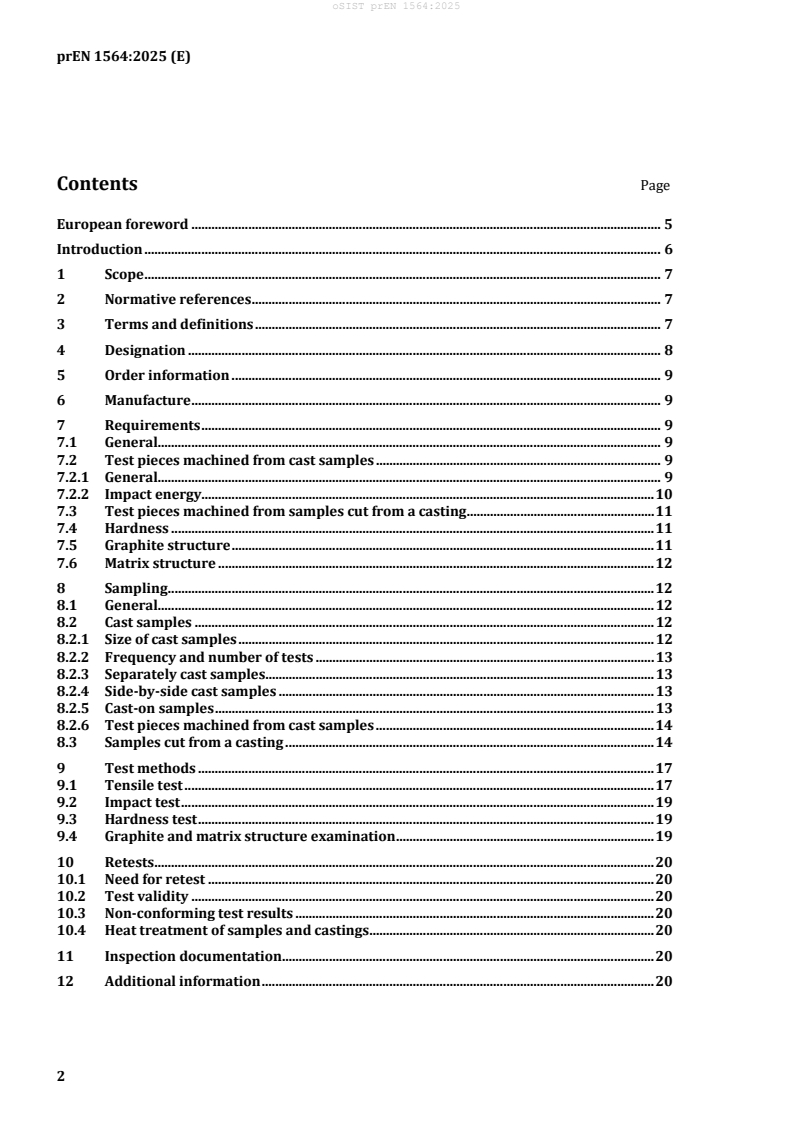
Contents Page
European foreword . 5
Introduction . 6
1 Scope . 7
2 Normative references . 7
3 Terms and definitions . 7
4 Designation . 8
5 Order information . 9
6 Manufacture . 9
7 Requirements . 9
7.1 General. 9
7.2 Test pieces machined from cast samples . 9
7.2.1 General. 9
7.2.2 Impact energy. 10
7.3 Test pieces machined from samples cut from a casting . 11
7.4 Hardness . 11
7.5 Graphite structure . 11
7.6 Matrix structure . 12
8 Sampling . 12
8.1 General. 12
8.2 Cast samples . 12
8.2.1 Size of cast samples . 12
8.2.2 Frequency and number of tests . 13
8.2.3 Separately cast samples. 13
8.2.4 Side-by-side cast samples . 13
8.2.5 Cast-on samples . 13
8.2.6 Test pieces machined from cast samples . 14
8.3 Samples cut from a casting . 14
9 Test methods . 17
9.1 Tensile test . 17
9.2 Impact test . 19
9.3 Hardness test . 19
9.4 Graphite and matrix structure examination . 19
10 Retests . 20
10.1 Need for retest . 20
10.2 Test validity . 20
10.3 Non-conforming test results . 20
10.4 Heat treatment of samples and castings . 20
11 Inspection documentation. 20
12 Additional information . 20
Annex A (normative) Abrasion resistant grades of ausferritic spheroidal graphite cast irons
................................................................................................................................................................... 21
A.1 General . 21
A.2 Requirements . 21
A.3 Sampling . 21
A.4 Hardness test . 21
A.5 Retests . 22
Annex B (informative) Comparison of ausferritic spheroidal graphite cast iron material
designations according to EN 1560 and ISO/TR 15931 [2] [7] . 23
Annex C (informative) Values for tensile strength and elongation for test pieces machined
from samples cut from a casting . 24
Annex D (informative) Values for Brinell hardness . 25
Annex E (informative) Determination of the hardness range . 26
E.1 General . 26
E.2 Procedure . 26
Annex F (informative) Nodularity . 28
Annex G (normative) Sectioning procedure for cast samples . 29
Annex H (informative) Un-notched impact test . 30
H.1 General . 30
H.2 Requirements . 30
H.3 Sampling . 30
H.4 Test method . 30
H.5 Retests . 31
Annex I (informative) Additional information on mechanical and physical properties . 32
Annex J (informative) Fracture mechanical approach to spheroidal graphite cast irons . 35
J.1 General . 35
J.2 Fracture mechanics concept . 35
J.3 Determination of fracture mechanical properties . 35
J.4 Influences on fracture mechanical properties . 36
J.5 Publications . 36
J.6 Literature. 37
Annex K (informative) Machinability of ausferritic spheroidal graphite cast irons . 40
K.1 Introduction . 40
K.2 Chip form . 40
K.3 Surface quality . 40
K.4 Cutting forces . 40
K.5 Tool wear and tool life . 41
K.6 Other considerations . 41
Annex L (informative) Significant technical changes between this document and the previous
edition . 42
Annex ZA (informative) Relationship between this European Standard and the Essential
Requirements of EU Directive 2014/68/EU aimed to be covered . 43
Bibliography . 44
European foreword
This document (prEN 1564:2025) has been prepared by Technical Committee CEN/TC 190 “Foundry
technology”, the secretariat of which is held by DIN.
This document is currently submitted to the CEN Enquiry.
This document will supersede EN 1564:2011.
This document has been prepared under a standardization request addressed to CEN by the European
Commission. The Standing Committee of the EFTA States subsequently approves these requests for its
Member States.
For the relationship with EU Legislation, see informative Annex ZA, which is an integral part of this
document.
Annex L provides details of significant technical changes between this document and the previous
edition.
Introduction
Ausferritic spheroidal graphite cast iron is a cast alloy, iron, carbon and silicon based, the carbon being
present mainly in the form of spheroidal graphite particles.
NOTE 1 Ausferritic spheroidal graphite cast iron is also known as austempered ductile iron (ADI).
Compared with the spheroidal graphite cast irons as specified in EN 1563 [1], this material combines
higher strength and toughness properties as a result of the ausferritic matrix structure.
This document classifies ausferritic spheroidal graphite cast irons in accordance with the mechanical
properties of the material.
The mechanical properties of these ausferritic spheroidal graphite cast irons depend on the graphite and
the matrix structure.
The required structure is obtained by selecting the appropriate composition and subsequent processing.
The mechanical properties of the material can be evaluated on machined test pieces prepared from cast
samples or samples cut from a casting.
Five grades of ausferritic spheroidal graphite cast iron are defined by the mechanical properties
measured on machined test pieces prepared from cast samples. When, for these grades, hardness is a
requirement of the purchaser as being important for the application, Annex C provides guidance values
for hardness.
Two grades of ausferritic spheroidal graphite cast iron are defined in Annex A in accordance with their
hardness. These cast irons are used in applications (e.g. mining, earth moving) where high abrasion
resistance is required.
NOTE 2 This designation system by number is based on the principles and the structure as set out in EN 10027-
2:2015 [4] and so corresponds with the European numbering system for steel and other materials.
Some ausferritic spheroidal graphite cast iron grades can be used for pressure equipment up to and
including EN-GJS-1050-6.
The permitted material grades of ausferritic spheroidal graphite cast iron for pressure applications and
the conditions for their use are given in specific product or application standards.
For the design of pressure equipment, specific design rules apply.
1 Scope
This document defines the grades and the corresponding requirements for ausferritic spheroidal
graphite cast irons.
This document specifies five grades of ausferritic spheroidal graphite cast iron by a classification based
on mechanical properties measured on machined test pieces prepared from cast samples. One grade also
has additional but optional requirements for room temperature and notched-impact.
This document also specifies two grades by a classification as a function of hardness.
This document does not cover technical delivery conditions for iron castings.
NOTE For further details, see EN 1559-1:2011 and EN 1559-3:2011.
2 Normative references
The following documents are referred to in the text in such a way that some or all of their content
constitutes requirements of this document. For dated references, only the edition cited applies. For
undated references, the latest edition of the referenced document (including any amendments) applies.
EN 764-5:2014, Pressure equipment — Part 5: Inspection documentation of metallic materials and
compliance with the material specification
EN 1559-1:2011, Founding — Technical conditions of delivery — Part 1: General
EN 1559-3:2011, Founding — Technical conditions of delivery — Part 3: Additional requirements for iron
castings
EN 10204:2004, Metallic products — Types of inspection documents
EN ISO 148-1:2016, Metallic materials — Charpy pendulum impact test — Part 1: Test method
(ISO 148-1:2016)
EN ISO 945-1:2019, Microstructure of cast irons — Part 1: Graphite classification by visual analysis
(ISO 945-1:2019)
EN ISO 6506-1:2014, Metallic materials — Brinell hardness test — Part 1: Test method (ISO 6506-1:2014)
EN ISO 6892-1:2019, Metallic materials — Tensile testing — Part 1: Method of test at room temperature
(ISO 6892-1:2019)
3 Terms and definitions
For the purposes of this document, the following terms and definitions apply.
ISO and IEC maintain terminology databases for use in standardization at the following addresses:
— ISO Online browsing platform: available at https://www.iso.org/obp/
— IEC Electropedia: available at https://www.electropedia.org/
3.1
ausferritic spheroidal graphite cast iron
cast material, iron, carbon and silicon based with the carbon being present mainly in the form of
spheroidal graphite particles, with an ausferritic matrix structure
3.2
graphite spheroidizing treatment
operation that brings the liquid iron into contact with a substance to produce graphite in the
predominantly spheroidal (nodular) form during solidification
Note 1 to entry: This operation is often followed by a second one called inoculation.
3.3
austemper heat treatment of spheroidal graphite cast iron
process, consisting of heating the castings above the A temperature and holding a sufficient time to
C1
increase the carbon content of the austenite, followed by cooling at a rate sufficient to avoid the formation
of pearlite and transforming the matrix structure for a time and a temperature (above the martensite
start temperature) sufficient to produce the desired properties
Note 1 to entry: This process produces a microstructure that consists predominantly of ferrite and austenite. This
microstructure is called ausferrite.
3.4
cast sample
quantity of material cast to represent the cast material, including separately cast sample, side by side cast
sample and cast-on sample
3.5
separately cast sample
sample cast in a separate sand mould under representative manufacturing conditions and material grade
3.6
side-by-side cast sample
sample cast in the mould alongside the casting, with a joint running system
3.7
cast-on sample
sample attached directly to the casting
3.8
relevant wall thickness
wall thickness representative of the casting, defined for the determination of the size of the cast samples
to which the mechanical properties apply
4 Designation
The material shall be designated either by symbol or by number as given in Tables 1, 2 or Table A.1.
In the case of samples cut from the casting the letter C is added at the end of the designation by symbol,
as given in EN 1560:2011 [2].
NOTE The comparison of this document grade designations with the grades from the ISO standard for
ausferritic spheroidal graphite cast irons, ISO 17804:2020 [6], is given in Annex B.
5 Order information
The following information shall be specified in the order:
a) the reference of this document;
b) the designation of the material;
c) the relevant wall thickness of the casting;
d) any special requirements, such as dimensions of test pieces, casting defects, types of test samples.
All requirements shall be agreed at the time of acceptance of the order, such as technical delivery
conditions according to EN 1559-1:2011 and EN 1559-3:2011.
6 Manufacture
Unless otherwise agreed at the time of order, the method of manufacture of ausferritic spheroidal
graphite cast irons and heat treatment shall ensure that the requirements of this document are met.
7 Requirements
7.1 General
The property values apply to ausferritic spheroidal graphite cast irons cast in sand moulds or moulds of
comparable thermal behaviour. Subject to amendments to be agreed upon in the order, they shall apply
to castings obtained by alternative methods.
The material designation shall be based on the minimum mechanical properties obtained in cast samples
with a thickness or diameter of 25 mm. The designation shall be irrespective of the type of cast sample.
Mechanical properties shall be wall thickness dependant as shown in Table 1.
NOTE Tensile testing requires sound test pieces in order to guarantee pure uni-axial stress during the test.
7.2 Test pieces machined from cast samples
7.2.1 General
The mechanical properties of ausferritic spheroidal graphite cast iron test pieces shall be as specified in
Table 1. For the additional but optional unnotched impact requirement, refer to Table 2.
Table 1 — Mechanical properties measured on test pieces machined from cast samples
Relevant wall 0,2 % proof Tensile
Elongation
a
thickness strength strength
A
Material designation
t R R
p0,2 m
MPa MPa %
mm
Symbol Number min. min. min.
t ≤ 30 800 10
EN-GJS-800-10 5.3400
30 < t ≤ 60 500 750 6
b
EN-GJS-800-10-RT 5.3401
60 < t ≤ 100 720 5
t ≤ 30 900 8
EN-GJS-900-8 5.3402 30 < t ≤ 60 600 850 5
60 < t ≤ 100 820 4
t ≤ 30 1 050 6
EN-GJS-1050-6 5.3403 30 < t ≤ 60 700 1 000 4
60 < t ≤ 100 970 3
t ≤ 30 1 200 3
EN-GJS-1200-3 5.3404 30 < t ≤ 60 850 1 170 2
60 < t ≤ 100 1 140 1
t ≤ 30 1 400 1
EN-GJS-1400-1 5.3405 30 < t ≤ 60 1 100
To be specified in the order.
60 < t ≤ 100
NOTE 1 The relevant wall thickness does not affect the minimum 0,2 % proof strength provided the heat
treatment parameters and alloying are adjusted as a function of the relevant wall thickness.
NOTE 2 Guidance values for Brinell hardness for these grades are given in Annex D.
a
For relevant wall thicknesses more than 100 mm, the type and size of the cast sample and the minimum values to be
obtained shall be specified.
b
RT corresponds to Room temperature
7.2.2 Impact energy
The impact energy values given in Table 2 at room temperature shall be applicable to EN-GJS-800-10-RT
only.
Table 2 — Minimum impact energy values measured on V-notched test pieces machined from
cast samples
Impact energy value at room
Relevant wall
Material designation temperature
a
thickness
23 °C ± 5 °C
Mean value of 3
Individual value
tests
t
Symbol Number J
J
mm
min.
min.
t ≤ 30 10 9
EN-GJS-800-10-RT 5.3401 30 < t ≤ 60 9 8
60 < t ≤ 100 8 7
a
For relevant wall thicknesses more than 100 mm, the type and size of the cast sample and the minimum values to be
obtained shall be specified.
NOTE The use of impact energy is currently being reassessed regarding its limited relevance as an assessment
of the resistance to brittle fracture in castings subject to application loads. Annex J gives information about the
fracture mechanical approach to spheroidal graphite cast irons.
7.3 Test pieces machined from samples cut from a casting
Information regarding test pieces machined from samples cut from a casting shall comprise:
— the location(s) on a casting where the sample(s) shall be taken;
— the mechanical properties that shall be measured;
— the minimum values, or allowable range of values, for these mechanical properties (for information,
see Annex C).
NOTE 1 The properties of castings are not uniform, depending on the complexity of the castings and variation in
their section thickness.
NOTE 2 Mechanical properties for test pieces cut from a casting are affected not only by material properties
(subject of this document) but also by the local casting soundness (not subject of this document).
7.4 Hardness
Brinell hardness and its range values for the grades listed in Table 1 shall only be specified by the time of
acceptance of the order.
For the five grades listed in Table 1, information regarding hardness is given in accordance with Annex D
and Annex E.
For the two grades defined by hardness properties, Annex A shall apply.
7.5 Graphite structure
The graphite structure shall be mainly of form V and VI in accordance with EN ISO 945-1:2019.
NOTE Annex F gives more information regarding nodularity.
7.6 Matrix structure
The matrix structure of the various grades of ausferritic spheroidal graphite cast iron consists
predominantly of ferrite and austenite, otherwise known as ausferrite. Other matrix constituents
(e.g. martensite, carbides) may be present at a level that will not affect the required mechanical
properties.
Intercritical austenitization may be used to produce EN 1564/JS/800-10 or 800-10/RT. This will result
in the formation of a mixed microstructure that includes the presence of proeutectoid ferrite. Intercritical
austenitization requires a higher hardenability than the grades specified in Table 1.
The cooling rate within some sections might not be sufficient to avoid the formation of pearlite or other
transformation products. In such cases, the maximum acceptable quantities of these microconstituents,
the locations within the casting, and the mechanical properties in these locations may be specified in the
order.
8 Sampling
8.1 General
Samples shall be made from the same material as that used to produce the casting(s) which they
represent.
NOTE Several types of samples (separately cast samples, cast-on samples, side-by-side cast samples, samples
cut from a casting) can be used, depending on the mass and wall thickness of the casting.
The type of sample shall be specified in the order.
When the mass of the casting exceeds 2 000 kg and its relevant wall thickness exceeds 60 mm, cast-on
samples or side-by-side samples shall preferably be used; the dimensions and the location of the sample
shall be specified by the time of acceptance of the order.
If the spheroidizing treatment is carried out in the mould (in-mould process), the separately cast sample
shall be avoided.
All samples shall be adequately marked to guarantee full traceability to the castings which they represent.
The samples shall be subject to the same heat treatment, as that of the castings they represent, if any.
Tensile and impact test pieces shall be finally machined from the samples after the heat treatment.
8.2 Cast samples
8.2.1 Size of cast samples
The size of the sample shall be in accordance with the relevant wall thickness of the casting as shown in
Table 3.
NOTE Other sizes can be used or to be specified in the order.
Table 3 — Types and size of cast sample and size of tensile test pieces in relation to relevant wall
thickness of the casting
Type of sample Preferred
Relevant
diameter of
wall Option 1 Option 2 Option 3
tensile test piece
Cast-on
thickness
U-shaped Y-shaped Round bar a
t
d
(see
mm
(see Figure 2) (see Figure 3) (see Figure 4)
mm
Figure 1)
t ≤ 12,5 — I Types b, c A
(Option 3: 14 mm)
12,5 < t ≤ 30 — II Types a, b, c B 14
b
30 < t ≤ 60 III — C 14
60 < t ≤ 100 — IV — D 14
a
Other diameters, in accordance with Figure 5, shall be specified in the order.
b
The cooling rate of this cast sample shall correspond to that of a 40 mm thick wall.
8.2.2 Frequency and number of tests
Sample representatives of the material shall be produced at a frequency in accordance with the quality
assurance procedures applicable to the process.
In the absence of a process quality assurance procedure, a minimum of one cast sample for the tensile
test shall be produced to confirm the material grade. The frequency of such practice shall be specified in
the order.
When impact tests are required, samples shall be produced at a frequency as specified in the order.
8.2.3 Separately cast samples
The samples shall be cast separately in sand moulds and under representative manufacturing conditions.
The moulds used to cast the separately cast samples shall have comparable thermal behaviour to the
moulding material used to cast the castings.
The samples shall meet the requirements of either Figures 1, 2, 3 or 4.
The samples shall be removed from the mould at a temperature similar to that of the castings.
8.2.4 Side-by-side cast samples
Side-by-side cast samples shall be representative of the castings concurrently cast and also of all other
castings of a similar relevant wall thickness from the same test unit.
When mechanical properties are required for a series of castings belonging to the same test unit, the side-
by-side cast sample(s) shall be produced in the last mould(s) poured.
The samples shall meet the requirements of either Figures 1, 2, 3 or 4.
8.2.5 Cast-on samples
Cast-on samples shall be representative of the castings to which they are attached and also of all other
castings of a similar relevant wall thickness from the same test unit.
When mechanical properties are required for a series of castings belonging to the same test unit, the cast-
on sample(s) shall be produced in the last mould(s) poured.
The sample shall have a general shape as indicated in Figure 4 and the dimensions shown therein.
The location of the cast-on sample shall be specified in the order, taking into account the shape of the
casting and the running system, in order to avoid any unfavourable effect on the properties of the adjacent
material.
8.2.6 Test pieces machined from cast samples
The tensile test piece shown in Figure 5 and the impact test piece shown in Figure 6 shall be machined
from a sample shown in Figure 4 or from the hatched part of Figures 1, 2 or 4.
The sectioning procedure for cast samples shall be in accordance with Annex G.
Unless specified in the order, the preferred diameter for the test piece shall be used.
8.3 Samples cut from a casting
In addition to the requirements of the material, the properties required at stated locations in the casting
shall be specified in the order. These properties shall be determined by testing test pieces machined from
samples cut from the casting at these stated locations.
NOTE 1 For information on the properties, see Annex C.
The dimensions of these test pieces shall be specified in accordance with Clause 5.
In the absence of specific directions, the locations for cutting the samples and the dimensions of the test
pieces may be selected as appropriate.
The centreline of the test piece shall be located at a point half way between the surface and the centre.
NOTE 2 When the zone of last solidification in the casting is included in the test piece diameter, the minimum
elongation guidance value is not be obtained.
NOTE 3 In the case of large individual castings trepanned samples can be taken at agreed positions in the casting
which are to be stated.
Dimensions in millimetres
Key
a
for information only
b
the length z shall be chosen to allow a test piece of dimensions shown in Figure 5 to be machined from the
sample
The thickness of the sand mould surrounding the samples shall be at least 40 mm.
Figure 1 — Separately cast or side-by-side cast sample — Option 1: U-shaped sample
Dimensions in millimetres
Key
see Table 4
The thickness of the sand mould surrounding the samples shall be at least:
— 40 mm for types I and II;
— 80 mm for type III and IV.
Figure 2 — Separately cast or side-by-side cast samples — Option 2: Y-shaped sample
Table 4 — Dimension of cast Y-shaped sample
Type
Dimension
I II III IV
u 12,5 25 50 75
v 40 55 100 125
x 25 40 50 65
a
y 135 140 150 175
b
z A function of the test piece length
a
for information only.
b
z shall be chosen to allow a test piece of dimensions shown in Figure 5 to be machined from the cast sample.
Dimensions in millimetres
Key
see Table 5
The thickness of the sand mould surrounding the samples shall be at least 40 mm.
Figure 3 — Separately cast or side-by-side cast samples — Option 3: Round bar-shaped sample
Table 5 — Dimension of round bar-shaped sample
Type A B D H H L L L W
b f n t
a 4,5 5,5 25 50 — L + 20 L – 50 100
t t
a
b 4,5 5,5 25 50 — Lt + 20 Lt – 50 50
c 4,0 5,0 25 35 15 Lt + 20 Lt – 50 50
a
L shall be chosen to allow a test piece of dimensions shown in Figure 5 to be machined from the cast sample.
t
Dimensions in millimetres
Key
1 casting
a, b, c, h, L see Table 6
t
The thickness of the sand mould surrounding the samples shall be at least:
— 40 mm for types A and BI;
— 80 mm for type C and D.
If smaller dimensions are agreed, the followings relationships shall apply:
b = 0,75 × a
c = 0,5 × a
Figure 4 — Cast-on samples
Table 6 — Dimension of cast-on samples
b c
Relevant wall thickness
Type a h L
t
t
max. min.
A t ≤ 12,5 15 11 7,5 20 to 30
B 12,5 < t ≤ 30 25 19 12,5 30 to 40
a
C 30 < t ≤ 60 40 30 20 40 to 65
D 60 < t ≤ 100 70 52,5 35 65 to 105
a
L shall be chosen to allow a test piece of a dimension shown in Figure 5 to be machined from the cast sample.
t
9 Test methods
9.1 Tensile test
The tensile test shall be carried out in accordance with EN ISO 6892-1:2019.
The preferred test piece diameter is 14 mm but, either for technical reasons or for test pieces machined
from samples cut from the casting, it is permitted to use a test piece of different diameter (see Figure 5).
In all cases the original gauge length of the test piece shall conform to the Formula (1):
L=5,65 ×=S 5× d (1)
oo
where
L is the original gauge length;
o
S is the original cross-section area of the test piece;
o
d is the diameter of the test piece along the gauge length.
is not applicable, the dimensions of the test piece to be made shall be specified
If the above equation for Lo
in the order. A test piece with a different gauge length shall be specified in the order.
Dimensions in millimetres
Key
d, L , L , see Table 7
o c
Lo is the original gauge length, i.e. Lo = 5 × d;
d is the diameter of the test piece along the gauge length;
L is the parallel length; L > L (in principle, L – L ≥ d);
c c o c o
L is the total length of the test piece, which depends on L ;
t c
r is the transition radius, which shall be at least 4 mm.
NOTE The method of gripping the ends of the test piece, together with their length lt, can be specified in the
order.
Figure 5 — Tensile test piece
Table 7 — Dimension of tensile test piece
L
c
d Lo
min.
5 25 30
7 35 42
10 50 60
a
14 70 84
20 100 120
a
Preferred dimension for 25 mm cast sample diameter.
9.2 Impact test
The impact test shall be carried out on three Charpy V-notched impact test pieces (see Figure 6) in
accordance with EN ISO 148-1:2016 using test equipment with an appropriate energy to determine the
properties correctly.
Dimensions in millimetres
Figure 6 — Charpy V-notched impact test piece
9.3 Hardness test
The hardness shall be determined as Brinell hardness in accordance with EN ISO 6506-1:2014.
Alternative hardness tests and the corresponding required hardness values shall also be specified in the
order.
The test shall be carried out on the test piece or at one or several points on the casting after preparation
of the testing area in accordance with the order.
If it is not possible to carry out the hardness test on the casting, it shall then be specified in the order that
the hardness test shall be carried out on a knob cast-on to the casting.
9.4 Graphite and matrix structure examination
The graphite and matrix structure shall be confirmed by metallographic examination.
NOTE Non-destructive methods can also give information regarding the graphite structure.
An indirect method to determine if the required microstructure after the heat treatment has been
obtained shall use the impact testing of un-notched Charpy test samples.
The minimum impact energy values to be obtained and details of the un-notched Charpy impact test are
given in Annex H.
10 Retests
10.1 Need for retest
Retests shall be carried out if a test is not valid.
Retests shall be carried out if a test result does not meet the mechanical property requirements specified
in Table 1 for separately cast test pieces or Table C.1 for test pieces out of a casting.
10.2 Test validity
A test is not valid if there is:
a) a faulty mounting of the test piece or defective operation of the test machine;
b) a defective test piece because of incorrect pouring or incorrect machining;
c) a fracture of the tensile test piece outside the gauge length;
d) a casting defect in the test piece, evident after fracture.
In the above cases, a new test piece shall be taken from the same cast sample or from a duplicate sample
cast at the same time and having undergone the same heat treatment, to replace those invalid test results.
10.3 Non-conforming test results
If any test gives results which do not conform to the specified requirements, for reasons other than those
given in 10.2, retests can be reconducted if specified in the order.
Two retests shall be carried out for each failed test.
If both retests give results that meet the specified requirements, the material shall be deemed to conform
to this document.
If one or both retests give results that fail to meet the specified requirements, the material shall be
deemed not to conform to this document.
10.4 Heat treatment of samples and castings
In the case of castings which have undergone a heat treatment and for which the test results are not valid
or not satisfactory, re-heat treatment of the castings and the representative samples shall be carried out.
In this event, the samples shall receive the same number of heat treatments as the castings.
If the results of the tests carried out on the test pieces machined from the re-heat treated samples are
satisfactory, then the re-heat treated castings shall be regarded as conforming to the specified
requirements of this document.
11 Inspection documentation
Metallic materials compliant with the requirements of this document shall be accompanied by inspection
documentation in accordance with EN 10204:2004.
The type of inspection document shall be in accordance with EN 764-5:2014 and include an affirmation
of compliance to the material specification.
12 Additional information
Annex I gives additional information on mechanical and physical properties of ausferritic spheroidal
graphite cast irons.
Annex A
(normative)
Abrasion resistant grades of ausferritic spheroidal graphite cast irons
A.1 General
Grades given in Annex A are not intended for pressure equipment applications.
This annex specifies the grades of abrasion-resistant ausferritic spheroidal graphite cast irons based on
hardness.
A.2 Requirements
The Brinell hardness for the different grades shall be as specified in Table A.1.
The maximum Brinell hardness shall be specified in the order.
Table A.1 — Abrasion resistant ausferritic spheroidal graphite cast irons
Brinell Other properties
hardness (for information only)
Material designation
HBW Rp0,2 Rm A
Symbol Number min. MPa MPa %
EN-GJS-HB400 5.3406 400 1 100 1 400 1
EN-GJS-HB450 5.3407 450 1 300 1 600 —
A.3 Sampling
Unless otherwise specified, by the time of acceptance of the order, the number and frequency of Brinell
hardness tests shall be in accordance with the applicable process quality assurance procedures.
If it is not possible to carry out the hardness test on the casting, and if included in the order, the hardness
test shall be carried out on a knob cast-on to, and heat treated with, the casting.
A.4 Hardness test
The Brinell hardness test shall be carried out in accordance with EN ISO 6506-1:2014.
NOTE 1 Hardness determined by one test method is not necessarily comparable to hardness determined by
other test methods. Hardness conversion from other test methods can be done if included in the order.
Unless otherwise specified, the dimensions and location of the cast-on block, as well as the locations for
Brinell hardness tests on the casting or a cast-on test block, shall be specified in the order.
NOTE 2 A cast-on test block can be used when the size of the casting or the number of castings to be tested makes
direct testing on the castings impracticable.
If the test is to be carried out on a cast-on block the latter shall not be removed from the casting until after
the hea
...