


EN 12572-3:2008
(Main)Artificial climbing structures - Part 3: Safety requirements and test methods for climbing holds
General Information
- Abstract
This European Standard specifies the safety requirements and test methods for holds.
This European Standard is applicable to holds, which are used for the natural progression of the climber, i.e. without the use of artificial means (e.g. ice axes, crampons, hooks, nuts) on artificial climbing structures (ACS) and bouldering walls. Holds are designed to be mounted on the ACS with bolts, screws etc. Holds include large volumes or features that are designed for use without additional holds being attached to them. (Volumes or features that are designed for use with additional holds attached to them should meet the requirements of
EN 12572-1) The main fixation points for holds forms part of the existing layout of the ACS and are considered in EN 12572-1 and EN 12572-2.
A hold is not a belay anchor system; it is not designed to accommodate the latter and is therefore is not intended for belaying the climber. If a hold is designed as belay point it should meet EN 12572-1 and
EN 12572-3 of the standard.
This European Standard is not applicable to ice climbing, dry tooling and playground equipment.
- Status
- Withdrawn
- Publication Date
- 04-Nov-2008
- Withdrawal Date
- 22-Sep-2026
- Technical Committee
- CEN/TC 136 - Sports, playground and other recreational equipment
- Drafting Committee
- CEN/TC 136/WG 9 - Artificial climbing structures
- Current Stage
- 9960 - Withdrawal effective - Withdrawal
- Start Date
- 11-Jan-2017
- Completion Date
- 23-Sep-2026

Relations
- Effective Date
- 22-Dec-2008
- Effective Date
- 10-Apr-2013
- Effective Date
- 28-Jan-2026
- Effective Date
- 28-Jan-2026
Frequently Asked Questions
EN 12572-3:2008 is a standard published by the European Committee for Standardization (CEN). Its full title is "Artificial climbing structures - Part 3: Safety requirements and test methods for climbing holds". This standard covers: This European Standard specifies the safety requirements and test methods for holds. This European Standard is applicable to holds, which are used for the natural progression of the climber, i.e. without the use of artificial means (e.g. ice axes, crampons, hooks, nuts) on artificial climbing structures (ACS) and bouldering walls. Holds are designed to be mounted on the ACS with bolts, screws etc. Holds include large volumes or features that are designed for use without additional holds being attached to them. (Volumes or features that are designed for use with additional holds attached to them should meet the requirements of EN 12572-1) The main fixation points for holds forms part of the existing layout of the ACS and are considered in EN 12572-1 and EN 12572-2. A hold is not a belay anchor system; it is not designed to accommodate the latter and is therefore is not intended for belaying the climber. If a hold is designed as belay point it should meet EN 12572-1 and EN 12572-3 of the standard. This European Standard is not applicable to ice climbing, dry tooling and playground equipment.
This European Standard specifies the safety requirements and test methods for holds. This European Standard is applicable to holds, which are used for the natural progression of the climber, i.e. without the use of artificial means (e.g. ice axes, crampons, hooks, nuts) on artificial climbing structures (ACS) and bouldering walls. Holds are designed to be mounted on the ACS with bolts, screws etc. Holds include large volumes or features that are designed for use without additional holds being attached to them. (Volumes or features that are designed for use with additional holds attached to them should meet the requirements of EN 12572-1) The main fixation points for holds forms part of the existing layout of the ACS and are considered in EN 12572-1 and EN 12572-2. A hold is not a belay anchor system; it is not designed to accommodate the latter and is therefore is not intended for belaying the climber. If a hold is designed as belay point it should meet EN 12572-1 and EN 12572-3 of the standard. This European Standard is not applicable to ice climbing, dry tooling and playground equipment.
EN 12572-3:2008 is classified under the following ICS (International Classification for Standards) categories: 97.220.10 - Sports facilities. The ICS classification helps identify the subject area and facilitates finding related standards.
EN 12572-3:2008 has the following relationships with other standards: It is inter standard links to EN 12572:1998, EN 12572-3:2017, EN 12572-2:2008, EN 12572-1:2007. Understanding these relationships helps ensure you are using the most current and applicable version of the standard.
EN 12572-3:2008 is available in PDF format for immediate download after purchase. The document can be added to your cart and obtained through the secure checkout process. Digital delivery ensures instant access to the complete standard document.
Standards Content (Sample)
2003-01.Slovenski inštitut za standardizacijo. Razmnoževanje celote ali delov tega standarda ni dovoljeno.Umetne plezalne stene - 3. del: Varnostne zahteve in preskusne metode za oprimkeKünstliche Kletteranlagen - Teil 3: Sicherheitstechnische Anforderungen und Prüfverfahren für KlettergriffeStructures artificielles d'escalade - Partie 3 : Exigences de sécurité et méthodes d'essai relatives aux prises d'escaladeArtificial climbing structures - Part 3: Safety requirements and test methods for climbing holds97.220.10Športni objektiSports facilitiesICS:Ta slovenski standard je istoveten z:EN 12572-3:2008SIST EN 12572-3:2009en,de01-januar-2009SIST EN 12572-3:2009SLOVENSKI
STANDARDSIST EN 12572:20021DGRPHãþD
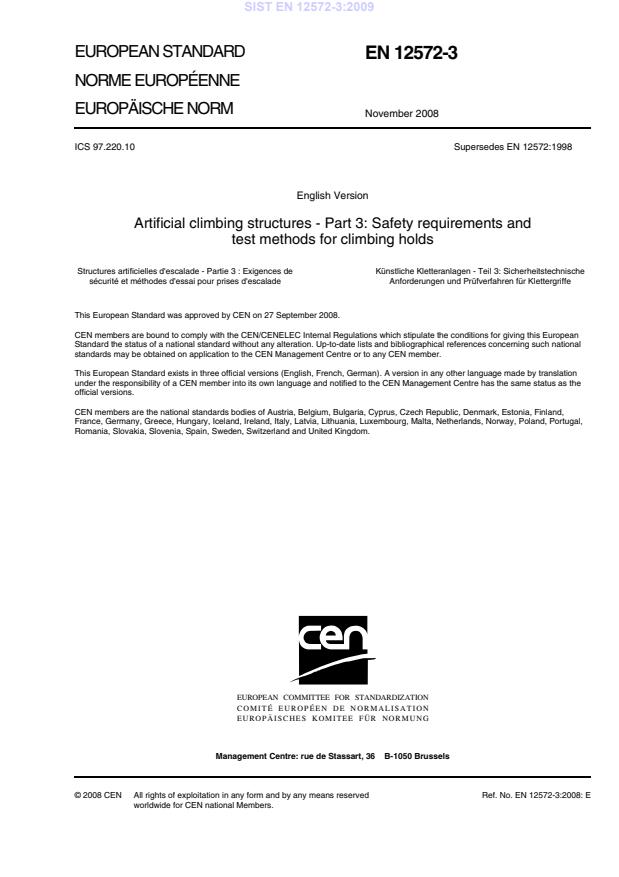
EUROPEAN STANDARDNORME EUROPÉENNEEUROPÄISCHE NORMEN 12572-3November 2008ICS 97.220.10Supersedes EN 12572:1998
English VersionArtificial climbing structures - Part 3: Safety requirements andtest methods for climbing holdsStructures artificielles d'escalade - Partie 3 : Exigences desécurité et méthodes d'essai pour prises d'escaladeKünstliche Kletteranlagen - Teil 3: SicherheitstechnischeAnforderungen und Prüfverfahren für KlettergriffeThis European Standard was approved by CEN on 27 September 2008.CEN members are bound to comply with the CEN/CENELEC Internal Regulations which stipulate the conditions for giving this EuropeanStandard the status of a national standard without any alteration. Up-to-date lists and bibliographical references concerning such nationalstandards may be obtained on application to the CEN Management Centre or to any CEN member.This European Standard exists in three official versions (English, French, German). A version in any other language made by translationunder the responsibility of a CEN member into its own language and notified to the CEN Management Centre has the same status as theofficial versions.CEN members are the national standards bodies of Austria, Belgium, Bulgaria, Cyprus, Czech Republic, Denmark, Estonia, Finland,France, Germany, Greece, Hungary, Iceland, Ireland, Italy, Latvia, Lithuania, Luxembourg, Malta, Netherlands, Norway, Poland, Portugal,Romania, Slovakia, Slovenia, Spain, Sweden, Switzerland and United Kingdom.EUROPEAN COMMITTEE FOR STANDARDIZATIONCOMITÉ EUROPÉEN DE NORMALISATIONEUROPÄISCHES KOMITEE FÜR NORMUNGManagement Centre: rue de Stassart, 36
B-1050 Brussels© 2008 CENAll rights of exploitation in any form and by any means reservedworldwide for CEN national Members.Ref. No. EN 12572-3:2008: ESIST EN 12572-3:2009
EN 12572-3:
...