


EN 2591-514:2002
(Main)Aerospace series - Elements of electrical and optical connection - Test methods - Part 514: Solderability of contacts with self-contained solder and flux
General Information
- Abstract
This standard specifies a method of verifying solderability of contacts with self-contained solder and flux, which are not accessible to a solder iron.
- Status
- Published
- Publication Date
- 18-Jun-2002
- Withdrawal Date
- 30-Dec-2002
- Technical Committee
- ASD-STAN - Aerospace
- Drafting Committee
- ASD-STAN/D 2 - Electrical
- Current Stage
- 9093 - Decision to confirm - Review Enquiry
- Start Date
- 30-Jun-2017
- Completion Date
- 17-Sep-2026

Overview
EN 2591-514:2002 is a CEN/AECMA aerospace test method that specifies how to verify the solderability of contacts with self-contained solder and flux - i.e., contacts where the solder and flux are incorporated and are not accessible to a soldering iron. The standard defines specimen preparation, the heat-application procedure (using the component’s installation heat profile without inserting a cable) and the required visual assessment to confirm acceptable solder wetting.
Key Topics and Requirements
- Scope: Verifies solderability of contacts containing built‑in solder and flux that cannot be soldered directly by iron.
- Specimen condition: Test specimens must be tested “as supplied” in their original packaging.
- Test method: Apply heat according to the component’s installation procedure, with the exception that no cable is introduced into the contact during the test.
- Visual inspection: Assessment is made by visual examination in accordance with EN 2591-101 (naked eye or up to 4× magnification).
- Acceptance criterion: The solder must have wetted the contact area and form a relatively uniform, adherent film on the base material. If necessary, the contact may be carefully opened to inspect internal solder coverage.
- Normative reference: EN 2591-101 (visual examination method) is referenced and used for the inspection procedure.
Applications and Who Uses It
EN 2591-514 is targeted at organizations involved in aerospace electrical and optical connectors and their quality assurance:
- Aerospace component manufacturers - to qualify contact designs that use pre‑placed solder/flux and to validate assembly processes.
- Quality/inspection engineers and test laboratories - for routine acceptance, incoming inspection and supplier audits.
- Design and reliability engineers - to ensure connector designs meet solderability requirements when direct soldering is not possible.
- Procurement and regulatory teams - to define procurement specifications and compliance with aerospace connector test regimes.
This test method is particularly relevant for aerospace solderability testing, connector qualification, and ensuring robust electrical connections where conventional soldering access is restricted.
Related Standards
- EN 2591-101 - Aerospace series: Elements of electrical and optical connection - Test methods - Part 101: Visual examination (normative reference).
- Other parts of the EN 2591 series cover additional test methods for aerospace electrical and optical connection elements; consult the EN 2591 family for complementary test procedures.
Keywords: EN 2591-514:2002, solderability, aerospace, contacts with self-contained solder and flux, test methods, CEN, AECMA, visual examination, aerospace connector testing.
Relations
- Effective Date
- 28-Jan-2026
- Effective Date
- 28-Jan-2026
- Effective Date
- 28-Jan-2026
- Effective Date
- 28-Jan-2026
- Effective Date
- 28-Jan-2026
- Effective Date
- 28-Jan-2026
- Effective Date
- 28-Jan-2026
- Effective Date
- 28-Jan-2026
- Effective Date
- 28-Jan-2026
- Effective Date
- 28-Jan-2026
- Effective Date
- 28-Jan-2026
- Effective Date
- 28-Jan-2026
- Effective Date
- 28-Jan-2026
- Effective Date
- 28-Jan-2026
- Effective Date
- 28-Jan-2026
Get Certified
Connect with accredited certification bodies for this standard

BUREAU VERITAS Certification Germany
Bureau Veritas certification in Germany.

Element Materials Technology
Materials testing and product certification.

AQMS Ltd.
AQMS provides ISO certification to SMEs across the UK.
Sponsored listings
Frequently Asked Questions
EN 2591-514:2002 is a standard published by the European Committee for Standardization (CEN). Its full title is "Aerospace series - Elements of electrical and optical connection - Test methods - Part 514: Solderability of contacts with self-contained solder and flux". This standard covers: This standard specifies a method of verifying solderability of contacts with self-contained solder and flux, which are not accessible to a solder iron.
This standard specifies a method of verifying solderability of contacts with self-contained solder and flux, which are not accessible to a solder iron.
EN 2591-514:2002 is classified under the following ICS (International Classification for Standards) categories: 49.060 - Aerospace electric equipment and systems. The ICS classification helps identify the subject area and facilitates finding related standards.
EN 2591-514:2002 has the following relationships with other standards: It is inter standard links to EN 2591-101:1994, EN 3155-009:2025, EN 3155-012:2006, EN 3155-070:2019, EN 4531-001:2012, EN 3155-075:2009, EN 4644-001:2017, EN 3155-083:2019, EN 2591-100:2018, EN 4644-001:2012, EN 3155-066:2006, EN 3155-015:2019, EN 3660-004:2023, EN 3155-035:2012, EN 4531-101:2016. Understanding these relationships helps ensure you are using the most current and applicable version of the standard.
EN 2591-514:2002 is available in PDF format for immediate download after purchase. The document can be added to your cart and obtained through the secure checkout process. Digital delivery ensures instant access to the complete standard document.
Standards Content (Sample)
2003-01.Slovenski inštitut za standardizacijo. Razmnoževanje celote ali delov tega standarda ni dovoljeno.Aerospace series - Elements of electrical and optical connection - Test methods - Part 514: Solderability of contacts with self-contained solder and fluxLuft- und Raumfahrt - Elektrische und optische Verbindungselemente - Prüfverfahren - Teil 514: Lötbarkeit von Kontakten mit eingearbeitetem Lot und FlussmittelSérie aérospatiale - Organes de connexion électrique et optique - Méthodes d'essais - Partie 514: Soudabilité des contacts avec soudure et flux incorporésAerospace series - Elements of electrical and optical connection - Test methods - Part 514: Solderability of contacts with self-contained solder and flux49.060Aerospace electric equipment and systemsICS:Ta slovenski standard je istoveten z:EN 2591-514:2002SIST EN 2591-514:2004en01-maj-2004SIST EN 2591-514:2004SLOVENSKI
STANDARD
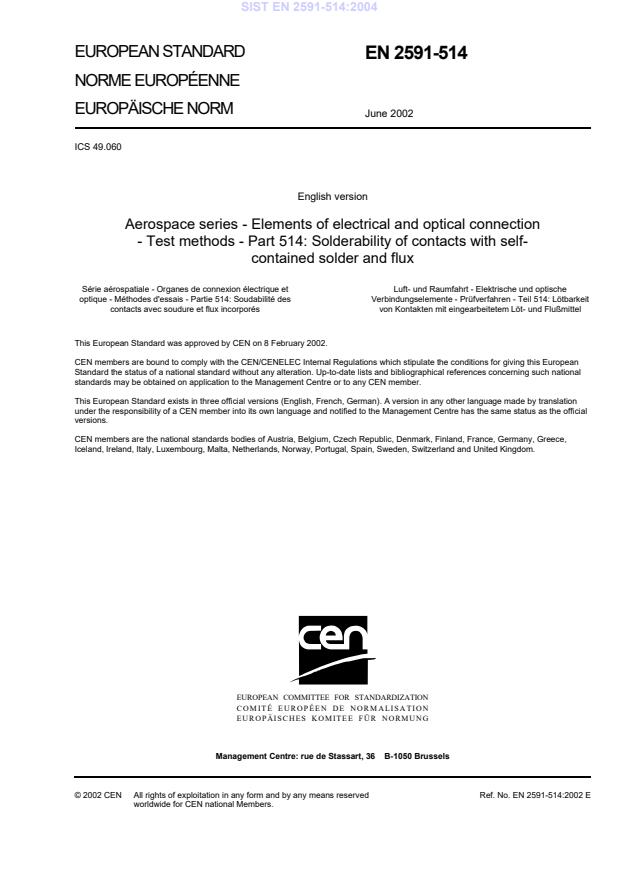
EUROPEAN STANDARDNORME EUROPÉENNEEUROPÄISCHE NORMEN 2591-514June 2002ICS 49.060English versionAerospace series - Elements of electrical and optical connection- Test methods - Part 514: Solderability of contacts with self-contained solder and fluxSérie aérospatiale - Organes de connexion électrique etoptique - Méthodes d'essais - Partie 514: Soudabilité descontacts avec soudure et flux incorporésLuft- und Raumfahrt - Elektrische und optischeVerbindungselemente - Prüfverfahren - Teil 514: Lötbarkeitvon Kontakten mit eingearbeitetem Löt- und FlußmittelThis European Standard was approved by CEN on 8 February 2002.CEN members are bound to comply with the CEN/CENELEC Internal Regulations which stipulate the conditions for giving this EuropeanStandard the status of a national standard without any alteration. Up-to-date lists and bibliographical references concerning such nationalstandards may be obtained on application to the Management Centre or to any CEN member.This European Standard exists in three official versions (English, French, German). A version in any other language made by translationunder the responsibility of a CEN member into its own language and notified to the Management Centre has the same status as the officialversions.CEN members are the national standards bodies of Austria, Belgium, Czech Republic, Denmark, Finland, France, Germany, Greece,Iceland, Ireland, Italy, Luxembourg, Malta, Netherlands, Norway, Portugal, Spain, Sweden, Switzerland and United Kingdom.EUROPEAN COMMITTEE FOR STANDARDIZATIONCOMITÉ EUROPÉEN DE NORMALISATIONEUROPÄISCHES KOMITEE FÜR NORMUNGManagement Centre: rue de Stass
...