


EN 15954-1:2013
(Main)Railway applications - Track - Trailers and associated equipment - Part 1: Technical requirements for running and working
General Information
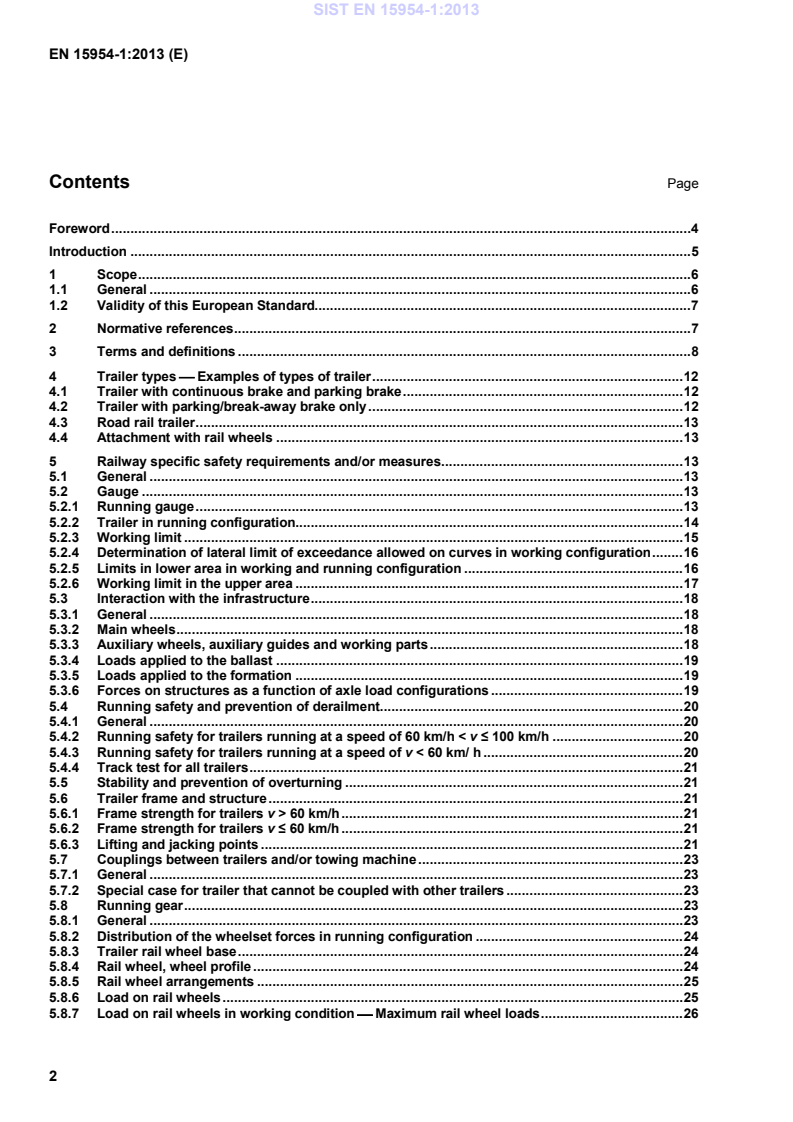
- Abstract
1.1 General
This European Standard specifies the technical requirements to minimise the specific railway hazards of trailers and associated equipment, which can arise during the commissioning, the operation and the maintenance of trailers when carried out in accordance with the specification given by the manufacturer or his authorised representative. This European Standard applies to trailers that are not intended to interact with operating signalling and control systems. Other machines are dealt with in other European Standards; see Annex E.
These trailers are not designed or intended for operating signalling and control systems and are only intended to work and run under special operating conditions specifically designated by the infrastructure manager.
These trailers are not intended to be vehicles as defined in the Interoperability Directive and are not permitted to run on the railway lines open to normal traffic. If this is required, they will need to be authorised or placed into service as set out in the Interoperability Directive 2008/57/EC.
Part 1 of this European Standard deals with the technical railway requirements; Part 2 deals with requirements for the trailer to be declared conformant by the manufacturer, except in the case of trailers classified in Annex 4 of the Machinery Directive 2006/42/EC which require conformity check in conjunction with a notified body.
Additional requirements can apply for running on infrastructures with narrow gauge or broad gauge lines, lines of tramways, railways utilising other than adhesion between the rail and rail wheels, and underground infrastructures.
This European Standard is also applicable to trailers and associated equipment that in working configuration are partly supported on the ballast or the formation.
Where two or more trailers are used together to transport loads in a fixed formation, e.g. where a metal container is fixed to two small trailers, the whole system is treated as a trailer for the purposes of compliance with the requirements of this European Standard.
This European Standard does not apply to the following:
- requirements for quality of the work or performance of the trailer;
- specific requirements established by the railway infrastructure operator for the use of trailers, which will be the subject of negotiation between the manufacturer and the operator;
- separate machines temporarily mounted on the trailer.
This European Standard does not establish the additional requirements for the following:
- operation subject to special rules, e.g. potentially explosive atmospheres;
- hazards due to natural causes, e.g. earthquake, lightning, flooding, etc;
- working methods;
- operation in severe working conditions requiring special measures, e.g. work in tunnels or in cuttings, extreme environmental conditions (below – 20 °C or above + 40 °C), corrosive environment, contaminating environments, strong magnetic fields;
- hazards due to errors in software;
- hazards occurring when used to handle suspended loads which may swing freely.
The intended use of these trailers may have operational parameters specified by each infrastructure manager; for example the maximum speed allowed for these trailers is likely to be limited by the infrastructure manager
- compliance with the clauses of this standard does not confer permission for trailers to travel at this speed. These trailers will not be allowed on a track open to normal railway traffic.
1.2 Validity of this European Standard
This European Standard applies to all trailers, which are ordered one year after the publication date by CEN of this standard.
- Status
- Withdrawn
- Publication Date
- 23-Apr-2013
- Withdrawal Date
- 22-Sep-2026
- Technical Committee
- CEN/TC 256 - Railway applications
- Drafting Committee
- CEN/TC 256/SC 1/WG 5 - Track construction and maintenance machines
- Current Stage
- 9960 - Withdrawal effective - Withdrawal
- Start Date
- 28-May-2025
- Completion Date
- 23-Sep-2026

Relations
- Effective Date
- 28-Jan-2023
- Effective Date
- 25-Aug-2026
- Effective Date
- 25-Aug-2026
- Effective Date
- 21-Jul-2026
- Effective Date
- 07-Jul-2026
- Effective Date
- 26-May-2026
- Effective Date
- 09-Feb-2026
- Effective Date
- 09-Feb-2026
- Effective Date
- 09-Feb-2026
- Effective Date
- 09-Feb-2026
- Effective Date
- 09-Feb-2026
- Effective Date
- 09-Feb-2026
- Effective Date
- 09-Feb-2026
- Effective Date
- 09-Feb-2026
- Effective Date
- 09-Feb-2026
Get Certified
Connect with accredited certification bodies for this standard

IRIS Certification (UNIFE)
International Railway Industry Standard certification.

TÜV SÜD Rail GmbH
TÜV SÜD railway certification services.

Bureau Veritas Railway Certification
Railway and transportation certification.
Sponsored listings
Frequently Asked Questions
EN 15954-1:2013 is a standard published by the European Committee for Standardization (CEN). Its full title is "Railway applications - Track - Trailers and associated equipment - Part 1: Technical requirements for running and working". This standard covers: 1.1 General This European Standard specifies the technical requirements to minimise the specific railway hazards of trailers and associated equipment, which can arise during the commissioning, the operation and the maintenance of trailers when carried out in accordance with the specification given by the manufacturer or his authorised representative. This European Standard applies to trailers that are not intended to interact with operating signalling and control systems. Other machines are dealt with in other European Standards; see Annex E. These trailers are not designed or intended for operating signalling and control systems and are only intended to work and run under special operating conditions specifically designated by the infrastructure manager. These trailers are not intended to be vehicles as defined in the Interoperability Directive and are not permitted to run on the railway lines open to normal traffic. If this is required, they will need to be authorised or placed into service as set out in the Interoperability Directive 2008/57/EC. Part 1 of this European Standard deals with the technical railway requirements; Part 2 deals with requirements for the trailer to be declared conformant by the manufacturer, except in the case of trailers classified in Annex 4 of the Machinery Directive 2006/42/EC which require conformity check in conjunction with a notified body. Additional requirements can apply for running on infrastructures with narrow gauge or broad gauge lines, lines of tramways, railways utilising other than adhesion between the rail and rail wheels, and underground infrastructures. This European Standard is also applicable to trailers and associated equipment that in working configuration are partly supported on the ballast or the formation. Where two or more trailers are used together to transport loads in a fixed formation, e.g. where a metal container is fixed to two small trailers, the whole system is treated as a trailer for the purposes of compliance with the requirements of this European Standard. This European Standard does not apply to the following: - requirements for quality of the work or performance of the trailer; - specific requirements established by the railway infrastructure operator for the use of trailers, which will be the subject of negotiation between the manufacturer and the operator; - separate machines temporarily mounted on the trailer. This European Standard does not establish the additional requirements for the following: - operation subject to special rules, e.g. potentially explosive atmospheres; - hazards due to natural causes, e.g. earthquake, lightning, flooding, etc; - working methods; - operation in severe working conditions requiring special measures, e.g. work in tunnels or in cuttings, extreme environmental conditions (below – 20 °C or above + 40 °C), corrosive environment, contaminating environments, strong magnetic fields; - hazards due to errors in software; - hazards occurring when used to handle suspended loads which may swing freely. The intended use of these trailers may have operational parameters specified by each infrastructure manager; for example the maximum speed allowed for these trailers is likely to be limited by the infrastructure manager - compliance with the clauses of this standard does not confer permission for trailers to travel at this speed. These trailers will not be allowed on a track open to normal railway traffic. 1.2 Validity of this European Standard This European Standard applies to all trailers, which are ordered one year after the publication date by CEN of this standard.
1.1 General This European Standard specifies the technical requirements to minimise the specific railway hazards of trailers and associated equipment, which can arise during the commissioning, the operation and the maintenance of trailers when carried out in accordance with the specification given by the manufacturer or his authorised representative. This European Standard applies to trailers that are not intended to interact with operating signalling and control systems. Other machines are dealt with in other European Standards; see Annex E. These trailers are not designed or intended for operating signalling and control systems and are only intended to work and run under special operating conditions specifically designated by the infrastructure manager. These trailers are not intended to be vehicles as defined in the Interoperability Directive and are not permitted to run on the railway lines open to normal traffic. If this is required, they will need to be authorised or placed into service as set out in the Interoperability Directive 2008/57/EC. Part 1 of this European Standard deals with the technical railway requirements; Part 2 deals with requirements for the trailer to be declared conformant by the manufacturer, except in the case of trailers classified in Annex 4 of the Machinery Directive 2006/42/EC which require conformity check in conjunction with a notified body. Additional requirements can apply for running on infrastructures with narrow gauge or broad gauge lines, lines of tramways, railways utilising other than adhesion between the rail and rail wheels, and underground infrastructures. This European Standard is also applicable to trailers and associated equipment that in working configuration are partly supported on the ballast or the formation. Where two or more trailers are used together to transport loads in a fixed formation, e.g. where a metal container is fixed to two small trailers, the whole system is treated as a trailer for the purposes of compliance with the requirements of this European Standard. This European Standard does not apply to the following: - requirements for quality of the work or performance of the trailer; - specific requirements established by the railway infrastructure operator for the use of trailers, which will be the subject of negotiation between the manufacturer and the operator; - separate machines temporarily mounted on the trailer. This European Standard does not establish the additional requirements for the following: - operation subject to special rules, e.g. potentially explosive atmospheres; - hazards due to natural causes, e.g. earthquake, lightning, flooding, etc; - working methods; - operation in severe working conditions requiring special measures, e.g. work in tunnels or in cuttings, extreme environmental conditions (below – 20 °C or above + 40 °C), corrosive environment, contaminating environments, strong magnetic fields; - hazards due to errors in software; - hazards occurring when used to handle suspended loads which may swing freely. The intended use of these trailers may have operational parameters specified by each infrastructure manager; for example the maximum speed allowed for these trailers is likely to be limited by the infrastructure manager - compliance with the clauses of this standard does not confer permission for trailers to travel at this speed. These trailers will not be allowed on a track open to normal railway traffic. 1.2 Validity of this European Standard This European Standard applies to all trailers, which are ordered one year after the publication date by CEN of this standard.
EN 15954-1:2013 is classified under the following ICS (International Classification for Standards) categories: 45.060.20 - Trailing stock; 45.120 - Equipment for railway/cableway construction and maintenance. The ICS classification helps identify the subject area and facilitates finding related standards.
EN 15954-1:2013 has the following relationships with other standards: It is inter standard links to EN 15955-1:2025, ISO/IEC 7501-1:1993, ISO 13686:1998, EN IEC 60947-5-5:2026, EN IEC 60947-10:2026, EN IEC 60947-6-1:2026, EN 60947-5-5:1997/A1:2005, EN IEC 60947-4-3:2024, EN IEC 60947-7-1:2025, EN IEC 60947-1:2021, EN IEC 60947-5-8:2021, EN IEC 60947-5-7:2025, EN 60947-5-5:1997/A11:2013, EN 60947-5-4:2003/A1:2019, EN IEC 60947-5-1:2025. Understanding these relationships helps ensure you are using the most current and applicable version of the standard.
EN 15954-1:2013 is associated with the following European legislation: EU Directives/Regulations: 2008/57/EC; Standardization Mandates: M/024, M/483. When a standard is cited in the Official Journal of the European Union, products manufactured in conformity with it benefit from a presumption of conformity with the essential requirements of the corresponding EU directive or regulation.
EN 15954-1:2013 is available in PDF format for immediate download after purchase. The document can be added to your cart and obtained through the secure checkout process. Digital delivery ensures instant access to the complete standard document.
Standards Content (Sample)
2003-01.Slovenski inštitut za standardizacijo. Razmnoževanje celote ali delov tega standarda ni dovoljeno.GHORYDQMHBahnanwendungen - Oberbau - Anhänger und zugehörige Ausstattung - Teil 1: Technische Anforderungen an das Fahren und den ArbeitseinsatzApplications ferroviaires - Voie - Remorques et éléments associés - Partie 1 : Prescriptions techniques pour la circulation et le travailRailway applications - Track - Trailers and associated equipment - Part 1: Technical requirements for running and working45.120åLþQLFEquipment for railway/cableway construction and maintenanceICS:Ta slovenski standard je istoveten z:EN 15954-1:2013SIST EN 15954-1:2013en,fr01-junij-2013SIST EN 15954-1:2013SLOVENSKI
STANDARD
EUROPEAN STANDARD NORME EUROPÉENNE EUROPÄISCHE NORM
EN 15954-1
April 2013 ICS 45.060.20; 45.120 English Version
Railway applications - Track - Trailers and associated equipment - Part 1: Technical requirements for running and working
Applications ferroviaires - Voie - Remorques et éléments associés - Partie 1 : Prescriptions techniques pour la circulation et le travail
Bahnanwendungen - Oberbau - Anhänger und zugehörige Ausstattung - Teil 1: Technische Anforderungen an das Fahren und den Arbeitseinsatz This European Standard was approved by CEN on 3 August 2012.
CEN members are bound to comply with the CEN/CENELEC Internal Regulations which stipulate the conditions for giving this European Standard the status of a national standard without any alteration. Up-to-date lists and bibliographical references concerning such national standards may be obtained on application to the CEN-CENELEC Management Centre or to any CEN member.
This European Standard exists in three official versions (English, French, German). A version in any other language made by translation under the responsibility of a CEN member into its own language and notified to the CEN-CENELEC Management Centre has the same status as the official versions.
CEN members are the national standards bodies of Austria, Belgium, Bulgaria, Croatia, Cyprus, Czech Republic, Denmark, Estonia, Finland, Former Yugoslav Republic of Macedonia, France, Germany, Greece, Hungary, Iceland, Ireland, Italy, Latvia, Lithuania, Luxembourg, Malta, Netherlands, Norway, Poland, Portugal, Romania, Slovakia, Slovenia, Spain, Sweden, Switzerland, Turkey and United Kingdom.
EUROPEAN COMMITTEE FOR STANDARDIZATION
COMITÉ EUROPÉEN DE NORMALISATION EUROPÄISCHES KOMITEE FÜR NORMUNG
Management Centre:
Avenue Marnix 17,
B-1000 Brussels © 2013 CEN All rights of exploitation in any form and by any means reserved worldwide for CEN national Members. Ref. No. EN 15954-1:2013: ESIST EN 15954-1:2013
Technical details for buffing and draw gear . 37 A.1 General . 37 A.2 Draw gear constituent parts . 37 A.2.1 Coupling part . 37 A.3 Application. 38 A.4 Technical details for coupling parts . 38 A.5 User information . 39 Annex B (normative)
Special national conditions . 40 Annex C (normative)
Check list for conformity . 44 Annex D (informative)
Trailer identification plate . 48 Annex E (informative)
Structure of European Standards for track construction and maintenance machines . 49 Bibliography . 51
Additional requirements can apply for running on infrastructures with narrow gauge or broad gauge lines, lines of tramways, railways utilising other than adhesion between the rail and rail wheels, and underground infrastructures. This European Standard is also applicable to trailers and associated equipment that in working configuration are partly supported on the ballast or the formation. Where two or more trailers are used together to transport loads in a fixed formation, e.g. where a metal container is fixed to two small trailers, the whole system is treated as a trailer for the purposes of compliance with the requirements of this European Standard. This European Standard does not apply to the following: requirements for quality of the work or performance of the trailer; specific requirements established by the railway infrastructure operator for the use of trailers, which will be the subject of negotiation between the manufacturer and the operator; separate machines temporarily mounted on the trailer. This European Standard does not establish the additional requirements for the following: operation subject to special rules, e.g. potentially explosive atmospheres; hazards due to natural causes, e.g. earthquake, lightning, flooding, etc; working methods; operation in severe working conditions requiring special measures, e.g. work in tunnels or in cuttings, extreme environmental conditions (below – 20 °C or above + 40 °C), corrosive environment, contaminating environments, strong magnetic fields; hazards due to errors in software; SIST EN 15954-1:2013
compliance with the clauses of this standard does not confer permission for trailers to travel at this speed. These trailers will not be allowed on a track open to normal railway traffic. 1.2 Validity of this European Standard This European Standard applies to all trailers, which are ordered one year after the publication date by CEN of this standard. 2 Normative references The following documents, in whole or in part, are normatively referenced in this document and are indispensable for its application. For dated references, only the edition cited applies. For undated references, the latest edition of the referenced document (including any amendments) applies. EN 791, Drill rigs Safety EN 12663-1:2010, Railway applications Structural requirements of railway vehicle bodies Part 1: Locomotives and passenger rolling stock (and alternative method for freight wagons) EN 13309, Construction machinery Electromagnetic compatibility of machines with internal electrical power supply EN 13715, Railway applications Wheelsets and bogies Wheels Tread profile EN 14033-1:2011, Railway applications Track Railbound construction and maintenance machines Part 1: Technical requirements for running EN 14033-2:2008+A1:2011, Railway applications Track Railbound construction and maintenance machines Part 2: Technical requirements for working EN 14363:2005, Railway applications Testing for the acceptance of running characteristics of railway vehicles — Testing of running behaviour and stationary tests EN 14601, Railway applications Straight and angled end cocks for brake pipe and main reservoir pipe EN 15273-2:2013, Railway applications Gauges Part 2: Rolling stock gauge EN 15528, Railway applications Line categories for managing the interface between load limits of vehicles and infrastructure EN 15954-2:2013, Railway applications Track Trailers and associated equipment Part 2: General safety requirements EN 50121-3-1:2006, Railway applications Electromagnetic compatibility Part 3-1: Rolling stock Train and complete vehicle EN 50121-3-2:2006, Railway applications Electromagnetic compatibility Part 3-2: Rolling stock Apparatus EN 50122-1, Railway applications Fixed installations Electrical safety, earthing and the return circuit Part 1: Protective provisions against electric shock SIST EN 15954-1:2013
Note 2 to entry: This includes attachments with rail wheels. 3.2 road-rail trailer trailer with additional road wheels to enable the trailer to be hauled on both rails and ground 3.3 road-rail machine self propelled machine that can run on rails and ground
Note 1 to entry: It is normally a road vehicle adapted for running on rail, but can be a specially designed rail vehicle for running on the ground. Note 2 to entry: It does not imply that the machine is suitable for use on the public road. 3.4 demountable machine self propelled machine that can run and work on rail and which is not intended to operate signalling and control systems Note 1 to entry: Such a machine is designed to get on and off track by its own means or with other lifting equipment. In the case of demounting by its own means these are not intended for running on the ground. Note 2 to entry: Such a machine is permitted to work on the railway only under special operating conditions granted by the infrastructure manager and run under special conditions granted by the authorising body and/or the infrastructure manager. 3.5 railbound machine on-track machine OTM vehicle specially designed for construction and maintenance of the track and infrastructure, and which is used in different modes: working configuration, running configuration as a self-propelling vehicle, running configuration as a hauled vehicle, when: it is running on its own rail wheels, it is designed to have characteristics necessary for the operation of track based train detection systems SIST EN 15954-1:2013
Note 1 to entry: It is designed so that the machine and/or its separate component parts may be manually placed on or off the track.
3.8 mobile elevating work platform MEWP mobile machine that is intended to move persons to working positions where they are carrying out work from the work platform with the intention that persons are getting on and off the work platform at one defined access position and which consists as a minimum of a work platform with controls, an extending structure and a chassis 3.9 host vehicle basic road vehicle or machine which is converted to run on rails 3.10 general attachment components or assembly of components which can be mounted onto the trailer or equipment for a specific use Note 1 to entry: See ISO 6746-1, ISO 6746-2 and ISO 6016. 3.11 railway specific attachment equipment that is capable of being temporarily fixed to and/or powered from a road rail machine or demountable machine but specifically excludes lifting accessories 3.12 lifting accessory loose lifting tackle, i.e. components or equipment not attached to the trailer and placed between the machinery and the load or on the load in order to attach it 3.13 manufacturer body that designs and constructs a trailer, or converts the original machine to a trailer 3.14 running configuration state of trailer when it is on the rail and all movable parts are stowed and secured within the applicable kinematic gauge Note 1 to entry: For the kinematic gauge, see EN 15273-2. SIST EN 15954-1:2013
EXAMPLE An assembly of trailers and/or wagons and/or category 3, 5, 7 machines described in EN 14033-1:2011 attached to a trailer under conditions prescribed by the infrastructure manager. 3.25 working limit contour limit in which a trailer can work without interfering with the kinematic gauge of trains on adjacent tracks Note 1 to entry: For the kinematic gauge, see EN 14033-2:2008+A1:2011, Annex D. SIST EN 15954-1:2013
3.35 methods of examination visual checks, measurements, functional tests, load test(s), specific verification/measurements and other controls 3.36 visual check check that establishes whether all elements on the machine, system or component, e.g. protective devices, visual warning device, marking, are present and that documents and drawings correspond to the requirements 3.37 measurement test test that establishes whether the stated measurable parameters have met the requirements of this standard
Note 1 to entry: Measureable parameters include geometric dimensions, safety distances, insulation resistance of electric circuits, noise and vibration. SIST EN 15954-1:2013
Figure 1 — Example of a box trailer with continuous and parking/break-away brake
Figure 2 — Example of a high speed flat bed trailer with continuous and parking/break-away brake
4.2 Trailer with parking/break-away brake only
Figure 3 — Example of a flat bed trailer with parking/break-away brake only SIST EN 15954-1:2013
Figure 4 — Example of road rail trailer with parking/break-away brake only 4.4 Attachment with rail wheels
Figure 5 — Example of railway specific attachment with parking/break-away brake only 5 Railway specific safety requirements and/or measures 5.1 General Trailers shall comply with the safety requirements and/ or protective measures in accordance with Clauses 5 and 6, and supplied with information in accordance with Clause 7. Trailers shall be designed to work on working track within the geometric limits, see EN 14033-2:2008+A1:2011, Annex F, and shall be designed to work on operating tracks. Trailers that can only work on operating tracks shall display on the identification plate an indication of that restriction. 5.2 Gauge 5.2.1 Running gauge 5.2.1.1 General Except as shown in 5.2.1.2, trailers in running configuration shall meet the dimensional requirements of EN 15273-2. The critical points near the limits of the permissible kinematic gauge, see EN 14033-1:2011, Annex C, shall be recorded in the technical documentation shown in Clause 7. 5.2.1.2 Special cases Trailers intended to travel on infrastructures with more restrictive gauges shall conform to the specific rules of those infrastructures and the corresponding restrictions shall be indicated on their operating permits. SIST EN 15954-1:2013
Key A = rail level B = exceedance of gauge permitted for road-rail trailers C = gauge according to EN 15273-2:2013 Figure 6 — Limits in lower area 5.2.2 Trailer in running configuration 5.2.2.1 Stowing of moveable trailer parts in running configuration When the trailer is in the running configuration, any movable equipment which has the capacity to go outside the gauge shall be capable of being stowed in a manner which prevents inadvertent or unintended movement out of the gauge. All such moveable parts and assemblies forming part of the trailer that are unpacked in order to allow the trailer to work in rail and non-rail configuration shall, in their stowed state, be secured by devices capable of resisting the foreseeable forces encountered during running, which shall not rely upon a power source to retain the locking function. Moveable parts shall be held by either: efficient locks: the visible positive locking components in running configuration shall be painted in red; if the locking mechanism is powered, the control of locking should preferably be possible from inside the trailer gauge; or check valves on hydraulic systems which shall prevent movement and fail safe. It shall be obvious to anyone checking the trailer that these parts of the trailer are locked in their stowed position. 5.2.2.2 Operating controls in running configuration When in running configuration all operating controls not related to running, including locking devices, shall be deactivated automatically. SIST EN 15954-1:2013
5.2.3.2.2 Design of movement limiting devices 5.2.3.2.2.1 General Movement limiting devices shall permit the height and rotation limit to be variable to suit each location. The movement limiting device shall stop the movement when height and lateral limits are reached, or prevent movement commencing in an unsafe direction if the machine is stopped at its limit. All movement limiting devices shall comply with 5.2.3.2.2.2 or 5.2.3.2.2.3 or 5.2.3.2.2.4, as appropriate. 5.2.3.2.2.2 Mechanical limiting devices These devices shall be capable of resisting the foreseeable forces encountered. NOTE This includes resisting static forces (start-up force of the motion) where they are in the form of a lock, and dynamic forces where they are in the form of a stop. 5.2.3.2.2.3 Electric limiting devices The design shall be such that there shall be no predictable credible single point failure that would cause the system to fail unsafe, i.e. allow the corresponding movement to continue. Any fault, including unacceptable differences in signals, shall cause the system to fail to a safe condition. SIST EN 15954-1:2013
This distance shall be taken with the worst case wheel wear and suspension condition. Trailers are permitted to move over live conductor rails providing they meet the requirements of the minimum safety distance given in Table 1. Trailers not meeting these clearances are not permitted to move over live conductor rail and the type approval certificate shall indicate this restriction. 5.2.6 Working limit in the upper area 5.2.6.1 General All metallic parts of the trailer shall be equipotential bonded to rail according to EN 15954-2:2013, 5.16.7. 5.2.6.2 Protection for the operator All work positions at a height greater than that shown in Annex B (line 9 of table) shall be protected such that it is not possible to make contact with live electric traction equipment. This requirement shall be achieved by either: a) The provision of an earthed metallic roof without open holes: where open holes in a metallic roof are necessary they shall be a maximum 25 mm aperture and covered by a conducting structure. It is permissible for non-conducting material to be used providing that the frame provides an earth path in the event of fallen catenary.
or b) The trailer shall be accepted for use with the restriction that it may only be operated under isolated and earthed catenaries (this means the electrical power switched off and the contact cable connected to ground potential). This restriction shall be written in the instruction handbook, see Clause 7, list entry a) 3) i), and a notice provided on the side of the trailer. A warning notice shall be placed on MEWPs which do not have a roof, which states that use under live overhead wires is prohibited; see EN 50122-1. All places on the trailer which allow access to either platforms or working areas without roofs in accordance with a) above shall be marked with a warning pictogram; see EN 14033-2:2008+A1:2011, Figure G.1. 5.2.6.3 Prevention of trailer contact with the
...