


EN 15429-3:2015
(Main)Sweepers - Part 3: Efficiency of particulate matter collection - Testing and Evaluation
General Information
- Abstract
This European Standard establishes a method to assess the PM10 and PM2,5 efficiency of road sweepers. PM10 and PM2,5 efficiency includes a sweeper’s ability to:
- Remove and capture PM10 and PM2,5 particulate matter, and coarse size fractions, from typical urban road surfaces;
- Minimize the amount of airborne and entrained PM10 and PM2,5 particulate matter resulting from the sweeping process.
The sweeper’s ability to remove and capture particulate matter and coarse size fractions is assessed using procedures and equipment to determine the amount of a test material (consisting of particulate matter and coarser size fractions) the sweeper is able to remove from a test surface during a controlled test run. This test measurement is used to calculate the removal efficiency for the sweeper.
The sweeper’s ability to minimize the amount of airborne and entrained particulate matter is also assessed using procedures and equipment to determine the airborne concentrations of PM10 and PM2,5 resulting from the sweeping of a test material (consisting of particulate matter and coarser size fractions) during a controlled test run. The test measurements are used to calculate PM10 and PM2,5 emission ratings for the sweeper.
This test allows the use of dust suppression water. Sweepers configured as flushing machines, or equipped with front-mounted spray bars which are not part of a dust suppression water system are not within the scope of this test.
The road sweeper’s performance results are reported in a quantitative numerical format that will allow comparative assessments of similarly classified sweepers. This test does not specify pass/fail criteria for the PM10 and PM2,5 efficiency measurements specified in the test procedure.
This test is applicable to truck mounted, self-propelled, towed and attached sweeping equipment as defined in EN 15429-1:2007, Clause 2.
This test is a model/type test, requiring the sweeper being tested to be representative of all factory production of that particular sweeper model.
- Status
- Published
- Publication Date
- 17-Mar-2015
- Withdrawal Date
- 29-Sep-2015
- Technical Committee
- CEN/TC 337 - Winter maintenance and road service area maintenance equipment
- Drafting Committee
- CEN/TC 337/WG 4 - Road cleaning equipment
- Current Stage
- 9060 - Closure of 2 Year Review Enquiry - Review Enquiry
- Start Date
- 04-Jun-2026
- Completion Date
- 04-Jun-2026

Overview
EN 15429-3:2015 (CEN) defines a laboratory-based method to assess the PM10 and PM2.5 efficiency of road sweepers. The standard measures two complementary outcomes: the sweeper’s ability to remove and capture particulate matter (including coarser fractions) from road surfaces, and its ability to minimise airborne and entrained PM10/PM2.5 generated during sweeping. Results are reported as quantitative numerical performance metrics (removal efficiency and PM emission rating) to enable comparative assessments - the standard does not set pass/fail criteria.
Key Topics and Requirements
- Scope and applicability: Applies to truck-mounted, self-propelled, towed and attached sweepers as defined in EN 15429-1. It is a model/type test requiring the tested unit to represent production models.
- Controlled test facility: Tests are performed within an enclosed facility creating a reproducible environment; the central sweeper test area is typically 20 m long.
- Test material and application: A defined test material (particulate matter plus coarser fractions) is applied at known density and location on the test surface to determine removal efficiency.
- Measurements:
- Removal efficiency: Determined by quantifying material removed from the test surface versus material remaining (vacuum collection of residuals recommended).
- PM emission rating: Determined by aerosol dust monitors positioned (e.g., at adult nose height) to record PM10 and PM2.5 concentrations during runs.
- Test procedure details:
- A sweeper test comprises four individual runs; the three most consistent runs with the lowest emission ratings and highest removal efficiencies are averaged for final results.
- Dust suppression water is allowed (application rate must be measured and reported). Flushing machines and front-mounted spray bars that are not part of a dust suppression system are excluded.
- Operational settings must be documented and remain constant for a test series; changes require a new series of four runs.
- Referenced standards: EN 12341 (PM measurement), EN 15429-1, EN 60335-2-69.
Applications and Users
- Municipalities and local authorities evaluating sweeper options to reduce urban particulate pollution.
- Manufacturers and R&D teams validating model/type performance for design optimization and marketing.
- Test laboratories and certification bodies conducting standardized performance assessments.
- Procurement specialists and environmental managers comparing sweepers by objective PM removal and emission metrics.
Related Standards (if applicable)
- EN 15429-1: Classification and Terminology for sweepers - defines vehicle types referenced in EN 15429-3.
- EN 12341: Reference gravimetric method for PM10/PM2.5 - normative reference for size-selective sampling.
- EN 60335-2-69: Requirements for industrial wet/dry vacuums - relevant for residual collection.
Keywords: EN 15429-3:2015, sweepers, PM10, PM2.5, particulate matter testing, removal efficiency, PM emission rating, dust suppression water, road sweeper standards.
Relations
- Effective Date
- 09-Feb-2026
- Effective Date
- 28-Jan-2026
- Effective Date
- 28-Jan-2026
Get Certified
Connect with accredited certification bodies for this standard

TÜV Rheinland
TÜV Rheinland is a leading international provider of technical services.

TÜV SÜD
TÜV SÜD is a trusted partner of choice for safety, security and sustainability solutions.

DEKRA Certification Inc.
DEKRA US certification services.
Sponsored listings
Frequently Asked Questions
EN 15429-3:2015 is a standard published by the European Committee for Standardization (CEN). Its full title is "Sweepers - Part 3: Efficiency of particulate matter collection - Testing and Evaluation". This standard covers: This European Standard establishes a method to assess the PM10 and PM2,5 efficiency of road sweepers. PM10 and PM2,5 efficiency includes a sweeper’s ability to: - Remove and capture PM10 and PM2,5 particulate matter, and coarse size fractions, from typical urban road surfaces; - Minimize the amount of airborne and entrained PM10 and PM2,5 particulate matter resulting from the sweeping process. The sweeper’s ability to remove and capture particulate matter and coarse size fractions is assessed using procedures and equipment to determine the amount of a test material (consisting of particulate matter and coarser size fractions) the sweeper is able to remove from a test surface during a controlled test run. This test measurement is used to calculate the removal efficiency for the sweeper. The sweeper’s ability to minimize the amount of airborne and entrained particulate matter is also assessed using procedures and equipment to determine the airborne concentrations of PM10 and PM2,5 resulting from the sweeping of a test material (consisting of particulate matter and coarser size fractions) during a controlled test run. The test measurements are used to calculate PM10 and PM2,5 emission ratings for the sweeper. This test allows the use of dust suppression water. Sweepers configured as flushing machines, or equipped with front-mounted spray bars which are not part of a dust suppression water system are not within the scope of this test. The road sweeper’s performance results are reported in a quantitative numerical format that will allow comparative assessments of similarly classified sweepers. This test does not specify pass/fail criteria for the PM10 and PM2,5 efficiency measurements specified in the test procedure. This test is applicable to truck mounted, self-propelled, towed and attached sweeping equipment as defined in EN 15429-1:2007, Clause 2. This test is a model/type test, requiring the sweeper being tested to be representative of all factory production of that particular sweeper model.
This European Standard establishes a method to assess the PM10 and PM2,5 efficiency of road sweepers. PM10 and PM2,5 efficiency includes a sweeper’s ability to: - Remove and capture PM10 and PM2,5 particulate matter, and coarse size fractions, from typical urban road surfaces; - Minimize the amount of airborne and entrained PM10 and PM2,5 particulate matter resulting from the sweeping process. The sweeper’s ability to remove and capture particulate matter and coarse size fractions is assessed using procedures and equipment to determine the amount of a test material (consisting of particulate matter and coarser size fractions) the sweeper is able to remove from a test surface during a controlled test run. This test measurement is used to calculate the removal efficiency for the sweeper. The sweeper’s ability to minimize the amount of airborne and entrained particulate matter is also assessed using procedures and equipment to determine the airborne concentrations of PM10 and PM2,5 resulting from the sweeping of a test material (consisting of particulate matter and coarser size fractions) during a controlled test run. The test measurements are used to calculate PM10 and PM2,5 emission ratings for the sweeper. This test allows the use of dust suppression water. Sweepers configured as flushing machines, or equipped with front-mounted spray bars which are not part of a dust suppression water system are not within the scope of this test. The road sweeper’s performance results are reported in a quantitative numerical format that will allow comparative assessments of similarly classified sweepers. This test does not specify pass/fail criteria for the PM10 and PM2,5 efficiency measurements specified in the test procedure. This test is applicable to truck mounted, self-propelled, towed and attached sweeping equipment as defined in EN 15429-1:2007, Clause 2. This test is a model/type test, requiring the sweeper being tested to be representative of all factory production of that particular sweeper model.
EN 15429-3:2015 is classified under the following ICS (International Classification for Standards) categories: 43.160 - Special purpose vehicles. The ICS classification helps identify the subject area and facilitates finding related standards.
EN 15429-3:2015 has the following relationships with other standards: It is inter standard links to EN 60335-2-69:2012, EN 15429-1:2007, EN 12341:2023. Understanding these relationships helps ensure you are using the most current and applicable version of the standard.
EN 15429-3:2015 is available in PDF format for immediate download after purchase. The document can be added to your cart and obtained through the secure checkout process. Digital delivery ensures instant access to the complete standard document.
Standards Content (Sample)
2003-01.Slovenski inštitut za standardizacijo. Razmnoževanje celote ali delov tega standarda ni dovoljeno.RFHQMHYDQMHKehrmaschinen - Teil 3: Aufnahmefähigkeit von Feinstaub - Prüfung und BewertungBalayeuses - Partie 3: Efficacité de la collecte des matières particulaires - Essai et évaluationSweepers - Part 3: Efficiency of particulate matter collection - Testing and Evaluation43.160Vozila za posebne nameneSpecial purpose vehicles13.030.40Naprave in oprema za odstranjevanje in obdelavo odpadkovInstallations and equipment for waste disposal and treatmentICS:Ta slovenski standard je istoveten z:EN 15429-3:2015SIST EN 15429-3:2015en01-maj-2015SIST EN 15429-3:2015SLOVENSKI
STANDARD
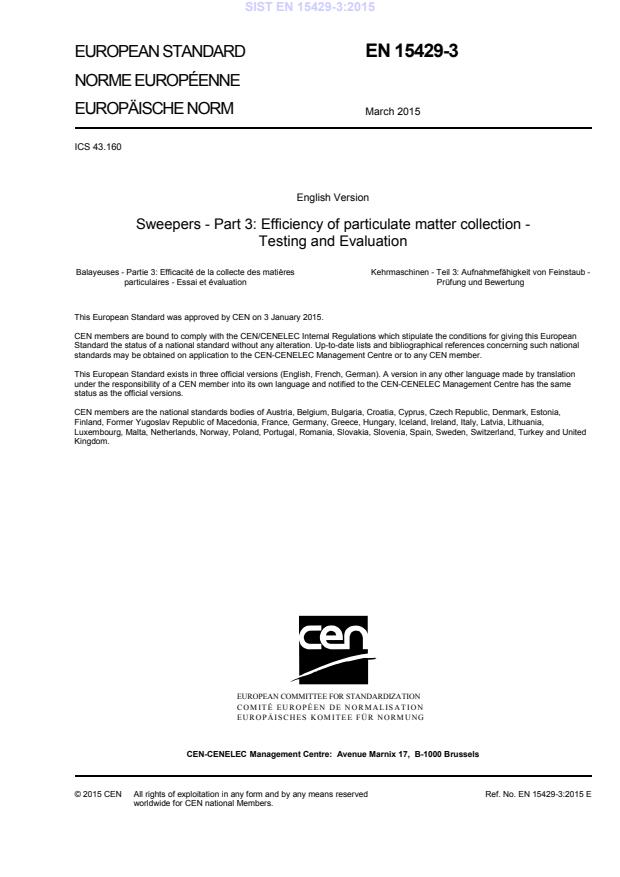
EUROPEAN STANDARD NORME EUROPÉENNE EUROPÄISCHE NORM
EN 15429-3
March 2015 ICS 43.160 English Version
Sweepers - Part 3: Efficiency of particulate matter collection - Testing and Evaluation
Balayeuses - Partie 3: Efficacité de la collecte des matières particulaires - Essai et évaluation
Kehrmaschinen - Teil 3: Aufnahmefähigkeit von Feinstaub -Prüfung und Bewertung This European Standard was approved by CEN on 3 January 2015.
CEN members are bound to comply with the CEN/CENELEC Internal Regulations which stipulate the conditions for giving this European Standard the status of a national standard without any alteration. Up-to-date lists and bibliographical references concerning such national standards may be obtained on application to the CEN-CENELEC Management Centre or to any CEN member.
This European Standard exists in three official versions (English, French, German). A version in any other language made by translation under the responsibility of a CEN member into its own language and notified to the CEN-CENELEC Management Centre has the same status as the official versions.
CEN members are the national standards bodies of Austria, Belgium, Bulgaria, Croatia, Cyprus, Czech Republic, Denmark, Estonia, Finland, Former Yugoslav Republic of Macedonia, France, Germany, Greece, Hungary, Iceland, Ireland, Italy, Latvia, Lithuania, Luxembourg, Malta, Netherlands, Norway, Poland, Portugal, Romania, Slovakia, Slovenia, Spain, Sweden, Switzerland, Turkey and United Kingdom.
EUROPEAN COMMITTEE FOR STANDARDIZATION
COMITÉ EUROPÉEN DE NORMALISATION EUROPÄISCHES KOMITEE FÜR NORMUNG
CEN-CENELEC Management Centre:
Avenue Marnix 17,
B-1000 Brussels © 2015 CEN All rights of exploitation in any form and by any means reserved worldwide for CEN national Members. Ref. No. EN 15429-3:2015 ESIST EN 15429-3:2015
Standard gravimetric measurement method for the determination of the PM10 or PM2,5 mass concentration of suspended particulate matter EN 15429-1:2007, Sweepers
Part 1: Classification and Terminology EN 60335-2-69, Household and similar electrical appliances
Safety
Part 2-69: Particular requirements for wet and dry vacuums, including power brush, for industrial and commercial use (IEC 60335-2-69) 3 Terms and definitions For the purposes of this document, the terms and definitions given in EN 15429-1 and the following apply. SIST EN 15429-3:2015
...