


prEN 18374
(Main)Earthworks - Geotechnical laboratory tests - Lime and/or hydraulic binder treated materials - Test for determining the treatment suitability of a soil
General Information
- Abstract
This document specifies a test method to determine the suitability of a soil to be treated with lime and/or hydraulic binders, with regard to volumetric swelling and mechanical strength, within a period not exceeding two to three weeks.
This test can be integrated into the general method of a study of treatment of materials with lime and/or a hydraulic binder, in compliance with standard EN 16907 4.
It is applicable to soils and alternative (or anthropogenic) materials treated with lime and/or hydraulic binders for the construction of embankments and capping layers; in the areas of roads, railways and airports; industrial or commercial platforms; hydraulic works and road foundations.
The results of this test:
— are only valid for the configuration tested (soil, treatment product, dosage);
— are in no case usable for dimensioning a structure including treated materials.
The values currently accepted to define treatment suitability are indicated for information in Annex A.
- Status
- Not Published
- Publication Date
- 12-Jul-2028
- Technical Committee
- CEN/TC 396 - Earthworks
- Drafting Committee
- CEN/TC 396/WG 8 - Test methods
- Current Stage
- 4020 - Submission to enquiry - Enquiry
- Start Date
- 09-Jul-2026
- Due Date
- 25-Feb-2027
- Completion Date
- 09-Jul-2026

Overview
prEN 18374:2026 is a draft European standard developed by CEN/TC 396, focusing on geotechnical laboratory testing for earthworks. Specifically, it outlines a method for determining the suitability of soil treated with lime and/or hydraulic binders by evaluating volumetric swelling and mechanical strength within a period of two to three weeks. This test supports the assessment and quality control of soil stabilization in civil engineering projects such as road, railway, and airport construction, as well as industrial, commercial, and hydraulic works. The method is intended for integration within broader studies on material treatment, as indicated by its alignment with standard EN 16907-4.
Key Topics
- Soil Treatment Suitability: The standard provides a clear laboratory method to verify whether a specific soil, when treated with particular dosages of lime or hydraulic binders, will perform adequately in terms of swelling and mechanical strength.
- Testing Process: The test includes specimen preparation, curing, immersion, and measurement of swelling and strength. The results reflect only the tested soil-treatment configuration and are not to be used for structural dimensioning.
- Criteria for Evaluation:
- Volumetric Swelling: Soil is classified as suitable, uncertain, or unacceptable for treatment based on measured swelling post-immersion. Suitability thresholds are provided for practical interpretation.
- Mechanical Strength: The indirect tensile strength of treated soils is another key indicator. Values above specific thresholds suggest the soil is suitable for capping layer applications.
- Reporting Requirements: The standard describes the necessary elements for documenting and reporting test results to maximize transparency and traceability.
Applications
prEN 18374 is pivotal for civil and geotechnical engineers involved in:
- Infrastructure Projects: Determining the feasibility of soil treatment for constructing embankments, capping layers, road foundations, and airport subgrades.
- Material Quality Assessment: Evaluating both natural and alternative (anthropogenic) materials for stabilization using lime and/or hydraulic binders.
- Design Studies: As part of preliminary design or feasibility studies, laboratories and project teams use this standardized test to minimize risks of excessive swelling or insufficient strength after treatment.
- Quality Control: Providing a benchmark test as part of contractor or client quality management programs during construction projects.
Note: While the test provides important performance metrics related to swelling and tensile strength, these results are strictly limited to the tested configuration and should not be extrapolated for dimensioning or engineering design without further study.
Related Standards
To ensure comprehensive geotechnical evaluation and alignment with European practice, consider these related standards:
- EN 16907-4: Earthworks - Soil treatment with lime and/or hydraulic binders
- EN 16907-2: Classification of materials for earthworks
- EN 459-1: Building lime - Specifications and conformity criteria
- EN 13282-1/2: Hydraulic road binders - Composition and specifications
- EN 13286-2: Unbound and hydraulically bound mixtures - Laboratory Proctor compaction
- EN 13286-42: Determination of indirect tensile strength of hydraulically bound mixtures
- EN 196-3: Methods of testing cement - Setting times and soundness
Practical Value
By standardizing the methodology for assessing soil suitability for stabilization, prEN 18374 ensures robust, repeatable, and comparable results across projects and laboratories. This supports informed material selection, reduces the risk of unstable earthworks, and underpins sustainable infrastructure development. Integrating this test into project workflows delivers tangible benefits in terms of construction quality, compliance with regulatory requirements, and long-term serviceability of treated soils.
Get Certified
Connect with accredited certification bodies for this standard

Zavod za gradbeništvo Slovenije (ZAG) - Inšpekcija
ZAG inspection body for construction products, structures, and materials.
Sponsored listings
Frequently Asked Questions
prEN 18374 is a draft published by the European Committee for Standardization (CEN). Its full title is "Earthworks - Geotechnical laboratory tests - Lime and/or hydraulic binder treated materials - Test for determining the treatment suitability of a soil". This standard covers: This document specifies a test method to determine the suitability of a soil to be treated with lime and/or hydraulic binders, with regard to volumetric swelling and mechanical strength, within a period not exceeding two to three weeks. This test can be integrated into the general method of a study of treatment of materials with lime and/or a hydraulic binder, in compliance with standard EN 16907 4. It is applicable to soils and alternative (or anthropogenic) materials treated with lime and/or hydraulic binders for the construction of embankments and capping layers; in the areas of roads, railways and airports; industrial or commercial platforms; hydraulic works and road foundations. The results of this test: — are only valid for the configuration tested (soil, treatment product, dosage); — are in no case usable for dimensioning a structure including treated materials. The values currently accepted to define treatment suitability are indicated for information in Annex A.
This document specifies a test method to determine the suitability of a soil to be treated with lime and/or hydraulic binders, with regard to volumetric swelling and mechanical strength, within a period not exceeding two to three weeks. This test can be integrated into the general method of a study of treatment of materials with lime and/or a hydraulic binder, in compliance with standard EN 16907 4. It is applicable to soils and alternative (or anthropogenic) materials treated with lime and/or hydraulic binders for the construction of embankments and capping layers; in the areas of roads, railways and airports; industrial or commercial platforms; hydraulic works and road foundations. The results of this test: — are only valid for the configuration tested (soil, treatment product, dosage); — are in no case usable for dimensioning a structure including treated materials. The values currently accepted to define treatment suitability are indicated for information in Annex A.
prEN 18374 is classified under the following ICS (International Classification for Standards) categories: 93.020 - Earthworks. Excavations. Foundation construction. Underground works. The ICS classification helps identify the subject area and facilitates finding related standards.
prEN 18374 is available in PDF format for immediate download after purchase. The document can be added to your cart and obtained through the secure checkout process. Digital delivery ensures instant access to the complete standard document.
Standards Content (Sample)
SLOVENSKI STANDARD
01-september-2026
Zemeljska dela - Geotehnični laboratorijski preskusi - Materiali obdelani z apnom
in/ali hidravličnim vezivom - Preskus za določitev primernosti obdelave tal
Earthworks - Geotechnical laboratory tests - Lime and/or hydraulic binder treated
materials - Test for determining the treatment suitability of a soil
Erdarbeiten - Geotechnische Laboruntersuchungen - Mit Kalk und/oder hydraulischem
Bindemittel behandelte Materialien - Prüfung zur Bestimmung der Behandlungsfähigkeit
eines Bodens
Terrassements - Essais de laboratoire géotechniques - Matériaux traités à la chaux et/ou
au liant hydraulique - Essai visant à déterminer l'aptitude d'un sol au traitement
Ta slovenski standard je istoveten z: prEN 18374
ICS:
93.020 Zemeljska dela. Izkopavanja. Earthworks. Excavations.
Gradnja temeljev. Dela pod Foundation construction.
zemljo Underground works
2003-01.Slovenski inštitut za standardizacijo. Razmnoževanje celote ali delov tega standarda ni dovoljeno.
DRAFT
EUROPEAN STANDARD
NORME EUROPÉENNE
EUROPÄISCHE NORM
July 2026
ICS 93.020
English Version
Earthworks - Geotechnical laboratory tests - Lime and/or
hydraulic binder treated materials - Test for determining
the treatment suitability of a soil
Terrassements - Essais de laboratoire géotechniques - Erdarbeiten - Geotechnische Laboruntersuchungen -
Matériaux traités à la chaux et/ou au liant hydraulique Mit Kalk und/oder hydraulischem Bindemittel
- Essai visant à déterminer l'aptitude d'un sol au behandelte Materialien - Prüfung zur Bestimmung der
traitement Behandlungsfähigkeit eines Bodens
This draft European Standard is submitted to CEN members for enquiry. It has been drawn up by the Technical Committee
CEN/TC 396.
If this draft becomes a European Standard, CEN members are bound to comply with the CEN/CENELEC Internal Regulations
which stipulate the conditions for giving this European Standard the status of a national standard without any alteration.
This draft European Standard was established by CEN in three official versions (English, French, German). A version in any other
language made by translation under the responsibility of a CEN member into its own language and notified to the CEN-CENELEC
Management Centre has the same status as the official versions.
CEN members are the national standards bodies of Austria, Belgium, Bulgaria, Croatia, Cyprus, Czech Republic, Denmark, Estonia,
Finland, France, Germany, Greece, Hungary, Iceland, Ireland, Italy, Latvia, Lithuania, Luxembourg, Malta, Netherlands, Norway,
Poland, Portugal, Republic of North Macedonia, Romania, Serbia, Slovakia, Slovenia, Spain, Sweden, Switzerland, Türkiye and
United Kingdom.
Recipients of this draft are invited to submit, with their comments, notification of any relevant patent rights of which they are
aware and to provide supporting documentation.
Warning : This document is not a European Standard. It is distributed for review and comments. It is subject to change without
notice and shall not be referred to as a European Standard.
EUROPEAN COMMITTEE FOR STANDARDIZATION
COMITÉ EUROPÉEN DE NORMALISATION
EUROPÄISCHES KOMITEE FÜR NORMUNG
CEN-CENELEC Management Centre: Rue de la Science 23, B-1040 Brussels
© 2026 CEN All rights of exploitation in any form and by any means reserved Ref. No. prEN 18374:2026 E
worldwide for CEN national Members.
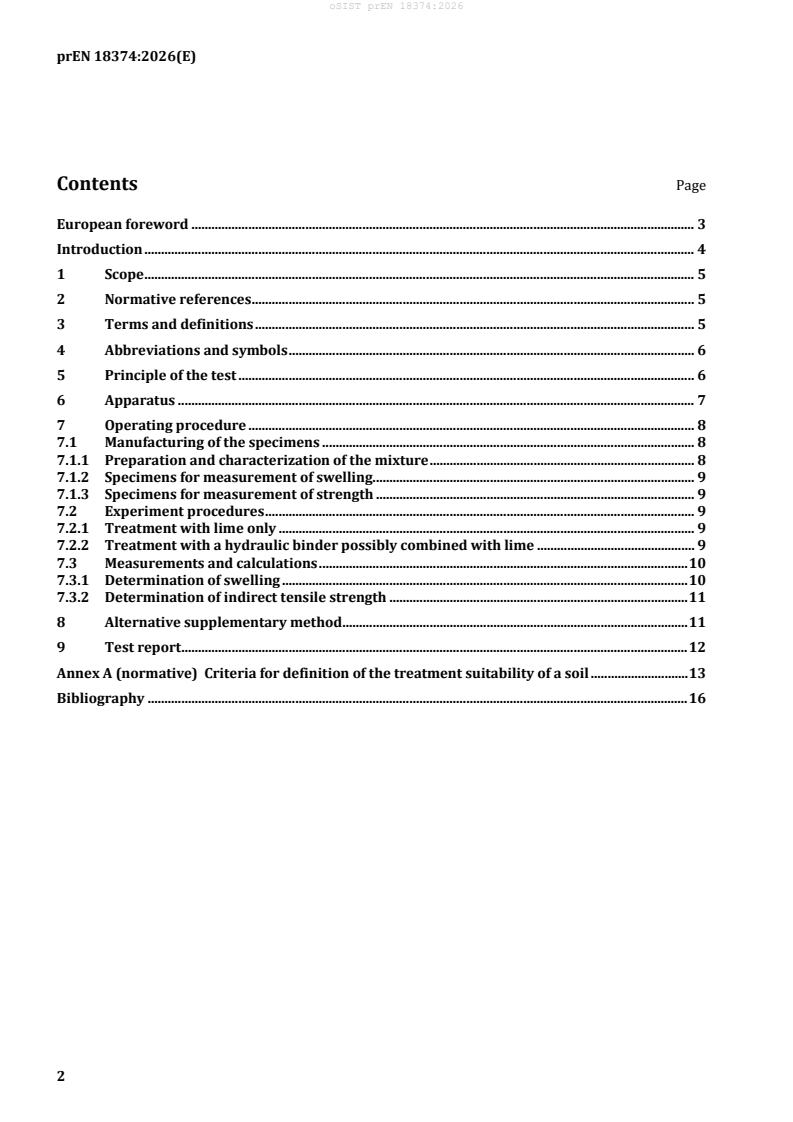
Contents Page
European foreword . 3
Introduction . 4
1 Scope . 5
2 Normative references . 5
3 Terms and definitions . 5
4 Abbreviations and symbols . 6
5 Principle of the test . 6
6 Apparatus . 7
7 Operating procedure . 8
7.1 Manufacturing of the specimens . 8
7.1.1 Preparation and characterization of the mixture . 8
7.1.2 Specimens for measurement of swelling. 9
7.1.3 Specimens for measurement of strength . 9
7.2 Experiment procedures . 9
7.2.1 Treatment with lime only . 9
7.2.2 Treatment with a hydraulic binder possibly combined with lime . 9
7.3 Measurements and calculations . 10
7.3.1 Determination of swelling . 10
7.3.2 Determination of indirect tensile strength . 11
8 Alternative supplementary method . 11
9 Test report . 12
Annex A (normative) Criteria for definition of the treatment suitability of a soil . 13
Bibliography . 16
European foreword
This document (prEN 18374:2026) has been prepared by Technical Committee CEN/TC 396
“Earthworks”, the secretariat of which is held by AFNOR.
This document is currently submitted to the CEN Enquiry.
Introduction
The purpose of the test for determining the treatment suitability of a soil is to detect the risk of swelling
and/or failure to a set of material treated with lime and/or hydraulic binders. In fact, the
material/treatment product reaction can sometimes be disrupted, even inhibited, by mineral or chemical
elements present in the material or in the water supplied, making the treatment uncertain or
unacceptable. The interaction of the material with the treatment product tested then creates a pathology
that might manifest as significant swelling and/or insufficient hydraulic setting or even non-setting.
This test also specifies the criteria considered for treatment suitability, in Annex A.
NOTE This test does not allow identification of the specific nature of the possible disruption.
1 Scope
This document specifies a test method to determine the suitability of a soil to be treated with lime and/or
hydraulic binders, with regard to volumetric swelling and mechanical strength, within a period not
exceeding two to three weeks.
This test can be integrated into the general method of a study of treatment of materials with lime and/or
a hydraulic binder, in compliance with standard EN 16907-4.
It is applicable to soils and alternative (or anthropogenic) materials treated with lime and/or hydraulic
binders for the construction of embankments and capping layers; in the areas of roads, railways and
airports; industrial or commercial platforms; hydraulic works and road foundations.
The results of this test:
— are only valid for the configuration tested (soil, treatment product, dosage);
— are in no case usable for dimensioning a structure including treated materials.
The values currently accepted to define treatment suitability are indicated for information in Annex A.
2 Normative references
The following reference documents are indispensable for the application of this document. For dated
references, only the edition cited applies. For undated references, the latest edition of the referenced
document (including any amendments) applies.
EN 13286-2, Unbound and hydraulically bound mixtures - Part 2: Test methods for laboratory reference
density and water content - Proctor compaction
EN 459-1, Building lime - Part 1: definitions, specifications and conformity criteria
EN 13282-1, Hydraulic road binders - Part 1: Rapid hardening hydraulic road binders - Composition,
specifications and conformity criteria
EN 13282-2, Hydraulic road binders - Part 2: Normal hardening hydraulic road binders - Composition,
specifications and conformity criteria
EN 13286-42, Unbound and hydraulically bound mixtures - Part 42: Test method for the determination of
the indirect tensile strength of hydraulically bound mixtures
EN 13286-53:2004, Unbound and hydraulically bound mixtures - Part 53: Methods for the manufacture of
test specimens of hydraulically bound mixtures using axial compression
3 Terms and definitions
For the purposes of this document, the following terms and definitions apply.
3.1
curing time
time period between the completion of preparation of test specimens and their immersion
3.2
immersion time
time period after the end of curing, during which the test specimens are kept completely underwater
3.3
material
soil or alternative (or anthropogenic) material
[SOURCE: EN 16907-2]
3.4
hydraulic binder
cement or hydraulic road binder
Note to entry: This term can also apply to non-standard products.
[SOURCE: EN 197-1, EN 13282 (all parts) and EN 16907-4.]
3.5
treatment product
product added to a material and composed of either a hydraulic binder only, or a hydraulic binder with
lime, or lime only
4 Abbreviations and symbols
For the purposes of this document, the following abbreviations and symbols apply to the entire
document, unless otherwise specified.
d diameter of tested specimens, expressed in centimetres
h height of tested specimens, expressed in centimetres
ρ density of water, expressed in grams per cubic centimetre
w
Initial volume immediately after the specimen is released from the mould, expressed in
V
cubic centimetres
sum of the final volume of the specimen after immersion, the volume of all elastics and
V
containment band, expressed in cubic centimetres
V volume of all elastics and containment band, expressed in cubic centimetres
V final volume of the specimen after immersion, expressed in cubic centimetres
volumetric swelling of the specimen after maturation, expressed as a percentage
GV
R indirect tensile strength, expressed in megapascals
it
ρ dry density at optimum normal Proctor
dOPN
w water content at optimum normal Proctor
OPN
m submerged mass of the whole determined by hydrostatic weighing
m mass in open air of the whole ‘specimen, containment bands and elastics’ after immersion
5 Principle of the test
This test makes it possible to accelerate the phenomena of hydraulic setting and any potential swelling
by application of particular conditions (curing time, immersion in water at 40°C for 7 days) in accordance
with the terms indicated in articles 7 and 8 of this document.
Annex A gives an example of criteria used to define the treatment suitability of a soil following use.
6 Apparatus
The equipment shall comprise of:
— a mixer such as the one suggested in EN 13286-2 which is able to make a homogeneous mixture of
the material with the treatment product(s) under consideration;
— a press, used for manufacture of specimens, as defined in EN 13286-53;
— a moulding set comprising (see Figure 1):
o a counter-mould,
o two compacting pistons,
o five cases (at a minimum),
o a pair of spacer half shells as defined in Table 2 of EN 13286-53:2004,
o a thermostatic device capable of keeping a volume of water sufficient for complete immersion of
the specimens being tested at (40 ± 2)°C,
o a hydrostatic weighing set for the specimens, fitting on a scale whose precision is compatible
with the requirements defined in 6.3,
o a press, used for crushing of specimens, as defined in EN 13286-42;
— other common devices and materials:
o at least 3 containment bands for the specimens, cut from a
...