


EN 1439:2017
(Main)LPG equipment and accessories - Procedure for checking transportable refillable LPG cylinders before, during and after filling
General Information
- Abstract
This document specifies the procedures to be adopted when checking transportable refillable LPG cylinders before, during and after filling.
This document applies to transportable refillable LPG cylinders of water capacity not exceeding 150 l and deemed to be fitted with valves designed according to EN ISO 14245 [4] and EN ISO 15995 [5].
This document does not cover the requirements for filling LPG cylinders that are designed and equipped for filling by the user.
This document does not cover the requirements for filling LPG containers on vehicles.
This document is applicable to the following:
- welded and brazed steel LPG cylinders with a specified minimum wall thickness (see EN 1442 and EN 12807 [1] or an equivalent standard);
- welded steel LPG cylinders without specified minimum wall thickness (see EN 14140 or an equivalent standard);
- welded aluminium LPG cylinders (see EN 13110 [2] or an equivalent standard);
- composite LPG cylinders (see EN 14427 or an equivalent standard); and
- over-moulded cylinders (OMC).
Specific requirements for the different types of cylinders are detailed in Annex A, Annex B, Annex C, Annex D and Annex G.
This draft standard is intended to be applied to cylinders complying with RID/ADR [6] [7] (including pi marked cylinders) and also to existing non RID/ADR cylinder populations.
- Status
- Withdrawn
- Publication Date
- 20-Jun-2017
- Withdrawal Date
- 22-Sep-2026
- Technical Committee
- CEN/TC 286 - Liquefied petroleum gas equipment and accessories
- Current Stage
- 9960 - Withdrawal effective - Withdrawal
- Start Date
- 27-Oct-2021
- Completion Date
- 23-Sep-2026
Buy Documents


Relations
- Effective Date
- 28-Jun-2017
- Effective Date
- 03-Nov-2021
- Effective Date
- 29-Apr-2026
- Effective Date
- 28-Jan-2026
- Effective Date
- 28-Jan-2026
- Effective Date
- 28-Jan-2026
- Refers
EN 10028-7:2016 - Flat products made of steels for pressure purposes - Part 7: Stainless steels - Effective Date
- 28-Jan-2026
- Effective Date
- 28-Jan-2026
- Effective Date
- 28-Jan-2026
- Effective Date
- 28-Jan-2026
- Effective Date
- 28-Jan-2026
- Refers
EN 12816:2010 - LPG equipment and accessories - Transportable refillable LPG cylinders - Disposal - Effective Date
- 28-Jan-2026
- Effective Date
- 28-Jan-2026
- Effective Date
- 28-Jan-2026
- Effective Date
- 28-Jan-2026
Buy Documents
Get Certified
Connect with accredited certification bodies for this standard

Institut za varilstvo d.o.o. (Welding Institute)
Slovenia's leading welding institute since 1952. ISO 3834, EN 1090, pressure equipment certification, NDT personnel, welder qualification. Only IIW Au
Sponsored listings
Frequently Asked Questions
EN 1439:2017 is a standard published by the European Committee for Standardization (CEN). Its full title is "LPG equipment and accessories - Procedure for checking transportable refillable LPG cylinders before, during and after filling". This standard covers: This document specifies the procedures to be adopted when checking transportable refillable LPG cylinders before, during and after filling. This document applies to transportable refillable LPG cylinders of water capacity not exceeding 150 l and deemed to be fitted with valves designed according to EN ISO 14245 [4] and EN ISO 15995 [5]. This document does not cover the requirements for filling LPG cylinders that are designed and equipped for filling by the user. This document does not cover the requirements for filling LPG containers on vehicles. This document is applicable to the following: - welded and brazed steel LPG cylinders with a specified minimum wall thickness (see EN 1442 and EN 12807 [1] or an equivalent standard); - welded steel LPG cylinders without specified minimum wall thickness (see EN 14140 or an equivalent standard); - welded aluminium LPG cylinders (see EN 13110 [2] or an equivalent standard); - composite LPG cylinders (see EN 14427 or an equivalent standard); and - over-moulded cylinders (OMC). Specific requirements for the different types of cylinders are detailed in Annex A, Annex B, Annex C, Annex D and Annex G. This draft standard is intended to be applied to cylinders complying with RID/ADR [6] [7] (including pi marked cylinders) and also to existing non RID/ADR cylinder populations.
This document specifies the procedures to be adopted when checking transportable refillable LPG cylinders before, during and after filling. This document applies to transportable refillable LPG cylinders of water capacity not exceeding 150 l and deemed to be fitted with valves designed according to EN ISO 14245 [4] and EN ISO 15995 [5]. This document does not cover the requirements for filling LPG cylinders that are designed and equipped for filling by the user. This document does not cover the requirements for filling LPG containers on vehicles. This document is applicable to the following: - welded and brazed steel LPG cylinders with a specified minimum wall thickness (see EN 1442 and EN 12807 [1] or an equivalent standard); - welded steel LPG cylinders without specified minimum wall thickness (see EN 14140 or an equivalent standard); - welded aluminium LPG cylinders (see EN 13110 [2] or an equivalent standard); - composite LPG cylinders (see EN 14427 or an equivalent standard); and - over-moulded cylinders (OMC). Specific requirements for the different types of cylinders are detailed in Annex A, Annex B, Annex C, Annex D and Annex G. This draft standard is intended to be applied to cylinders complying with RID/ADR [6] [7] (including pi marked cylinders) and also to existing non RID/ADR cylinder populations.
EN 1439:2017 is classified under the following ICS (International Classification for Standards) categories: 23.020.30 - Pressure vessels, gas cylinders; 23.020.35 - Gas cylinders. The ICS classification helps identify the subject area and facilitates finding related standards.
EN 1439:2017 has the following relationships with other standards: It is inter standard links to EN 1439:2008, EN 1439:2021, EN 16728:2026, EN 14140:2014, EN 14427:2022, EN 13952:2017, EN 10028-7:2016, EN 1440:2016+A2:2020, EN 15202:2019, EN 16728:2016+A2:2020, EN 1442:2017, EN 12816:2010, EN 14894:2021, EN 1459-1:2017, CEN/TS 1459-8:2018. Understanding these relationships helps ensure you are using the most current and applicable version of the standard.
EN 1439:2017 is associated with the following European legislation: EU Directives/Regulations: 2008/68/EC; Standardization Mandates: M/086. When a standard is cited in the Official Journal of the European Union, products manufactured in conformity with it benefit from a presumption of conformity with the essential requirements of the corresponding EU directive or regulation.
EN 1439:2017 is available in PDF format for immediate download after purchase. The document can be added to your cart and obtained through the secure checkout process. Digital delivery ensures instant access to the complete standard document.
Standards Content (Sample)
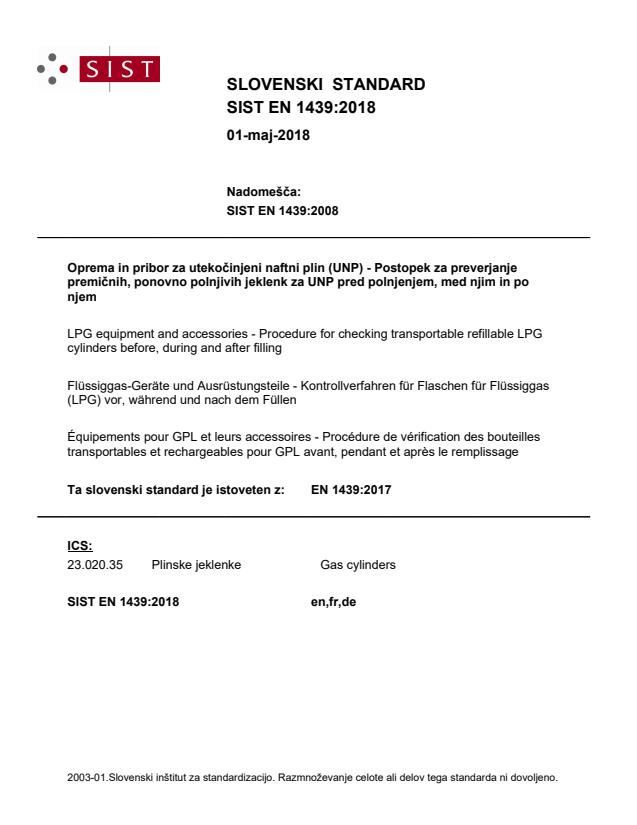
2003-01.Slovenski inštitut za standardizacijo. Razmnoževanje celote ali delov tega standarda ni dovoljeno.SUHYHUMDQMHQMHPFlüssiggas-Geräte und Ausrüstungsteile - Kontrollverfahren für Flaschen für Flüssiggas (LPG) vor, während und nach dem FüllenÉquipements pour GPL et leurs accessoires - Procédure de vérification des bouteilles transportables et rechargeables pour GPL avant, pendant et après le remplissageLPG equipment and accessories - Procedure for checking transportable refillable LPG cylinders before, during and after filling23.020.35Plinske jeklenkeGas cylindersICS:Ta slovenski standard je istoveten z:EN 1439:2017SIST EN 1439:2018en,fr,de01-maj-2018SIST EN 1439:2018SLOVENSKI
STANDARDSIST EN 1439:20081DGRPHãþD
EUROPEAN STANDARD NORME EUROPÉENNE EUROPÄISCHE NORM
EN 1439
June
t r s y ICS
t uä r t rä u w Supersedes EN
s v u {ã t r r zEnglish Version
LPG equipment and accessories æ Procedure for checking transportable refillable LPG cylinders beforeá during and after filling Équipements pour GPL et leurs accessoires æ Procédure de vérification des bouteilles transportables et rechargeables pour GPL avantá pendant et après le remplissage
FlüssiggasæGeräte und Ausrüstungsteile æ vorá während und nach dem Füllen This European Standard was approved by CEN on
s r April
t r s yä
egulations which stipulate the conditions for giving this European Standard the status of a national standard without any alterationä Upætoædate lists and bibliographical references concerning such national standards may be obtained on application to the CENæCENELEC Management Centre or to any CEN memberä
translation under the responsibility of a CEN member into its own language and notified to the CENæCENELEC Management Centre has the same status as the official versionsä
CEN members are the national standards bodies of Austriaá Belgiumá Bulgariaá Croatiaá Cyprusá Czech Republicá Denmarká Estoniaá Finlandá Former Yugoslav Republic of Macedoniaá Franceá Germanyá Greeceá Hungaryá Icelandá Irelandá Italyá Latviaá Lithuaniaá Luxembourgá Maltaá Netherlandsá Norwayá Polandá Portugalá Romaniaá Serbiaá Slovakiaá Sloveniaá Spainá Swedená Switzerlandá Turkey and United Kingdomä
EUROPEAN COMMITTEE FOR STANDARDIZATION COMITÉ EUROPÉEN DE NORMALISATION EUROPÄISCHES KOMITEE FÜR NORMUNG
CEN-CENELEC Management Centre:
Avenue Marnix 17,
B-1000 Brussels
t r s y CEN All rights of exploitation in any form and by any means reserved worldwide for CEN national Membersä Refä Noä EN
s v u {ã t r s y ESIST EN 1439:2018
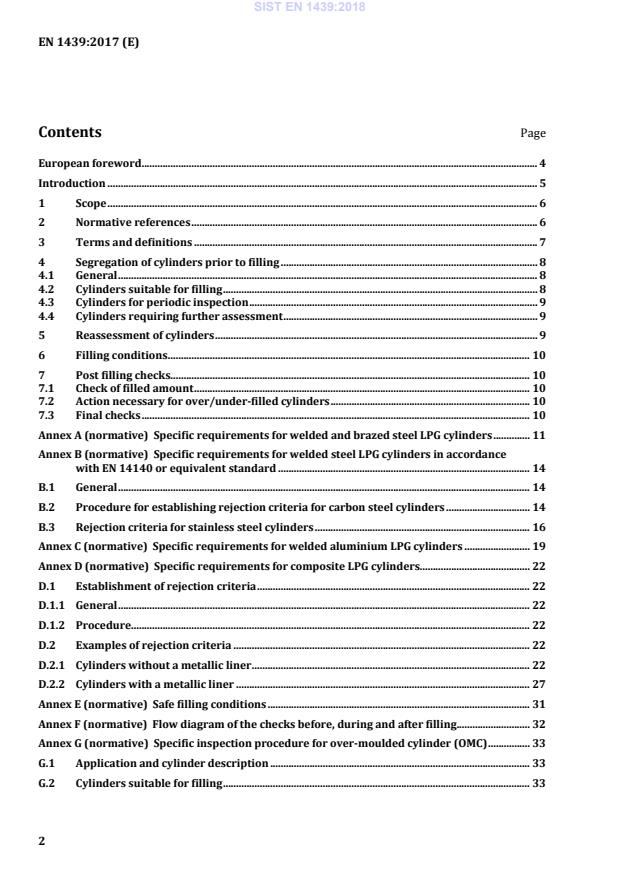
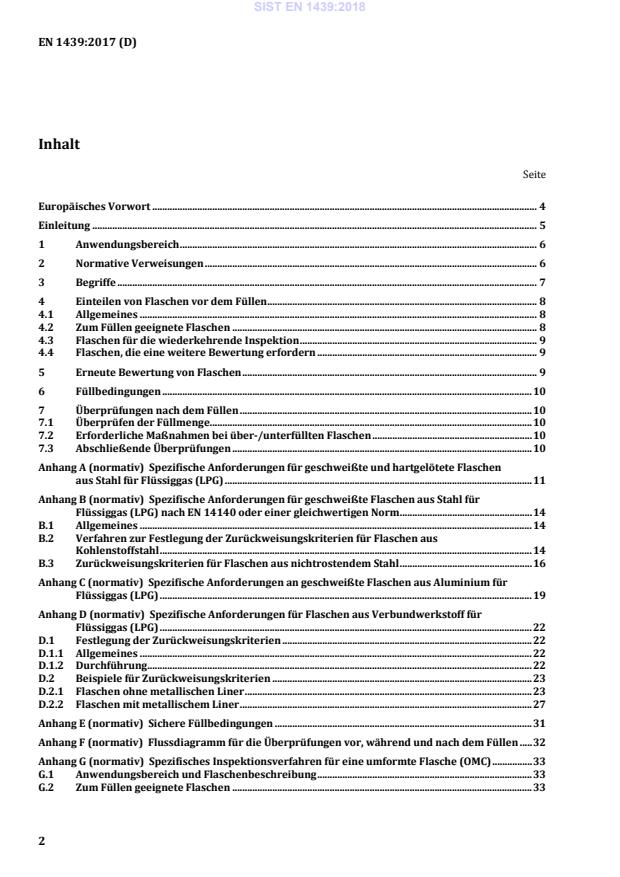
Specific requirements for welded and brazed steel LPG cylinders . 11 Annex B (normative)
Specific requirements for welded steel LPG cylinders in accordance with EN 14140 or equivalent standard . 14 B.1 General . 14 B.2 Procedure for establishing rejection criteria for carbon steel cylinders . 14 B.3 Rejection criteria for stainless steel cylinders . 16 Annex C (normative)
Specific requirements for welded aluminium LPG cylinders . 19 Annex D (normative)
Specific requirements for composite LPG cylinders. 22 D.1 Establishment of rejection criteria . 22 D.1.1 General . 22 D.1.2 Procedure. 22 D.2 Examples of rejection criteria . 22 D.2.1 Cylinders without a metallic liner . 22 D.2.2 Cylinders with a metallic liner . 27 Annex E (normative)
Safe filling conditions . 31 Annex F (normative)
Flow diagram of the checks before, during and after filling. 32 Annex G (normative)
Specific inspection procedure for over-moulded cylinder (OMC) . 33 G.1 Application and cylinder description . 33 G.2 Cylinders suitable for filling . 33 SIST EN 1439:2018
Example of an Over-Moulded Cylinder . 35 Bibliography . 36
— welded and brazed steel LPG cylinders with a specified minimum wall thickness (see EN 1442 and EN 12807 [1] or an equivalent standard); — welded steel LPG cylinders without specified minimum wall thickness (see EN 14140 or an equivalent standard); — welded aluminium LPG cylinders (see EN 13110 [2] or an equivalent standard); — composite LPG cylinders (see EN 14427 or an equivalent standard); and — over-moulded cylinders (OMC). Specific requirements for the different types of cylinders are detailed in Annex A, Annex B, Annex C, Annex D and Annex G. This draft standard is intended to be applied to cylinders complying with RID/ADR [6] [7] (including pi marked cylinders) and also to existing non RID/ADR cylinder populations. 2 Normative references The following documents, in whole or in part, are normatively referenced in this document and are indispensable for its application. For dated references, only the edition cited applies. For undated references, the latest edition of the referenced document (including any amendments) applies. EN 549, Rubber materials for seals and diaphragms for gas appliances and gas equipment EN 1440, LPG equipment and accessories - Transportable refillable traditional welded and brazed steel Liquefied Petroleum Gas (LPG) cylinders - Periodic inspection EN 1442, LPG equipment and accessories — Transportable refillable welded steel cylinders for LPG — Design and construction EN 10028-7, Flat products made of steels for pressure purposes - Part 7: Stainless steels EN 12816, LPG equipment and accessories - Transportable refillable LPG cylinders - Disposal EN 13952, LPG cylinders - Filling procedures EN 14140, LPG equipment and accessories - Transportable refillable welded steel cylinders for LPG - Alternative design and construction SIST EN 1439:2018
Specific requirements for welded and brazed steel LPG cylinders Rejection limits for physical, material and other defects on the cylinder shell are given in Table A.1, Table A.2 and Table A.3. Table A.1 — Physical defects in the cylinder wall Defect Description Rejection limit Bulge Visible swelling of the cylinder. All. Dent A depression in the cylinder that has neither penetrated nor removed metal, when its width at any point is greater than 2 % of the external cylinder diameter. When the depth of the dent exceeds 25 % of its width at any point a. Cut or gouge A sharp impression where metal has been removed or redistributed. Where the original calculated wall thickness is known: Depth of cut or gouge is such that the undamaged (remaining) wall is less than the minimum calculated wall thickness. Where the original calculated wall thickness is not known: All. Dent containing cut or gouge A depression in the cylinder within which there is a cut or gouge. When the size of the dent, cut or gouge exceeds the dimensions for rejection as an individual defect. Crack A split or rift in the cylinder shell. All. Lamination Layering of the material within the cylinder wall appearing as a discontinuity, crack, lap or bulge at the surface. All. a Appearance (e.g. sharp dent) and location (e.g. on shoulder of the cylinder) also play a part in the evaluation of dent severity. Table A.2 — Corrosion on the cylinder wall Type of corrosion Description Rejection limit Isolated corrosion pits A pitting of metal occurring in isolated areas at a concentration not greater than 1 pit per 500 mm2 of surface area. When the depth of discrete pits exceeds 0,6 mm. A greater depth of corrosion can be accepted provided that depth of corrosion does not reduce the wall thickness below the minimum calculated wall thickness. SIST EN 1439:2018
...
2003-01.Slovenski inštitut za standardizacijo. Razmnoževanje celote ali delov tega standarda ni dovoljeno.SUHYHUMDQMHQMHPFlüssiggas-Geräte und Ausrüstungsteile - Kontrollverfahren für Flaschen für Flüssiggas (LPG) vor, während und nach dem FüllenÉquipements pour GPL et leurs accessoires - Procédure de vérification des bouteilles transportables et rechargeables pour GPL avant, pendant et après le remplissageLPG equipment and accessories - Procedure for checking transportable refillable LPG cylinders before, during and after filling23.020.35Plinske jeklenkeGas cylindersICS:Ta slovenski standard je istoveten z:EN 1439:2017SIST EN 1439:2018en,fr,de01-maj-2018SIST EN 1439:2018SLOVENSKI
STANDARDSIST EN 1439:20081DGRPHãþD
EUROPÄISCHE NORM EUROPEAN STANDARD NORME EUROPÉENNE
EN 1439
Juni
t r s y ICS
t uä r t rä u w Ersatz für EN
s v u {ã t r r zDeutsche Fassung
FlüssiggasæGeräte und Ausrüstungsteile æ Kontrollverfahren Füllen LPG equipment and accessories æ Procedure for checking transportable refillable LPG cylinders beforeá during and after filling
Équipements pour GPL et leurs accessoires æ Procédure de vérification des bouteilles transportables et rechargeables pour GPL avantá pendant et après le remplissage Diese Europäische Norm wurde vom CEN am
s rä April
t r s y angenommenä
ung zu erfüllená in der die Bedingungen festgelegt sindá unter denen dieser Europäischen Norm ohne jede Änderung der Status einer nationalen Norm zu geben istä Auf dem letzten Stand befindliche Listen dieser nationalen Normen mit ihren bibliographischen Angaben sind beim CENæCENELECæManagementæZentrum oder bei jedem CENæMitglied auf Anfrage erhältlichä
Spracheá die von einem CENæMitglied in eigener Verantwortung durch Übersetzung in seine Landessprache gemacht und dem ManagementæZentrum mitgeteilt worden istá hat den gleichen Status wie die offiziellen Fassungenä
CENæMitglieder sind die nationalen Normungsinstitute von Belgiená Bulgariená Dänemarká Deutschlandá der ehemaligen jugoslawischen Republik Mazedoniená Estlandá Finnlandá Frankreichá Griechenlandá Irlandá Islandá Italiená Kroatiená Lettlandá Litauená Luxemburgá Maltaá den Niederlandená Norwegená Österreichá Polená Portugalá Rumäniená Schwedená der Schweizá Serbiená der Slowakeiá Sloweniená Spaniená der Tschechischen Republiká der Türkeiá Ungarná dem Vereinigten Königreich und Zypernä
EUROPÄISCHES KOMITEE FÜR NORMUNG EUROPEAN COMMITTEE FOR STANDARDIZATION
COMITÉ EUROPÉEN DE NORMALISATION
CEN-CENELEC Management-Zentrum:
Avenue Marnix 17,
B-1000 Brüssel
t r s y CEN Alle Rechte der Verwertungá gleich in welcher Form und in welchem Verfahrená sind weltweit den nationalen Mitgliedern von CEN vorbehaltenä Refä Nrä EN
s v u {ã t r s y DSIST EN 1439:2018
Seite Europäisches Vorwort . 4 Einleitung . 5 1 Anwendungsbereich . 6 2 Normative Verweisungen . 6 3 Begriffe . 7 4 Einteilen von Flaschen vor dem Füllen . 8 4.1 Allgemeines . 8 4.2 Zum Füllen geeignete Flaschen . 8 4.3 Flaschen für die wiederkehrende Inspektion . 9 4.4 Flaschen, die eine weitere Bewertung erfordern . 9 5 Erneute Bewertung von Flaschen . 9 6 Füllbedingungen . 10 7 Überprüfungen nach dem Füllen . 10 7.1 Überprüfen der Füllmenge . 10 7.2 Erforderliche Maßnahmen bei über-/unterfüllten Flaschen . 10 7.3 Abschließende Überprüfungen . 10
(normativ)
Spezifische Anforderungen für geschweißte und hartgelötete Flaschen Anhang Aaus Stahl für Flüssiggas (LPG) . 11
(normativ)
Spezifische Anforderungen für geschweißte Flaschen aus Stahl für Anhang BFlüssiggas (LPG) nach EN 14140 oder einer gleichwertigen Norm . 14 B.1 Allgemeines . 14 B.2 Verfahren zur Festlegung der Zurückweisungskriterien für Flaschen aus Kohlenstoffstahl . 14 B.3 Zurückweisungskriterien für Flaschen aus nichtrostendem Stahl . 16
(normativ)
Spezifische Anforderungen an geschweißte Flaschen aus Aluminium für Anhang CFlüssiggas (LPG) . 19
(normativ)
Spezifische Anforderungen für Flaschen aus Verbundwerkstoff für Anhang DFlüssiggas (LPG) . 22 D.1 Festlegung der Zurückweisungskriterien . 22 D.1.1 Allgemeines . 22 D.1.2 Durchführung . 22 D.2 Beispiele für Zurückweisungskriterien . 23 D.2.1 Flaschen ohne metallischen Liner . 23 D.2.2 Flaschen mit metallischem Liner . 27
(normativ)
Sichere Füllbedingungen . 31 Anhang E (normativ)
Flussdiagramm für die Überprüfungen vor, während und nach dem Füllen . 32 Anhang F (normativ)
Spezifisches Inspektionsverfahren für eine umformte Flasche (OMC) . 33 Anhang GG.1 Anwendungsbereich und Flaschenbeschreibung . 33 G.2 Zum Füllen geeignete Flaschen . 33 SIST EN 1439:2018
(informativ)
Beispiel einer umformten Flasche . 35 Anhang HLiteraturhinweise. 36
Anhang A(normativ)
Spezifische Anforderungen für geschweißte und hartgelötete Flaschen aus Stahl für Flüssiggas (LPG) Zurückweisungsgrenzen für physische, werkstoffbezogene und andere Fehler des Flaschenmantels sind in Tabelle A.1, Tabelle A.2 und Tabelle A.3 aufgeführt. Tabelle A.1 — Physische Fehler in der Flaschenwand Fehler Beschreibung Zurückweisungsgrenze Beule Sichtbare Wölbung der Flasche. Alle Delle Eine Einbeulung in der Flasche, die Metall weder durchstoßen noch entfernt hat und deren Breite an einem beliebigen Punkt 2 % des Außendurchmessers der Flasche überschreitet. Wenn die Tiefe der Delle an einem beliebigen Punkt 25 % ihrer Breite überschreiteta. Einschnitt oder Riefe Ein scharfer Eindruck, bei dem Metall entfernt oder umverteilt wurde. Wenn die ursprünglich berechnete Wanddicke bekannt ist: Wenn Einschnitt oder Riefe so tief sind, dass die unbeschädigte (verbleibende) Wanddicke die berechnete Mindestwanddicke unterschreitet. Wenn die ursprünglich berechnete Wanddicke nicht bekannt ist:
Alle Delle mit Einschnitt oder Riefe Eine Einbeulung in der Flasche, die einen Einschnitt oder eine Riefe enthält. Wenn die Größe von Delle, Einschnitt oder Riefe als Einzelfehler die Maße für die Zurückweisung überschreitet. Riss Eine Aufspaltung oder ein Sprung im Flaschenmantel. Alle Schichtung Schichtung von Material innerhalb der Flaschenwand, welche als Unregelmäßig-keit, Riss, Überlappung oder Beule an der Oberfläche erscheint. Alle a Beschaffenheit (z. B. scharfkantige Delle) und Lage (z. B. an der Flaschenschulter) spielen ebenfalls eine Rolle in der Beurteilung der Delle.
...