


EN 1650:2008+A1:2013
(Main + Amendment)Chemical disinfectants and antiseptics - Quantitative suspension test for the evaluation of fungicidal or yeasticidal activity of chemical disinfectants and antiseptics used in food, industrial, domestic and institutional areas - Test method and requirements (phase 2, step 1)
General Information
- Abstract
This document specifies a test method and the minimum requirements for fungicidal or yeasticidal activity of chemical disinfectant and antiseptic products that form a homogeneous, physically stable preparation when diluted with hard water or - in the case of ready-to-use-products - with water. Products can only be tested at a concentration of 80 % or less as some dilution is always produced by adding the test organisms and interfering substance.
This document applies to products that are used in food, industrial, domestic and institutional areas excluding areas and situations where disinfection is medically indicated and excluding products used on living tissues except those for hand hygiene in the above considered areas. The following areas are at least included:
a) processing, distribution and retailing of:
1) food of animal origin: 2) food of vegetable origin:
- milk and milk products; - beverages;
- meat and meat products; - fruits, vegetables and derivatives (including sugar, distillery ...);
- fish, seafood, and related products; - flour, milling and baking;
- eggs and egg products; - animal feeds;
- animal feeds; - etc.
- etc.
b) institutional and domestic areas:
- catering establishments;
- public areas;
- public transports;
- schools;
- nurseries;
- shops;
- sports rooms;
- waste containers (bins ...);
- hotels;
- dwellings;
- clinically non-sensitive areas of hospitals;
- offices;
- etc.
c) other industrial areas:
- packaging material;
- biotechnology (yeast, proteins, enzymes, ...);
- pharmaceutical;
- cosmetics and toiletries;
- textiles;
- space industry, computer industry;
- etc.
EN 14885 specifies in detail the relationship of the various tests to one another and to use recommendations.
NOTE 1 The method described is intended to determine the activity of commercial formulations or active substances under the conditions in which they are used.
NOTE 2 This method corresponds to a phase 2 step 1 test.
- Status
- Withdrawn
- Publication Date
- 21-May-2013
- Withdrawal Date
- 22-Sep-2026
- Technical Committee
- CEN/TC 216 - Chemical disinfectants and antiseptics
- Drafting Committee
- CEN/TC 216/WG 3 - Food hygiene and domestic and institutional use
- Current Stage
- 9960 - Withdrawal effective - Withdrawal
- Start Date
- 14-Aug-2019
- Completion Date
- 23-Sep-2026



Relations
- Effective Date
- 20-Mar-2013
- Effective Date
- 20-Mar-2013
- Effective Date
- 04-May-2016
- Effective Date
- 25-Aug-2026
- Effective Date
- 28-Jan-2026
- Effective Date
- 28-Jan-2026
Get Certified
Connect with accredited certification bodies for this standard

ECOCERT
Organic and sustainability certification.

Eurofins Food Testing Global
Global leader in food, environment, and pharmaceutical product testing.

Intertek Bangladesh
Intertek certification and testing services in Bangladesh.
Sponsored listings
Frequently Asked Questions
EN 1650:2008+A1:2013 is a standard published by the European Committee for Standardization (CEN). Its full title is "Chemical disinfectants and antiseptics - Quantitative suspension test for the evaluation of fungicidal or yeasticidal activity of chemical disinfectants and antiseptics used in food, industrial, domestic and institutional areas - Test method and requirements (phase 2, step 1)". This standard covers: This document specifies a test method and the minimum requirements for fungicidal or yeasticidal activity of chemical disinfectant and antiseptic products that form a homogeneous, physically stable preparation when diluted with hard water or - in the case of ready-to-use-products - with water. Products can only be tested at a concentration of 80 % or less as some dilution is always produced by adding the test organisms and interfering substance. This document applies to products that are used in food, industrial, domestic and institutional areas excluding areas and situations where disinfection is medically indicated and excluding products used on living tissues except those for hand hygiene in the above considered areas. The following areas are at least included: a) processing, distribution and retailing of: 1) food of animal origin: 2) food of vegetable origin: - milk and milk products; - beverages; - meat and meat products; - fruits, vegetables and derivatives (including sugar, distillery ...); - fish, seafood, and related products; - flour, milling and baking; - eggs and egg products; - animal feeds; - animal feeds; - etc. - etc. b) institutional and domestic areas: - catering establishments; - public areas; - public transports; - schools; - nurseries; - shops; - sports rooms; - waste containers (bins ...); - hotels; - dwellings; - clinically non-sensitive areas of hospitals; - offices; - etc. c) other industrial areas: - packaging material; - biotechnology (yeast, proteins, enzymes, ...); - pharmaceutical; - cosmetics and toiletries; - textiles; - space industry, computer industry; - etc. EN 14885 specifies in detail the relationship of the various tests to one another and to use recommendations. NOTE 1 The method described is intended to determine the activity of commercial formulations or active substances under the conditions in which they are used. NOTE 2 This method corresponds to a phase 2 step 1 test.
This document specifies a test method and the minimum requirements for fungicidal or yeasticidal activity of chemical disinfectant and antiseptic products that form a homogeneous, physically stable preparation when diluted with hard water or - in the case of ready-to-use-products - with water. Products can only be tested at a concentration of 80 % or less as some dilution is always produced by adding the test organisms and interfering substance. This document applies to products that are used in food, industrial, domestic and institutional areas excluding areas and situations where disinfection is medically indicated and excluding products used on living tissues except those for hand hygiene in the above considered areas. The following areas are at least included: a) processing, distribution and retailing of: 1) food of animal origin: 2) food of vegetable origin: - milk and milk products; - beverages; - meat and meat products; - fruits, vegetables and derivatives (including sugar, distillery ...); - fish, seafood, and related products; - flour, milling and baking; - eggs and egg products; - animal feeds; - animal feeds; - etc. - etc. b) institutional and domestic areas: - catering establishments; - public areas; - public transports; - schools; - nurseries; - shops; - sports rooms; - waste containers (bins ...); - hotels; - dwellings; - clinically non-sensitive areas of hospitals; - offices; - etc. c) other industrial areas: - packaging material; - biotechnology (yeast, proteins, enzymes, ...); - pharmaceutical; - cosmetics and toiletries; - textiles; - space industry, computer industry; - etc. EN 14885 specifies in detail the relationship of the various tests to one another and to use recommendations. NOTE 1 The method described is intended to determine the activity of commercial formulations or active substances under the conditions in which they are used. NOTE 2 This method corresponds to a phase 2 step 1 test.
EN 1650:2008+A1:2013 is classified under the following ICS (International Classification for Standards) categories: 71.100.35 - Chemicals for industrial and domestic disinfection purposes. The ICS classification helps identify the subject area and facilitates finding related standards.
EN 1650:2008+A1:2013 has the following relationships with other standards: It is inter standard links to EN 1650:2008, EN 1650:2008/FprA1, EN 1650:2019, ISO 4793:1980, EN 14885:2022, EN 12353:2021. Understanding these relationships helps ensure you are using the most current and applicable version of the standard.
EN 1650:2008+A1:2013 is available in PDF format for immediate download after purchase. The document can be added to your cart and obtained through the secure checkout process. Digital delivery ensures instant access to the complete standard document.
Standards Content (Sample)
2003-01.Slovenski inštitut za standardizacijo. Razmnoževanje celote ali delov tega standarda ni dovoljeno.Chemische Desinfektionsmittel und Antiseptika - Quantitativer Suspensionsversuch zur Bestimmung der fungiziden oder levuroziden Wirkung chemischer Desinfektionsmittel und Antiseptika in den Bereichen Lebensmittel, Industrie, Haushalt und öffentliche Einrichtungen - Prüfverfahren und Anforderungen (Phase 2, Stufe 1)Antiseptiques et désinfectants chimiques - Essai quantitatif de suspension pour l'évaluation de l'activité fongicide ou levuricide des antiseptiques et des désinfectants chimiques utilisés dans le domaine de l'agro-alimentaire, dans l'industrie, dans les domaines domestiques et en collectivité - Méthode d'essai et prescriptions (phase 2, étape 1)Chemical disinfectants and antiseptics - Quantitative suspension test for the evaluation of fungicidal or yeasticidal activity of chemical disinfectants and antiseptics used in food, industrial, domestic and institutional areas - Test method and requirements (phase 2, step 1)71.100.35Kemikalije za dezinfekcijo v industriji in domaChemicals for industrial and domestic disinfection purposesICS:Ta slovenski standard je istoveten z:EN 1650:2008+A1:2013SIST EN 1650:2008+A1:2013en,fr,de01-julij-2013SIST EN 1650:2008+A1:2013SLOVENSKI
STANDARDSIST EN 1650:20081DGRPHãþD
EUROPEAN STANDARD NORME EUROPÉENNE EUROPÄISCHE NORM
EN 1650:2008+A1
May 2013 ICS 71.100.35 Supersedes EN 1650:2008
English Version
Chemical disinfectants and antiseptics - Quantitative suspension test for the evaluation of fungicidal or yeasticidal activity of chemical disinfectants and antiseptics used in food, industrial, domestic and institutional areas - Test method and requirements (phase 2, step 1)
Antiseptiques et désinfectants chimiques - Essai quantitatif de suspension pour l'évaluation de l'activité fongicide ou levuricide des antiseptiques et des désinfectants chimiques utilisés dans le domaine de l'agro-alimentaire, dans l'industrie, dans les domaines domestiques et en collectivité - Méthode d'essai et prescriptions (phase 2, étape 1)
Chemische Desinfektionsmittel und Antiseptika - Quantitativer Suspensionsversuch zur Bestimmung der fungiziden oder levuroziden Wirkung chemischer Desinfektionsmittel und Antiseptika in den Bereichen Lebensmittel, Industrie, Haushalt und öffentliche Einrichtungen - Prüfverfahren und Anforderungen (Phase 2, Stufe 1) This European Standard was approved by CEN on 5 April 2008 and includes Amendment 1 approved by CEN on 28 March 2013.
CEN members are bound to comply with the CEN/CENELEC Internal Regulations which stipulate the conditions for giving this European Standard the status of a national standard without any alteration. Up-to-date lists and bibliographical references concerning such national standards may be obtained on application to the CEN-CENELEC Management Centre or to any CEN member.
This European Standard exists in three official versions (English, French, German). A version in any other language made by translation under the responsibility of a CEN member into its own language and notified to the CEN-CENELEC Management Centre has the same status as the official versions.
CEN members are the national standards bodies of Austria, Belgium, Bulgaria, Croatia, Cyprus, Czech Republic, Denmark, Estonia, Finland, Former Yugoslav Republic of Macedonia, France, Germany, Greece, Hungary, Iceland, Ireland, Italy, Latvia, Lithuania, Luxembourg, Malta, Netherlands, Norway, Poland, Portugal, Romania, Slovakia, Slovenia, Spain, Sweden, Switzerland, Turkey and United Kingdom.
EUROPEAN COMMITTEE FOR STANDARDIZATION
COMITÉ EUROPÉEN DE NORMALISATION
EUROPÄISCHES KOMITEE FÜR NORMUNG
Management Centre:
Avenue Marnix 17,
B-1000 Brussels © 2013 CEN All rights of exploitation in any form and by any means reserved worldwide for CEN national Members. Ref. No. EN 1650:2008+A1:2013: E SIST EN 1650:2008+A1:2013
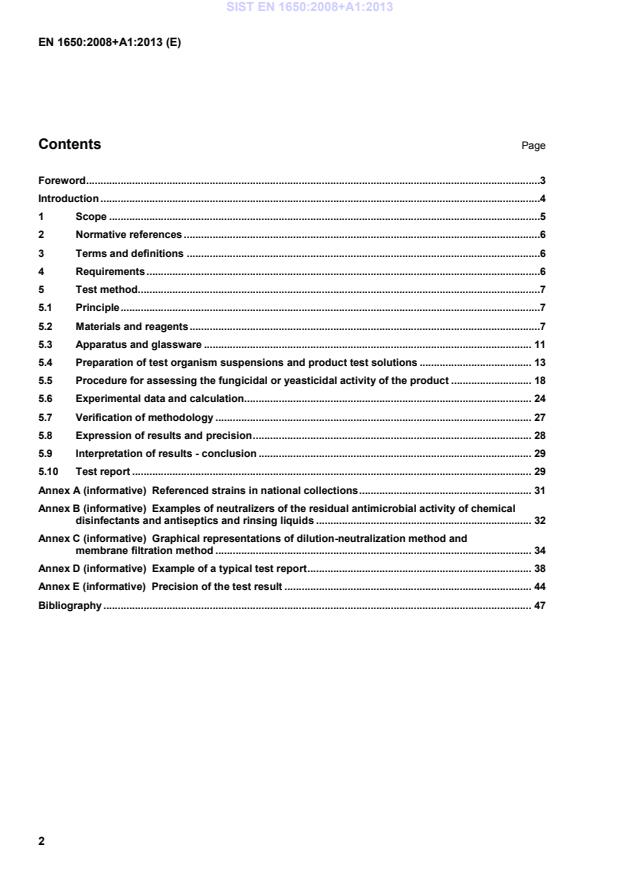
Referenced strains in national collections . 31 Annex B (informative)
Examples of neutralizers of the residual antimicrobial activity of chemical disinfectants and antiseptics and rinsing liquids . 32 Annex C (informative)
Graphical representations of dilution-neutralization method and membrane filtration method . 34 Annex D (informative)
Example of a typical test report . 38 Annex E (informative)
Precision of the test result . 44 Bibliography . 47
!". This European Standard was revised to include the results of a collaborative trial (ANDISTAND), to correct obvious errors and ambiguities, to harmonize the structure and wording with other quantitative suspension tests of CEN/TC 216 (existing or in preparation), and to improve the readability of the standard and thereby make it more understandable. According to the CEN/CENELEC Internal Regulations, the national standards organisations of the following countries are bound to implement this European Standard: Austria, Belgium, Bulgaria, Croatia, Cyprus, Czech Republic, Denmark, Estonia, Finland, Former Yugoslav Republic of Macedonia, France, Germany, Greece, Hungary, Iceland, Ireland, Italy, Latvia, Lithuania, Luxembourg, Malta, Netherlands, Norway, Poland, Portugal, Romania, Slovakia, Slovenia, Spain, Sweden, Switzerland, Turkey and the United Kingdom.
The conditions are intended to cover general purposes and to allow reference between laboratories and product types. Each utilization concentration of the chemical disinfectant or antiseptic found by this test corresponds to defined experimental conditions. However, for some applications the recommendations of use of a product may differ and therefore additional test conditions should be used. SIST EN 1650:2008+A1:2013
a) processing, distribution and retailing of: 1) food of animal origin: 2) food of vegetable origin: milk and milk products; beverages; meat and meat products; fruits, vegetables and derivatives (including sugar, distillery .); fish, seafood, and related products; flour, milling and baking; eggs and egg products; animal feeds; animal feeds; etc. etc.
b) institutional and domestic areas: catering establishments; public areas; public transports; schools; nurseries; shops; sports rooms; waste containers (bins .); hotels; dwellings; clinically non-sensitive areas of hospitals; offices; etc. SIST EN 1650:2008+A1:2013
The fungicidal activity shall be evaluated using the following two test organisms:
Candida albicans (vegetative cells); SIST EN 1650:2008+A1:2013
NOTE For these additional conditions, the concentration defined as a result can be lower than the one obtained under the obligatory test conditions. 5 Test method 5.1 Principle 5.1.1 A sample of the product as delivered and/or diluted with hard water (or water for ready to use products) is added to a test suspension of fungi (yeast cells or mould spores) in a solution of an interfering substance. The mixture is maintained at (20 ± 1) °C for 15 min ± 10 s (obligatory test conditions). At the end of this contact time, an aliquot is taken, and the fungicidal and/or the fungistatic activity in this portion is immediately neutralized or suppressed by a validated method. The method of choice is dilution-neutralization. If a suitable neutralizer cannot be found, membrane filtration is used. The numbers of surviving fungi in each sample are determined and the reduction is calculated. 5.1.2 The test is performed using the vegetative cells of Candida albicans and the spores of Aspergillus niger (fungicidal activity) or only the vegetative cells of Candida albicans (yeasticidal activity) as test organisms (obligatory test conditions). 5.1.3 Additional and optional contact times and temperatures are specified. Additional test organisms can be used. 5.2 Materials and reagents 5.2.1 Test organisms The fungicidal activity shall be evaluated using the following strains as test organisms:1)
Candida albicans ATCC 10231 Aspergillus niger ATCC 16404
The yeasticidal activity shall be evaluated using only Candida albicans. NOTE See annex A for strain references in some other culture collections. The required incubation temperature for these test organisms is (30 ± 1) °C (5.3.2.3). If required for specific applications, additional strains may be chosen from, e.g. for breweries:
1) The ATCC numbers are the collection numbers of strains supplied by the American Type Culture Collection (ATCC). This information is given for the convenience of users of this standard and does not constitute an endorsement by CEN of the product named.
5.2.2 Culture media and reagents 5.2.2.1 General All weights of chemical substances given in this standard refer to the anhydrous salts. Hydrated forms may be used as an alternative, but the weights required shall be adjusted to allow for consequent molecular weight differences. The reagents shall be of analytical grade and/or appropriate for microbiological purposes. They shall be free from substances that are toxic or inhibitory to the test organisms. NOTE 1 To improve reproducibility, it is recommended that commercially available dehydrated material is used for the preparation of culture media. The manufacturer's instructions relating to the preparation of these products should be rigorously followed.
NOTE 2 For each culture medium and reagent, a limitation for use should be fixed. SIST EN 1650:2008+A1:2013
Malt extract
30,0 g
Agar
15,0 g
Water (5.2.2.2)
to 1 000,0 ml The malt extract should be food grade (e.g. Cristomalt powder from Difal) or equivalent that is not highly purified and not only based on maltose (e.g. Malt extract from OXOID) 1). However if there are problems producing at least 75 % spiny spores see 5.4.1.4.2.
Sterilize in the autoclave [5.3.2.1a)]. After sterilization, the pH of the medium shall be equivalent to 5,6 ± 0,2 when measured at (20 ± 1) °C. NOTE In case of encountering problems with neutralization (5.5.1.2 and 5.5.1.3), it may be necessary to add neutralizer to the MEA. Annex B gives guidance on the neutralizers that may be used.". 5.2.2.4 Diluent Tryptone sodium chloride solution, consisting of: Tryptone, pancreatic digest of casein
1,0 g Sodium chloride (NaCl)
8,5 g Water (5.2.2.2)
to 1 000,0 ml
Sterilize in the autoclave [5.3.2.1a)]. After sterilization, the pH of the diluent shall be equivalent to 7,0 ± 0,2 when measured at (20 ± 1) °C. 5.2.2.5 Neutralizer The neutralizer shall be validated for the product being tested in accordance with 5.5.1.2, 5.5.1.3 and 5.5.2. It shall be sterile. NOTE Information on neutralizers that have been found to be suitable for some categories of products is given in Annex B.
1) This information is given for the convenience of users of this European Standard and does not constitute an endorsement by CEN of the product named. Equivalent products may be used if they can be shown to lead to the same results. SIST EN 1650:2008+A1:2013
The hard water shall be freshly prepared under aseptic conditions and used within 12 h. NOTE When preparing the product test solutions (5.4.2), the addition of the product to the hard water produces a different final water hardness in each test tube. In any case the final hardness is lower than 300 mg/l of calcium carbonate (CaCO3) in the test tube. 5.2.2.8 Interfering substance 5.2.2.8.1 General The interfering substance shall be chosen according to the conditions of use laid down for the product. The interfering substance shall be sterile and prepared at 10 times its final concentration in the test. The ionic composition (e.g. pH, calcium and/or magnesium hardness) and chemical composition (e.g. mineral substances, protein, carbohydrates, lipids and detergents) shall be defined. NOTE The term “interfering substance” is used even if it contains more than one substance.
5.2.2.8.2 Clean conditions (bovine albumin solution – low concentration) Dissolve 0,3 g of bovine albumin fraction V (suitable for microbiological purposes) in 100 ml of water (5.2.2.2).
Sterilize by membrane filtration (5.3.2.7), keep in the refrigerator (5.3.2.8) and use within one month. The final concentration of bovine albumin in the test procedure (5.5) is 0,3 g/l. SIST EN 1650:2008+A1:2013
b) by dry heat, in the hot air oven [5.3.2.1b)]
2) Disposable sterile equipment is an acceptable alternative to reusable glassware. 3) Vortex® is an example of a suitable product available commercially. This information is given for the convenience of users of this standard and does not constitute an endorsement by CEN of this product. SIST EN 1650:2008+A1:2013
5.4 Preparation of test organism suspensions and product test solutions 5.4.1 Test organism suspensions (test and validation suspension) 5.4.1.1 General For each test organism, two different suspensions have to be prepared: the “test suspension” to perform the test and the “validation suspension” to perform the controls and method validation. 5.4.1.2 Preservation and stock cultures of test organisms The test organisms and their stock cultures shall be prepared and kept in accordance with EN 12353. 5.4.1.3 Working culture of test organisms 5.4.1.3.1 Candida albicans (yeast) In order to prepare the working culture of Candida albicans (5.2.1), prepare a subculture from the stock culture (5.4.1.2) by streaking onto MEA (5.2.2.3) slopes or plates (5.3.2.10) and incubate (5.3.2.3). After 42 h to 48 h, prepare a second subculture from the first subculture in the same way and incubate for 42 h to 48 h. From this second subculture, a third subculture may be produced in the same way. The second and (if produced) third subcultures are the working cultures. If it is not possible to prepare the second subculture on a particular day, a 72 h subculture may be used for subsequent subculturing, provided that the subculture has been kept in the incubator (5.3.2.3) during the 72 h period. Never produce and use a fourth subculture. ! 5.4.1.3.2 Aspergillus brasiliensis (previously A. niger) (mould) For Aspergillus brasiliensis (previously A. niger) (5.2.1), use only the first subculture grown on MEA (5.2.2.3) in Petri dishes or flasks with ventilated caps (5.3.2.14) and incubate for 7 d to 9 d. No further subculturing is needed. Do not stack the Petri dishes during the incubation to improve the temperature homogenization. At the end of incubation, all the cultures have to show a dark brown or black surface. Cultures with appearance of rare and small white or grey areas might be kept (see Figure 1).
Figure 1 — Photos N°1: A. brasiliensis ATCC 16404 after 7 d of incubation at 30 °C (right cultures)
Figure 2 — Photo N°2: A. brasiliensis ATCC 16404 after 7 d of incubation at 30 °C (wrong culture)" 5.4.1.3.3 Other test organisms (yeasts or moulds) For additional test organisms, any departure from this method of culturing the yeast or the mould or of preparing the suspensions shall be noted, giving the reasons in the test report. 5.4.1.4 Test suspension (“N”) 5.4.1.4.1 Candida albicans The procedure for preparing the Candida albicans test suspension is as follows. a) Take 10 ml of diluent (5.2.2.4) and place in a 100 ml flask with 5 g of glass beads (5.3.2.11). Take the working culture (5.4.1.3.1) and transfer loopfuls of the cells into the diluent (5.2.2.4). The cells should be suspended in the diluent by rubbing the loop against the wet wall of the flask to dislodge the cells before immersing in the diluent. Shake the flask for 3 min using a mechanical shaker [5.3.2.6b)]. Aspirate the suspension from the glass beads and transfer to another tube. b) Adjust the number of cells in the suspension to 1,5 x 10⁷ cfu/ml4) to 5,0 x 10⁷ cfu/ml using diluent (5.2.2.4), estimating the number of cfu by any suitable means. Maintain this test suspension in the water bath at the test temperature θ [5.5.1.1a)] and use within 2 h. NOTE The use of a spectrophotometer for adjusting the number of cells is highly recommended (approximately 620 nm wavelength — cuvette 10 mm path length). Each laboratory should therefore produce calibration data for
4) cfu/ml = colony-forming unit(s) per millilitre. SIST EN 1650:2008+A1:2013
Figure 3 — Photo N°3 Observation of conidiospores under light microscope: presence of smooth (a) and spiny (b) spores (wrong suspension)
Figure 4 — Photo N°4 Observation of conidiospores under light microscope: High concentration of characteristic mature spores with spiny aspect (right suspension)
c) Adjust the number of spores in the suspension to 1,5 x 10⁷ cfu/ml to 5,0 x 10⁷ cfu/ml using the diluent (5.2.2.4), estimating the number of cfu by any suitable means. Use the suspension within 4 h in a water bath controlled at 20 °C ± 1 °C (5.3.2.2). In any case, adjust the temperature according to 5.5.1.4 only immediately before the start of the test (5.5.2 or 5.5.3). The use of a cell counting device for adjusting the number of cells is highly recommended. When using a suitable counting chamber, it is essential to follow the instructions explicitly. Each laboratory should therefore produce calibration data to establish the relationship between the counts obtained using the counting device and the counts (5.4.1.6) obtained by the pour plate or the spread plate technique. Experienced laboratories found a better fit to the required number of spores when the spore suspension count in the device was 10 % to 50 % higher than the number aimed at. d) For counting, prepare 10-5 and 10-6 dilutions of the test suspension using diluent (5.2.2.4). Mix [5.3.2.6a)].
Take a sample of 1,0 ml of each dilution in duplicate and inoculate using the pour plate or thespread plate
technique. 1) When using the pour plate technique, transfer about half of each 1,0 ml sample into separate Petri dishes (i.e. in duplicate = four plates) and add 15 ml to 20 ml of melted MEA (5.2.2.3),cooled to
(45 ± 1) °C. 2) When using the spread plate technique, spread about one quarter of each 1,0 ml sample on an appropriate number (at least four) of surface dried plates containing MEA (5.2.2.3) (i.e. in duplicate – at least eight plates). For incubation and counting see 5.4.1.6." SIST EN 1650:2008+A1:2013
c) For incubation and counting, see 5.4.1.6. 5.4.1.6 Incubation and counting of the test and the validation suspensions For incubation and counting of the test and the validation suspensions, the procedure is as follows. a) Incubate (5.3.2.3) the plates for 42 h to 48 h. Discard any plates that are not countable for any reason. Count the cfu on the plates to determine the total number of cfu.
Only for Aspergillus niger incubate the plates for a further 20 h to 24 h and - if the number of colonies has increased - for a third additional period of 20 h to 24 h. Do not recount plates that no longer show well-separated colonies. Recount the remaining plates. If the number has increased, use only the higher number for further evaluation. b) Note for each plate the exact number of colonies, but record ">165" (for moulds) or ">330" (for yeasts) for any counts higher than 165 and 330 respectively and determine the Vc values according to 5.6.2.2. c) Calculate the numbers of cfu/ml in the test suspension “N” and in the validation suspension “Nv” using the methods given in 5.6.2.3 and 5.6.2.5. Verify according to 5.7. 5.4.2 Product test solutions
The concentration of a product test solution shall be 1,25 times the desired test concentration because it is diluted to 80 % during the test and the method validation (5.5.2 or 5.5.3). Product test solutions shall be prepared in hard water (5.2.2.7) at minimum three different concentrations to include one concentration in the active range and one concentration in the non-active range (5.8.2). The product as received may be used as one of the product test solutions, in this case the highest tested concentration is 80%.
Dilutions of ready-to-use products, i.e. products that are not diluted when applied, shall be prepared in water (5.2.2.2). For solid products, dissolve the product as received by weighing at least 1,0 g ± 10 mg of the product in a volumetric flask and filling up with hard water (5.2.2.7). Subsequent dilutions (lower concentrations) shall be prepared in volumetric flasks (5.3.2.12) on a volume/volume basis in hard water (5.2.2.7). For liquid products, dilutions of the product shall be prepared with hard water (5.2.2.7) on a volume/volume basis using volumetric flasks (5.3.2.12). The product test solutions shall be prepared freshly and used in the test within 2 h. They shall give a physically homogeneous preparation that is stable during the whole procedure. If during the procedure a visible inhomogeneity appears due to the formation of a precipitate or flocculant (for example, through the addition of the interfering substance), it shall be recorded in the test report. NOTE Counting micro-organisms embedded in a precipitate or flocculant is difficult and unreliable. The concentration of the product stated in the test report shall be the desired test concentration. Record the test concentration in terms of mass per volume or volume per volume and details of the product sample as received. SIST EN 1650:2008+A1:2013
additional temperatures may be chosen from 4 °C, 10 °C or 40 °C; the allowed deviation for each chosen temperature is ± 1 °C; b) contact time t (in min): the obligatory contact time to be tested is t = 15 min; additional contact times may be chosen from 1 min, 5 min, 30 min or 60 min; the allowed deviation for each chosen contact time is ± 10 s (except for 1 min: ± 5 s); c) interfering substance: the obligatory interfering substance to be tested is 0,3 g/l bovine albumin (5.2.2.8.2) for clean conditions or 3 g/l bovine albumin (5.2.2.8.3) for dirty conditions according to practical applications; additional interfering substances as given in 5.2.2.8 shall be chosen according to the field of application specified for the product; SIST EN 1650:2008+A1:2013
5.5.1.3 General instructions for validation and control procedures The neutralization and/or removal of the fungicidal and/or fungistatic activity of the product shall be controlled and validated - only for the highest product test concentration - for each of the used test organisms and for each experimental condition (interfering substance, temperature, contact time). These procedures (experimental condition control, neutralizer or filtration control and method validation) shall be performed at the same time with the test and with the same neutralizer – or rinsing liquid – used in the test. In the case of ready-to-use-products use water (5.2.2.2) instead of hard water. If because of problems with neutralization, a neutralizer has been added to MEA (5.5.1.2) used for the validation and control procedures the MEA used for the test shall contain the same amount of this neutralizer as well. 5.5.1.4 Equilibration of temperature Prior to testing, equilibrate all reagents (product test solutions (5.4.2), test suspension (5.4.1.4), validation suspension (5.4.1.5), diluent (5.2.2.4), hard water (5.2.2.7) and interfering substance (5.2.2.8) to the test temperature θ= [5.5.1.1a)] using the water bath (5.3.2.2) controlled at θ. Check that the temperature of the reagents is stabilized at θ. The neutralizer (5.2.2.5) or the rinsing liquid (5.2.2.6) and water (5.2.2.2) shall be equilibrated at a temperature of (20 ± 1) °C. In the case of ready-to-use-products, water (5.2.2.2) shall be additionally equilibrated to θ=.
5.5.1.5 Precautions for manipulation of test organisms Do not touch the upper part of the test tube sides when adding the test or the validation suspensions (5.4.1). 5.5.2 Dilution-neutralization method5)
5) For a graphical representation of this method see C.1. SIST EN 1650:2008+A1:2013
At the end of this time, add 8,0 ml of one of the product test solutions (5.4.2). Restart the stopwatch at the beginning of the addition. Mix [5.3.2.6a)] and place the tube in a water bath controlled at θ for the chosen contact time t [5.5.1.1b)]. Just before the end of t, mix [5.3.2.6a)] again. b) At the end of t, take a 1,0 ml sample of the test mixture "Na" and transfer into a tube containing 8,0 ml neutralizer (5.2.2.5) and 1,0 ml water (5.2.2.2). Mix [5.3.2.6a)] and place in a water bath controlled at (20 ± 1)°C. After a neutralization time of 5 min ± 10 s, mix and immediately take a sample of 1,0 ml of the neutralized test mixture "Na" (containing neutralizer, product test solution, interfering substance and test suspension) in duplicate and inoculate using the pour plate or spread plate technique. 1) When using the pour plate technique, pipette each 1,0 ml sample into separate Petri dishes and add 15 ml to 20 ml of melted MEA (5.2.2.3), cooled to (45 ± 1) °C.
2) When using the spread
...