


EN 16252:2012
(Main)Machines for compacting waste materials or recyclable fractions - Horizontal baling presses - Safety requirements
General Information
- Abstract
This European Standard specifies the safety requirements for the design, manufacture and information for safe use of horizontal baling presses for compacting waste material or recyclable fractions (e.g. paper, plastics, textiles, cans, cardboard, mixed waste), hereafter referred to as materials. It covers only machines fed by conveyors or by feed hoppers where the bales are bound manually or automatically. The feed hoppers covered by this European Standard are only fed mechanically or by hand.
The scope of this European Standard includes any mechanical feed equipment, such as belt type loading and feed conveyors or bin lifts, forming an integral part of the baling press assembly. However, pneumatic conveying systems are outside the scope of this European Standard.
This European Standard does not apply to cranes, lift trucks or other mobile plant used to load materials into the feed hopper. Nor does it apply to hazards arising from loading the feed hopper using cranes, lift trucks or other mobile plant.
This European Standard does not apply to pre-conditioning equipment connected at the inlet side of the feed hopper (e.g. sorter, shredder, stand-alone perforator), nor to equipment at the outlet side of the baling press.
This European Standard does not deal with suction and de-dusting mechanisms.
This European Standard does not apply to hazards arising from the materials being processed (e.g. asbestos, clinical waste, aerosol containers).
This European Standard does not cover risks arising from installation of baling presses in places accessible to the public.
All hazards mentioned in Clause 4 are dealt with in this European Standard.
This European Standard is not applicable for horizontal baling presses which are manufactured before the date of its publication as an European Standard.
- Status
- Published
- Publication Date
- 18-Dec-2012
- Withdrawal Date
- 29-Jun-2013
- Technical Committee
- CEN/TC 397 - Project Committee - Baling presses - Safety requirements
- Drafting Committee
- CEN/TC 397 - Project Committee - Baling presses - Safety requirements
- Current Stage
- 9060 - Closure of 2 Year Review Enquiry - Review Enquiry
- Start Date
- 03-Mar-2024
- Completion Date
- 03-Mar-2024
- Directive
- Harmonized Standard2006/42/EC - Directive 2006/42/EC of the European Parliament and of the Council of 17 May 2006 on machinery, and amending Directive 95/16/EC (recast)OJ Ref: C, C 99 OJ Date: 05-Apr-2013

Overview
EN 16252:2012 is the CEN European standard that defines safety requirements for horizontal baling presses used to compact waste materials or recyclable fractions (for example paper, plastics, textiles, cans, cardboard and mixed waste). It specifies requirements for design, manufacture and the information needed for safe use of machines fed by conveyors or feed hoppers, with bales bound manually or automatically. EN 16252:2012 is a Type C machine-specific standard and supports essential requirements of the EU Machinery Directive (2006/42/EC).
Key scope points:
- Applies to horizontal baling presses and integral mechanical feed equipment (belt conveyors, bin lifts).
- Excludes pneumatic conveying systems, cranes/lift trucks used for loading, pre‑conditioning equipment (sorters, shredders), suction/de-dusting systems, hazards from processed materials (e.g. asbestos, clinical waste), and public-access installation risks.
- Not applicable to machines manufactured before publication.
Key Topics
EN 16252:2012 organizes safety requirements and protective measures around practical machine hazards and includes verification and user information. Major technical topics include:
- Mechanical hazards: feed equipment, feed hopper, baling chamber, wire guidance, bale channel and tying areas.
- Control-system failures & unexpected start-up: safe control devices, prevention of unauthorized operation, emergency stop requirements and required performance levels (PLr) according to EN ISO 13849‑1.
- Electrical and hydraulic safety: electrical equipment requirements, enclosure protection (IP/IK), hydraulic system safety per EN ISO 4413.
- Noise: design and protective measures, declaration of emission values and the normative noise test code (Annex A).
- Ergonomics, slips/trips/falls: design for safe access, maintenance and operation.
- Verification & documentation: functional checks, testing, marking, manufacturer’s plate, operating and maintenance instructions, spare parts and troubleshooting guidance.
- Annexes: noise measurement code and a user–manufacturer dialogue guide; Annex ZA links the standard to the Machinery Directive.
Applications
EN 16252:2012 is intended for:
- Manufacturers and machine designers of horizontal baling presses to integrate compliant safety features.
- Safety engineers and CE conformity teams assessing machines against EU requirements.
- Plant managers and operators who need clear operating, maintenance and noise information.
- Inspectors, purchasers and maintenance personnel specifying or validating safe installations and retrofit work.
Using this standard reduces risk of crushing, entanglement, unexpected start‑up and excessive noise, and helps demonstrate conformity with European safety legislation.
Related standards
EN 16252:2012 references and aligns with several relevant standards, for example:
- EN ISO 13849‑1 (control‑system performance levels),
- EN 60204‑1 (electrical equipment of machines),
- EN ISO 4413 (hydraulic safety),
- EN 349, EN 953 (guarding and gap requirements),
- EN ISO 3744 / 3746 / 3747 / 11200 series (acoustics / noise measurement).
For compliance or procurement, consult the full EN 16252:2012 text and the normative references listed therein.
Relations
- Effective Date
- 25-Aug-2026
- Effective Date
- 09-Feb-2026
- Effective Date
- 09-Feb-2026
- Effective Date
- 09-Feb-2026
- Effective Date
- 09-Feb-2026
- Effective Date
- 28-Jan-2026
- Effective Date
- 28-Jan-2026
- Effective Date
- 28-Jan-2026
- Effective Date
- 28-Jan-2026
- Effective Date
- 28-Jan-2026
- Effective Date
- 28-Jan-2026
- Effective Date
- 28-Jan-2026
- Effective Date
- 28-Jan-2026
- Effective Date
- 28-Jan-2026
- Effective Date
- 28-Jan-2026
Get Certified
Connect with accredited certification bodies for this standard

DVS-ZERT GmbH
German welding certification society.
CARES (UK Certification Authority for Reinforcing Steels)
UK certification for reinforcing steels and construction.
CIS Institut d.o.o.
Personal Protective Equipment (PPE) certification body. Notified Body NB-2890 for EU Regulation 2016/425 PPE.
Sponsored listings
Frequently Asked Questions
EN 16252:2012 is a standard published by the European Committee for Standardization (CEN). Its full title is "Machines for compacting waste materials or recyclable fractions - Horizontal baling presses - Safety requirements". This standard covers: This European Standard specifies the safety requirements for the design, manufacture and information for safe use of horizontal baling presses for compacting waste material or recyclable fractions (e.g. paper, plastics, textiles, cans, cardboard, mixed waste), hereafter referred to as materials. It covers only machines fed by conveyors or by feed hoppers where the bales are bound manually or automatically. The feed hoppers covered by this European Standard are only fed mechanically or by hand. The scope of this European Standard includes any mechanical feed equipment, such as belt type loading and feed conveyors or bin lifts, forming an integral part of the baling press assembly. However, pneumatic conveying systems are outside the scope of this European Standard. This European Standard does not apply to cranes, lift trucks or other mobile plant used to load materials into the feed hopper. Nor does it apply to hazards arising from loading the feed hopper using cranes, lift trucks or other mobile plant. This European Standard does not apply to pre-conditioning equipment connected at the inlet side of the feed hopper (e.g. sorter, shredder, stand-alone perforator), nor to equipment at the outlet side of the baling press. This European Standard does not deal with suction and de-dusting mechanisms. This European Standard does not apply to hazards arising from the materials being processed (e.g. asbestos, clinical waste, aerosol containers). This European Standard does not cover risks arising from installation of baling presses in places accessible to the public. All hazards mentioned in Clause 4 are dealt with in this European Standard. This European Standard is not applicable for horizontal baling presses which are manufactured before the date of its publication as an European Standard.
This European Standard specifies the safety requirements for the design, manufacture and information for safe use of horizontal baling presses for compacting waste material or recyclable fractions (e.g. paper, plastics, textiles, cans, cardboard, mixed waste), hereafter referred to as materials. It covers only machines fed by conveyors or by feed hoppers where the bales are bound manually or automatically. The feed hoppers covered by this European Standard are only fed mechanically or by hand. The scope of this European Standard includes any mechanical feed equipment, such as belt type loading and feed conveyors or bin lifts, forming an integral part of the baling press assembly. However, pneumatic conveying systems are outside the scope of this European Standard. This European Standard does not apply to cranes, lift trucks or other mobile plant used to load materials into the feed hopper. Nor does it apply to hazards arising from loading the feed hopper using cranes, lift trucks or other mobile plant. This European Standard does not apply to pre-conditioning equipment connected at the inlet side of the feed hopper (e.g. sorter, shredder, stand-alone perforator), nor to equipment at the outlet side of the baling press. This European Standard does not deal with suction and de-dusting mechanisms. This European Standard does not apply to hazards arising from the materials being processed (e.g. asbestos, clinical waste, aerosol containers). This European Standard does not cover risks arising from installation of baling presses in places accessible to the public. All hazards mentioned in Clause 4 are dealt with in this European Standard. This European Standard is not applicable for horizontal baling presses which are manufactured before the date of its publication as an European Standard.
EN 16252:2012 is classified under the following ICS (International Classification for Standards) categories: 13.030.40 - Installations and equipment for waste disposal and treatment; 25.120.10 - Forging equipment. Presses. Shears. The ICS classification helps identify the subject area and facilitates finding related standards.
EN 16252:2012 has the following relationships with other standards: It is inter standard links to ISO 8598:1996, EN 60947-5-1:2004, EN 60529:1991, EN 62262:2002, EN 60947-5-3:2013, EN ISO 14122-3:2001, EN ISO 13855:2010, EN ISO 4413:2010, EN 2286:1989, EN 1088:1995+A2:2008, EN ISO 11200:2009, EN 349:1993+A1:2008, EN 953:1997+A1:2009, EN ISO 9614-2:1996, EN ISO 11204:2010. Understanding these relationships helps ensure you are using the most current and applicable version of the standard.
EN 16252:2012 is associated with the following European legislation: EU Directives/Regulations: 2006/42/EC; Standardization Mandates: M/396. When a standard is cited in the Official Journal of the European Union, products manufactured in conformity with it benefit from a presumption of conformity with the essential requirements of the corresponding EU directive or regulation.
EN 16252:2012 is available in PDF format for immediate download after purchase. The document can be added to your cart and obtained through the secure checkout process. Digital delivery ensures instant access to the complete standard document.
Standards Content (Sample)
2003-01.Slovenski inštitut za standardizacijo. Razmnoževanje celote ali delov tega standarda ni dovoljeno.Maschinen zum Verdichten von Abfällen oder recyclebaren Materialien - Horizontal arbeitende Ballenpressen - SicherheitsanforderungenMachines de compactage pour déchets ou matières recyclables - Presses à balles horizontales - Prescriptions de sécuritéMachines for compacting waste materials or recyclable fractions - Horizontal baling presses - Safety requirements25.120.10Kovaški stroji. Stiskalnice. ŠkarjeForging equipment. Presses. Shears13.030.40Naprave in oprema za odstranjevanje in obdelavo odpadkovInstallations and equipment for waste disposal and treatmentICS:Ta slovenski standard je istoveten z:EN 16252:2012SIST EN 16252:2013en,fr,de01-junij-2013SIST EN 16252:2013SLOVENSKI
STANDARD
EUROPEAN STANDARD NORME EUROPÉENNE EUROPÄISCHE NORM
EN 16252
December 2012 ICS 13.030.40; 25.120.10 English Version
Machines for compacting waste materials or recyclable fractions - Horizontal baling presses - Safety requirements
Machines de compactage pour déchets ou matières recyclables - Presses à balles horizontales - Prescriptions de sécurité
Maschinen zum Verdichten von Abfällen oder recyclebaren Materialien - Horizontal arbeitende Ballenpressen - Sicherheitsanforderungen This European Standard was approved by CEN on 3 November 2012.
CEN members are bound to comply with the CEN/CENELEC Internal Regulations which stipulate the conditions for giving this European Standard the status of a national standard without any alteration. Up-to-date lists and bibliographical references concerning such national standards may be obtained on application to the CEN-CENELEC Management Centre or to any CEN member.
This European Standard exists in three official versions (English, French, German). A version in any other language made by translation under the responsibility of a CEN member into its own language and notified to the CEN-CENELEC Management Centre has the same status as the official versions.
CEN members are the national standards bodies of Austria, Belgium, Bulgaria, Croatia, Cyprus, Czech Republic, Denmark, Estonia, Finland, Former Yugoslav Republic of Macedonia, France, Germany, Greece, Hungary, Iceland, Ireland, Italy, Latvia, Lithuania, Luxembourg, Malta, Netherlands, Norway, Poland, Portugal, Romania, Slovakia, Slovenia, Spain, Sweden, Switzerland, Turkey and United Kingdom.
EUROPEAN COMMITTEE FOR STANDARDIZATION
COMITÉ EUROPÉEN DE NORMALISATION EUROPÄISCHES KOMITEE FÜR NORMUNG
Management Centre:
Avenue Marnix 17,
B-1000 Brussels © 2012 CEN All rights of exploitation in any form and by any means reserved worldwide for CEN national Members. Ref. No. EN 16252:2012: ESIST EN 16252:2013
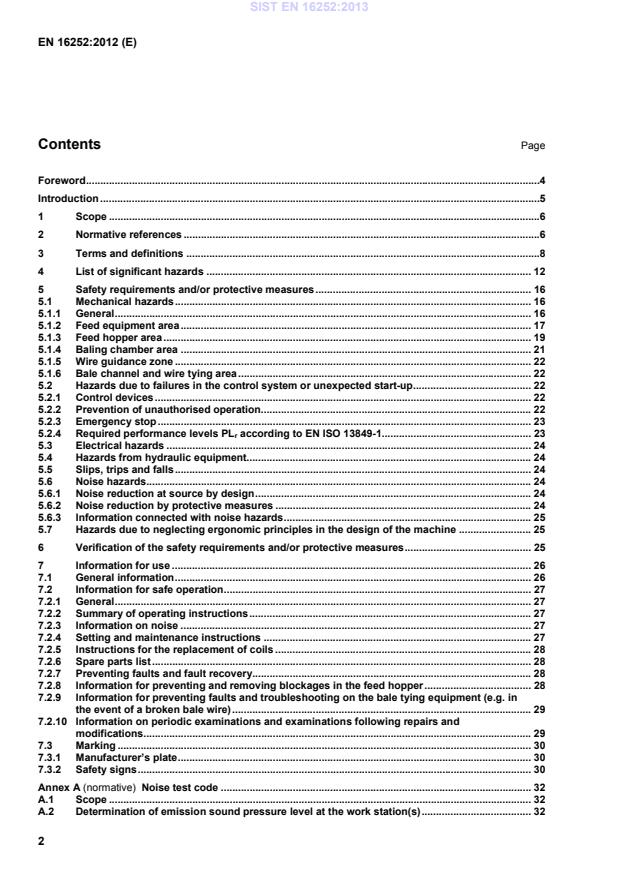
Noise test code . 32A.1 Scope . 32A.2 Determination of emission sound pressure level at the work station(s) . 32SIST EN 16252:2013
Preliminary dialogue between manufacturer and user . 36Annex ZA (informative)
Relationship between this European Standard and the Essential Requirements of EU Directive 2006/42/EC . 37Bibliography . 38 SIST EN 16252:2013
Key 1 loading conveyor 2 feed conveyor 3 emergency stop actuator 4 feed hopper 5 access door 6 access platform 7 wire guidance zone 8 wire coils 9 control station Figure 1a — Horizontal baling press, front view
Key 4 feed hopper 5 access door 6 access platform 7 wire guidance zone 8 wire coils 9 control station 10 bale tying equipment 11 bale channel 12 counter pressure device Figure 1b — Horizontal baling press, side view 3.1 baling press plant for pressing and binding loose materials into a bale (materials can include paper, plastics, textiles, cans, cardboard or mixed waste) Note 1 to entry: A baling press can consist of a control system and control station, feed equipment, feed hopper, distributor, pressing equipment, bale tying equipment, wire-decoiling equipment and bale channel. 3.2 horizontal baling press baling press as defined in 3.1 on which the compacting pressure is applied horizontally Note 1 to entry: See Figure 1. 3.3 feed equipment equipment used for feeding materials to be baled to the pressing equipment Note 1 to entry: Feed equipment usually consists of a loading conveyor and a feed conveyor or a bin lift. Loading and feed conveyors can also be designed as one single conveying unit. Note 2 to entry: Other types of feed equipment sometimes used to feed horizontal baling presses include cranes, lift trucks and other items of mobile plant that load the material directly into the feed hopper or into the baling chamber but these, and the hazards arising from using them, are outside the scope of this standard. SIST EN 16252:2013
Note 1 to entry: This device can be inserted into, and retracted from, the feed hopper. 3.12 perforator device used to pierce empty containers (e.g. plastic bottles) to be compacted before they enter the baling chamber Note 1 to entry: This device can be inserted into, and retracted from, the feed hopper. 3.13 pressing equipment all components directly involved in compressing the material into bales (e.g. hydraulic system, pre-compression plate, compression plate, baling chamber and bale channel) 3.14 pre-compression plate(s) pivoting plate(s) that level(s) the materials and close(s) the top of the baling chamber SIST EN 16252:2013
area behind the compression plate where the hydraulic and mechanical moving parts are for the compression plate 3.16 compression plate
plate that moves horizontally by a powered ram that applies pressure to the material to be compacted 3.17 baling chamber chamber receiving the loose material either directly or from the feed hopper and in which the compression plate moves to compress the material Note 1 to entry: The chamber extends from the point at which the compression plate is fully retracted to the point at which it is fully extended or, in the case of baling presses that compact the material against a bale discharge door, from the point at which the compression plate is fully retracted to the bale discharge door. 3.18 bale channel channel, extending from the point at which the compression plate is fully extended to the point at which the bales are discharged, through which the bales travel from the baling chamber to reach the discharge point Note 1 to entry: The output cross section of the channel may reduce progressively towards the discharge end to generate the counter pressure required for forming the bales. 3.19 counter pressure device device located at the end of the bale channel and enabling to adjust the bale density by compressing it, e.g. using a pantograph or a pressing plate 3.20 bale tying equipment equipment for binding individual bales
3.21 wire guidance zone zone outside the body of the baling press, in which the bale tying wires are fed from coils and guided into the bale tying mechanism 3.22 bale discharge door door through which a completed bale is discharged from the baling chamber Note 1 to entry: On some baling presses, the compression plate compacts the materials directly against the bale discharge door at the end of the baling chamber. The door, when closed, is held closed by a clamping/retaining mechanism. 3.23 control station place from which the baling press is started, stopped or manually controlled 3.24 cycle of the compression plate complete forward and reverse movement of the compression plate 3.25 automatic initiation of cycles operating mode in which the successive cycles of the compression plate are initiated by either a sensing device detecting the presence of materials to be compacted or by time delay SIST EN 16252:2013
Note 1 to entry: Access platforms can be fixed to the baling press, floor or building structure. 3.27 troubleshooting rectification of operational failures (e.g. clearing blockages in the feed hopper or dealing with a broken bale wire) 3.28 work station position in the vicinity of the machine under test which is intended for the operator EXAMPLE The control station, the feeding position, the bale tying area, the bin lift operation control. 3.29 work cycle required number of movements of the compression plate and completion of the wire tying process to produce a bale 4 List of significant hazards Table 1 lists the significant hazards that are present on baling presses. It cross-references the subclauses of this standard in which the corresponding safety requirements and/or protective measures are specified. Table 1 — List of significant hazards (1 of 4)
Significant hazards Applicable subclauses 4.1 Mechanical hazards
4.1.1 General
5.1.1 4.1.2 Feed equipment area 5.1.1, 5.1.2, 5.2, 5.5, 7.3 Crushing and shearing by moving parts of conveyors when stepping on conveyors.
Falling into the loading conveyor pit.
Falling when walking on conveyors. SIST EN 16252:2013
Significant hazards Applicable subclauses
Drawing-in and crushing at in-running nips between the conveyor belt and the head and tail drums and between the conveyor belt and tensioning rollers.
Drawing-in and crushing at the transfer point between the loading and feed conveyors. Drawing-in and crushing between moving transmission parts of the conveyors. Being struck by material falling from the feed conveyor. Impact, crushing and shearing between the bin lift mechanism and fixed parts of the bin lift or baling press, or being picked up by moving parts of the bin lift mechanism. Drawing-in and crushing between moving transmission parts of the bin lift. Being struck by the bin in the event of it falling out of the bin lift while in a raised position.
Being struck by material falling from the bin when it is in a raised position. 4.1.3
Feed hopper area 5.1.1, 5.1.3, 5.2, 5.5, 7.2.2, 7.2.8, 7.3.2
Reaching into, or falling down the feed hopper into, the baling chamber during loading or troubleshooting or maintenance, followed by crushing or shearing by the compression plate.
Crushing and shearing between the distributor or perforator and fixed parts when the distributor or perforator is inserted into, or retracted from, the feed hopper. Being struck by material which is thrown up by the rotating distributor or perforator.
Impact, shearing, drawing-in and crushing by the distributor or perforator when it is rotating, including residual rotation during retraction.
Impact and crushing by the pre-compression plate during normal powered movement of the plate.
If the feed hopper is equipped with an access door: crushing, shearing or impact by moving parts in the baling chamber;
impact caused by the access door flying open in an uncontrolled manner; being buried by the material when clearing a blockage. SIST EN 16252:2013
Significant hazards Applicable subclauses 4.1.4 Baling chamber area 5.1.1, 5.1.4, 5.2, 7.2.2, 7.2.8, 7.3.2
Impact and crushing by the main and pre-compression plates caused by unintended movement (e.g. due to pressure or counter pressure of the material or failure of electrical or hydraulic components). Fatal or severe crushing or shearing by the main and pre-compression plates after gaining access into the baling chamber through maintenance and inspection openings, openings for troubleshooting or bale discharge doors. Impact to the head when going through the door and/or intervening in the baling chamber area.
Impact caused by access doors (i.e. movable guards) and/or bale discharge doors of the baling chamber flying open in an uncontrolled manner due to high internal pressure.
On baling machines whose baling chambers have a power operated discharge door, being struck by the moving door and crushing and shearing by the door and/or the door clamping and retaining mechanism as the door opens and/or closes. Crushing and shearing by moving parts e.g. when reaching underneath the baling press. Being buried by the material when clearing a blockage. 4.1.5 Wire guidance zone Impact, fall on a level, tripping and slipping on oily ground due to bale tying wires running between the coils installed outside the machine frame and the machine. Drawing-in points in the wire guidance zone. Fall from a height when replacing the coils and guiding the wires. 5.1.5, 7.2.5, Annex B
4.1.6 Bale channel and wire tying area 5.1.1, 5.1.6, 5.2.1, 7.2.9, 7.3.2, Annex B
Impact and crushing between a bale and fixed parts of the building in the area of pick up of the bales while the bale automatically discharges. Stabbing, crushing or puncturing by the needles/needle assembly of the wire threading and tying mechanism. Entanglement and severing by the rotating wire twisting mechanism. On machines fitted with an automatic looped wire tying system, crushing/cutting injuries to parts of the body if it is within the loop of wire as it is tightened around the bale. On baling presses at which the bales are manually bound, impact between parts of any hand tools provided for clearing channels and threading bale wires and fixed parts of the baling press resulting in injuries to the hands and arms. On baling presses at which the bales are manually bound, impact injuries to the eyes and face through being struck by ends of bale wires when threading them around the bale.
Trapping and crushing arising from the counter pressure device. SIST EN 16252:2013
Significant hazards Applicable subclauses 4.1.7 Rear ram housing
Crushing, shearing and trapping between fixed and movable parts. 5.1.4 4.2 Hazards due to failures in the control system or unexpected start-up 5.2 4.3 Electrical hazards Electrical shock or burns due to direct or indirect contact with live parts. 5.3 4.4 Hazards from hydraulic equipment 5.1.4, 5.4
Hazards arising from unintentional release of liquids under pressure from the hydraulic system, particularly from hoses and their fittings. ,
Crushing, shearing or trapping due to creep movement of hydraulic cylinders.
Crushing, shearing or trapping due to a loss of hydraulic power resulting in gravity fall of any vertically mounted ram.
4.5 Slip, trip and fall hazards
5.5 4.6 Hazards generated by noise Hearing loss, tinnitus, physiological disorders, loss of balance or awareness, tiredness, accidents due to interference with auditory signals and speech communication due to noise, generated e.g. by:
the hydraulic system, in particular during the baling process; movement of the pressing equipment;
operation of the distributor or perforator;
feed equipment;
bale tying mechanism. 5.6 7.2.3 Annex A 4.7 Hazards due to neglecting ergonomic principles in the design of the machine Musculoskeletal disorders resulting from repeated efforts of bending, lifting and reaching when loading the hopper by hand and, in the case of baling presses at which the bales are manually bound, when tying the bales and when replacing the coils of tying wires. 5.7, 7.2.5 4.8 Hazards due to poor or non-existent organisation, training or instructions 7 SIST EN 16252:2013
EN 1088:1995+A2:2008. The interlocking guards shall be designed and positioned so that opening one of them stops the movement of any dangerous part of machinery before any part of a person enters the danger zone. This can be achieved e.g. by the following: 1) movable guards being equipped with at least one position switch acting on the main switching device of the power circuit (e.g. valve, contactor) via the control circuit. The position switches shall either have mechanically actuated positive opening contacts and comply with EN 60947-5-1:2004, Annex K or they shall be proximity switches that are in accordance with EN 60947-5-3. As soon as the guard is opened, the position switch shall be positively and directly actuated by the guard and the control signal for the dangerous movement shall be positively interrupted; 2) using a trapped key interlocking device that is in accordance with EN 1088:1995+A2:2008, Annex E. There shall be sufficient keys to allow the removal of every guard within the system. See also Annex B. c) Sensitive protective equipment (SPE) that is in accordance with the relevant type B standards, e.g. EN 1760-1:1997+A1:2009, EN 61496-1, CLC/TS 61496-2 and/or CLC/TS 61496-3. The safety functions of the chosen safeguards shall meet the performance levels specified in 5.2.4. 5.1.1.3 Safety distances Minimum gaps to avoid crushing shall comply with EN 349:1993+A1:2008. The positioning of electro-sensitive protective equipment shall comply with EN ISO 13855:2010. Any opening in fixed or movable guards shall comply with EN ISO 13857:2008, Tables 3, 4 and/or 7. 5.1.2 Feed equipment area
5.1.2.1 Horizontal baling presses fed by conveyors Conveyor systems shall comply with EN 620:2002+A1:2010. To protect a person who has gone, or fallen, onto the conveyor, additional emergency stop devices that act in accordance with 5.2.3 shall be fitted. These shall be actuated by pull cords located above and along the length of the feed conveyor. They shall be capable of being operated within 2 m at the beginning and the discharge point of the feed conveyor and at least every 3 m between these points.
Figure 2 — Example of ‘V’ configuration pull cord Figure 3 —Example of goalpost configuration pull cords Figure 4 — Example of tripwires along the side configuration pull cords If a danger of material falling down exists, the conveyor shall be fitted with fixed guards along the underside of the whole of its length except for the point at which the overspill is allowed to fall to the floor. At this point, a vertical chute or cage shall be fitted to direct the overspill safely to floor level and to prevent people walking into the spill zone. SIST EN 16252:2013
...