


EN 1776:2025
(Main)Gas infrastructure - Gas measuring systems - Functional requirements
General Information
- Abstract
This document specifies functional requirements for the design, construction, testing, commissioning/decommissioning, operation, maintenance and, where appropriate, calibration, together with suitable documented provisions for all new gas measuring systems and any major changes of existing systems.
This document also specifies accuracy classes of measuring systems and thresholds applicable to these classes. Demonstration of compliance is achieved through the selection, installation and operation of appropriate measurement instruments, together with suitable documented provisions for calculations. Examples of demonstration of compliance are provided for each accuracy class; however, they are not prescriptive solutions.
This document is applicable for gases of the 2nd family as classified in EN 437. It is also applicable for treated non-conventional combustible gases complying with EN 437 and for which a detailed technical evaluation of the functional requirements (such as injected biomethane) is performed ensuring there are no other constituents or properties of the gases that can affect the metrological and physical integrity of the measuring systems. This version mentions technical topics to consider when hydrogen and natural gas / hydrogen blends flow through the measuring systems. Blends with a hydrogen content between 20mol% and 98 mol% are not considered by this standard. This document applies to hydrogen with a purity as specified in CEN/TS 17977 for rededicated natural gas systems.
This document can also be used as a guideline for measuring systems for other gases e.g. gaseous CO2 for CCUS.
This document does not apply to for raw or sour gases.
This document does not apply to for gas measurement in CNG filling stations.
This document gives guidelines when designing, installing and operating gas meters with additional functionalities (smart gas meters).
Communication protocols and interfaces for gas meters and remote reading of gas meters are outside the scope of this document and are covered by the appropriate parts of the EN 13757 series. which provide a number of protocols for meter communications. Supervisory control and data acquisition protocols (SCADA) are also not covered by this document.
Unless otherwise specified all pressures used in this document are gauge pressures.
For associated pressure regulating systems the requirements of EN 12186 and/or EN 12279 apply.
For requirements on design, housing, lay-out, materials for components, construction, ventilation, venting and overall safety of gas measuring systems within the scope of this document, the EN 15001 series, EN 12186, EN 12279 and/or EN 1775 apply additionally, where relevant.
- Status
- Published
- Publication Date
- 16-Dec-2025
- Technical Committee
- CEN/TC 234 - Gas infrastructure
- Drafting Committee
- CEN/TC 234/WG 5 - Gas measuring
- Current Stage
- 6060 - Definitive text made available (DAV) - Publishing
- Start Date
- 17-Dec-2025
- Due Date
- 19-Mar-2025
- Completion Date
- 17-Dec-2025

Overview
EN 1776:2025 - Gas infrastructure - Gas measuring systems - Functional requirements - specifies functional requirements for the design, construction, testing, commissioning/decommissioning, operation, maintenance and, where appropriate, calibration of new gas measuring systems and major modifications to existing systems. The standard defines accuracy classes, thresholds and examples of demonstration of compliance for gas measuring systems used in gas infrastructure, with particular applicability to gases of the 2nd family (EN 437), treated non-conventional combustible gases (e.g., injected biomethane) and certain hydrogen scenarios. EN 1776:2025 provides guidance for ensuring metrological integrity, safety and documented procedures without prescribing single technical solutions.
Key topics and technical requirements
- Classification and accuracy classes: Defines system classes (A, B, C, D) and minimum requirements per class for flow, pressure and energy determination.
- Energy determination and conversions: Requirements for measurement inputs (flow, pressure, temperature), gross calorific value (GCV) determination, PTZ/T/Z conversions, compressibility and uncertainty of energy determination.
- Design and modules: Guidance on measuring stations, meter types, meter runs, pipework, valves, filters, pulsation/vibration mitigation, venting and ventilation, and housing.
- Calorific value and sampling: Requirements for CV determination systems, sampling, on-site CVDD options and calibration provisions.
- Instrumentation and sensors: Requirements for pressure/temperature sensors, thermowells, (differential) pressure transducers, and sensor testing.
- Testing and commissioning: Strength/tightness tests, purging, pre-commissioning checks, commissioning/re-commissioning, acceptance and documentation.
- Operation, maintenance and decommissioning: Maintenance records, calibration/verification, reference equipment and guidance for meter-specific maintenance (ultrasonic, turbine, orifice, rotary, vortex).
- Smart meters: Guidelines for gas meters with additional functionalities; communication protocols (EN 13757) and SCADA are explicitly out of scope.
- Hydrogen and blends: Notes technical topics for hydrogen/natural gas-hydrogen blends; blends between 20 mol% and 98 mol% hydrogen are not covered. Applies to hydrogen in rededicated natural gas systems as per CEN/TS 17977.
- Scope exclusions: Not applicable to raw/sour gases or gas measurement in CNG filling stations.
Practical applications
- Design and verification of custody-transfer and industrial gas measuring stations
- Specification of metering systems for biomethane injection and treated non-conventional gases
- Development of operational and maintenance procedures for gas utilities and grid operators
- Basis for procurement, testing, commissioning and acceptance of metering installations
Who should use this standard
- Gas network operators and transmission companies
- Meter manufacturers and integrators
- Engineering consultancies and station designers
- Calibration laboratories and metrology experts
- Regulatory bodies and project owners requiring compliant measurement systems
Related standards
- EN 437 (gas family classification)
- CEN/TS 17977 (hydrogen purity/rededication)
- EN 13757 series (meter communication protocols) - out of scope for communication
- EN 12186, EN 12279, EN 15001, EN 1775 (pressure regulation, safety, design and installation)
Relations
- Effective Date
- 28-Jan-2023
- Effective Date
- 15-Sep-2026
- Effective Date
- 25-Aug-2026
- Effective Date
- 09-Feb-2026
- Effective Date
- 09-Feb-2026
- Effective Date
- 09-Feb-2026
- Effective Date
- 09-Feb-2026
- Effective Date
- 09-Feb-2026
- Effective Date
- 09-Feb-2026
- Effective Date
- 09-Feb-2026
- Effective Date
- 09-Feb-2026
- Effective Date
- 09-Feb-2026
- Effective Date
- 09-Feb-2026
- Effective Date
- 09-Feb-2026
- Effective Date
- 09-Feb-2026
Get Certified
Connect with accredited certification bodies for this standard

Element Materials Technology
Materials testing and product certification.

ABS Group Brazil
ABS Group certification services in Brazil.

ABS Quality Evaluations Inc.
American Bureau of Shipping quality certification.
Sponsored listings
Frequently Asked Questions
EN 1776:2025 is a standard published by the European Committee for Standardization (CEN). Its full title is "Gas infrastructure - Gas measuring systems - Functional requirements". This standard covers: This document specifies functional requirements for the design, construction, testing, commissioning/decommissioning, operation, maintenance and, where appropriate, calibration, together with suitable documented provisions for all new gas measuring systems and any major changes of existing systems. This document also specifies accuracy classes of measuring systems and thresholds applicable to these classes. Demonstration of compliance is achieved through the selection, installation and operation of appropriate measurement instruments, together with suitable documented provisions for calculations. Examples of demonstration of compliance are provided for each accuracy class; however, they are not prescriptive solutions. This document is applicable for gases of the 2nd family as classified in EN 437. It is also applicable for treated non-conventional combustible gases complying with EN 437 and for which a detailed technical evaluation of the functional requirements (such as injected biomethane) is performed ensuring there are no other constituents or properties of the gases that can affect the metrological and physical integrity of the measuring systems. This version mentions technical topics to consider when hydrogen and natural gas / hydrogen blends flow through the measuring systems. Blends with a hydrogen content between 20mol% and 98 mol% are not considered by this standard. This document applies to hydrogen with a purity as specified in CEN/TS 17977 for rededicated natural gas systems. This document can also be used as a guideline for measuring systems for other gases e.g. gaseous CO2 for CCUS. This document does not apply to for raw or sour gases. This document does not apply to for gas measurement in CNG filling stations. This document gives guidelines when designing, installing and operating gas meters with additional functionalities (smart gas meters). Communication protocols and interfaces for gas meters and remote reading of gas meters are outside the scope of this document and are covered by the appropriate parts of the EN 13757 series. which provide a number of protocols for meter communications. Supervisory control and data acquisition protocols (SCADA) are also not covered by this document. Unless otherwise specified all pressures used in this document are gauge pressures. For associated pressure regulating systems the requirements of EN 12186 and/or EN 12279 apply. For requirements on design, housing, lay-out, materials for components, construction, ventilation, venting and overall safety of gas measuring systems within the scope of this document, the EN 15001 series, EN 12186, EN 12279 and/or EN 1775 apply additionally, where relevant.
This document specifies functional requirements for the design, construction, testing, commissioning/decommissioning, operation, maintenance and, where appropriate, calibration, together with suitable documented provisions for all new gas measuring systems and any major changes of existing systems. This document also specifies accuracy classes of measuring systems and thresholds applicable to these classes. Demonstration of compliance is achieved through the selection, installation and operation of appropriate measurement instruments, together with suitable documented provisions for calculations. Examples of demonstration of compliance are provided for each accuracy class; however, they are not prescriptive solutions. This document is applicable for gases of the 2nd family as classified in EN 437. It is also applicable for treated non-conventional combustible gases complying with EN 437 and for which a detailed technical evaluation of the functional requirements (such as injected biomethane) is performed ensuring there are no other constituents or properties of the gases that can affect the metrological and physical integrity of the measuring systems. This version mentions technical topics to consider when hydrogen and natural gas / hydrogen blends flow through the measuring systems. Blends with a hydrogen content between 20mol% and 98 mol% are not considered by this standard. This document applies to hydrogen with a purity as specified in CEN/TS 17977 for rededicated natural gas systems. This document can also be used as a guideline for measuring systems for other gases e.g. gaseous CO2 for CCUS. This document does not apply to for raw or sour gases. This document does not apply to for gas measurement in CNG filling stations. This document gives guidelines when designing, installing and operating gas meters with additional functionalities (smart gas meters). Communication protocols and interfaces for gas meters and remote reading of gas meters are outside the scope of this document and are covered by the appropriate parts of the EN 13757 series. which provide a number of protocols for meter communications. Supervisory control and data acquisition protocols (SCADA) are also not covered by this document. Unless otherwise specified all pressures used in this document are gauge pressures. For associated pressure regulating systems the requirements of EN 12186 and/or EN 12279 apply. For requirements on design, housing, lay-out, materials for components, construction, ventilation, venting and overall safety of gas measuring systems within the scope of this document, the EN 15001 series, EN 12186, EN 12279 and/or EN 1775 apply additionally, where relevant.
EN 1776:2025 is classified under the following ICS (International Classification for Standards) categories: 75.180.30 - Volumetric equipment and measurements. The ICS classification helps identify the subject area and facilitates finding related standards.
EN 1776:2025 has the following relationships with other standards: It is inter standard links to EN 1776:2015, EN IEC 61000-4-29:2026, ISO 2186:2007, EN 61000-3-2:2006/A2:2009, EN 61000-4-20:2003/A1:2007, EN 61000-4-3:1996/A2:2001, EN 61000-4-13:2002/A1:2009, EN 61000-4-6:2009, EN 61000-4-30:2015/A1:2021, EN 61000-6-4:2007/A1:2011, EN 61000-4-28:2000/A1:2004, EN 61000-4-14:1999/A2:2009, EN 61000-4-28:2000/A2:2009, EN 61000-4-4:2012, EN 61000-4-21:2011. Understanding these relationships helps ensure you are using the most current and applicable version of the standard.
EN 1776:2025 is associated with the following European legislation: Standardization Mandates: M/017. When a standard is cited in the Official Journal of the European Union, products manufactured in conformity with it benefit from a presumption of conformity with the essential requirements of the corresponding EU directive or regulation.
EN 1776:2025 is available in PDF format for immediate download after purchase. The document can be added to your cart and obtained through the secure checkout process. Digital delivery ensures instant access to the complete standard document.
Standards Content (Sample)
SLOVENSKI STANDARD
01-maj-2026
Nadomešča:
SIST EN 1776:2016
Infrastruktura za plin - Merilni sistemi - Funkcionalne zahteve
Gas infrastructure - Gas measuring systems - Functional requirements
Gasinfrastruktur - Gasmesssysteme - Funktionale Anforderungen
Infrastructures gazières - Systèmes de mesure de gaz - Prescriptions fonctionnelles
Ta slovenski standard je istoveten z: EN 1776:2025
ICS:
75.180.30 Oprema za merjenje Volumetric equipment and
prostornine in merjenje measurements
91.140.40 Sistemi za oskrbo s plinom Gas supply systems
2003-01.Slovenski inštitut za standardizacijo. Razmnoževanje celote ali delov tega standarda ni dovoljeno.
EN 1776
EUROPEAN STANDARD
NORME EUROPÉENNE
December 2025
EUROPÄISCHE NORM
ICS 75.180.30 Supersedes EN 1776:2015
English Version
Gas infrastructure - Gas measuring systems - Functional
requirements
Infrastructures gazières - Systèmes de mesure de gaz - Gasinfrastruktur - Gasmesssysteme - Funktionale
Exigences fonctionnelles Anforderungen
This European Standard was approved by CEN on 1 December 2025.
CEN members are bound to comply with the CEN/CENELEC Internal Regulations which stipulate the conditions for giving this
European Standard the status of a national standard without any alteration. Up-to-date lists and bibliographical references
concerning such national standards may be obtained on application to the CEN-CENELEC Management Centre or to any CEN
member.
This European Standard exists in three official versions (English, French, German). A version in any other language made by
translation under the responsibility of a CEN member into its own language and notified to the CEN-CENELEC Management
Centre has the same status as the official versions.
CEN members are the national standards bodies of Austria, Belgium, Bulgaria, Croatia, Cyprus, Czech Republic, Denmark, Estonia,
Finland, France, Germany, Greece, Hungary, Iceland, Ireland, Italy, Latvia, Lithuania, Luxembourg, Malta, Netherlands, Norway,
Poland, Portugal, Republic of North Macedonia, Romania, Serbia, Slovakia, Slovenia, Spain, Sweden, Switzerland, Türkiye and
United Kingdom.
EUROPEAN COMMITTEE FOR STANDARDIZATION
COMITÉ EUROPÉEN DE NORMALISATION
EUROPÄISCHES KOMITEE FÜR NORMUNG
CEN-CENELEC Management Centre: Rue de la Science 23, B-1040 Brussels
© 2025 CEN All rights of exploitation in any form and by any means reserved Ref. No. EN 1776:2025 E
worldwide for CEN national Members.
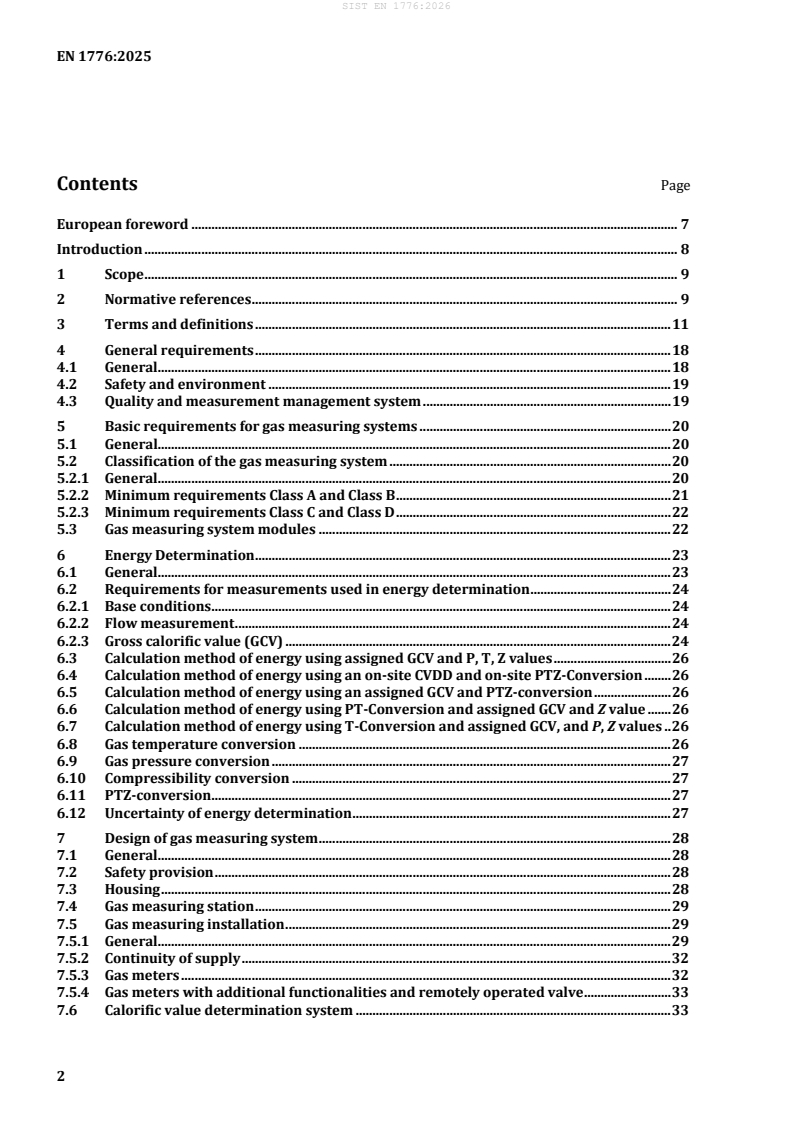
Contents Page
European foreword . 7
Introduction . 8
1 Scope . 9
2 Normative references . 9
3 Terms and definitions . 11
4 General requirements . 18
4.1 General. 18
4.2 Safety and environment . 19
4.3 Quality and measurement management system . 19
5 Basic requirements for gas measuring systems . 20
5.1 General. 20
5.2 Classification of the gas measuring system . 20
5.2.1 General. 20
5.2.2 Minimum requirements Class A and Class B . 21
5.2.3 Minimum requirements Class C and Class D . 22
5.3 Gas measuring system modules . 22
6 Energy Determination . 23
6.1 General. 23
6.2 Requirements for measurements used in energy determination . 24
6.2.1 Base conditions . 24
6.2.2 Flow measurement . 24
6.2.3 Gross calorific value (GCV) . 24
6.3 Calculation method of energy using assigned GCV and P, T, Z values . 26
6.4 Calculation method of energy using an on-site CVDD and on-site PTZ-Conversion . 26
6.5 Calculation method of energy using an assigned GCV and PTZ-conversion . 26
6.6 Calculation method of energy using PT-Conversion and assigned GCV and Z value . 26
6.7 Calculation method of energy using T-Conversion and assigned GCV, and P, Z values . 26
6.8 Gas temperature conversion . 26
6.9 Gas pressure conversion . 27
6.10 Compressibility conversion . 27
6.11 PTZ-conversion . 27
6.12 Uncertainty of energy determination . 27
7 Design of gas measuring system . 28
7.1 General. 28
7.2 Safety provision . 28
7.3 Housing . 28
7.4 Gas measuring station . 29
7.5 Gas measuring installation . 29
7.5.1 General. 29
7.5.2 Continuity of supply . 32
7.5.3 Gas meters . 32
7.5.4 Gas meters with additional functionalities and remotely operated valve . 33
7.6 Calorific value determination system . 33
7.6.1 General . 33
7.6.2 Sampling . 34
7.6.3 Provisions for calibration . 34
7.7 Gas pressure measurement . 34
7.7.1 General . 34
7.7.2 Gas pressure measurement Class A and Class B . 34
7.7.3 Gas pressure determination Class C and Class D . 35
7.8 Gas temperature measurement . 35
7.9 Conversion device . 36
7.10 Compression factor . 36
7.11 Pipework requirements . 36
7.11.1 For Class A and Class B measuring installation . 36
7.11.2 For Class C and Class D measuring installation . 37
7.12 Valves . 37
7.12.1 General . 37
7.12.2 By-pass. 37
7.13 Parallel meter runs . 37
7.14 Pulsations and vibrations . 38
7.14.1 General . 38
7.14.2 Pulsating effects related to specific flow meter types . 39
7.15 Filter . 39
7.16 Gas conditioning, hydrate protection . 39
7.17 Duplication/redundancy of measuring instruments . 39
7.18 Venting. 40
7.19 Ventilation . 40
7.20 Odorants and/or additives . 40
7.21 Electromagnetic compatibility (EMC) . 40
7.22 Documented provisions . 40
7.22.1 General . 40
7.22.2 Data handling (Security) . 41
8 Construction of a gas measuring installation . 41
8.1 General . 41
8.2 Specific requirements for thermowells . 42
8.3 Specific requirements for (differential) pressure transducers . 42
8.4 Specific requirements for sampling systems for CVDD’s . 42
8.5 Corrosion protection . 42
8.6 Equipment in hazardous area . 43
9 Testing of the gas measuring installation/station. 43
9.1 Strength and tightness test . 43
9.1.1 General . 43
9.1.2 Test report . 43
9.2 Purging . 43
10 Pre-commissioning and commissioning of the gas measuring installation . 44
10.1 General . 44
10.2 Pre-commissioning checks . 44
10.2.1 General . 44
10.2.2 Electrical or electronic system. 44
10.3 Commissioning and re-commissioning . 44
10.3.1 General . 44
10.3.2 Gas meters . 45
10.3.3 Instrumentation . 46
10.3.4 Initial comparison check. 46
10.4 Acceptance, documentation and hand-over . 46
10.5 Post-commissioning checks . 47
11 Operation and maintenance . 47
11.1 General. 47
11.2 Reference equipment . 48
11.3 Gas meters . 49
11.3.1 General. 49
11.3.2 Rotary displacement meters . 49
11.3.3 Turbine meters . 49
11.3.4 Vortex meters . 50
11.3.5 Ultrasonic meters . 50
11.3.6 Orifice Meters . 50
11.4 Conversion devices . 50
11.5 Calorific value determination device . 51
11.6 Sensors . 51
11.7 Calibration/verification and maintenance records . 51
12 Decommissioning . 52
Annex A (informative) Guideline for the selection of meters . 53
Annex B (informative) Sensor test procedures . 59
B.1 Differential pressure sensors . 59
B.1.1 General. 59
B.1.2 High static pressure testing . 59
B.1.3 “Footprint testing” . 59
B.1.4 Atmospheric calibration . 60
B.2 Pressure sensors . 60
B.3 Temperature sensors . 60
B.3.1 Platinum resistance thermometers (PRTs) . 60
B.3.2 Other temperature sensors . 60
B.4 Density sensors . 60
B.4.1 Density sensors for operating conditions . 60
B.4.2 Density sensors for base conditions . 62
Annex C (informative) Set of formulae to calculate volume or mass to energy . 63
C.1 General. 63
C.2 Calculation of volume . 64
C.3 Calculation of mass . 64
C.4 Calculation of energy . 64
Annex D (informative) Determination of the acceptance criteria for the uncertainty of the
energy determination . 65
D.1 General. 65
D.2 Measurement Systems . 65
D.3 Energy Determination Systems . 66
Annex E (informative) Specific national examples of the assessment of conformity of the
metrological performance of a gas measuring system . 67
E.1 Introduction . 67
E.2 Example 1 . 68
E.3 Example 2 . 72
E.4 Example 3 . 74
E.5 Example 4 . 77
E.6 Example 5 . 80
E.7 Example 6 . 83
E.8 Example 7 . 88
Annex F (informative) Documentation and records . 93
F.1 Documentation . 93
F.2 Records . 93
F.3 Responsibilities for documentation and records . 93
Annex G (informative) Typical examples of positions of gas measuring installations . 95
Annex H (informative) Significant technical changes from the last edition of this standard,
EN 1776:2015 . 96
Annex I (informative) Hydrogen and its blends with natural gas . 98
I.1 General . 98
I.2 5.2.2 Minimum requirements Class A and Class B . 98
I.3 6.2.2 Flow measurement . 99
I.4 6.2.3.1 Gross calorific value (GCV)/ General conciderations . 100
I.5 6.2.3.2 Calorific value determination device (CVDD) . 100
I.6 6.3 Calculation method of energy using assigned GCV and P, T, Z values . 100
I.7 6.4 Calculation method of energy using an on-site CVDD and on-site PTZ-Conversion
..................................................................................................................................................................... 100
I.8 6.5 Calculation method of energy using an assigned GCV and PTZ-conversion . 100
I.9 6.6 Calculation method of energy using PT-Conversion and assigned GCV and Z value
..................................................................................................................................................................... 100
I.10 6.7 Calculation method of energy using T-Conversion and assigned GCV, and P, Z values
..................................................................................................................................................................... 100
I.11 6.10 Compressibility conversion . 100
I.12 6.11 PTZ-conversion . 100
I.13 6.12 Uncertainty of energy determination . 101
I.14 7.2 Safety provision . 101
I.15 7.5.3 Gas meters . 101
I.16 7.11. Compression factor . 101
I.17 7.11.1 Pipework requirements . 101
I.18 7.15.1 General . 102
I.19 7.15.2.1 Turbine meter . 102
I.20 7.15.2.2 Rotary displacement meter . 102
I.21 7.15.2.3 Ultrasonic meter (non-domestic) . 102
I.22 8.1 General . 102
I.23 8.2 Specific requirements for thermowells . 102
I.24 8.6 Electrical equipment in hazardous area . 102
I.25 9.1.1 General . 103
I.26 10.2.1 General . 103
I.27 10.2.2 Electrical or electronic system . 103
I.28 10.3.1 General . 103
I.29 10.3.2. Gas meters . 103
I.30 10.3.2.2 Non-domestic ultrasonic meters . 103
I.31 10.3.2.3 Orifice plate meter . 104
I.32 10.3.2.4 Coriolis meter . 104
I.33 11.2 Reference equipment . 104
I.34 11.3.1 General . 104
I.35 11.3.4 Vortex meters . 105
I.36 11.5 Calorific value determination device . 105
I.37 B 4.1.4 Hydrogen test. 105
I.38 G Typical examples of positions of gas measuring installations . 105
Bibliography . 107
European foreword
This document (EN 1776:2025) has been prepared by Technical Committee CEN/TC 234 “Gas
infrastructure”, the secretariat of which is held by DIN.
This European Standard shall be given the status of a national standard, either by publication of an
identical text or by endorsement, at the latest by June 2025, and conflicting national standards shall be
withdrawn at the latest by June 2025.
Attention is drawn to the possibility that some of the elements of this document may be the subject of
patent rights. CEN shall not be held responsible for identifying any or all such patent rights.
This document supersedes EN 1776:2015.
in Table H.1 in Annex H.
This version of the document comprises a major revision of EN 1776:2015. The scope of the standard is
expanded and now includes natural gas / hydrogen blends and hydrogen, as mentioned in
CEN/TR 17797. For this purpose, the document has been amended.
This document has been prepared under a standardization request addressed to CEN by the European
Commission.
This document has in part been developed in response to the work of the European Standards
Organisations (CEN/CENELEC/ETSI) under the Commission Mandate M/441. The standard is applying
in conjunction with CEN/CLC/ETSI TR 50572, Functional Reference Architecture for Communications in
Smart Metering Systems and EN 16314, Gas meters – Additional functionalities (often referred to as a smart
gas meter).
Directive 2009/73/EC concerning common rules for the internal market in natural gas and the related
Regulation (EC) No 715/2009 on conditions for access to the natural gas transmission networks also aim
at technical safety (security) including technical reliability of the European gas system. These aspects are
also in the scope of CEN/TC 234 standardization. In this respect CEN/TC 234 evaluated the indicated EU
legislation and amended this technical standard accordingly, where required and appropriate.
This document covers the environmental aspects relevant to the design, construction, operation, and
maintenance and commissioning/decommissioning of gas measuring systems, where appropriate, in
accordance with CEN Guide 4 and CEN/TR 16388.
In preparing this document, a basic understanding of gas infrastructure by the user has been assumed.
Any feedback and questions on this document should be directed to the users’ national standards body.
A complete listing of these bodies can be found on the CEN website.
According to the CEN-CENELEC Internal Regulations, the national standards organisations of the
following countries are bound to implement this European Standard: Austria, Belgium, Bulgaria, Croatia,
Cyprus, Czech Republic, Denmark, Estonia, Finland, France, Germany, Greece, Hungary, Iceland, Ireland,
Italy, Latvia, Lithuania, Luxembourg, Malta, Netherlands, Norway, Poland, Portugal, Republic of North
Macedonia, Romania, Serbia, Slovakia, Slovenia, Spain, Sweden, Switzerland, Türkiye and the United
Kingdom.
Introduction
This document specifies different classes of measuring systems, each having their own specific
requirements.
By nature, a measuring system is an aggregate of several components. In this document, it is assumed
that each component is in full compliance with applicable CEN or ISO standards, if any.
This document allows the user to choose between different accuracy classes of measuring systems, the
choice of which can be justified on economic grounds.
This document specifies common basic principles for gas infrastructure. Users of this document are
expected to be aware that there can exist more detailed national standards and/or codes of practice in
the CEN member countries.
This document is intended to be applied in association with these national standards and/or codes of
practice setting out the basic principles as outlined in Clause 1 of this document.
1 Scope
This document specifies functional requirements for the design, construction, testing,
commissioning/decommissioning, operation, maintenance and, where appropriate, calibration, together
with suitable documented provisions for all new gas measuring systems and any major changes of
existing systems.
This document also specifies accuracy classes of measuring systems and thresholds applicable to these
classes. Demonstration of compliance is achieved through the selection, installation and operation of
appropriate measurement instruments, together with suitable documented provisions for calculations.
Examples of demonstration of compliance are provided for each accuracy class; however, they are not
prescriptive solutions.
This document is applicable for gases of the 2nd family as classified in EN 437. It is also applicable for
treated non-conventional combustible gases complying with EN 437 and for which a detailed technical
evaluation of the functional requirements (such as injected biomethane) is performed ensuring there are
no other constituents or properties of the gases that can affect the metrological and physical integrity of
the measuring systems. This version mentions technical topics to consider when hydrogen and natural
gas / hydrogen blends flow through the measuring systems. Blends with a hydrogen content between
20mol% and 98 mol% are not considered by this standard. This document applies to hydrogen with a
purity as specified in CEN/TS 17977 for rededicated natural gas systems.
This document can also be used as a guideline for measuring systems for other gases e.g. gaseous CO for
CCUS.
This document does not apply to for raw or sour gases.
This document does not apply to for gas measurement in CNG filling stations.
This document gives guidelines when designing, installing and operating gas meters with additional
functionalities (smart gas meters).
Communication protocols and interfaces for gas meters and remote reading of gas meters are outside the
scope of this document and are covered by the appropriate parts of the EN 13757 series. which provide
a number of protocols for meter communications. Supervisory control and data acquisition protocols
(SCADA) are also not covered by this document.
Unless otherwise specified all pressures used in this document are gauge pressures.
For associated pressure regulating systems the requirements of EN 12186 and/or EN 12279 apply.
For requirements on design, housing, lay-out, materials for components, construction, ventilation,
venting and overall safety of gas measuring systems within the scope of this document, the EN 15001
series, EN 12186, EN 12279 and/or EN 1775 apply additionally, where relevant.
2 Normative references
The following documents are referred to in the text in such a way that some or all of their content
constitutes requirements of this document. For dated references, only the edition cited applies. For
undated references, the latest edition of the referenced document (including any amendments) applies.
NOTE There is assumption that any guidance within these standards will be updated to include hydrogen.
EN 1594, Gas infrastructure - Pipelines for maximum operating pressure over 16 bar - Functional
requirements
EN 1775, Gas supply - Gas pipework for buildings - Maximum operating pressure less than or equal to 5 bar
- Functional recommendations
EN 12186, Gas infrastructure - Gas pressure regulating stations for transmission and distribution -
Functional requirements
EN 12279, Gas supply systems - Gas pressure regulating installations on service lines - Functional
requirements
EN 12327, Gas infrastructure - Pressure testing, commissioning and decommissioning procedures -
Functional requirements
EN 12405 (all parts), Gas meters — Conversion devices
EN 15001-1, Gas Infrastructure - Gas installation pipework with an operating pressure greater than 0,5 bar
for industrial installations and greater than 5 bar for industrial and non-industrial installations - Part 1:
Detailed functional requirements for design, materials, construction, inspection and testing
EN 15001-2, Gas supply systems - Gas installation pipework with an operating pressure greater than 0,5 bar
for industrial installations and greater than 5 bar for industrial and non-industrial installations - Part 2:
Detailed functional requirements for commissioning, operation and maintenance
EN 16314, Gas meters - Additional functionalities
EN IEC 60079-10-1, Explosive atmospheres - Part 10-1: Classification of areas - Explosive gas atmospheres
(IEC 60079-10-1)
EN 60079-14, Explosive atmospheres - Part 14: Electrical installations design, selection and erection
(IEC 60079-14)
EN 60079-17, Explosive atmospheres - Part 17: Electrical installations inspection and maintenance
(IEC 60079-17)
EN 61000 (all parts), Electromagnetic compatibility (EMC) (IEC 61000 (all parts))
EN ISO 5167-1, Measurement of fluid flow by means of pressure differential devices inserted in circular
cross-section conduits running full - Part 1: General principles and requirements (ISO 5167-1)
EN ISO 5167-2, Measurement of fluid flow by means of pressure differential devices inserted in circular
cross-section conduits running full - Part 2: Orifice plates (ISO 5167-2)
EN ISO 6141, Gas analysis - Contents of certificates for calibration gas mixtures (ISO 6141:2015)
EN ISO 6142-1, Gas analysis - Preparation of calibration gas mixtures - Part 1: Gravimetric method for Class
I mixtures (ISO 6142-1)
EN ISO 6143, Gas analysis - Comparison methods for determining and checking the composition of
calibration gas mixtures (ISO 6143)
EN ISO 6975, Natural gas - Extended analysis - Gas-chromatographic method (ISO 6975)
EN ISO 10715, Natural gas - Gas sampling (ISO 10715)
EN ISO 10723, Natural gas - Performance evaluation for analytical systems (ISO 10723)
EN ISO 12213-1, Natural gas - Calculation of compression factor - Part 1: Introduction and guidelines (ISO
12213-1)
EN ISO 12213-2, Natural gas - Calculation of compression factor - Part 2: Calculation using molar-
composition analysis (ISO 12213-2)
EN ISO 15970, Natural gas - Measurement of properties - Volumetric properties: density, pressure,
temperature and compression factor (ISO 15970)
EN ISO 20765-1, Natural gas - Calculation of thermodynamic properties - Part 1: Gas phase properties for
transmission and distribution applications (ISO 20765-1)
EN ISO 20765-2, Natural gas - Calculation of thermodynamic properties - Part 2: Single-phase properties
(gas, liquid, and dense fluid) for extended ranges of application (ISO 20765-2)
EN ISO 20765-5, Natural gas - Calculation of thermodynamic properties - Part 5: Calculation of viscosity,
Joule-Thomson coefficient, and isentropic exponent (ISO 20765-5)
EN ISO 80079-36, Explosive atmospheres - Part 36: Non-electrical equipment for explosive atmospheres -
Basic method and requirements (ISO 80079-36)
ISO 2186, Fluid flow in closed conduits — Connections for pressure signal transmissions between primary
and secondary elements
ISO 10790, Measurement of fluid flow in closed conduits — Guidance to the selection, installation and use
of Coriolis flowmeters (mass flow, density and volume flow measurements)
ISO/IEC Guide 98-1, Guide to the expression of uncertainty in measurement — Part 1: Introduction
ISO/IEC Guide 98-3:2008, Uncertainty of measurement — Part 3: Guide to the expression of uncertainty in
measurement (GUM:1995)
ISO/IEC Guide 98-3 Supplement 1, Uncertainty of measurement — Part 3: Guide to the expression of
uncertainty in measurement (GUM:1995) — Supplement 1: Propagation of distributions using a Monte
Carlo method)
ISO/IEC Guide 98-3 Supplement 2, Uncertainty of measurement — Part 3: Guide to the expression of
uncertainty in measurement (GUM:1995) — Supplement 2: Extension to any number of output quantities)
ISO/IEC Guide 98-4, Uncertainty of measurement — Part 4: Role of measurement uncertainty in conformity
assessment
3 Terms and definitions
For the purposes of this document, the following terms and definitions apply.
ISO and IEC maintain terminology databases for use in standardization at the following addresses:
— ISO Online browsing platform: available at https://ww
...