


EN 15984:2017
(Main)Petroleum industry and products - Determination of composition of refinery heating gas and calculation of carbon content and calorific value - Gas chromatography method
General Information
- Abstract
This draft European Standard defines a gas chromatographic analysis for the determination of the composition of fuel gases, as used in refinery heating gas. These results are used to calculate the carbon content and the lower calorific value.
With this gas chromatographic analysis, an overall of 23 refinery heating gas components are determined in concentrations as typically found in refineries (see Table 1 for further details).
Water is not analyzed. The results represent dry gases.
NOTE 1 Depending on the equipment used, there is a possibility to determine higher hydrocarbons as well.
NOTE 2 For the purposes of this draft European Standard, the terms "% (V/V)" is used to represent the volume fraction (φ).
IMPORTANT - This standard does not purport to address all of the safety problems associated with its use. It is the responsibility of the user of this standard to establish appropriate safety and health practices and determine the applicability of regulatory limitations.
- Status
- Withdrawn
- Publication Date
- 08-Aug-2017
- Withdrawal Date
- 22-Sep-2026
- Technical Committee
- CEN/TC 19 - Petroleum products, lubricants and related products
- Drafting Committee
- CEN/TC 19/WG 9 - Chromatographic test methods
- Current Stage
- 9960 - Withdrawal effective - Withdrawal
- Start Date
- 09-Feb-2022
- Completion Date
- 23-Sep-2026

Relations
- Effective Date
- 16-Aug-2017
- Effective Date
- 16-Feb-2022
Get Certified
Connect with accredited certification bodies for this standard

Element Materials Technology
Materials testing and product certification.

ABS Group Brazil
ABS Group certification services in Brazil.

ABS Quality Evaluations Inc.
American Bureau of Shipping quality certification.
Sponsored listings
Frequently Asked Questions
EN 15984:2017 is a standard published by the European Committee for Standardization (CEN). Its full title is "Petroleum industry and products - Determination of composition of refinery heating gas and calculation of carbon content and calorific value - Gas chromatography method". This standard covers: This draft European Standard defines a gas chromatographic analysis for the determination of the composition of fuel gases, as used in refinery heating gas. These results are used to calculate the carbon content and the lower calorific value. With this gas chromatographic analysis, an overall of 23 refinery heating gas components are determined in concentrations as typically found in refineries (see Table 1 for further details). Water is not analyzed. The results represent dry gases. NOTE 1 Depending on the equipment used, there is a possibility to determine higher hydrocarbons as well. NOTE 2 For the purposes of this draft European Standard, the terms "% (V/V)" is used to represent the volume fraction (φ). IMPORTANT - This standard does not purport to address all of the safety problems associated with its use. It is the responsibility of the user of this standard to establish appropriate safety and health practices and determine the applicability of regulatory limitations.
This draft European Standard defines a gas chromatographic analysis for the determination of the composition of fuel gases, as used in refinery heating gas. These results are used to calculate the carbon content and the lower calorific value. With this gas chromatographic analysis, an overall of 23 refinery heating gas components are determined in concentrations as typically found in refineries (see Table 1 for further details). Water is not analyzed. The results represent dry gases. NOTE 1 Depending on the equipment used, there is a possibility to determine higher hydrocarbons as well. NOTE 2 For the purposes of this draft European Standard, the terms "% (V/V)" is used to represent the volume fraction (φ). IMPORTANT - This standard does not purport to address all of the safety problems associated with its use. It is the responsibility of the user of this standard to establish appropriate safety and health practices and determine the applicability of regulatory limitations.
EN 15984:2017 is classified under the following ICS (International Classification for Standards) categories: 75.160.30 - Gaseous fuels. The ICS classification helps identify the subject area and facilitates finding related standards.
EN 15984:2017 has the following relationships with other standards: It is inter standard links to EN 15984:2011, EN 15984:2022. Understanding these relationships helps ensure you are using the most current and applicable version of the standard.
EN 15984:2017 is available in PDF format for immediate download after purchase. The document can be added to your cart and obtained through the secure checkout process. Digital delivery ensures instant access to the complete standard document.
Standards Content (Sample)
2003-01.Slovenski inštitut za standardizacijo. Razmnoževanje celote ali delov tega standarda ni dovoljeno.Mineralölindustrie und -produkte - Bestimmung der Zusammensetzung von Heizgas für Raffinerien und Berechnung des Kohlenstoffgehaltes und des Heizwertes - Gaschromatographisches VerfahrenIndustries et produits pétroliers - Détermination de la composition des gaz combustibles de raffinerie, de leur pouvoir calorifique et de leur teneur en carbone - Méthode par chromatographie en phase gazeusePetroleum industry and products - Determination of composition of refinery heating gas and calculation of carbon content and calorific value - Gas chromatography method75.160.30Plinska gorivaGaseous fuels71.040.50Fizikalnokemijske analitske metodePhysicochemical methods of analysisICS:Ta slovenski standard je istoveten z:EN 15984:2017SIST EN 15984:2017en,fr,de01-oktober-2017SIST EN 15984:2017SLOVENSKI
STANDARDSIST EN 15984:20111DGRPHãþD
EUROPEAN STANDARD NORME EUROPÉENNE EUROPÄISCHE NORM
EN 15984
August
t r s y ICS
y wä s x rä u r Supersedes EN
s w { z vã t r s sEnglish Version
Petroleum industry and products æ Determination of composition of refinery heating gas and calculation of carbon content and calorific value æ Gas chromatography method Industries et produits pétroliers æ Détermination de la composition des gaz combustibles de raffinerieá de leur pouvoir calorifique et de leur teneur en carbone æ Méthode par chromatographie en phase gazeuse
Mineralölindustrie und æprodukte æ Bestimmung der Zusammensetzung von Heizgas für Raffinerien und Berechnung des Kohlenstoffgehaltes und des Heizwertes æ Gaschromatographisches Verfahren This European Standard was approved by CEN on
s { June
t r s yä
egulations which stipulate the conditions for giving this European Standard the status of a national standard without any alterationä Upætoædate lists and bibliographical references concerning such national standards may be obtained on application to the CENæCENELEC Management Centre or to any CEN memberä
translation under the responsibility of a CEN member into its own language and notified to the CENæCENELEC Management Centre has the same status as the official versionsä
CEN members are the national standards bodies of Austriaá Belgiumá Bulgariaá Croatiaá Cyprusá Czech Republicá Denmarká Estoniaá Finlandá Former Yugoslav Republic of Macedoniaá Franceá Germanyá Greeceá Hungaryá Icelandá Irelandá Italyá Latviaá Lithuaniaá Luxembourgá Maltaá Netherlandsá Norwayá Polandá Portugalá Romaniaá Serbiaá Slovakiaá Sloveniaá Spainá Swedená Switzerlandá Turkey and United Kingdomä
EUROPEAN COMMITTEE FOR STANDARDIZATION COMITÉ EUROPÉEN DE NORMALISATION EUROPÄISCHES KOMITEE FÜR NORMUNG
CEN-CENELEC Management Centre:
Avenue Marnix 17,
B-1000 Brussels
t r s y CEN All rights of exploitation in any form and by any means reserved worldwide for CEN national Membersä Refä Noä EN
s w { z vã t r s y ESIST EN 15984:2017
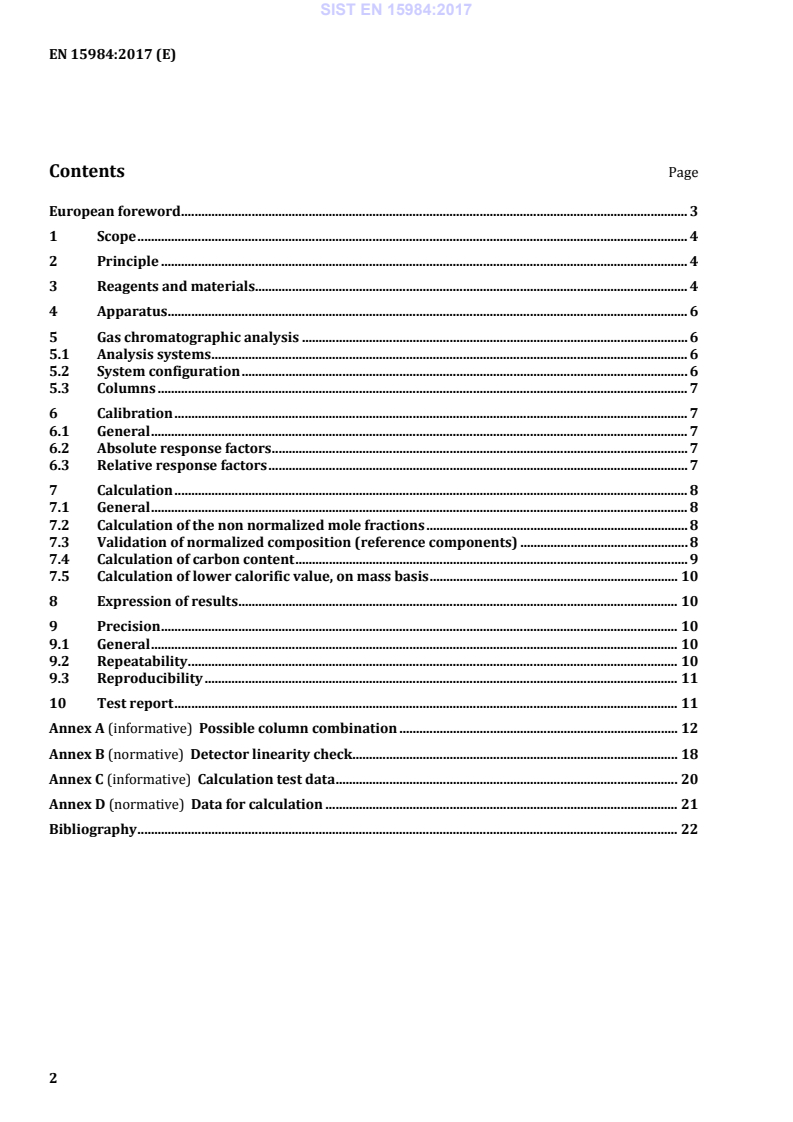
Contents Page European foreword . 3 1 Scope . 4 2 Principle . 4 3 Reagents and materials . 4 4 Apparatus . 6 5 Gas chromatographic analysis . 6 5.1 Analysis systems . 6 5.2 System configuration . 6 5.3 Columns . 7 6 Calibration . 7 6.1 General . 7 6.2 Absolute response factors . 7 6.3 Relative response factors . 7 7 Calculation . 8 7.1 General . 8 7.2 Calculation of the non normalized mole fractions . 8 7.3 Validation of normalized composition (reference components) . 8 7.4 Calculation of carbon content . 9 7.5 Calculation of lower calorific value, on mass basis . 10 8 Expression of results . 10 9 Precision . 10 9.1 General . 10 9.2 Repeatability . 10 9.3 Reproducibility . 11 10 Test report . 11 Annex A (informative)
Possible column combination . 12 Annex B (normative)
Detector linearity check . 18 Annex C (informative)
Calculation test data . 20 Annex D (normative)
Data for calculation . 21 Bibliography . 22
1 Scope This European Standard specifies a gas chromatographic analysis for the determination of the composition of fuel gases, as used in refinery heating gas. These results are used to calculate the carbon content and the lower calorific value. With this gas chromatographic analysis, an overall of 23 refinery heating gas components are determined in concentrations as typically found in refineries (see Table 1 for further details). Water is not analysed. The results represent dry gases. NOTE 1 Depending on the equipment used, there is a possibility to determine higher hydrocarbons as well. NOTE 2 For the purposes of this European Standard, the terms “% (V/V)” is used to represent the volume fraction (). WARNING — The use of this standard can involve hazardous materials, operations and equipment. This document does not purport to address all of the safety problems associated with its use. It is the responsibility of users of this standard to take appropriate measures to ensure the safety and health of personnel prior to application of the document, and fulfil statutory and regulatory requirements for this purpose. 2 Principle This European Standard defines a procedure that is used to determine all components that are present in a typical refinery heating gas, as indicated in Table 1. The composition range in which each component can be analysed does depend on the actual sample composition as higher amounts of a certain component may affect the detection range of other components eluting close by. The general ranges which apply to all the individual components are: — hydrocarbons from 0,01 (mol/100 mol) up to 100 (mol/100 mol); — non-condensable gases from 0,02 (mol/100 mol) up to 100 (mol/100 mol); — for hydrogen sulfide a range between 0,1 (mol/100 mol) up to 10 (mol/100 mol) has been found applicable. Three different analysis systems are necessary; they may be built in three separate gas chromatographs, or be integrated into one. Depending on the configuration, hydrocarbons with more than five carbon atoms are reported as a sum parameter. The composition of the refinery heating gas is used to calculate the carbon content and the calorific value. A typical procedure is described hereafter. A configuration is acceptable when the determination gives the precision as described in Clause 9. 3 Reagents and materials 3.1 Gases. 3.1.1 Hydrogen, with a minimum purity of 99,995 % (V/V). 3.1.2 Helium, with a minimum purity of 99,995 % (V/V). 3.1.3 Nitrogen, with a minimum purity of 99,995 % (V/V). 3.1.4 Air, free of oil and water. SIST EN 15984:2017
(Propyne, Methylacetylene) C3H4 14 Allene (Propadiene) C3H4 15 Methylpropane (iso-Butane) C4H10 16 n-Butane C4H10 17 But-2-ene Trans
(trans-2-Butene) C4H8 18 But-1-ene (1-Butene) C4H8 19 2-methylprop-1-ene
(2-Methyl-Propene) C4H8 20 Cis But-2-ene (cis-2-Butene) C4H8 21 Buta-1,3-diene
(1,3-Butadiene) C4H6 22 2-Methylbutane (iso-Pentane) C5H12 23 n-Pentane C5H12 24 Other components with 5 or more Carbon atoms, excluding 2-Methylbutaneand
Pentane (C5+) SIST EN 15984:2017
4 Apparatus 4.1 Usual laboratory apparatus and glassware. 4.2 Gas chromatographic apparatus, consisting of at least three separation systems able to work simultaneously in one gas chromatograph, with a Thermal Conductivity Detector (TCD) and Flame Ionization Detector (FID) that should be available, and confirming to the requirements as given in Clause 5. 5 Gas chromatographic analysis 5.1 Analysis systems The gas chromatographic system consists of the following three parts: 1) Analysis system 1 All components except hydrogen (see Table 1) are retained on a porous polymer and a molecular sieve column and back flushed. Hydrogen is determined on a TCD with nitrogen (3.1.3) as the carrier gas (see Figure A.4). 2) Analysis system 2 The second analysis system separates non-condensable gases, carbon dioxide, and hydrocarbons with two carbon atoms and hydrogen sulfide with helium (3.1.2) as the carrier gas and a TCD as a detector. After a pre-separation on a porous polymer column (column 3) propane and higher hydrocarbons are back flushed and vented. See Figure A.5 for details. When the inert gases (O2/Ar, N2, CH4 and CO) are on the molecular sieve 13X column, this column is isolated. Carbon dioxide, the C2-hydrocarbons and hydrogen sulfide are eluted from the porous polymer column (column 4) and are detected. The C2-hydrocarbons from this fraction are not used for quantification. After this the molecular sieve 13X column (column 6) is eluted and the components are determined on the TCD. Methane is quantified on Analysis System 3. 3) Analysis system 3 The third analysis system separates and quantifies all hydrocarbons by an FID and hydrogen (3.1.1) or helium (3.1.2) as the carrier gas. Two columns are used in series. From the methyl silicone column (column 1), the components above a certain cut point e.g. n-pentane are back flushed and determined as a summed peak. The hydrocarbons from the alumina oxide column, column 2, are then separated and quantified. See Figure A.6 for details. 5.2 System configuration The gas chromatographic system may consist of one or more gas chromatographs, with the possibility for isothermal or temperature programmed runs or both depending on the selected system configuration. A TCD and an FID shall be available. A gas flow control system and gas sampling valves and switching valves are used. Means for quantification shall be provided. Optionally a vaporizer may be used. SIST EN 15984:2017
...