


EN 12852:2001+A1:2010
(Main + Amendment)Food processing machinery - Food processors and blenders - Safety and hygiene requirements
General Information
- Abstract
1.1 This European Standard specifies the safety and hygiene requirements for the design and manufacture of food processors and blenders.
It applies to food processors and blenders having a bowl which is stationary while the food is being processed.
The total volume of the bowl is less than or equal to 150 l.
The machines covered by this standard are intended to carry out various types of operations such as: mincing, mixing, blending, whipping, using a large number of products and raw materials, and which are used in food and catering industries such as restaurants, hotels, coffee shops and pubs.
This European Standard specifies all significant hazards, hazardous situations and events relevant to food processors and blenders, when they are used as intended and under conditions of misuse which are reasonably foreseeable by the manufacturer (see Clause 4).
This European Standard deals with the hazards which can arise during commissioning, operation, cleaning, removal of food blockages, feeding, changing the tools, maintenance and decommissioning of the machine.
1.2 This standard does not apply to:
- domestic machines;
- machinery dedicated to food industrial processing (e.g. pet food, cannery industry, industrial meat processing).
Small machines called "shakers" which are dedicated to blending liquid, with an impellor, usually driven from above are excluded.
1.3 This European Standard is not applicable to food processors and blenders which are manufactured before the date of its publication as EN.
- Status
- Published
- Publication Date
- 04-May-2010
- Withdrawal Date
- 29-Nov-2010
- Technical Committee
- CEN/TC 153 - Food processing machinery - Safety and hygiene specifications
- Drafting Committee
- CEN/TC 153/WG 4 - Catering equipment
- Current Stage
- 9060 - Closure of 2 Year Review Enquiry - Review Enquiry
- Start Date
- 04-Mar-2018
- Completion Date
- 04-Mar-2018
- Directive
- Harmonized Standard2006/42/EC - Directive 2006/42/EC of the European Parliament and of the Council of 17 May 2006 on machinery, and amending Directive 95/16/EC (recast)OJ Ref: C, C 284 OJ Date: 20-Oct-2010
Not Harmonized98/37/EC - Machinery

Overview
EN 12852:2001+A1:2010 is a CEN Type C standard that specifies safety and hygiene requirements for commercial food processors and blenders with a stationary bowl and a total bowl volume ≤ 150 L. Prepared by CEN/TC 153, the standard covers significant hazards arising during commissioning, operation, cleaning, removal of blockages, feeding, tool changes, maintenance and decommissioning. It supports conformity with the EU Machinery Directive (2006/42/EC) and is intended for foodservice and catering equipment used in restaurants, hotels, coffee shops, pubs and similar commercial kitchens.
Key topics and technical requirements
- Scope and machine types: Applies to machines with stationary bowls; defines machine types by total volume and power (e.g., type 1: Vt < 5 L; type 2: 5–25 L and P ≤ 3 kW; type 3: 25–150 L or P > 3 kW). Excludes domestic machines, heavy industrial processing machinery and small “shakers.”
- Hazard identification: Lists significant hazards - mechanical (zones 1–5: access to moving tools, drive shafts, tilting mechanisms, ejection of blades), electrical, hygiene, ergonomics and noise.
- Safety measures: Requirements for guards and interlocks, conformity with interlocking and guarding standards, stability, correct assembly, safe handling and storage of cutting tools, and specifications for controls and ergonomics.
- Hygiene and cleanability: Design principles to prevent food contamination, allow effective cleaning and reduce microbial and chemical residues (Annex B).
- Noise and verification: Noise test code and measurement/verification procedures are included (Annex A).
- Documentation & marking: Requirements for instruction handbooks, markings and user information to ensure safe use and maintenance.
- Risk assessment: Manufacturers must apply EN ISO 12100 principles and reference applicable type-B standards when relevant.
Practical applications and users
Who uses EN 12852:
- Manufacturers and machine designers - to design and certify safe, hygienic food processors and blenders for commercial use.
- Safety and compliance engineers - for risk assessments, CE conformity and machine validation.
- Procurement and facility managers - to specify compliant equipment for commercial kitchens and catering operations.
- Test labs and inspectors - to verify noise, guarding, electrical safety and cleanability.
Practical benefits: improved operator safety, reduced contamination risk, easier cleaning and maintenance, and demonstrable compliance with EU safety and hygiene regulations.
Related standards
Normative and related references include: EN ISO 12100-1/-2, EN 60204-1, EN 953, EN 1088, EN 1672-2, EN ISO 13849-1, EN ISO 13857, and acoustics standards (EN ISO 3744, EN ISO 11201, EN ISO 4871). These standards are commonly applied alongside EN 12852 to fulfil detailed safety, control system and hygiene requirements.
Relations
- Effective Date
- 06-Mar-2010
- Effective Date
- 25-Aug-2026
- Effective Date
- 09-Feb-2026
- Effective Date
- 28-Jan-2026
- Effective Date
- 28-Jan-2026
- Effective Date
- 28-Jan-2026
- Effective Date
- 28-Jan-2026
- Effective Date
- 28-Jan-2026
- Effective Date
- 28-Jan-2026
- Effective Date
- 28-Jan-2026
- Effective Date
- 28-Jan-2026
- Effective Date
- 28-Jan-2026
- Effective Date
- 28-Jan-2026
- Effective Date
- 28-Jan-2026
- Effective Date
- 28-Jan-2026
Get Certified
Connect with accredited certification bodies for this standard

BSI Group
BSI (British Standards Institution) is the business standards company that helps organizations make excellence a habit.

Bureau Veritas
Bureau Veritas is a world leader in laboratory testing, inspection and certification services.

DNV
DNV is an independent assurance and risk management provider.
Sponsored listings
Frequently Asked Questions
EN 12852:2001+A1:2010 is a standard published by the European Committee for Standardization (CEN). Its full title is "Food processing machinery - Food processors and blenders - Safety and hygiene requirements". This standard covers: 1.1 This European Standard specifies the safety and hygiene requirements for the design and manufacture of food processors and blenders. It applies to food processors and blenders having a bowl which is stationary while the food is being processed. The total volume of the bowl is less than or equal to 150 l. The machines covered by this standard are intended to carry out various types of operations such as: mincing, mixing, blending, whipping, using a large number of products and raw materials, and which are used in food and catering industries such as restaurants, hotels, coffee shops and pubs. This European Standard specifies all significant hazards, hazardous situations and events relevant to food processors and blenders, when they are used as intended and under conditions of misuse which are reasonably foreseeable by the manufacturer (see Clause 4). This European Standard deals with the hazards which can arise during commissioning, operation, cleaning, removal of food blockages, feeding, changing the tools, maintenance and decommissioning of the machine. 1.2 This standard does not apply to: - domestic machines; - machinery dedicated to food industrial processing (e.g. pet food, cannery industry, industrial meat processing). Small machines called "shakers" which are dedicated to blending liquid, with an impellor, usually driven from above are excluded. 1.3 This European Standard is not applicable to food processors and blenders which are manufactured before the date of its publication as EN.
1.1 This European Standard specifies the safety and hygiene requirements for the design and manufacture of food processors and blenders. It applies to food processors and blenders having a bowl which is stationary while the food is being processed. The total volume of the bowl is less than or equal to 150 l. The machines covered by this standard are intended to carry out various types of operations such as: mincing, mixing, blending, whipping, using a large number of products and raw materials, and which are used in food and catering industries such as restaurants, hotels, coffee shops and pubs. This European Standard specifies all significant hazards, hazardous situations and events relevant to food processors and blenders, when they are used as intended and under conditions of misuse which are reasonably foreseeable by the manufacturer (see Clause 4). This European Standard deals with the hazards which can arise during commissioning, operation, cleaning, removal of food blockages, feeding, changing the tools, maintenance and decommissioning of the machine. 1.2 This standard does not apply to: - domestic machines; - machinery dedicated to food industrial processing (e.g. pet food, cannery industry, industrial meat processing). Small machines called "shakers" which are dedicated to blending liquid, with an impellor, usually driven from above are excluded. 1.3 This European Standard is not applicable to food processors and blenders which are manufactured before the date of its publication as EN.
EN 12852:2001+A1:2010 is classified under the following ICS (International Classification for Standards) categories: 67.260 - Plants and equipment for the food industry. The ICS classification helps identify the subject area and facilitates finding related standards.
EN 12852:2001+A1:2010 has the following relationships with other standards: It is inter standard links to EN 12852:2001, ISO 8598:1996, EN 60529:1991, EN ISO 4871:1996, EN 2286:1989, EN ISO 13849-1:2008, EN 1088:1995, EN ISO 12100-2:2003, EN 614-1:2006, EN ISO 13857:2008, EN ISO 4287:1998, EN ISO 3744:1995, EN ISO 12100-1:2003, EN ISO 11201:1995, EN 1005-3:2002+A1:2008. Understanding these relationships helps ensure you are using the most current and applicable version of the standard.
EN 12852:2001+A1:2010 is associated with the following European legislation: EU Directives/Regulations: 2006/42/EC, 98/37/EC; Standardization Mandates: M/396. When a standard is cited in the Official Journal of the European Union, products manufactured in conformity with it benefit from a presumption of conformity with the essential requirements of the corresponding EU directive or regulation.
EN 12852:2001+A1:2010 is available in PDF format for immediate download after purchase. The document can be added to your cart and obtained through the secure checkout process. Digital delivery ensures instant access to the complete standard document.
Standards Content (Sample)
2003-01.Slovenski inštitut za standardizacijo. Razmnoževanje celote ali delov tega standarda ni dovoljeno.Nahrungsmittelmaschinen - Vertikalkutter und Mixer - Sicherheits- und HygieneanforderungenMachines pour les produits alimentaires - Préparateurs culinaires et blenders - Prescriptions relatives à la sécurité et à l'hygièneFood processing machinery - Food processors and blenders - Safety and hygiene requirements67.260Tovarne in oprema za živilsko industrijoPlants and equipment for the food industryICS:Ta slovenski standard je istoveten z:EN 12852:2001+A1:2010SIST EN 12852:2002+A1:2010en,fr01-junij-2010SIST EN 12852:2002+A1:2010SLOVENSKI
STANDARDSIST EN 12852:20021DGRPHãþD
EUROPEAN STANDARD NORME EUROPÉENNE EUROPÄISCHE NORM
EN 12852:2001+A1
May 2010 ICS 67.260 Supersedes EN 12852:2001English Version
Food processing machinery - Food processors and blenders - Safety and hygiene requirements
Machines pour les produits alimentaires - Préparateurs culinaires et blenders - Prescriptions relatives à la sécurité et à l'hygiène
Nahrungsmittelmaschinen - Vertikalkutter und Mixer - Sicherheits- und Hygieneanforderungen This European Standard was approved by CEN on 20 April 2001 and includes Amendment 1 approved by CEN on 25 March 2010.
CEN members are bound to comply with the CEN/CENELEC Internal Regulations which stipulate the conditions for giving this European Standard the status of a national standard without any alteration. Up-to-date lists and bibliographical references concerning such national standards may be obtained on application to the CEN Management Centre or to any CEN member.
This European Standard exists in three official versions (English, French, German). A version in any other language made by translation under the responsibility of a CEN member into its own language and notified to the CEN Management Centre has the same status as the official versions.
CEN members are the national standards bodies of Austria, Belgium, Bulgaria, Croatia, Cyprus, Czech Republic, Denmark, Estonia, Finland, France, Germany, Greece, Hungary, Iceland, Ireland, Italy, Latvia, Lithuania, Luxembourg, Malta, Netherlands, Norway, Poland, Portugal, Romania, Slovakia, Slovenia, Spain, Sweden, Switzerland and United Kingdom.
EUROPEAN COMMITTEE FOR STANDARDIZATION
COMITÉ EUROPÉEN DE NORMALISATION EUROPÄISCHES KOMITEE FÜR NORMUNG
Management Centre:
Avenue Marnix 17,
B-1000 Brussels © 2010 CEN All rights of exploitation in any form and by any means reserved worldwide for CEN national Members. Ref. No. EN 12852:2001+A1:2010: ESIST EN 12852:2002+A1:2010
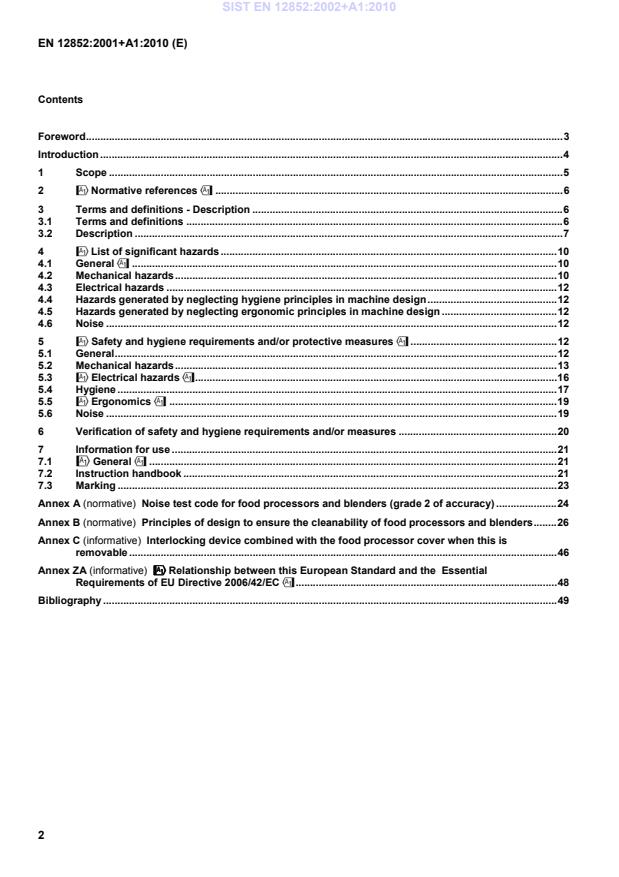
Foreword . 3Introduction . 41Scope . 52!Normative references" . 63Terms and definitions - Description . 63.1Terms and definitions . 63.2Description . 74!List of significant hazards . 104.1General" . 104.2Mechanical hazards . 104.3Electrical hazards . 124.4Hazards generated by neglecting hygiene principles in machine design . 124.5Hazards generated by neglecting ergonomic principles in machine design . 124.6Noise . 125!Safety and hygiene requirements and/or protective measures" . 125.1General . 125.2Mechanical hazards . 135.3!Electrical hazards". 165.4Hygiene . 175.5!Ergonomics" . 195.6Noise . 196Verification of safety and hygiene requirements and/or measures . 207Information for use . 217.1!General" . 217.2Instruction handbook . 217.3Marking . 23Annex A (normative)
Noise test code for food processors and blenders (grade 2 of accuracy) . 24Annex B (normative)
Principles of design to ensure the cleanability of food processors and blenders . 26Annex C (informative)
Interlocking device combined with the food processor cover when this is removable . 46Annex ZA (informative)
!!!!Relationship between this European Standard and the
Essential Requirements of EU Directive 2006/42/EC" . 48Bibliography . 49SIST EN 12852:2002+A1:2010
5 l type 2: machines for which 5 l ≤ Vt ≤
25 l and with a total power rating P ≤ 3 kW type 3: machines for which 25 l < Vt ≤ 150 l or with a total power rating P > 3 kW
Key 1: Cover or lid 2: Housing 3: Motor 4: Shaft 5: Tool 6: Bowl
Figure 1 — Example of a blender
Key 1: Cover or lid 2: Housing 3: Motor 4: Shaft 5: Tool 6: Bowl Figure 2 — Example of a food processor Figure 3 — Example of a food processor with tilting bowl SIST EN 12852:2002+A1:2010
Hazard of cutting fingers; zone 2: tool drive shaft
Hazard of cutting fingers with rotating shaft; zone 3: access to the drive mechanism Hazard of crushing hands; zone 4: tilting zone of the bowl Hazard of crushing arms and hands; zone 5: ejection of blades in the event of breakage Hazard of cutting or penetration to body. SIST EN 12852:2002+A1:2010
Figure 4a — On a blender Figure 4b —On a food processor
Figure 4c —
Zone 4 - On a food processor with tilting bowl Figure 4 — Danger zones 4.2.2 Loss of stability Hazards of crushing and impact to the body. SIST EN 12852:2002+A1:2010
EN 1005-3, EN 1088, EN 60204-1, EN 60529, EN ISO 12100, EN ISO 13849-1 and EN ISO 13857, the manufacturer shall carry out a risk assessment to establish the requirements of the type B-standard. This specific risk assessment shall be part of the general risk assessment of the machine." SIST EN 12852:2002+A1:2010
EN ISO 12100-1:2003, 5.3.2.5 of EN ISO 12100-2:2003 and EN 1088:1995." SIST EN 12852:2002+A1:2010
Figure 5 — Bowl with integral guard (example)
EN ISO 12100-1:2003 and 5.3.2.3 b) of EN ISO 12100-2:2003." With non-removable covers, the interlocking device shall comply with 6.2.1 of EN 1088:1995. With completely removable covers, the interlock shall comply with EN 1088 (i.e. there shall be two interlock switches one operating in a positive mode and the other one in a negative mode). Where the application of this principle of positive mechanical action is not easily reconcilable with the other requirements for this kind of machine, e.g. hygiene, index of protection (IP), prevention of defeat and safety distances, the absence of a positive mechanical action of the cover on the position detector shall be balanced/compensated so as to achieve an equal level of safety e.g. by applying the principle illustrated in informative annex C. Nevertheless in all cases where a single mechanically actuated position detector is used, it shall comply with 6.2.1.2 of EN 1088:1995. !The safety distances from the upper edge of the aperture to the upper blade of the tool shall comply with
Table 4 and 4.2.4.3 of EN ISO 13857:2008." The stopping time shall be less than 4 s when the machine is running empty. If the bowl is removable, an interlocking device shall prevent the machine from starting with bowl incorrectly fitted. 5.2.1.3 Zone 3 !Access to the danger zone shall be prevented by a fixed guard complying with 5.3.2.2 of
EN ISO 12100-2:2003 and EN 953." Those requirements are applicable to the three types. 5.2.1.4 Zone 4 The bowl shall be tilted only by a voluntary action of the operator. The requirements shall be the same when the bowl is tilted back to its working position. When the tilting is power operated, the movement of the machine shall be controlled with a hold to run control situated out of the danger zone. The bowl shall remain stable in all positions when it stops. SIST EN 12852:2002+A1:2010
EN 60204-1:2006, 7.2.3. In case of single phase machines, no such device is required for the earthed neutral conductor. 5.3.5 Protection against earth faults in control circuits For machinery supplied from a single-phase conductor and an earthed neutral conductor, there is no requirement for double pole interruption of the control circuit. The single pole interruption shall be in the phase conductor (see 9.4.3.1 of EN 60204-1:2006). 5.3.6 Emergency stop Machines shall be fitted with at least one emergency stop (see 10.7 of EN 60204-1:2006), as far as the risk assessment carried out by the manufacturer doesn't allow to establish that such a device would not reduce the stopping time, or would not enable the special measures, required to deal with the risk, to be taken. In general no emergency stop is required for food processors and blenders. In this case particular attention shall be given to the accessibility of the normal OFF switch from the operator position. 5.3.7 Motor enclosures Where a motor has a degree of protection lower than IP23 it shall be mounted inside an enclosure (see 14.2 of
EN 60204-1:2006) that guarantees a minimum degree of protection of IP23." 5.4 Hygiene 5.4.1 General The machine shall be designed in accordance with !EN 1672-2:2005" and the requirements given below. It shall also be designed in accordance with annex B. Hygiene zones (examples) are shown in figures 6a and 6b. SIST EN 12852:2002+A1:2010
Key 1: Food area 2: Splash area Figure 6a — On a blender Figure 6b — On a food processor Figure 6 — Hygiene areas 5.4.2 Food area The following parts shall be considered to be in the food area as defined in !EN 1672-2:2005": the inside of the bowl; the tool set; the inner part of the lid covering the bowl; the scraping devices. SIST EN 12852:2002+A1:2010
!(see 7.1 e))". 5.5 !Ergonomics Regard shall be given to the safeguards set out in 4.8 of EN ISO 12100-2:2003
...